Ever felt that soul-crushing despair of finding the perfect domain name, only to see that dreaded "already registered" message? Ugh, we've all been there. The truth is, hunting for a fresh, brandable domain in 2026 is often a fool's errand. The real money—and the real strategic advantage—is in picking up the valuable assets that others have left behind.
That’s where a good domain name picker comes in. Forget starting from scratch. We’re going treasure hunting for expired domains, and trust me, it's way more fun.
Why Build When You Can Buy a Foundation?
Trying to get a brand-new domain to rank is like planting a tree from a tiny seed. It takes an incredible amount of time, patience, and back-breaking work just to see it sprout. Acquiring a quality expired domain, on the other hand, is like transplanting a healthy, young tree with a root system already in place. You get a massive head start from day one.

This isn’t just some clever theory. The advantage is real and measurable. Many of these dropped domains come with a history—a backlink profile built over years. Building that kind of authority from zero can take an eternity and a small fortune. A good expired domain hands it to you on a silver platter.
You also get the benefit of domain age, which search engines often view as a signal of trust. An aged domain can lend your project instant credibility that a freshly registered name just can't compete with. Some even come with a trickle of "type-in" traffic from people who remember the old site. That means visitors from day one, before you’ve spent a penny on marketing.
A Quick Look at Your Options
So, should you register a new domain or go after an expired one? Here’s a quick breakdown of how these two strategies stack up against each other.
Domain Acquisition Strategy Quick Comparison
| Factor | Registering a New Domain | Acquiring an Expired Domain |
|---|---|---|
| Initial Cost | Very low (typically $10-$20 per year) | Varies wildly (from $10 to $10,000+), plus renewal |
| Time to Authority | Slow and arduous (months to years) | Can be immediate, inheriting existing authority |
| SEO Head Start | None. You start from absolute zero. | Significant. Comes with age, backlinks, and trust. |
| Branding Control | Total freedom to create any available name | Limited to what's available and relevant |
| Hidden Risks | Minimal | Potential for spam history, penalties, or bad backlinks |
For most projects, the SEO head start from an expired domain is a game-changer. The key is to mitigate the risks by doing your homework, which is exactly what a powerful domain picker helps you do.
Start Thinking Like an Investor
The market is ridiculously crowded. We're talking about 364.3 million domain name registrations globally. The short, memorable .com and .net names are either gone or astronomically expensive. This is why the sharpest entrepreneurs have stopped being simple name-seekers and have started acting like strategic asset investors.
The most successful entrepreneurs and SEOs don't just build assets; they acquire them. An expired domain is a pre-built foundation, giving you a massive shortcut on your journey to online visibility and authority.
This is where you need a specialized tool. Tens of thousands of domains drop every single day, and most of them are garbage. A domain name picker is your filter. It lets you sift through the noise and hunt for the metrics that actually matter—backlink quality, domain authority, and age—so you can find the gold. If you want to get a feel for the hunt, checking out a guide on domains that are about to expire is a good starting point.
The game has changed. Instead of fighting for scraps, you can now find fully-formed opportunities just waiting to be claimed. You just need to know what you’re looking for and have the right tools to find it.
Before you even dream of hunting for a domain, you need a map. Firing up a domain search tool without a plan is like going to the grocery store starving—you’ll come back with a cart full of junk you don't need and a hole in your wallet.
What is this domain actually for? It’s the one question that saves you from a world of pain.
The perfect domain for a shiny new SaaS product is utterly useless for a gritty niche affiliate site. Without a clear goal, you'll get distracted by shiny objects: short, snappy names with zero SEO history or high-metric monsters in a niche you have no business being in. It's the fastest way I know to waste both time and money.
I find it helps to create a simple "domain persona." It's just a quick profile of your ideal domain—what it's for, what it needs to have. This little document becomes your North Star, letting you instantly filter out the noise and focus only on the domains that can actually do the job.
What’s Your End Game?
Every successful domain hunt I've ever been on started with one question: what’s the primary goal here? Your answer will radically change your search criteria. Are you building a brand from scratch, chasing Google rankings, or just looking to flip for a quick profit?
Building a Brand: If you're launching a startup, a service, or a personal brand, you care about two things: is it memorable and is it available? You’re after something short, catchy, and dead simple to spell, ideally ending in .com. The SEO metrics are a nice bonus, not a requirement. Think about names like
Slack.comorFigma.com. They were built, not found.SEO and Niche Sites: For an affiliate site or a content project, your priorities are flipped entirely. Here, you're hunting for history and authority. You want a domain with a clean backlink profile from relevant sites, solid Trust Flow, and a history that matches your topic. The name itself is almost an afterthought compared to the SEO juice it brings to the table.
Flipping for Profit: As an investor, you're an opportunist looking for undervalued assets. This could be a brandable name a founder would kill for, a domain with monster SEO metrics that an affiliate marketer can build on, or a keyword-rich name with obvious commercial intent. Your only goal is pure ROI.
Decide on this before you do anything else. It dictates every filter you'll set and every metric you'll obsess over.
The Founder vs. The SEO
Let's make this real.
Imagine Sarah, a founder launching a new project management app she’s calling "FlowState." Her mission is simple: get flowstate.com or the closest possible alternative. She couldn't care less about its backlink profile or age. She needs a name that looks professional on a business card and is easy for customers to type. Her entire search is about brand alignment.
Now, meet Ben, a seasoned SEO. He’s building an affiliate site about home coffee brewing. The idea of a "brandable" name makes him laugh. He's diving into domain pickers looking for dropped domains that used to be coffee blogs. He's prioritizing metrics like the number of referring domains from food blogs and a high Trust Flow score. For him, a domain like joesbrewingblog.com with a great history is a jackpot.
The single biggest mistake you can make is trying to be Sarah and Ben at the same time. Pick a lane. You’ll find your perfect domain ten times faster.
Your Pre-Search Checklist
Before you open a single search tool, write down the answers to these questions. Seriously, do it.
- What's my one primary objective? (Branding, SEO, or Flipping)
- Who’s the audience? (Do they want something quirky and cool or something that sounds like a Fortune 500 company?)
- What’s my real budget? Are you scraping for a hand-registration bargain or are you ready to write a four-figure check for a premium name?
- Which TLD is a must-have? Is it .com or nothing, or are you fine with a .io, .co, or a country-specific TLD?
- Are there any non-negotiable keywords? If you're in the coffee niche, is "coffee" or "brew" an absolute must-have in the domain?
Answering these gives you a concrete framework. It transforms your search from a random walk into a targeted mission. Whether you’re sifting through thousands of Available domains on a platform like NameSnag for an instant pickup or setting up alerts for future Expiring domains, you'll now be operating with purpose. This is how domain hunting becomes a strategic, and dare I say, fun exercise.
Alright, you've got your strategy sorted. Branding, SEO, a quick flip—whatever the mission, you know what you’re looking for. Now the real work begins. This is the treasure hunt, but before you go digging, you need to learn how to spot 24-karat gold from the fool's gold that glitters on the surface.
This is where almost everyone messes up. They get mesmerized by shiny, worthless metrics.
You have to understand, not all expired domains are created equal. In fact, 99% of them are complete junk. They're expired for a good reason. But that other 1%? That’s where fortunes get made and SEO campaigns get an almost unfair head start. The secret is knowing which numbers to ignore and which ones to practically worship.
Forget the Vanity Metrics
The first number everyone sees is Domain Authority (DA), a score developed by Moz. For a long time, it was the standard for a quick quality check. I'll let you in on a little secret from the people who do this for a living: we barely glance at DA anymore.
Why? Because DA is laughably easy to manipulate. You can juice a domain's DA score with a quick blast of cheap, spammy links. A high DA might look impressive on a spreadsheet, but it often masks a toxic backlink profile—a digital time bomb just waiting to go off and take your project with it. Trusting DA is like buying a used car because it has a fresh coat of paint, without ever bothering to pop the hood.
Instead, we've learned to focus on metrics that are much harder to fake. They paint a far more honest picture of a domain's real power.
A domain with a DA of 15 built on clean, relevant backlinks is infinitely more valuable than a domain with a DA of 50 propped up by spam. It's always quality over quantity.
The New Trinity of Domain Metrics
If you want to size up domains like a pro, you need to fixate on a new set of numbers. When you look at these three together, you get an incredibly reliable snapshot of a domain's true worth.
Majestic Trust Flow (TF): This is your new best friend. Trust Flow, from Majestic, measures the quality of the links pointing to a site, not the sheer volume. It works by figuring out how closely a domain is connected to a hand-picked set of highly trusted seed websites. A high TF score—think 15+ for a solid baseline—is a powerful sign that the domain has earned links from reputable places.
Referring Domains (RDs): This is simply the number of unique websites linking to the domain. The total number of backlinks can be misleading—one website can link to you 10,000 times—but the count of unique referring domains shows how widely the domain was actually cited across the web. A healthy number of unique, high-quality RDs is the hallmark of a natural link profile.
Backlink Profile Cleanliness: This isn't a single metric, but a gut-check you have to do manually. Does the link profile feel natural? Are the links coming from sites that are actually relevant to the domain's old topic? Or is it a mess of links from sketchy Russian forums and spammy blog comments? You also have to eyeball the anchor text—the clickable words in a link. If it's stuffed with "buy cheap widgets," you run. If you see the brand name and natural-sounding phrases, that's a fantastic sign.
Beyond the immediate traffic and brand value, a domain's long-term worth is deeply tied to its built-in search engine optimization potential. Taking some time to learn about the SEO potential of URLs can give you a much deeper appreciation for how a domain’s very structure adds to its value.
Digging Through the Past
There's one final, non-negotiable step: doing a historical check using the Wayback Machine at Archive.org. This tool is a time machine for websites, showing you what the site looked like in previous years.
You’re looking for legitimacy and consistency. Was this a real business or a blog that made sense for its name? Or was it a spammy, auto-generated site, or worse, used for something illicit? A clean history is every bit as important as a clean backlink profile.
Getting a handle on these core metrics is the first real step to becoming a savvy domain investor. If you're ready to go even deeper on this, our comprehensive guide on how to value domain names breaks down the entire framework. With this knowledge, you can use a domain name picker not just to find available names, but to unearth genuine, high-value digital assets.
Alright, enough theory. It's time to roll up our sleeves and put this into practice. This is where we turn all that planning—your goals, metrics, and niche research—into a repeatable process using a modern domain name picker. We're about to transform hours of tedious, manual searching into a few smart clicks.
The whole point is to stop drowning in lists of junk domains. You want a tool to do the heavy lifting for you, acting like an expert assistant who sifts through the digital chaos to find the handful of names that are actually worth your time.
Translating Your Goals into Filters
The first real step is to take that "domain persona" we talked about and turn it into a set of hard filters. This is where your prep work pays off.
Looking for a short, punchy brand name? You'll probably want to filter for .com domains under 10 characters. Hunting for an SEO powerhouse? You'll be setting minimums for metrics like Trust Flow (let’s say TF > 15) and a healthy number of referring domains.
Think back to our affiliate marketer, Ben, who wants to build that coffee review site. In a tool like NameSnag, his setup would look something like this:
- He’d start with keywords like "coffee," "brew," "roast," or "espresso."
- He'd set a minimum Trust Flow of 15 to ensure some existing authority.
- Then, he'd filter for domains with at least 20 unique referring domains.
- If he's feeling ambitious, he might even look for domains that have a few powerful .edu or .gov backlinks.
Just like that, a potential list of tens of thousands of domains gets whittled down to a manageable few. That’s the real power of a purpose-built domain picker.
Snatching Available Domains vs. Scouting Expiring Ones
Now for the fun part. A good platform lets you fish in two different ponds, and each requires a slightly different strategy.
First, there's the Available domains pond. These are names that have gone through the entire expiration and deletion cycle. They've been dropped and are now fair game for anyone to register immediately. This is a game of speed. When you find a gem here, you don't think—you act. You register it on the spot before someone else does. You can dive into this pond right now and see all the Available domains that have dropped today.
The second, and often more valuable, pond is for Expiring domains. These names have expired but are still in a grace period before they're officially deleted and released. You can't register them yet, and that’s precisely what makes them so interesting.
Scouting expiring domains is like getting an early look at properties hitting the real estate market next month. It gives you precious time to do your due diligence, analyze their backlink profile, and decide if you want to be ready to pounce the moment they become available.
Using a platform like NameSnag, you can apply the same sharp filters to the list of Expiring domains. What's really neat is that you can adjust the timeline, letting you zero in on high-potential domains dropping in the next 3 days, 7 days, or even a full 30 days out. This gives you a massive strategic head start on the competition.
Putting Your Search on Autopilot with Alerts
This is how you level up from being a domain hunter to a domain tycoon. Manually running even the most filtered searches every day is a chore and a great way to miss opportunities. The pro move is to automate it.
Most modern domain tools let you save your filter combinations as Watchers or Alerts. Once you’ve dialed in the perfect recipe for your coffee site, you can save it. The system then gets to work for you 24/7, pinging you with an email or SMS whenever a domain that matches your exact criteria pops up.
This is a complete game-changer.
- No more FOMO: You won't miss out on a killer domain just because you forgot to check one afternoon.
- Zero wasted time: The opportunities come directly to your inbox.
- Insane efficiency: You can monitor dozens of different niches or criteria sets at the same time with no extra work.
The infographic below outlines the kind of quick mental checklist you should run through when an alert hits your inbox. It’s all about a rapid-fire check for quality, spam signals, and history.
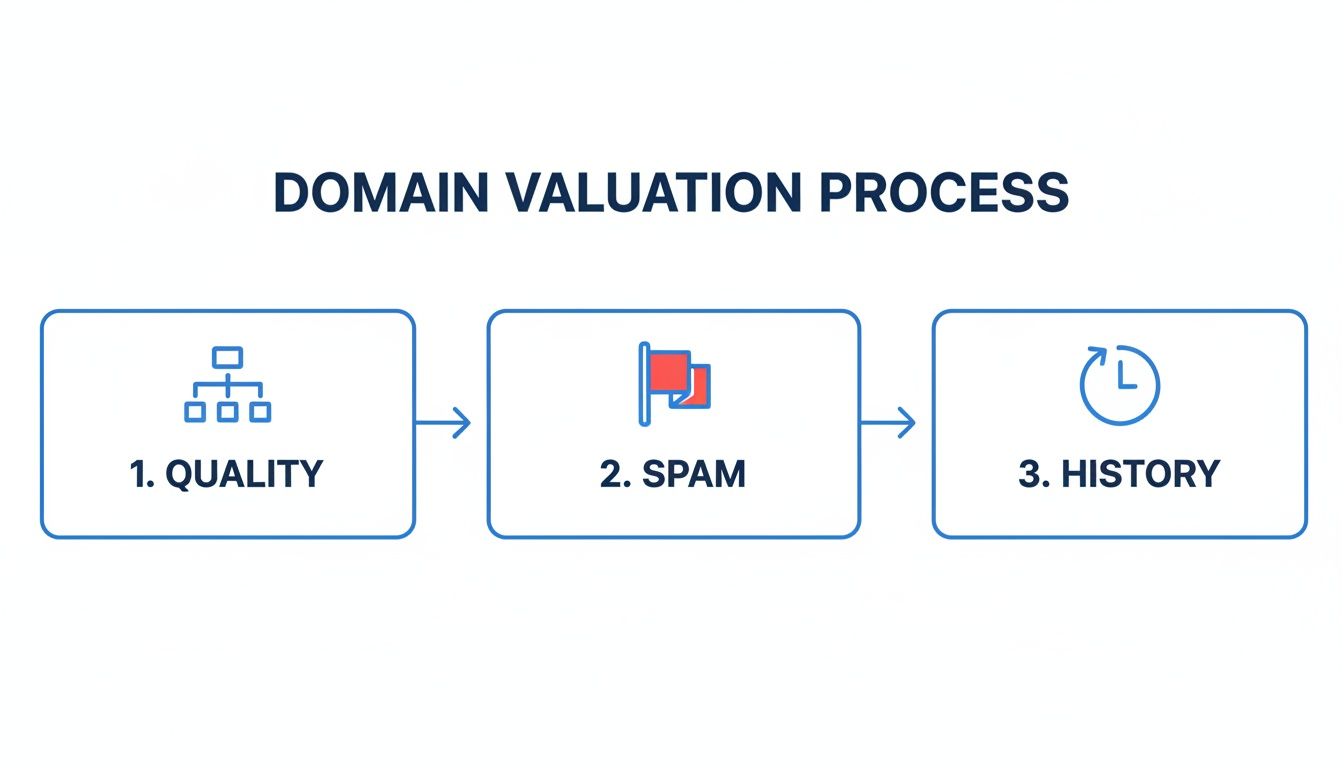
This simple process helps you immediately filter out the duds and focus only on the domains with real potential. Automating this first pass of due diligence is incredibly powerful. For those who want to really dig in, you can learn more about due diligence automation in our detailed guide.
By combining smart filters, a clear strategy for both available and expiring domains, and automated alerts, you can turn the overwhelming task of finding a great domain into a simple, efficient, and honestly, pretty enjoyable process.
From Shortlist to Purchase: The Final Decision Checklist
So you ran a domain name picker, tweaked the filters, and now you’re staring at a shortlist of shiny, promising domains. It’s easy to feel like you’re at the finish line. You're not. This is the most critical stage of the whole process.
This is where you separate a genuine asset from someone else’s digital garbage. Rushing this step is a recipe for buyer’s remorse. Let's walk through the final checks that separate a good find from a great investment.
The Manual Backlink Spot-Check
Metrics are great for getting a shortlist. Now you need to get your hands dirty and manually inspect the backlink profiles of your top contenders. Don’t panic—you don't need to check every single link. Just focus on the most powerful ones.
What are you looking for? Simple: relevance and quality. If your domain is fastcarreviews.com, a link from a major auto magazine is gold. A link from a Russian pharmacy site? That’s not just a red flag; it's a five-alarm fire. You're looking for links that feel earned, not spammed.
Time-Traveling With The Wayback Machine
This is a non-negotiable step. Go to Archive.org and plug in your top domains. The Wayback Machine is your time machine, showing you what the site used to be. You're a detective now.
Here's what to look for:
- Consistency: Was the site always about a specific topic? A domain that hosted a dog grooming blog for five years is far more valuable for that niche than one that switched topics every six months from poker to crypto to gardening.
- Red Flags: Hunt for signs of spam—pages filled with gibberish, casino links, or adult content. That kind of history can carry a permanent stigma that's hard to shake.
- PBN Footprints: Was the site clearly part of a Private Blog Network? These sites often have thin, awful content and exist only to sell links. They're a penalty waiting to happen.
If the history looks sketchy, drop the domain. Move on. The risk isn't worth it.
The All-Important Trademark Check
This is the one check that can save you from a legal and financial nightmare. Before you get emotionally attached to a name, you absolutely must see if it infringes on an existing trademark. A quick search on the U.S. Patent and Trademark Office (USPTO) site, or your local equivalent, is your first stop.
Imagine building your entire brand, investing months of work and thousands of dollars, only to get a cease and desist letter. A five-minute trademark check now saves you that massive headache later.
Don’t just search for exact matches. Look for names that sound similar or could cause brand confusion. When in doubt, it's always, always better to pick a different name.
Simple Valuation Heuristics
Finally, apply some common-sense valuation rules to rank your remaining domains. This isn't about getting a perfect appraisal; it's about deciding which one offers the best bang for your buck.
- Is it a short, pronounceable .com? These are the blue-chip stocks of the domain world. They just have inherent value.
- Does it have authoritative backlinks? A single link from a well-known .edu or .gov site can be worth more than a hundred links from generic blogs. Authority matters.
- Does it pass the "radio test"? If you heard the name on the radio, could you easily type it into a browser?
Flickr.comfamously struggled with this for years because of its missing "e." Simple is better.
The global Domain Name Registrar market is projected to hit $3,927.64 million by 2033, which tells you something about the volume of transactions happening. With platforms like NameSnag analyzing over 170,000 domains daily, the fight for quality expired names is intense. These final checks are what give you an edge.
Once you’ve put your top choices through this gauntlet, a clear winner will likely emerge. As you prepare to buy, take a moment to find the best domain name registrar Australia or a top provider in your own region. Now you can make your purchase with confidence, knowing you've done your homework.
A Few Questions That Always Come Up
When you're digging through expired domains, it feels like there's a whole new vocabulary to learn. You've got your metrics, you've got your strategy, but a few questions seem to trip everyone up at the start. Let's clear up some of the common points of confusion so you don't waste time or money on the wrong assets.
What's The Difference Between Available And Expiring Domains?
This is a great question because the answer gets to the core of domain hunting. The terms sound similar, but they're two totally different ponds to fish in, and they require different gear.
Available Domains: These are domains that have run the full gauntlet of expiration and been officially dropped by the registrar. They're back in the wild. Anyone can register them right now for the standard fee. When you spot a good one on a list of Available domains, it’s a flat-out sprint to the registrar. He who clicks fastest, wins.
Expiring Domains: These are in a kind of purgatory. The owner didn't renew, but the domain isn't dead yet. It’s sitting in a grace period before it's either reclaimed or dropped. You can't register these. The game here isn't speed, it's preparation. Scouting the Expiring domains list lets you do your homework—checking backlink profiles, history, and metrics—before it ever hits the open market.
Think of it like real estate. Available domains are houses with a "For Sale" sign on the lawn today. Expiring domains are the pre-foreclosure notices you get a peek at. Both can be a source of incredible value, but you approach them differently.
Is A Domain With High Domain Authority Always A Good Buy?
Absolutely not. And falling for this is probably the single most common and costly mistake newcomers make. Domain Authority (DA) is a third-party metric, and like any third-party metric, it can be gamed. I've seen domains with a DA of 50+ that were propped up by nothing but toxic spam links from the darkest corners of the internet. It's the equivalent of putting a shiny new paint job on a car with a seized engine.
It’s far better to focus on metrics that measure genuine trust. A domain with a modest DA but high Trust Flow (TF) and clean, contextually relevant backlinks is almost always the superior asset.
Think of it this way: DA is a measure of popularity, while TF is a measure of reputation. You'd rather have five well-respected friends vouch for you than five hundred shady acquaintances. The same is true for your domain's backlink profile.
How Much Should I Expect To Pay For A Good Domain?
That’s the classic "how long is a piece of string?" question. A "good domain" can cost you anything from a standard registration fee (around $10-$15) to well into the five-figure range. The price is dictated by two things: its intrinsic value and how you acquire it.
If you have a powerful domain name picker and lightning-fast reflexes, you can find a domain with incredible metrics the second it becomes "Available" and hand-register it for a song. This is the treasure hunter’s dream. It's a race, but the payoff can be astronomical.
More often, though, domains with strong metrics, valuable keywords, or short, catchy names get scooped up and go to auction. Here, prices can swing wildly from $100 to over $10,000. Your budget needs to line up with your goals. If you're building a small niche site, maybe your ceiling is $200. If you're launching a major brand, paying thousands for the perfect domain might be a rounding error in your marketing budget.
Ready to stop guessing and start finding high-value domains? NameSnag is the AI-powered domain name picker that does the heavy lifting for you, analyzing over 170,000 domains daily to find the gems. Start your treasure hunt today!
Find Your Perfect Domain
Get access to thousands of high-value expired domains with our AI-powered search.
Start Free Trial