You've probably seen this happen. A new site shows up in your niche, and the domain feels unfairly good. It's short. It's clean. It has age. The backlink profile looks like it has lived a full life already. Meanwhile, the company behind it looks brand new.
That usually isn't luck. It's a domain name drop play.
The best operators in this space aren't sitting around brainstorming fresh hand registrations. They're combing through expired inventory, watching deletion cycles, and trying to acquire digital real estate that somebody else let go. Sometimes that means an old brandable .com with a clean history. Sometimes it means a niche domain with enough relevance and authority to become the base for a site, a redirect, or a hold-for-resale asset.
The catch is that this game is a lot uglier than most beginner guides admit. Great names disappear fast. Bad names can carry baggage. And chasing the obvious prize at the exact second of deletion is often the least efficient part of the entire process.
The Secret World of Dropped Domains
A dropped domain is exactly what it sounds like. Someone owned it, let it expire, failed to recover it in time, and the registry eventually released it back into the pool.
That's where the inside baseball starts.
Many investors assume a good domain begins with a clever idea and an available search at a registrar. Seasoned buyers know a lot of the best names are rediscovered, not invented. They come with history. Sometimes that history is useful. Sometimes it's radioactive.

Why people chase them
A strong dropped domain can solve a few problems at once:
- Branding head start if the name is memorable and clean
- SEO advantage if the backlink profile is natural and relevant
- Authority optics because an older domain often feels more established to users
- Scarcity value because many strong one-word or tightly branded .coms aren't available new
There's also a practical brand layer that gets overlooked. A domain isn't the whole identity. If you're evaluating a name for a real business, also check whether you can secure matching profiles and usernames. A tool for acquiring consistent social handles for brands can save you from buying a sharp domain that turns into a messy rollout across social platforms.
A dropped domain isn't valuable because it's old. It's valuable because its history still helps instead of hurts.
What newcomers usually get wrong
They focus on the dramatic part. The split-second catch. The auction. The rush.
That's not where most money is made.
The competitive advantage usually comes earlier, in the research phase. Buyers who win consistently spend more time filtering than bidding. They pass on names with weak link neighborhoods, off-topic histories, or obvious legal headaches. They know a dropped domain can be an asset, but only if the previous life of that domain still makes sense for the next one.
The Full Lifecycle of an Expired Domain
The easiest way to understand a domain drop is to think of an overdue library book. Just because it's late doesn't mean the next person can grab it. There's a process, and until that process ends, the original holder still has rights.
That distinction matters because buyers constantly confuse expired with available. They're not the same thing.
The five stages that matter
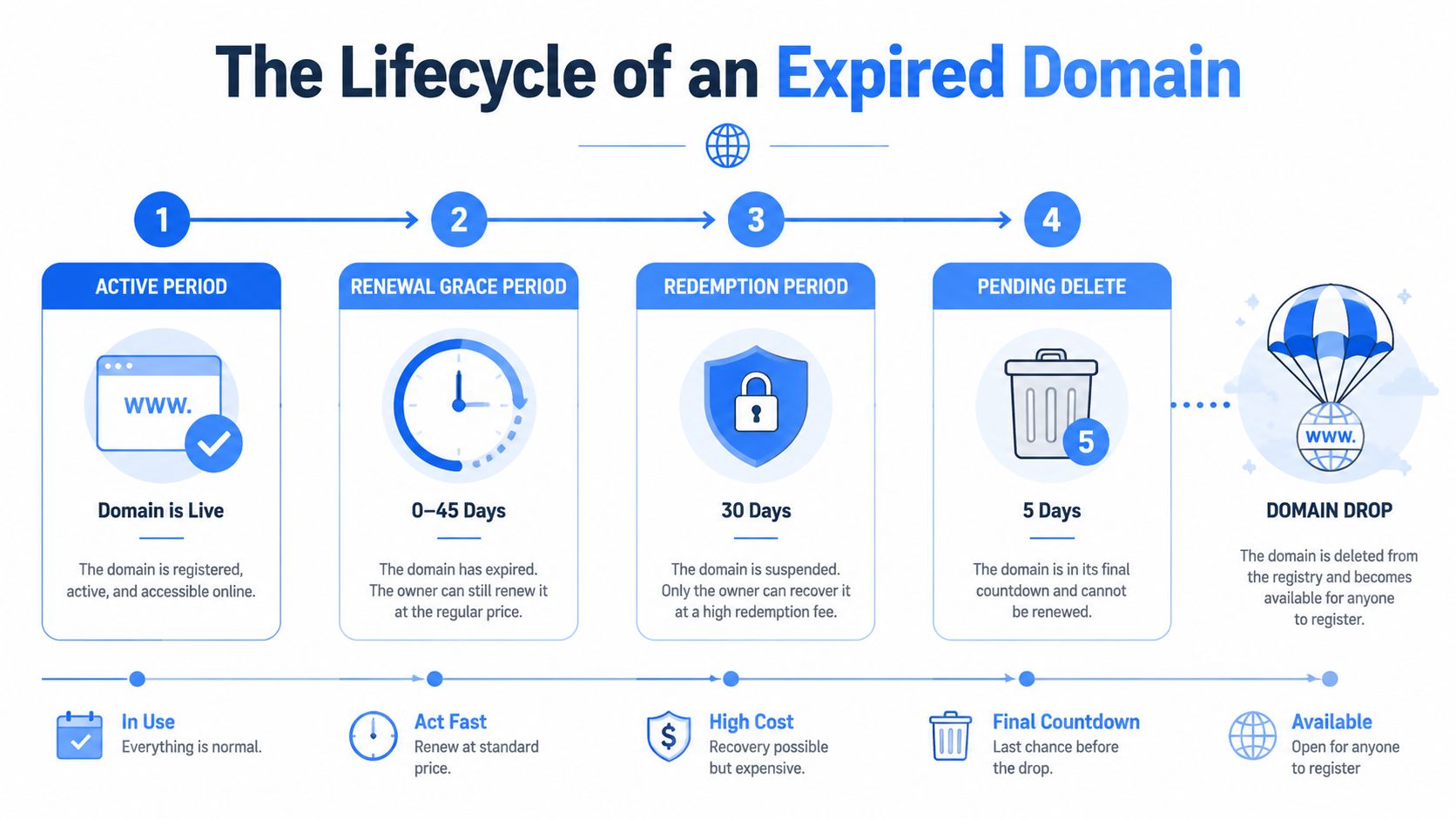
According to AlexHost's explanation of dropped domains, the lifecycle moves through Expiration, Grace Period, Redemption Period, Pending Delete, and Available for Registration. The grace period is typically 30 days, the redemption period runs 34 to 65 days, and pending delete lasts 5 days. During grace and redemption, the original owner still holds exclusive renewal rights.
Here's the practical version:
| Stage | What it means for you |
|---|---|
| Expiration | The domain has lapsed, but that does not mean you can buy it yet |
| Grace Period | Original owner can usually renew normally |
| Redemption Period | Original owner can still get it back, usually with extra cost |
| Pending Delete | Locked status. No more edits, no renewal, countdown is on |
| Available | The domain finally drops into the public pool |
Why this timeline changes your strategy
If a domain is in grace or redemption, it's still effectively spoken for. You can monitor it, research it, and put it on a watchlist, but you shouldn't act like it's yours to take.
That's why many “expired domain lists” create false urgency. They mix together names that are merely overdue with names that are close to deletion. If you don't know the lifecycle, you'll waste hours evaluating inventory that won't be obtainable for a long time, or at all if the former owner renews.
Practical rule: Don't spend deep evaluation time on a domain until you know which stage it's in.
What to do during each phase
During expiration
Make a quick first pass. Is the name even worth tracking?During grace and redemption
Research history, backlinks, topical fit, and brand safety. This is also the right time to read guidance on migration issues if you're repurposing a name. Arch has a useful guide to switching domains that's worth reviewing before you commit to a full move.During pending delete
Decide whether the domain is important enough for a backorder or whether it belongs on a secondary watch list.At drop
You either already have your plan, or you're too late.
If you want help understanding the timing side in plain English, this breakdown on when a domain will expire is a useful companion read.
The Great Domain Rush How Drops Are Caught
Once a worthwhile name reaches the end of pending delete, the vibe changes completely. This is no longer patient research. It's speed infrastructure.

Manual registration is basically a fantasy
The mechanics are brutally simple. In the final stage, the domain is purged and becomes available in a tiny release window. As explained in DomCop's guide to drop catching, the process runs at millisecond-level precision. During the 5-day pending delete window the domain is locked, and when it's finally released, professional services hit the registry with automated requests so quickly that manual registration is virtually impossible.
That's why refreshing your registrar page like a caffeinated maniac doesn't work on strong names. You're racing specialized systems, not other people clicking keyboards.
Who actually wins these races
Professional drop-catching services such as DropCatch, SnapNames, and NameJet have the infrastructure advantage. They use networks of registrars, direct connections, and a lot of automation.
If only one customer backorders a domain at a service and that service catches it, great. If multiple customers backorder the same name, the process often ends in a private auction. At that point, your “cheap expired domain” has turned into a bidding contest.
A good primer on the mechanics and trade-offs lives in this guide to how backorder domain services work.
Here's a quick reality check:
Obvious names attract attention Short .coms, exact-match commercial terms, and clean aged brandables rarely slip through unnoticed.
Backordering is not ownership
It gives you a seat at the table, not the asset.Registrar relationships matter
Some names never really hit an open field because auction pipelines and partner networks catch them upstream.
Before going further, it helps to see the process visually:
The part most people hate admitting
Reactive drop-catching feels exciting because it compresses everything into one dramatic moment. But from an investor's point of view, it often behaves like a lottery ticket with extra homework attached.
You can do everything right, identify a strong asset, line up your backorders, and still lose because somebody else had more coverage, more budget, or both.
That doesn't mean backorders are useless. It means they work best as one tool, not the entire strategy.
Separating SEO Treasure from Digital Trash
The biggest beginner mistake is buying the story instead of the asset. “Old domain.” “Aged backlinks.” “Looks authoritative.” That language empties a lot of wallets.
A dropped domain has value only if the previous footprint is still compatible with what you want to build now.
Why competition is a clue, not proof
The market does tell you something. In the NamePros discussion covering ExpiredDomains tracking, capture rates for dropped .com domains were consistently around 7.6% to 8%, with one tracked day showing 7,348 caught out of 91,337 expired .coms and another showing 6,988 out of 91,695. That kind of activity tells you buyers are aggressively chasing domains with perceived SEO value, backlinks, or brandability.
It does not tell you every chased name is good.
The evaluation lens I trust
Start with fit, not vanity metrics.
Relevance beats raw age
If the domain used to host a local bakery and you want to build a B2B SaaS site on it, the age doesn't magically transfer strategic value. The old backlinks may be real, but they may also be contextually useless.
Link quality beats link count
A small number of strong, relevant backlinks can be far better than a bloated profile full of junk. I look at the neighborhood first. What kinds of sites linked in? Were those links editorial, directory-based, forum spam, scraped mirrors, or sidebar clutter?
Anchor text tells on people
Spammy anchor patterns are one of the fastest ways to spot abuse. If a domain's historical link anchors scream casino, pills, adult, or random multilingual nonsense, I move on fast.
A clean domain can be improved. A dirty history usually stays expensive.
A practical screening checklist
Use this before you even think about bidding:
Check historical use
Review archived versions of the site. You want continuity, legitimacy, and a topic that makes sense.Inspect backlink context
Don't just look at metrics. Open linking pages and ask whether a human editor would have placed that link.Watch for redirect abuse
Domains that were repeatedly repurposed can carry messy signals.Look at brandability
Can a real company use this without sounding awkward or suspicious?Check history before emotions kick in
A dedicated process matters for this stage. A guide on how to check domain history is worth keeping in your workflow.
What usually isn't worth saving
Some domains are cheap for a reason. Long hyphenated strings, irrelevant keyword mashups, obvious former spam projects, and names with trademark vibes usually don't deserve “one more chance.” Good investors pass more than they buy.
Your Practical Workflow for Snagging Gems
Most domain buyers waste time in the most crowded corner of the market. They wait until a domain is fully dropped, then scramble with everyone else.
I prefer a two-track workflow. One path is for names you can register right now. The other is for names that are expiring and deserve research before the crowd piles in.
Track one for immediate opportunities
This is the fast pass. You look for domains that already dropped and are available to register immediately.
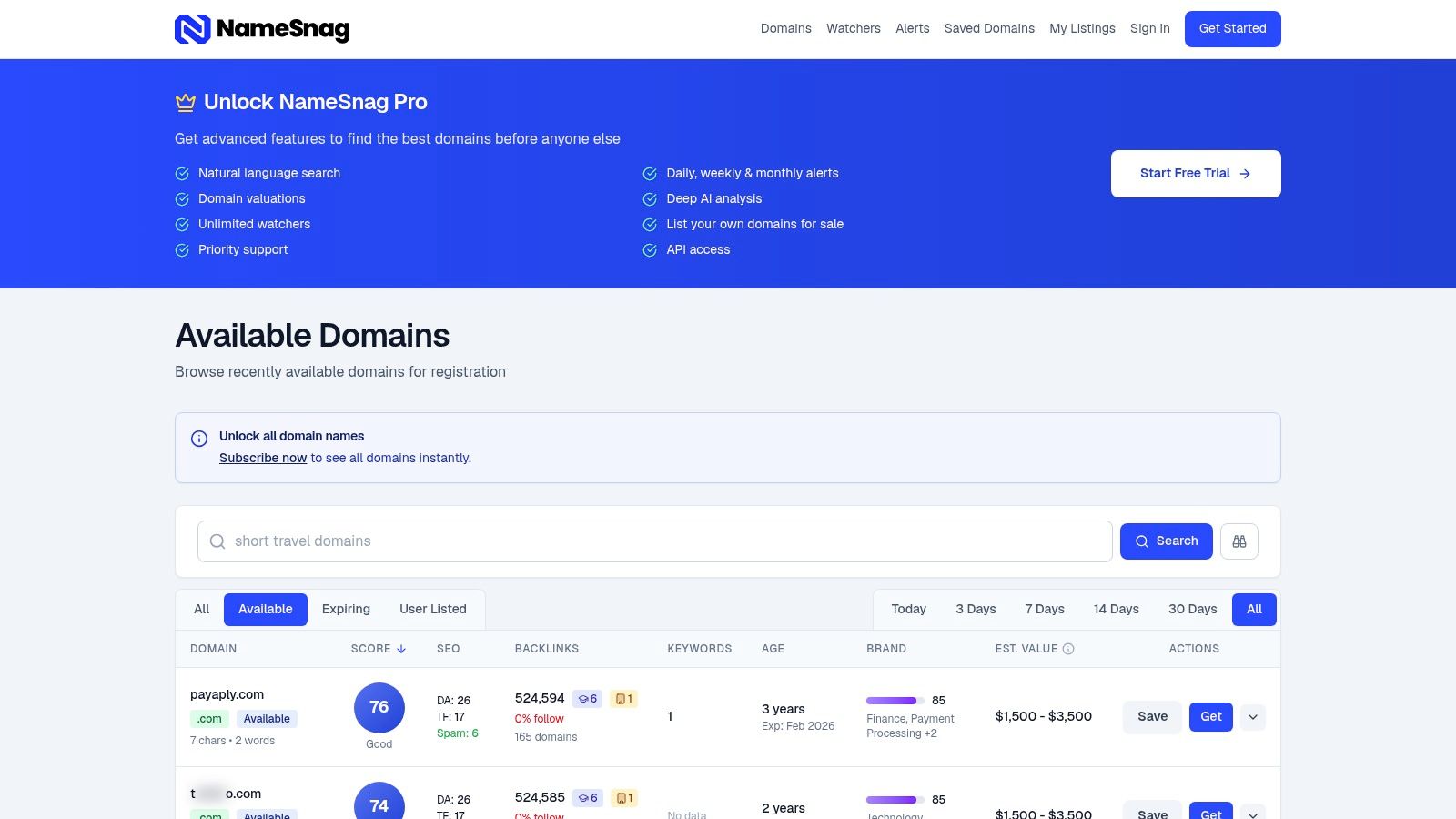
Use a filtered list of available dropped domains, then narrow by time window so you're not digging through stale inventory. The shorter windows are useful when you want fresh opportunities that others may have skipped.
Here's how I'd work that list:
Start with recency
Today or the last few days is usually the cleanest way to surface names that just slipped past aggressive buyers.Cull obvious junk fast
If the string looks clumsy, over-optimized, or legally risky, don't overanalyze it.Open only survivors
Save your history and backlink work for names that pass a quick smell test.
Track two for names worth stalking
The smarter money often sits upstream. Instead of reacting at the drop, build a watchlist from expiring domains and review them while they're still in the lifecycle.
That gives you room to think. You can compare multiple candidates, check old site versions, study brand fit, and decide whether a domain is worth a backorder at all.
A simple routine works well:
Use shorter time filters for urgency
Today, 3 Days, and 7 Days are ideal when you want names nearing the action window.Use wider windows for pipeline building
Longer ranges help if you're sourcing domains for multiple projects.Keep a ranked watchlist Separate “must try,” “nice if cheap,” and “ignore unless it drops.”
Why proactive beats reactive
Data matters in this context. The USENIX-cited finding in the brief you provided notes that traditional drop-catch services succeed in only about 9.5% of cases for .com domains because of intense competition, which is why a proactive discovery process can shift the game from blind chase to calculated selection, as summarized from the USENIX Security presentation page.
That matches what practitioners already feel in the trenches. If you wait for the final second, you're buying uncertainty. If you do the work earlier, you at least know which names deserve a fight.
Field note: Good domain hunting looks less like sniping and more like inventory management.
Pair domain research with content intent
A domain isn't an isolated asset. It needs a plan. If you're buying for SEO, map the topical territory before you buy. A semantic map generator for SEOs can help pressure-test whether a domain's history and your future content direction line up.
That step sounds small, but it saves a lot of bad purchases. A domain can be clean, brandable, and still wrong for the site you want to build.
Avoiding Hidden Traps and Legal Landmines
A lot of domain drop advice stops at “check for spam.” That's necessary, but it's not enough anymore.
The bigger risks often sit outside classic SEO. A domain can have a clean-looking backlink profile and still create legal, privacy, or brand headaches you didn't price in.
Trademark trouble is still the old classic
If the name contains a recognizable brand, product line, or company identifier, walk carefully. The fact that a domain expired doesn't give you a free pass to use someone else's mark.
Even accidental overlap can become expensive. That's especially true when a domain looks generic at first glance but has a long commercial history tied to a known business.
Data history can create modern problems
One of the more overlooked issues is prior data use. The guidance in Wix's dropped-domain overview highlights that re-registering expired domains with histories of collecting user data can expose the new owner to GDPR or CCPA compliance risks, and that automated verification and history analysis tools are increasingly important for reducing that exposure, according to Wix's article on dropped domains.
That matters more than many buyers realize.
If a domain previously ran lead generation, memberships, ecommerce, or anything involving tracking and stored user interactions, you need to think beyond links and rankings. Old pages may still be cached. Old scripts may still be referenced. Old expectations from users can linger.
A short risk screen before you buy
| Risk area | What to look for |
|---|---|
| Trademark conflict | Brand names, product names, company identifiers |
| Privacy baggage | Signs the old site collected user data or ran heavy tracking |
| Reputation spillover | Complaints, scams, controversial past use |
| Link contamination | Spam networks, hacked pages, manipulative anchors |
The cleanest domain is often the boring one. No drama. No legal ambiguity. No weird history to explain later.
Your Domain Drop Questions Answered
The mechanics confuse people because the market looks chaotic from the outside. It isn't random, but it is competitive.
One useful anchor point comes from the IMC study summary: drop-catching services account for over 86% of same-day re-registrations, while the overall same-day re-registration rate for deleted .com domains is just 9.5%, which means over 90% of dropped domains are not immediately re-registered, according to the IMC paper on domain re-registration behavior. That's why chasing only the flashiest names is a mistake. There's opportunity outside the feeding frenzy.
Frequently Asked Questions about Domain Drops
| Question | Answer |
|---|---|
| Is a domain drop the same as an expired domain? | No. Expired means the owner missed renewal. Dropped means the domain completed the lifecycle and became publicly available again. |
| Can I catch a good domain by hand at my registrar? | On valuable names, usually no. Automated services operate at speeds manual buyers can't match. |
| Are dropped domains good for SEO automatically? | No. History matters more than age alone. Bad links, spam use, or irrelevant topical history can ruin the value. |
| Should I always place a backorder on a strong name? | Only if your research says the name is worth fighting for. Backorders are easy to place and easy to waste. |
| Are most dropped domains instantly taken? | No. The hottest names go fast, but many dropped domains are not re-registered the same day. |
| What's the smarter play for most buyers? | Build a watchlist of expiring domains, research them early, and stay selective. That beats blindly chasing every visible drop. |
The big shift is mental. Treating domain names like scratch-off tickets leads to impulse buys and bad auctions. Treating them like inventory leads to cleaner decisions.
If you want a faster way to sort through the junk and focus on domains with real SEO and branding potential, NameSnag is built for exactly that. It helps you review available and expiring domains, filter aggressively, and spend your time on names worth serious consideration instead of drowning in low-quality lists.
Find Your Perfect Domain
Get access to thousands of high-value expired domains with our AI-powered search.
Start Free Trial