You know the feeling. You pull a fresh domain list, start scanning, and within minutes your eyes glaze over. Half the names look like bot sludge. The other half are either obvious junk or obvious buys that someone else already grabbed.
That is where common misconceptions about recently registered domains arise. They are often treated as a single category. In practice, there are very different classes of opportunities hiding inside that phrase. Some are brand new registrations worth watching for trend signals. Some are names in expiration limbo that can still be won before the crowd notices. Some have already dropped and can be registered immediately if you move fast enough.
If you're an SEO, affiliate builder, domain investor, or founder, that distinction matters. The game isn't “find a domain.” The game is to find a domain with a reason to exist, a clean history, and a path to monetization. That takes a workflow, not luck.
The Hidden World of Recently Registered Domains
Most beginners start with the wrong mental model. They hear “recently registered domains” and think only about domains that were created yesterday. Security teams often use the term that way, because they're watching fresh registrations for abuse. Investors and SEOs need a wider lens.
The better view is this. Recently registered domains are part of a live stream of domain movement. New names get registered. Old names expire. Some enter grace periods. Others drop back into the pool. The opportunity isn't sitting in one list. It's spread across the lifecycle.
A lot of money gets wasted because people chase the noisiest part of that lifecycle. They scan raw fresh registrations hoping to stumble into the next hot keyword or some overlooked brandable. Sometimes that works. More often, you burn an afternoon on garbage strings and trademark traps.
What the good hunters actually watch
The domain market has constant churn. Around 250,000 domains are freshly registered and 340,000 are expiring each day across more than 1,591 extensions, according to WHOISXML API's market overview. That volume is the whole story. You're not dealing with a tidy marketplace. You're dealing with a moving river.
That's why I think of recently registered domains in three practical groups:
- Fresh registrations that reveal trend momentum, competitor behavior, and niche demand
- Expiring domains that are close to dropping and may still carry useful age, links, or brand value
- Recently dropped domains that can be registered immediately if you catch them before someone else does
Most domain lists are junk. That's normal. The edge comes from knowing which junk pile is worth sorting.
Why this matters beyond security
Security people look at fresh domains and see risk. They're not wrong. But that's only half the picture. The same stream can tell you where markets are moving, which keywords founders are betting on, and which names are about to become available with real history attached.
That's the hidden world. The domain game isn't just registration. It's timing, filtration, and due diligence. Once you start treating recently registered domains as a strategic asset pipeline instead of a random list, the whole workflow gets cleaner.
Your Treasure Map for Finding Domain Gems
A good domain hunt usually starts the same way. You open a feed expecting a few ideas, then get buried under a pile of names nobody should buy. The edge comes from running a tighter workflow than the next investor. Discovery first. Evaluation next. Acquisition last.
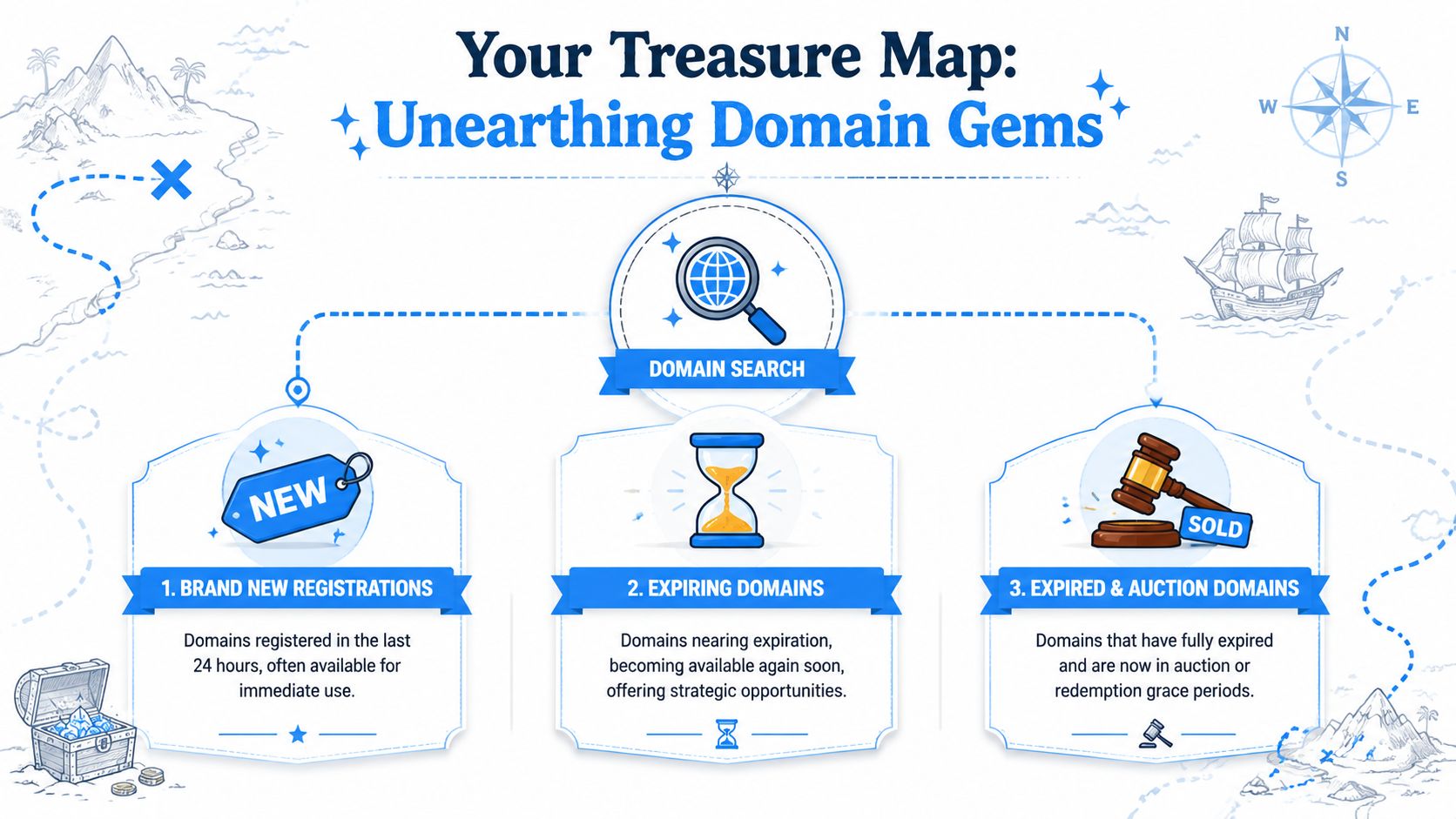
Three hunting grounds matter here, and each one serves a different job in the pipeline. Fresh registrations help you spot momentum early. Expiring domains help you build a shortlist before the crowd shows up. Dropped domains give you immediate buying opportunities if your filters are already dialed in.
Brand new registrations
Fresh registrations are research fuel. I use them to see where attention is forming before the aftermarket prices catch up.
The goal is pattern recognition. Watch for repeated keyword stems, sudden interest in a niche, odd TLD concentration, and defensive registrations around brands or products. That tells you where to focus your backorders, where to protect your own brand, and where a speculative hand-reg might still make sense.
This is also useful for SEO operators. If a topic starts showing up in domain behavior, it often means publishers, affiliates, or startups are preparing content and landing pages around it. That signal is not perfect, but it is often earlier than the polished content wave. Pair that with broader trend validation, including rank.fast's mobile SEO insights, and you get a better read on whether a niche has commercial legs or just social noise.
Expiring domains
Expiring domains are where the workflow starts to produce real targets. You still have time to inspect the name, check history, and decide whether to place a backorder or walk away.
Use a list built for expiring domains, then cut the time window hard. Today is best when your niche has plenty of volume. Three or seven days works when the category is thin and you need more inventory. Anything wider can still work, but you will spend more time clearing junk than finding value.
Discipline matters at this stage. I separate expiring names into three buckets right away: SEO rebuild candidates, resale candidates, and defensive buys. Mixing those goals usually leads to bad pricing decisions. A name that works for brand protection may be useless for resale. A name with old links may still be awkward as a brand.
If you want a system for tracking the same terms and competitors over time, this guide to domain name monitoring workflows is a practical add-on.
Available dropped domains
Dropped domains reward speed, but only after the prep work is done. Once a decent name hits open registration, you are racing other investors, SEOs, and anyone running scripts against the same lists.
Search available dropped domains when you want names you can register now. That speed is useful for two cases. First, you find an overlooked domain with clean history and obvious commercial use. Second, you catch a defensive registration before someone else turns it into a headache.
I have made good buys here. I have also bought names I should have skipped because the clock created fake urgency. Fast access helps. It does not excuse sloppy screening.
A practical workflow that keeps the list usable
The market is large. Your working list should be small.
Choose the objective before the source
Start by deciding whether you want trend research, SEO assets, resale inventory, or brand protection targets.Match the source to the objective
Fresh registrations are best for discovery. Expiring domains are best for planned acquisition. Dropped domains are best for immediate action.Use narrow filters early
Filter by time window, keyword family, TLD, price ceiling, and commercial intent before you save anything.Write the reason for every name
If you cannot explain the use case in one line, the name probably does not belong on the shortlist.Only send qualified names to evaluation
That keeps you from wasting time checking backlinks, archive history, and trademark risk on names that were weak from the start.
That last step is where many investors slip. They treat discovery like shopping. It works better as triage. The list only needs enough good names to create options at acquisition time.
Separating Gold from Garbage With Smart Evaluation
Locating candidates is straightforward. The challenge lies in determining if a domain is clean, useful, and worth the effort. Domain investing begins to feel less like treasure hunting and more like forensic work during this evaluation process.
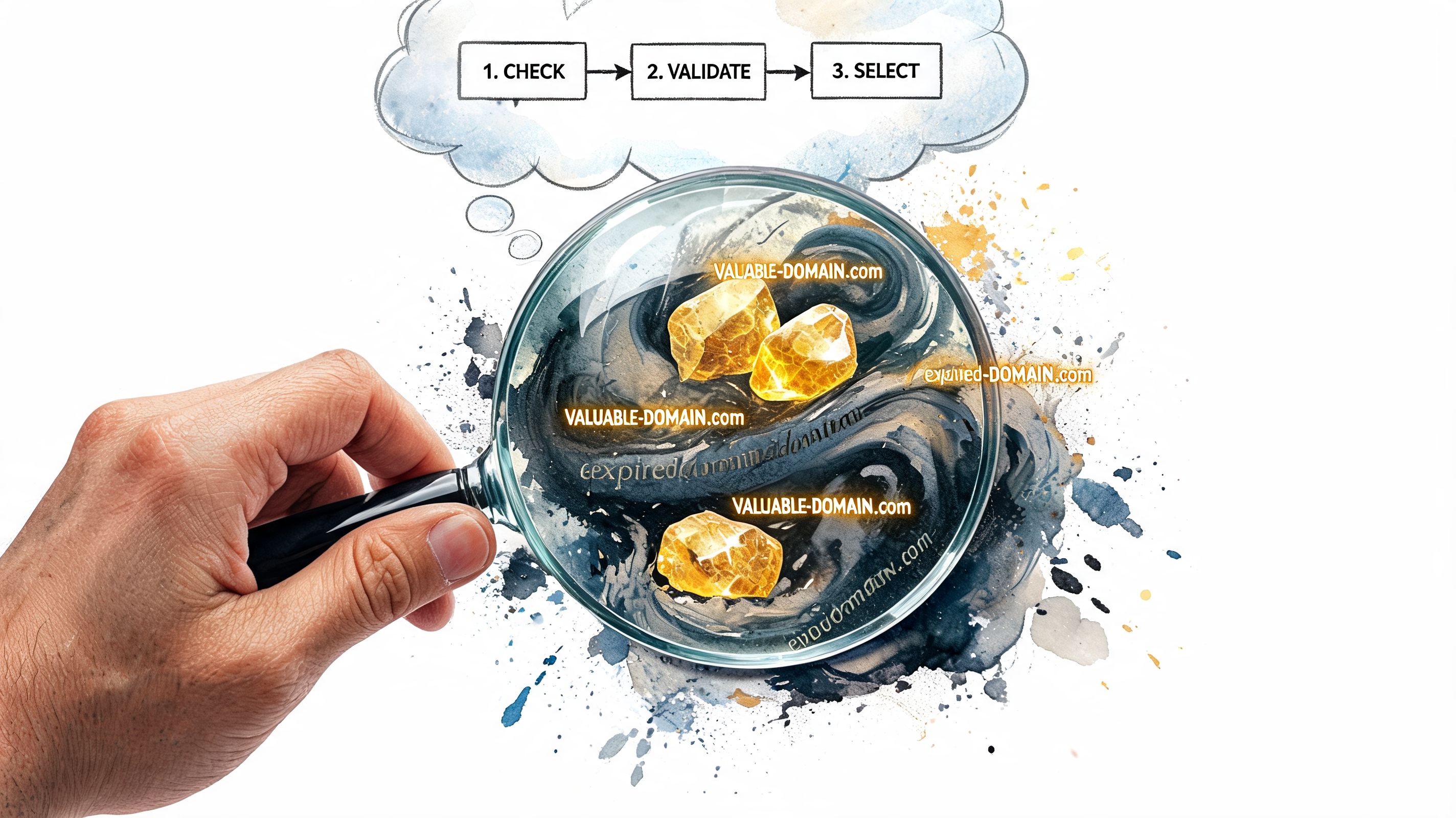
The first pass should be brutal. I want to know three things quickly. Does the name make sense to a human? Does the history look usable? Does anything about it smell wrong?
The first screen I use
A domain can have links and still be worthless. It can be short and still be legally dangerous. It can look clean in one tool and be a spam heap in another. That's why I like a composite approach instead of obsessing over one metric.
A useful scoring system blends signals like Trust Flow, age, referring domains, backlink quality, domain authority, and brandability. That's the appeal of tools that consolidate the data instead of making you bounce between tabs for every candidate.
My quick screen usually looks like this:
| Check | What I want | What sends it to the trash |
|---|---|---|
| Name quality | Clear, pronounceable, commercial, or memorable | Hyphen spam, awkward strings, forced keywords |
| Backlink profile | Relevant links, varied anchors, signs of real use | Casino, pills, foreign spam, comment blasts |
| History | A coherent prior purpose | Repeated topic switching, scraped content patterns |
| Trademark risk | Generic or safely distinctive | Brand imitation, typo versions, obvious infringement |
| Use case | SEO asset, flip candidate, niche build, or defensive buy | No buyer, no project, no rationale |
The security lens helps investors too
Security teams often define newly registered domains as those under 32 days old, because many malicious domains operate briefly before getting abandoned. Organizations using this kind of NRD-driven scoring report 30 to 40 percent faster detection of phishing activity, according to Palo Alto Networks' explanation of malicious newly registered domains.
That matters even if you're not running a SOC. If a name has signals that would make a security team nervous, I treat it as contaminated until proven otherwise. Weird ownership patterns, obfuscated history, sudden hosting changes, or obvious lookalike branding all belong in the danger bucket.
Aged domains can be risky. Fresh domains can be risky. The point is to know why.
What actually deserves a deeper look
Once a domain survives the first pass, then I'll spend more time on it.
Look closely at:
Anchor text balance
Natural anchors usually look mixed. Extreme commercial anchors often mean manipulation.Topical consistency
If a domain was about gardening, then crypto, then coupons, then “AI tools,” that's not evolution. That's abuse.Brand fit
A domain can be SEO-clean but still impossible to sell because it sounds cheap.Penalty clues
If you're vetting old inventory, a dedicated check like this domain spam score checker guide is worth having in the workflow.
If the backlink profile needs a long explanation, the domain is already telling you no.
A related practical issue is the build you'll eventually put on the domain. If the end use is a site, not just a redirect or flip, remember that cleanup isn't enough. The site experience still matters. rank.fast's mobile SEO insights are useful here. They're a good reminder that a strong domain won't rescue a weak mobile experience.
Here's a useful walkthrough on evaluating expired domains in more detail:
What doesn't work
A few habits consistently lose money:
- Buying on metrics alone
Numbers can hide ugly histories. - Buying on brand feel alone
Cool names with no resale path pile up fast. - Ignoring legal risk
Trademark headaches aren't “part of the game.” They're avoidable. - Assuming every aged domain has SEO value
Plenty of old names are just old trash.
The best buyers combine skepticism with speed. Not paranoia. Skepticism.
Automate Your Hunt for a Competitive Edge
A manual routine breaks the moment the market gets busy. You open a fresh list, skim a few names, flag two to revisit, get pulled into something else, and come back after the good ones are gone. I've bought names that way early on. I've also missed enough obvious winners to stop pretending hand-checking scales.

Automation fixes a simple problem. Recently registered domains show up in volume, and valuable patterns disappear fast. If you want an edge for investing, SEO scouting, or brand protection, the job is not “check more names.” The job is to build a pipeline that brings the right names to you, already filtered.
Why automation wins
The payoff is speed, but speed is only part of it.
Good automation also gives you consistency. A rules-based feed checks every day, every keyword cluster, every brand variation, every TLD bucket you care about. Human review still matters, but it belongs at the end of the process, where judgment is expensive and valuable, not at the beginning where you are wasting time sorting junk.
That shift matters in practice. Instead of hunting name by name, you can watch behavior across a market. A burst of registrations around one product category, one phrase pattern, or one competitor naming convention often matters more than any single domain on the list.
What to automate first
Start with inputs that can lead to action this week, not vague “interesting” signals.
Set up monitoring around:
Keyword groups with proven buyer intent
Track terms tied to niches where you already know the monetization path, resale demand, or affiliate economics.Competitor and brand permutations
This catches defensive problems early and also shows where others are expanding, testing, or hedging.TLD-specific naming trends .com behaves differently from .ai, .io, or .app. Separate them so your alerts reflect how those buyers shop.
Minimum qualification rules
Filter for length, word count, pattern type, registrar, or any signals that match your buying thesis.
One warning. If your filters are too loose, automation creates busywork. If they are too tight, you miss the weird names that turn into money. The best setup starts narrow, then widens once you know which alerts produce usable leads.
Alerts are triage, not decisions
An alert should answer one question only. Is this worth five more minutes?
That is why the workflow matters more than the tool. Discovery comes first. Then clustering, filtering, and shortlisting. Only after that do you review legal risk, use case, resale angle, or SEO fit. If you want a practical system for that review layer, this due diligence automation workflow for domain research is a solid model.
The buyers who keep finding opportunities do not rely on hustle alone. They build repeatable watchlists, clean filters, and review habits that turn noise into acquisitions. That is the competitive edge.
From Domain to Done Deal Three Winning Use Cases
A domain without a plan is inventory. Sometimes that's fine if you're a pure trader. Readers of this article should be thinking in use cases. Why this domain, for this project, in this market, right now?

The most effective way to understand recently registered domains is through three strategies: SEO potential, resale, and brand protection.
SEO assets that already have a pulse
A good aged domain can shorten the runway on a build. Not magically. Not irresponsibly. But meaningfully, if the history and links line up with the intended use.
I care less about raw age and more about fit. If the old topic aligns with the new build, the backlinks are legitimate, and the brand still makes sense, you may have an asset worth rebuilding or redirecting. If the previous life is irrelevant or spammy, leave it alone.
Good SEO use cases usually fall into these lanes:
- Rebuild the site when the old topic still maps to a real audience
- Support a related property when the overlap is tight and the links justify the effort
- Hold for a future build if the domain is clean and unusually strong for your niche
The mistake is forcing every decent expired domain into a redirect plan. Some are better rebuilt. Some are better sold. Some should stay unbought.
Brandable flips with less competition in newer extensions
The market isn't standing still. New gTLD registrations grew 15.9 percent year over year in 2024 and reached 42.9 million by Q3 2025, based on CircleID's domain industry market data. That matters because a lot of buyers still search like it's only 2014 and .com is the only game in town.
That creates a practical opening. In extensions like .app, .io, and .ai, you can still find short, brandable names that feel modern and product-ready. They won't replace premium .com in every category, but they absolutely have resale value when the name is crisp and the buyer type is obvious.
A flip worth making usually has these traits:
| Use case | What helps | What hurts |
|---|---|---|
| Startup brandable | Short, pronounceable, category-adjacent | Weird spelling, trendy slang that ages badly |
| Tool or SaaS name | Clean two-word combo, strong fit with extension | Too generic, hard to trademark |
| Media or content project | Memorable phrase, topical clarity | Name sounds disposable or spammy |
Defensive registrations that save headaches later
This is the least glamorous use case and one of the smartest. Founders and brand managers should watch recently registered domains because not every domain you buy is meant to make money directly. Some are meant to stop future pain.
If your brand is gaining traction, monitor variations, misspellings, and adjacent TLD versions. That can prevent confusion, affiliate leakage, or flat-out impersonation later. Security teams do this from a threat perspective. Operators should do it from a business perspective.
The cheapest domain in your portfolio is often the one that prevents a much more expensive problem.
This use case gets overlooked because it doesn't produce a flashy sale screenshot. It just keeps your brand cleaner and your future self less annoyed.
Making Your Move The Art of Acquisition
By the time you're ready to buy, the hard thinking should already be done. Acquisition itself is usually simple. The pressure comes from timing and restraint.
There are three common paths.
Register it immediately if it's available
If a dropped domain is open for hand registration, move quickly, but only after the checks are done. This is the cleanest acquisition path because there's no waiting for another owner or guessing how an auction room will behave.
Good hand-register opportunities reward preparation. You already know what quality looks like, what your budget is, and what you'll do with the asset if you win it.
Backorder it if it's still in the expiration pipeline
When a domain is expiring but hasn't fully dropped, the right move is often a backorder. That puts you in line for the moment the domain becomes available. For names with real value, assume other people are watching too.
Discipline is paramount. Set your ceiling before the action starts. Don't invent a higher budget because the room got excited.
Expect auctions on stronger names
High-value domains often draw multiple buyers once they near release. If that happens, bidding strategy matters more than emotion.
A few rules help:
Bid based on use case
A redirect asset, a brandable flip, and a defensive registration should not share the same ceiling.Pay up more willingly for cleaner names
A simple domain with strong fit is easier to use and easier to sell.Be pickier with compromised histories
If there's cleanup work or uncertainty, your margin disappears fast.
One market truth still anchors pricing. As of September 30, 2024, .com accounted for 156.7 million of the world's 362.3 million registered domains, or about 43 percent of all registrations, according to Openprovider's domain market summary. That's why strong expired .com names still command more attention. They carry trust, familiarity, and broader resale appeal.
That doesn't mean you should only buy .com. It means you should know when the extension deserves a premium and when it doesn't.
Recently registered domains reward a repeatable process. Track the right pools. Filter hard. Vet history. Set alerts. Buy with a plan. That's the whole game.
If you want a faster way to sort through expired and expiring inventory without drowning in junk, NameSnag is built for exactly that. It helps you surface cleaner opportunities, review SEO and brandability signals in one place, and move earlier on domains worth chasing.
Find Your Perfect Domain
Get access to thousands of high-value expired domains with our AI-powered search.
Start Free Trial