
Ever feel like all the good domain names are gone? That every clever .com you can think of was snatched up back in 1998? Well, I've got good news for you!
The truth is, some of the best digital real estate isn’t gone forever—it’s just waiting to be rediscovered. Welcome to the strategic world of domains that are about to expire, a treasure hunt for properties already packed with history, authority, and massive SEO potential.

The Hidden World of Expiring Domains
Think of it like finding a classic car hidden under a dusty sheet, but with a powerful, perfectly tuned engine just waiting to be fired up. That’s what a great expiring domain offers. It's a massive shortcut for savvy SEOs, affiliate marketers, and entrepreneurs looking for a serious competitive edge.
This isn’t about stumbling upon random names. It’s a calculated strategy to acquire digital assets that let you:
- Skip the dreaded Google "sandbox" and get your content ranking much faster.
- Instantly inherit powerful backlinks from authoritative websites that took years to build.
- Get a huge head start on competitors who are building their authority from scratch.
Know Your Targets: Expiring vs. Available
Before you jump in, you need to understand the two main types of expired domains you'll be hunting. They might sound similar, but how you get them is completely different.
First up, you have Expiring domains. These are names that have passed their renewal date but are still in a "grace period," which usually lasts 30-45 days. The original owner can still swoop in and reclaim them. If they don't, these domains often go to auction. You can keep tabs on these high-value assets by checking out lists of expiring domains that will be dropping soon. You can even filter by when they're dropping: Today, 3 Days, 7 Days, and more, so you can plan your attack!
Then there are available domains that just dropped, often called "dropped" domains. These are the ones that went through the entire expiration lifecycle—grace period, redemption, auction—without anyone picking them up. They get released back into the public pool and can be registered by anyone, right now, for the standard registration fee. Finding these is a race, and with NameSnag, you can see what dropped Today to grab them before anyone else.
Here’s a quick breakdown of the two main types of expired domains you'll be hunting for and the best approach for each.
Expiring vs Available Domains At a Glance
| Domain Status | What It Means | Acquisition Strategy | Best Use Case |
|---|---|---|---|
| Expiring | Still in a grace/redemption period. Not publicly available yet. | Backorder or Auction: Place a backorder with a service, or prepare to bid if it goes to auction. | High-value, competitive domains with strong metrics that are worth fighting for. |
| Available | Has been "dropped" and released to the public. First-come, first-served. | Immediate Registration: Grab it the second it becomes available. Speed is everything. | Finding hidden gems with decent metrics that slipped through the cracks. |
Ultimately, the key difference boils down to timing and availability. Expiring domains require patience and a smart strategy (like backordering), while snagging available domains is all about being the fastest person to the "register" button.
Why This Strategy Is a Game-Changer
Picking up a domain with history is like starting a race halfway to the finish line. Instead of spending months or even years building a site's authority from zero, you're plugging into years of established trust and credibility that Google already recognizes.
It's an incredibly powerful way to fast-track your projects, whether you're launching a new niche site, creating a PBN, boosting an existing business, or flipping domains for a profit.
Now, let's get into the nitty-gritty of where to look, what tools to use, and how to spot the absolute gems among the junk.
Where to Find Your Domain Treasure Map
Any successful hunt starts with a reliable map. In the world of expiring domains, this means knowing exactly where to look for digital gold. If you just start sifting through endless, unfiltered lists of worthless names, you'll burn out fast. It's a surefire way to waste hours and find nothing. You need a better strategy.
Let's break down the real-world pros and cons of the different places you can find these domains, from massive data aggregators to specialized platforms. Each has its place, but knowing the difference is what separates an efficient search from a frustrating waste of time.
The Firehose vs. The Curated List
On one end, you've got the data firehoses. These are platforms that scrape and list pretty much every domain under the sun that's in some stage of expiration. They give you a staggering amount of raw data, which is both a blessing and a curse.
The upside is the sheer volume. If a domain is dropping, you'll almost certainly find it there. The downside? You’re often left to manually sort through tens of thousands of domains every single day, and I can tell you from experience, most of them are complete junk. It's a classic needle-in-a-haystack problem.
Sure, you could get technical. Some folks try to tame the firehose by learning about modern web scraping best practices to gather and filter information themselves, but that's a deep rabbit hole and not for everyone.
This is where curated platforms come into play. Modern tools like NameSnag take a different approach. They act more like a skilled treasure hunter than a simple mapmaker. Instead of just dumping data on you, they do the first round of analysis for you.
NameSnag, for instance, crunches over 170,000 domains daily. It runs each one through an AI-powered evaluation system that spits out a "SnagScore." This single number gives you a quick read on whether a domain is worth a closer look, saving you dozens of hours of manual research.
Filtering Your Way to Gold
Whether you're wrestling with a firehose or using a curated tool, effective filtering is your most powerful weapon. Picture this: you're faced with a list of 50,000 domains dropping today. How do you find the five that actually matter to you?
You start by defining your mission. What are you looking for?
- A catchy, brandable name for a new startup?
- A high-authority domain to build a niche site?
- Something with a specific, high-value keyword?
Your goal dictates your filters. At a minimum, I always start with these:
- Keyword Filters: Target domains containing words or phrases relevant to your industry (e.g., "solar," "keto," "design"). This is your first and most basic cut.
- Domain Age: Older domains often carry more trust and authority with search engines. Filtering for names that are 5+ years old is a great way to weed out the chaff.
- Backlink Profile: This is huge. Look for domains with links from reputable sources. Some tools even let you filter for those rare and valuable .edu or .gov links.
This process is exactly why having a powerful expired domain finder in your toolkit is non-negotiable.
Focusing on Imminent Drops
One of the most effective strategies I've found is to zero in on domains that are on the brink of becoming available. These are domains that have expired but are still in their grace or redemption period. You can't register them just yet, but they'll be dropping soon—which gives you precious time to do your homework and prepare.
This is where a dedicated feature can make all the difference. On NameSnag, for example, you can immediately narrow your search by hitting the Expiring domains filter. This instantly pulls up a list of domains in that "pre-drop" phase. From there, you can dial it in even further, filtering to see what's dropping in the next 3, 7, or even 30 days.
By starting with a curated list and focusing on what’s about to drop, you’re not just looking at a map. You're looking at a map where someone has already circled the most promising dig sites. This lets you spend your time vetting high-potential assets instead of just digging through digital dirt.
Alright, you’ve waded through the massive lists of expiring domains and have a shortlist of contenders. High five! Now comes the most important step in this whole game: the vetting process. This is where you put on your detective hat and turn into a digital forensic investigator.
A domain that looks incredible on paper—great name, solid age—could easily be a toxic asset just waiting to blow up. I always think of it like buying a used car. You wouldn't just be wowed by the shiny paint; you'd pop the hood, listen to the engine, and absolutely take it for a test drive. That’s exactly what we’re about to do here.
This is the part of the process that separates the true gems from the junk, making sure you don’t accidentally sink your money into a domain with a sketchy past that could poison your projects from day one.
Going Beyond Surface-Level Metrics
The first things that jump out are always those big, shiny numbers: Domain Authority (DA), Trust Flow (TF), or maybe a custom score from a platform like NameSnag's "SnagScore." These are great starting points, no doubt, but they rarely tell the full story. A critical aspect of vetting potential domain investments is understanding their existing SEO metrics, particularly knowing what is Domain Authority in SEO and how it influences a domain's value.
But remember, numbers can be played. A high DA score might just be propped up by thousands of garbage, spammy backlinks. That’s not an asset; it's a huge liability you’ll have to clean up later.
Key Takeaway: Treat metrics as clues, not conclusions. A high score is a signal to dig deeper, but it's the quality behind that number that really matters. A domain with a DA of 20 from a few highly relevant, authoritative sites is worlds more valuable than one with a DA of 40 built on spammy blog comments.
This flowchart gives you a simple visual for that first decision you'll make: are you going to tackle raw data yourself, or start with a pre-filtered list?
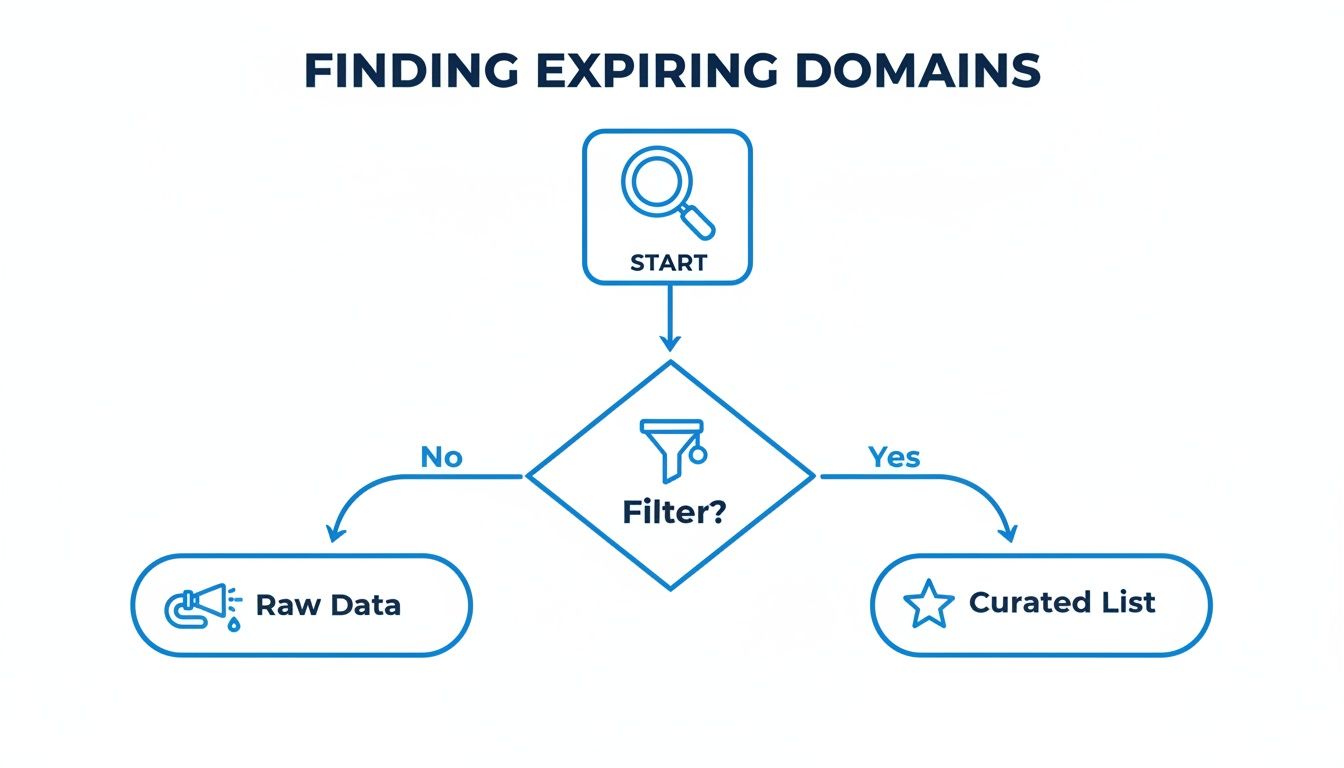
Starting with curated lists can be a massive time-saver, letting you jump straight to analyzing quality candidates instead of sifting through noise.
The Non-Negotiable Backlink Audit
The real value—the heart and soul—of an expired domain is its backlink profile. This is where you absolutely have to get your hands dirty. You’re on the hunt for links that are:
- Topically Relevant: If the domain was about dog training, are its links coming from pet blogs, veterinarian sites, and dog food brands? Or are they from sketchy casino and payday loan sites? The more relevant, the better.
- From High-Authority Sources: One single link from a major news outlet or a respected industry blog is worth more than a thousand links from low-quality web directories.
- Contextual: Look at how the links are placed. Are they naturally woven into articles, or are they all stuffed into forum signatures and blog comment sections? Contextual links carry far more SEO weight.
Just to give you a sense of the scale, every day, thousands of domains expire. We're talking about a massive pool of over 4.6 million expired domains available right now. Of those, 8.7 million have a TrustFlow of 5+ and nearly 3 million have a coveted link from Wikipedia.org. The opportunity to find link-rich domains is staggering if you know where and how to look.
Uncovering the Domain's Secret History
This step is an absolute must. You have to check a domain's history to see what it was used for before it expired. Was it a legitimate business, a personal blog, or a spam farm pumping out questionable content?
The Wayback Machine (Archive.org) is your best friend here. It's a time machine for the web. Just plug in the domain and start clicking through its past snapshots. Keep an eye out for these red flags:
- Sudden Changes: Did the site's topic, design, or language change abruptly? A site that was about gardening one year and then suddenly switched to selling pharmaceuticals in Chinese is a huge red flag.
- Spammy Content: Be on the lookout for signs of gambling links, adult content, or anything that feels out of place with the domain name.
- Previous Use: Was this a real, thriving e-commerce store, or was it just a parked page full of ads for most of its life? The former has much more potential value.
This detective work is non-negotiable. For a deeper look into the tools and techniques for this, our guide on how to check a domain's full history is a great resource. A few minutes of investigation can save you from a massive headache later. This is also where platforms that offer built-in spam checks and composite scores become invaluable—they do this heavy lifting for you, flagging penalty risks automatically.
You’ve done the detective work. You found the perfect domain—it’s clean, it’s powerful, and you’ve vetted it six ways from Sunday. Now what?
This is where the real game begins. How do you actually make it yours? It's a mix of timing, strategy, and a bit of nerve. The acquisition phase has its own rules, and knowing how to play is what separates the pros from the spectators who watch the best names get snatched up.
Getting your hands on a premium expiring domain isn’t as simple as clicking "buy now." The path you take depends entirely on where that domain is in its lifecycle. You might be in for a calm, calculated backorder, or you could find yourself in a frantic, last-second bidding war.
The Two Paths to Acquisition: Backordering vs. Auctions
For the most coveted domains that are about to expire, you'll likely face two primary scenarios: placing a backorder or jumping into an auction.
A backorder is basically a reservation. You're telling a service, "Hey, if this domain becomes available, I want you to try and grab it for me the microsecond it drops." It’s a strategic first move for domains you really want. If you're the only one who backordered it, you might get it for a flat fee. But if multiple people backorder the same domain, it often gets pushed into a private auction just for those who placed the order.
An auction, on the other hand, is an open battlefield. When a high-value domain isn't renewed, the registrar often puts it up for auction to the highest bidder. This is where things can get heated. My advice? Set a firm budget before you enter the fray and stick to it. It’s easy to get caught up in the thrill of a bidding war and end up overpaying.
The domain aftermarket, fueled by expiring domains, was valued at $0.64 billion in 2024 and is forecasted to hit $1.17 billion by 2033. Most of these aftermarket sales are for
.comsand "Buy Now" deals, showing that investors move quickly on expired assets with good metrics. You can explore more about these trends and discover insights on domain name statistics on hostinger.com.
This growing market means more competition, so having a clear acquisition strategy is more important than ever.
The Thrill of the Hand-Register
Sometimes, the best treasures are the ones that slip through the cracks. This brings us to the most exciting—and often most rewarding—method: hand-registering a dropped domain.
These are domains that have gone through their grace period and any potential auctions without anyone claiming them. The registry simply drops them, and they become publicly available for anyone to register at the standard price. No auctions, no bidding wars, just pure speed.
This is where you can find incredible bargains. A domain with solid metrics that might have fetched hundreds or thousands in an auction could be yours for about $10. The catch? You have to be the very first person to grab it the moment it becomes available.
This is precisely what the "Available" filter on NameSnag is built for. By focusing on available domains that just dropped today, you get a real-time feed of names you can register right now. When you see a gem, you don’t hesitate—you snag it immediately from your favorite registrar.
Pro Tactics for Staying Ahead
The best domain hunters don't just react; they anticipate. To get a serious edge, you need to move beyond basic searching and start using pro-level tactics like alerts and watchlists.
Think about it: what if you got a notification the moment a high-value domain you've been eyeing enters its final drop phase? That’s what features like Early Access Alerts and Watchers are for.
- Set Up Watchers: Create a personalized list of domains you're interested in. Instead of checking them daily, you get an alert the instant their status changes.
- Enable Early Access Alerts: Get an email or SMS notification before a domain hits the public marketplaces. This gives you critical time to finalize your research and get your acquisition strategy in order.
By setting up these automated systems, you shift from actively hunting to letting the opportunities come directly to you. This is how seasoned investors consistently secure the best domains before the broader market even knows they're available. It’s about being prepared, being fast, and having the right tools on your side.
Turn That New Domain Into a Real Asset

Alright, you did it. You snagged an awesome expired domain. That little rush when the acquisition confirmation hits your inbox is a great feeling, isn't it? But don't pop the champagne just yet. The real work—and the real fun—is just getting started.
What you're holding now is a digital asset brimming with potential. The next step is figuring out how to transform that potential into actual, tangible results. From my experience, there are three main paths you can take, and each one has its own playbook for success.
Path 1: The Niche Site Rebuild
This is my absolute favorite strategy, especially for domains that have a strong, focused history. Let's say you grabbed a domain that was once a beloved blog about vintage synthesizers. Rebuilding a site on that same topic is a total no-brainer. You get to draft off the domain's existing authority and topical relevance right out of the gate.
Google loves this. When you start publishing high-quality content that meshes with the domain's old backlink profile, you can start ranking for valuable keywords way faster than you ever could with a fresh domain. Think of it less like starting from scratch and more like renovating a historic property in a prime neighborhood.
A few tips if you go this route:
- Dig into the archives: Use the Wayback Machine to see what topics the old site covered. Your goal is to create new, better, and more up-to-date versions of that content.
- Stay on topic: Stick to the original niche like glue. If the domain was all about vegan recipes, this is not the time to pivot to monster trucks.
- Be patient, but optimistic: While you'll see results faster, it’s not instant. Give Google some time to re-crawl your new site and recognize the value you're bringing back to the web.
Path 2: The SEO Power-Up with 301 Redirects
Maybe building a whole new website from the ground up isn't in your game plan. No problem. Instead, you can give your main business site a serious SEO injection using the mighty 301 redirect. A 301 is a permanent redirect that basically tells search engines, "Hey, this old address has moved for good. All its mail should now go here."
When you do it right, a 301 passes most of the expired domain's "link juice" and authority over to your target site. It's like taking the powerful engine from a classic muscle car and dropping it into your daily driver. Suddenly, your main site has a lot more horsepower to climb the search rankings.
Crucial Insight: The key to making a 301 redirect work is relevance. Redirecting a former pet grooming blog to your SaaS company selling accounting software will set off major alarm bells at Google. You need to make sure the old domain's topic is closely related to the page you're pointing it to for maximum impact.
For a step-by-step walkthrough, you should definitely check out our guide on how to properly set up a 301 redirect with htaccess. It’ll help you transfer the most value without any technical fumbles.
Path 3: The Quick Flip for Profit
Perhaps you're more of an investor than a builder. You've got a good eye for spotting undervalued assets, and your goal is to buy low and sell high. Flipping domains that are about to expire can be an incredibly profitable game. You find and acquire a domain with great metrics for a low price—maybe just the standard registration fee—and then list it on an aftermarket platform for a tidy profit.
The market for valuable, aged domains is white-hot right now. Awareness is growing around the high cost of accidental expirations, and the aftermarket for these flips hit a staggering $0.64 billion in 2024. With over 114 million registered domains showing some search volume, the ability to find and verify a clean history is everything if you want to capitalize on this trend. You can find more data on the growth of the domain expiration market on marketresearch.com.
When pricing a domain for a flip, you’ll want to factor in:
- Hard Metrics: Look at the DA, TF, number of backlinks, and domain age.
- Brandability: Is it short, memorable, and easy to spell?
- Commercial Intent: Does the name contain keywords that businesses in a specific industry would pay a premium for?
Ultimately, the right path is all about your goals. Whether you're building a new empire, boosting an existing one, or just turning a quick profit, that expired domain you just bought is the launchpad for your next big win.
Your Questions About Expiring Domains Answered
Jumping into the world of domains that are about to expire can feel like learning a new language. A lot of terms get thrown around, and it's easy to get turned around. I've gathered a few of the most common questions to give you some clear, straightforward answers. The goal is to help you feel more confident on your domain-hunting journey.
Expiring vs. Expired vs. Dropped — What Is The Difference?
It's all about timing. Think of these as different stages in a domain's lifecycle after its owner misses the renewal date.
- An expiring domain is still owned, but its registration is about to end. It's in the final days before that expiration date hits.
- An expired domain has passed its expiration date. It's now in a "grace period," which usually lasts 30-45 days. The original owner can still renew it during this window, often for a higher fee.
- A dropped domain is the final state. It's gone through the grace period and any auction process without being renewed or bought. It gets released back to the public pool, where anyone can register it for the standard price.
This distinction is the core of your strategy. You can watch expiring domains that are about to drop and get ready for an auction or backorder. Or, you can pounce on available domains that have just been dropped for immediate registration.
Is Buying An Expired Domain Risky For SEO?
It absolutely can be, but only if you skip your homework. The single biggest risk is accidentally buying a domain with a sketchy history—think spam, or worse, a Google penalty. This is precisely why a thorough vetting process is the most critical step you'll take.
You have to check its backlink profile for toxic links. You need to review its past life on the Wayback Machine to see what it was used for. A domain previously home to a legitimate business is gold. One used for a spammy link farm is a toxic asset you don't want anywhere near your projects. This is exactly where a platform like NameSnag shines, as its "SnagScore" and built-in spam checks are designed to flag these risks before you ever commit.
How Much Should I Pay For An Expired Domain?
There's no single answer here. A domain's value is tied directly to its metrics and how "brandable" it is. A short, memorable name with high authority and clean backlinks from relevant sites could easily be worth thousands of dollars. On the other hand, a domain with weak metrics is only worth the standard registration fee.
Your acquisition strategy really determines the cost:
- Auctions and Backorders: For competitive domains, you have to set a budget based on the asset's value to your project and be prepared to bid. Don't get caught up in the heat of the moment.
- Hand-Registering: For dropped domains, you just pay the standard registration fee (usually around $10-$15) from your registrar. This is where you can find incredible bargains if you're patient and quick.
Can I Get Immediate Traffic From An Expired Domain?
Not automatically, no. An expired domain doesn't come with a built-in audience just waiting for you to show up. What it does give you is a massive head start.
If you rebuild a website on the domain, its existing authority can help it start ranking in search results much, much faster than a brand-new domain. This leads to organic traffic more quickly, but you still have to put in the work and create quality content.
Alternatively, you can use a 301 redirect to pass its "link juice" and authority to your main website. This can boost your primary site's rankings, which then leads to an increase in its traffic. The expired domain itself won't get any visitors until you actually put a live website on it.
Ready to find your own hidden gems? NameSnag is your AI-powered treasure map, analyzing over 170,000 domains daily to help you discover high-value domains without the junk. Stop wasting hours on manual research and start snagging powerful domains today at https://namesnag.com.
Find Your Perfect Domain
Get access to thousands of high-value expired domains with our AI-powered search.
Start Free Trial