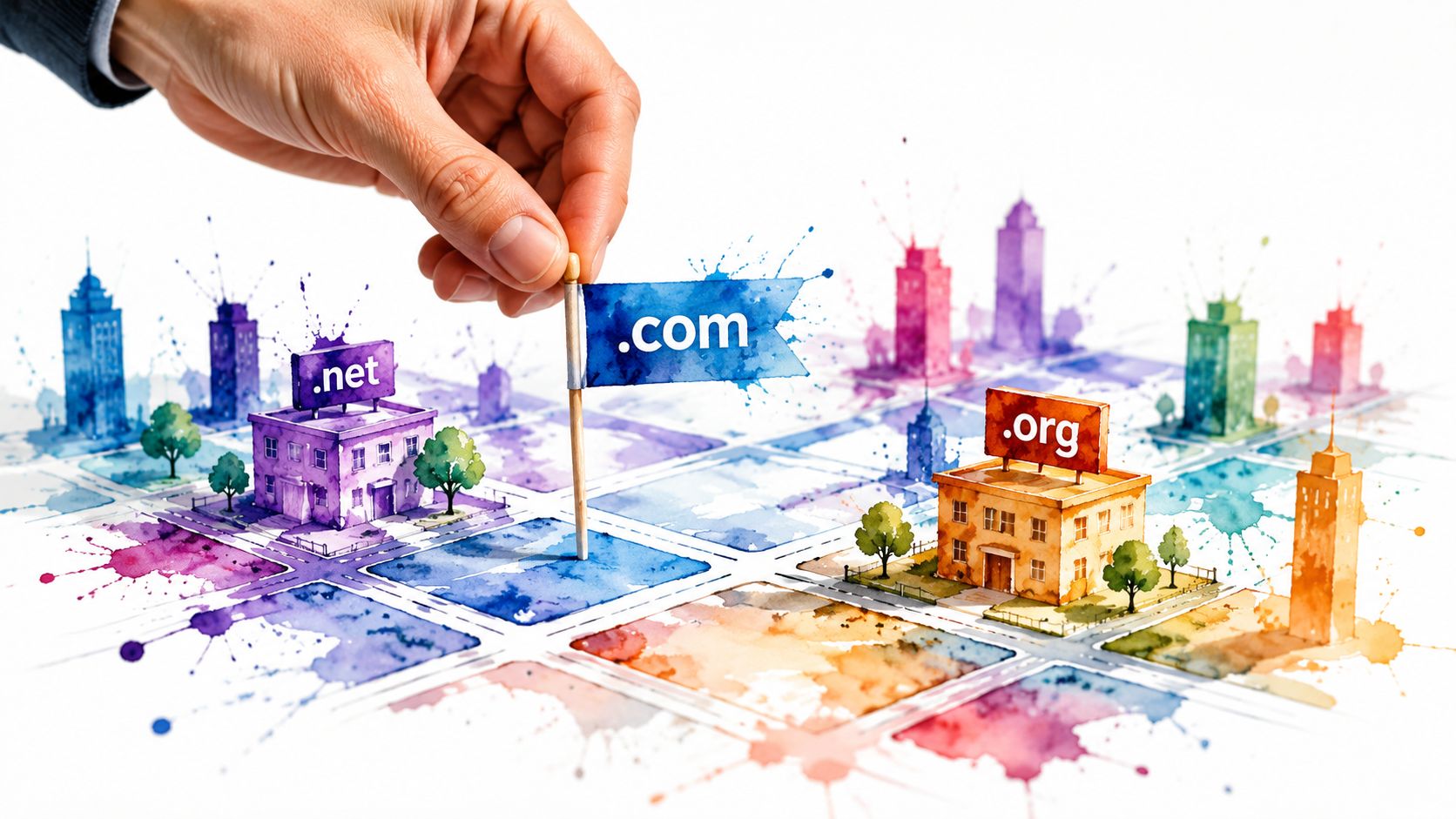
You've probably been here already. The idea is solid, the brand names are flying around in your notes app, and someone on the team says, “Let's grab the domain before somebody else does.”
That moment feels small. It isn't.
A domain name is your public address, your brand container, and in many cases your first defensible digital asset. If you're asking what is domain name registration, the beginner answer is “it's how you get a website address.” True, but incomplete. In practice, registration is closer to securing a plot in a crowded commercial district. The address affects memorability, trust, future flexibility, and sometimes SEO opportunity if you know where to look.
That matters because the market is crowded. By the third quarter of 2025, the global domain base reached 378.5 million, up 4.5% year over year, according to the Domain Name Industry Brief Q3 2025. Prime names don't wait around. Neither do strong expired ones.
Your Amazing Idea Needs a Digital Address
A good domain does more than point a browser to a website. It tells people whether your project feels credible, established, easy to remember, and worth clicking.
That's why I never treat domain registration like a box-checking task. It's usually the first branding decision with permanent consequences. Change your logo later, fine. Rewrite your homepage, no problem. Change the domain after launch and you introduce friction you didn't need.
Why the first pick matters
A weak domain usually fails in one of three ways:
- It's hard to say out loud. If somebody hears it once and can't spell it, you're leaking traffic and referrals.
- It's too generic. Generic can help in some niches, but bland names are forgettable and hard to defend as a brand.
- It backs you into a corner. A location-specific or product-specific name can become a burden once the business expands.
A strong one usually feels obvious in hindsight. Short enough to remember, clean enough to type, and broad enough to grow with the business.
Practical rule: If you have to explain the spelling every time, the domain is doing extra work before the business even starts.
Registration is strategy, not paperwork
The typical understanding of what is domain name registration focuses on the mechanic. Search a name, see if it's available, pay a registrar, done. But the strategic layer is where smart operators separate themselves.
You're not just choosing an address. You're choosing:
- A brand signal
- A trust signal
- A recoverability risk
- A resale or acquisition asset
- A future SEO path
And there's one more angle most beginner guides miss. Not every good domain is unregistered. Some of the best opportunities come from names that were owned before, then dropped, expired, or are about to re-enter the market. That's where registration starts looking less like shopping and more like dealmaking.
The Digital Real Estate Office Explained
The domain world gets easier once you stop thinking of it as a mysterious technical system and start thinking of it as property administration.
You don't “buy the internet.” You get rights to use a specific address inside a rule-based system.
Who does what
At the top, ICANN sets the broad policy framework. Think of it as the rulemaker for the naming system. Individuals rarely interact with ICANN directly, but its policies shape how registration, renewal, transfer, and recovery work.
Then you have registries. These operate specific extensions, also called top-level domains or TLDs. Examples include operators for extensions like .com or .net. They run the authoritative database for names inside that extension.
Then come registrars, the commonly recognized retail layer. Companies like GoDaddy, Namecheap, and others are the storefronts where you search, register, renew, and manage domains.
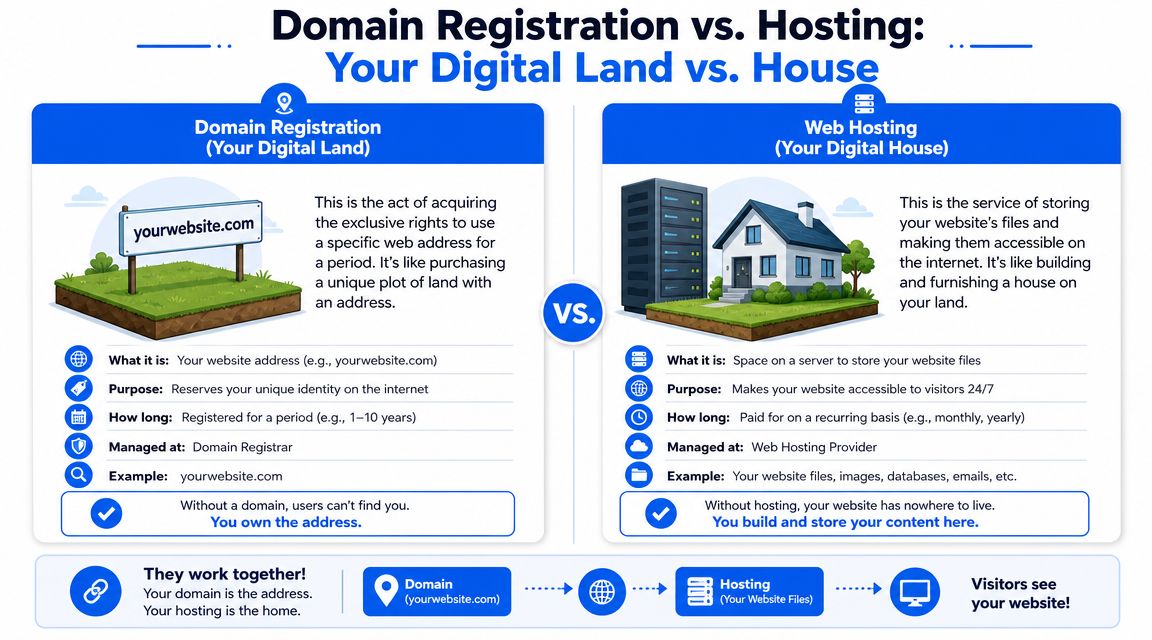
Here's the simplest visual for the difference between domain registration and what usually comes next.
What you actually get when you register
This is the part many people misunderstand. Registration is not permanent ownership in the usual sense. It's a leased-rights system. Registries control the namespace, registrars sell time-limited reservations, and the maximum standard registration period is 10 years at a time, as explained in Cloudflare's guide to how domain registrars work.
If you keep renewing, you keep control. If you don't, the domain can eventually return to the market.
That single fact drives a lot of the “inside baseball” in this space. Expired domain hunters know that missed renewals are one of the main ways strong names become available again.
The privacy piece most beginners miss
Registration also creates a data footprint. You're entering a contract and providing registrant details through the registrar.
A lot of beginner content glosses over this, but the privacy reality matters. SiteGround notes that registrant information becomes publicly available after registration, and that's why privacy options matter for many buyers. The broader point is that registration isn't just checkout. It's a data-governance decision with visibility and compliance implications, as discussed in SiteGround's overview of domain name registration and registrant data.
A short explainer helps if you want the visual walkthrough too.
Most people think they're buying a web address. Operationally, they're entering a renewable contract with rules, records, and consequences.
Your Land vs Your House Registration vs Hosting
People mix these up all the time, and the confusion creates bad purchasing decisions.
A domain name and hosting are related, but they are not the same product.
The simple comparison
| Item | What it is | Real estate analogy | What happens without it |
|---|---|---|---|
| Domain registration | Rights to use a web address | Your land parcel and street address | People can't reliably find you by name |
| Web hosting | The server space where your site files live | The house built on the land | The address exists, but there's nothing useful there |
A registrar may sell both services in one cart, and that's fine for convenience. But convenience isn't always the same as control.
When bundling works and when it doesn't
Bundling usually works for simple projects. If you're launching a portfolio site, a local business page, or a basic store, one provider can keep things tidy.
It works less well when you need flexibility. SEO teams, agencies, and domain investors often separate registrar and host because it reduces lock-in. If hosting performance tanks, you can move the site without touching the domain ownership layer. If a registrar account gets messy, your website infrastructure doesn't have to move with it.
That's why I usually tell people to think in roles, not brands. The company selling the address doesn't automatically deserve the hosting contract too.
For a deeper breakdown of the distinction, this guide on website vs domain name is a useful companion.
One technical limit worth knowing
Your domain also has to follow DNS naming rules. A label can be 1 to 63 octets, the full textual domain name can't exceed 253 ASCII characters, and labels can only use letters, digits, and hyphens, with hyphens not allowed at the start or end, per the Wikipedia entry on domain names.
You won't hit those limits often, but they matter when a founder tries to get clever with punctuation, ultra-long branding, or malformed naming conventions. If the string breaks the rules, it isn't registrable in DNS. Simple beats clever here.
The Domain Lifecycle From Birth to Rebirth
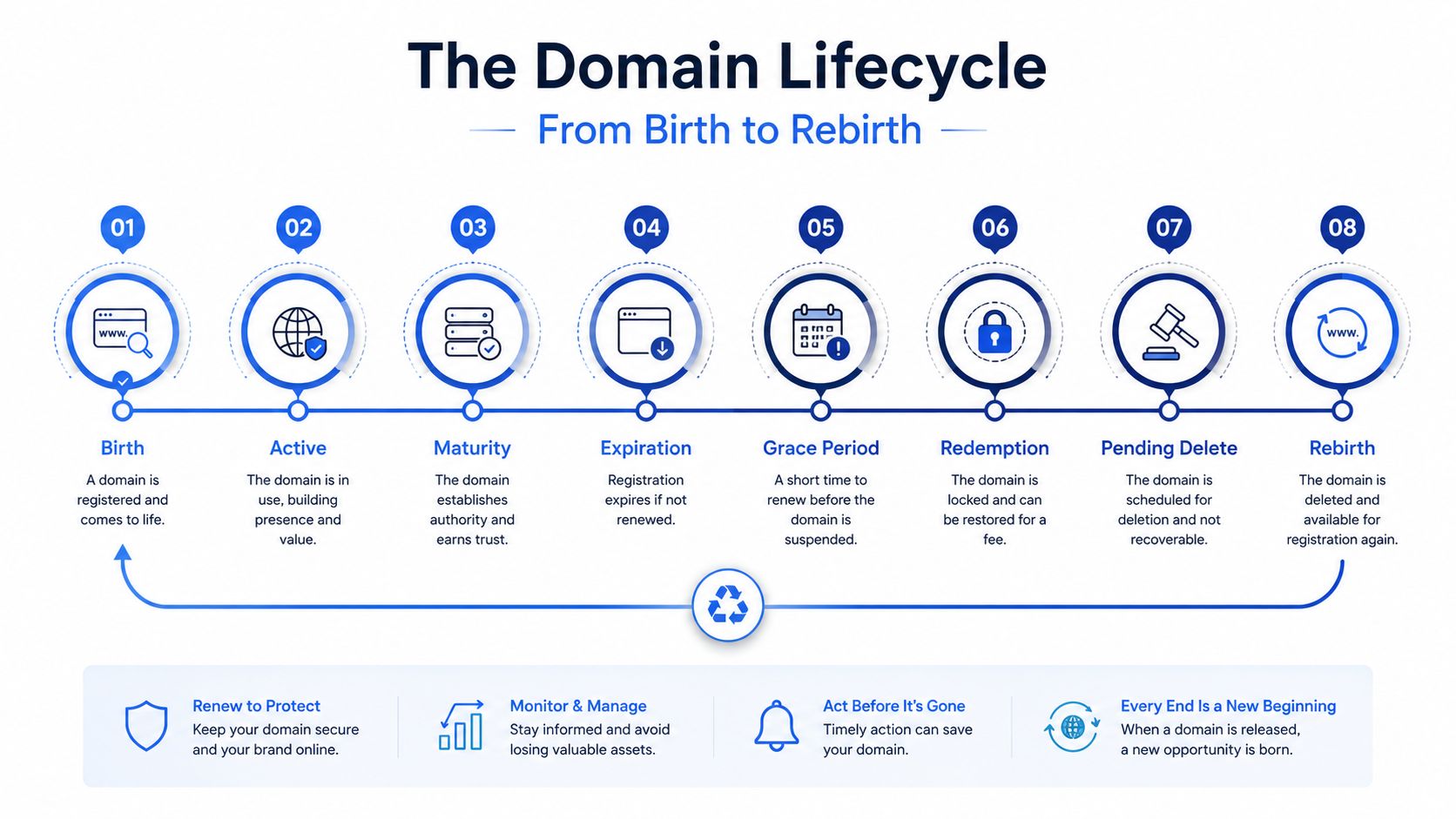
A domain isn't a forever purchase. It behaves more like a lease with stages, and understanding those stages is where domain strategy starts to get interesting.
The normal life of a domain
It starts with registration. The registrant secures the name for a set term. The standard maximum is 10 years, and the key point is that this is still a lease, not permanent ownership. If renewal fails, the domain can eventually drop back into the open market, which is why expiry monitoring matters so much, as Cloudflare explains in its overview of the domain registrar model.
Then comes the active period. This is the quiet middle. The name resolves, the site runs, email works, and most owners forget the domain exists until renewal notices hit their inbox.
Then one of two things happens. Either the owner renews, or they don't.
Where the opportunities appear
If the owner misses renewal, the domain doesn't always vanish instantly. It usually moves through a sequence of expiration-related stages before becoming publicly available again.
That lifecycle creates two useful hunting grounds:
- Expiring domains are names that have expired and are moving through grace-related stages. They're not yet open for immediate hand registration, but they're on the radar.
- Available dropped domains are names that completed the cycle and returned to the open pool. Anyone can register them through a registrar once they drop.
That distinction matters. If you're chasing a domain with strong branding or a clean history, timing is everything.
A practical way to watch this is to monitor expiring domains for names that may soon re-enter circulation, then check available domains for names that have already dropped and can be registered immediately.
Missed renewals create more opportunity than most startup founders realize. Good names often reappear because of neglect, not because they lacked value.
Why transfer and recovery matter more than people think
Most beginner guides fall short. They explain registration and maybe renewal, then stop right before the operationally important parts.
ICANN states that registrants have rights to information about registering, managing, transferring, renewing, and restoring a domain, which is why recovery and transfer knowledge matters just as much as the original signup flow. That's spelled out in ICANN's registrant guidance on domain rights and responsibilities.
If you want a practical timing breakdown, this explainer on when a domain expires is worth bookmarking.
The strategic takeaway is simple. Domains don't just exist in two states, owned or unowned. They move through a lifecycle, and every stage has different risk, different advantage, and different opportunity.
Choosing Your Domain For Strategy SEO and Branding
Good domain selection sits at the intersection of memory, trust, and future optionality.
People love to ask whether they should prioritize branding or keywords. The honest answer is that most strong names balance both, but the weight changes by business model. A startup can win with a distinctive coined brand. A niche publisher or local service site may benefit from clearer descriptive language.

What I look for first
Before I think about SEO, I check whether the name works in conversation.
Ask simple questions:
- Can someone spell it after hearing it once?
- Does it look credible in an email signature?
- Does it still fit if the business expands?
- Would I be comfortable saying it on a podcast or in a sales call?
If the answer is shaky, the name may still be usable, but it's already carrying friction.
Branding versus exact-match thinking
The old temptation is to chase keyword-heavy domains because they feel practical. Sometimes that still works, especially in narrow commercial niches. But exact-match logic can produce ugly names fast.
A stronger approach is usually to combine clarity with identity. You want a name that says enough, but doesn't sound like a machine generated it.
That's also where site architecture comes into play. If you're planning content growth, the choice between folders and subdomains affects how authority and organization play out over time. I like this breakdown with expert advice from AISEOGrow because it connects naming decisions with the bigger SEO structure you'll live with later.
Aged domains can change the starting line
Not every smart registration starts from zero. Some domains have history. That history can be useful or toxic.
A useful older domain may have a clean backlink profile, relevant legacy mentions, and a level of trust that saves time. A bad one may carry spam, unrelated link baggage, or a reputation problem you inherit the second you launch on it.
That's why expired and dropped names deserve due diligence before excitement.
Here's the rough framework I use:
- Brandability first: If the name is awkward, no metric will make it fun to market.
- History second: Check what lived on the domain before. Relevance matters.
- Link quality third: A small number of solid references beats a junk pile of spammy ones.
- Transfer and recovery awareness: Your rights don't stop at checkout. ICANN emphasizes that registrants should have information about managing, transferring, renewing, and restoring a domain, which makes operational literacy part of smart selection, not an afterthought.
If you want a naming-focused angle, this guide on keywords for domain name selection is a practical place to pressure-test ideas.
Actionable Best Practices and Common Pitfalls
A domain is easy to register and surprisingly easy to mishandle. Most disasters come from boring mistakes, not exotic technical failures.
What works in the real world
- Turn on auto-renew immediately. People lose good domains because renewal emails go to an old inbox, a card expires, or a teammate assumed someone else handled it.
- Register it in your own account. If a freelancer, employee, or agency registers the domain under their credentials, ownership can get ugly fast.
- Use privacy options when appropriate. Registration isn't just buying a name. It's also deciding what contact information sits behind that contract.
- Keep a registrar-specific admin email that you control. Don't tie something this important to a former contractor or a generic inbox nobody monitors.
What usually goes wrong
The most common pitfall is emotional buying. Someone finds a clever name, registers it fast, and only later realizes it's hard to say, too narrow, or attached to a messy history.
The second pitfall is skipping history checks on expired names. I've seen people get excited about an old domain because it sounds good, then discover it was previously used for junk content, irrelevant redirects, or obvious spam patterns.
Buy the domain like you're buying a used commercial property. The sign out front can look great while the plumbing behind the walls is a disaster.
A short checklist before you hit buy
- Say it out loud to another person.
- Search for obvious trademark risk in your market.
- Check prior use if the domain has history.
- Confirm who controls the registrar login and billing method.
- Think one business stage ahead. Will the name still work if the project grows?
If you're screening dropped or expiring names as part of that process, one option is NameSnag, which surfaces available and expiring domains and is built for evaluating names with SEO and branding potential before you register them.
Your Domain Is Your Digital Foundation
What is domain name registration, really?
It's the process of securing the rights to use a specific web address, but that definition is too thin for anyone building something serious. In practice, registration is asset selection, risk management, brand positioning, and sometimes opportunity hunting when expired domains come back into circulation.
The mechanics are simple. The consequences aren't.
A good domain makes marketing easier, makes a brand feel more legitimate, and gives you room to grow. A bad one adds friction every time someone hears it, types it, emails it, or tries to remember it later. And if you understand the lifecycle, you stop thinking only like a buyer of new names and start thinking like an operator who can spot overlooked value.
Treat the domain like foundation work. Nobody compliments the foundation at launch, but everybody notices when it's cracked.
If you want a faster way to spot clean, usable names instead of manually checking registrar search boxes all day, NameSnag is built for that workflow. It helps you monitor domains that are already available and domains that are expiring soon, so you can evaluate branding potential and timing before the crowd gets there.
Find Your Perfect Domain
Get access to thousands of high-value expired domains with our AI-powered search.
Start Free Trial