
If you’ve ever found yourself scratching your head over the term "Moz domain rating," you're in good company. It's a common point of confusion, but don't worry, the short answer is simple: people are almost always talking about Domain Authority (DA). It’s Moz's signature metric for predicting how well a website is likely to rank in search engine results, graded on a familiar scale of 1 to 100.
Decoding Moz's Domain Authority Metric

So, while "Moz domain rating" is the term people often search for, the metric we're actually digging into is Domain Authority, or DA. It’s super important to understand that DA isn't a direct ranking factor used by Google. Instead, think of it as a predictive scorecard—a very useful one—for gauging a website's overall strength relative to its competitors.
Imagine the internet is a massive popularity contest. In this contest, every link pointing to your website acts like a "vote." But not all votes are created equal. A single vote from a powerhouse site like a major university or a national news outlet carries way more weight than hundreds of votes from tiny, unknown blogs.
Domain Authority is the final tally of all these votes, but it's much smarter than a simple count. It dives deep into the quality of those links and the "authority" of the sites they come from. A high DA score is a strong signal that a site has a powerful, trustworthy backlink profile, which in turn makes it far more likely to climb to the top of the search results.
Why Domain Authority Is a Big Deal
Okay, so why should you care about this number? Because in a world of complex SEO data, DA gives you a straightforward way to measure your progress and spot opportunities. A strong Domain Authority is a serious asset for a few key reasons:
- Competitive Benchmarking: It lets you see exactly how you stack up against other players in your niche. If your main competitor has a DA of 55 and you're sitting at 35, you suddenly have a very clear target to aim for.
- Predictive Ranking Power: While it's not a crystal ball, a higher DA has a strong correlation with better search engine rankings. It's one of the most reliable indicators of a site's raw potential to compete for valuable keywords.
- Domain Evaluation: When you're in the market for a new domain, DA is your first and most critical gut check. Finding an expired or available domain that already has some DA built up can give you an incredible head start, saving you months—or even years—of link-building effort.
A website's Domain Authority is a reflection of its earned trust and reputation across the web. It's a story told through the quality of its backlinks, showing search engines that the site is a credible and valuable resource.
The Difference Between DA and PA
It’s also easy to mix up Domain Authority with its sibling, Page Authority (PA). They're related, but they measure different things. While DA scores the predictive ranking strength of your entire domain, PA zeroes in on the strength of a single page. For example, a killer blog post might earn a high PA on its own, but the site's overall DA reflects the collective strength of all its pages combined.
If you want to go deeper, our guide on Domain Authority vs. Page Authority really breaks down the nuances.
Getting a handle on DA is your first step toward using it strategically. Whether you're building a brand from scratch or hunting for that perfect expired domain on NameSnag, this one metric can shape your decisions and seriously speed up your journey to SEO success.
How Moz Calculates Its Domain Authority Score
Ever wondered what’s going on behind the curtain when Moz spits out that Domain Authority score? It’s not just some number pulled from thin air. Think of it like a sophisticated prediction model, one that’s constantly crunching data from across the web to figure out which sites carry the most weight.
The secret sauce, without a doubt, is a website's backlink profile. But the algorithm isn't just counting links. It’s laser-focused on where those links come from. A single link from a powerhouse like a major university or a government website is worth infinitely more than a mountain of links from sketchy, unknown sites.
The Role of Link Equity and Root Domains
This idea is often called link equity—the concept that some links pass more "authority" or "juice" than others. A link from a trusted source is like a glowing letter of recommendation. In contrast, links from spammy directories are like getting a referral from a total stranger; they just don't carry the same influence.
The model also pays close attention to the number of unique linking root domains. In plain English, getting 10 links from 10 different respectable websites is way more powerful than getting 10 links from the same site. That kind of diversity signals to the model that your domain is a widely recognized and trusted resource. If you want to dig deeper, our article on what are referring domains breaks down why this is such a big deal.
At its core, Moz Domain Authority is a predictive score from 0 to 100 that gauges how likely a site is to rank. It's calculated by a machine learning model that weighs factors like the quantity and quality of backlinks from different root domains.
The sheer scale of Moz's data is what makes this work. Their model draws from a massive index of over 45.5 trillion links and 8.7 trillion URLs spread across 1 billion domains. That enormous dataset is what gives DA its punch as a reliable comparative metric. For a full technical rundown, you can read Moz's full explanation of Domain Authority.
The Evolution to Domain Authority 2.0
To keep pace with Google's own constant evolution, Moz rolled out a major upgrade in 2019, which they dubbed Domain Authority 2.0. This wasn't just a minor tweak; it was a fundamental overhaul. The new model was trained against actual Google search results to more accurately predict how a site would perform in the wild.
Here’s a quick look at what changed:
- Smarter Spam Detection: The updated model got much better at sniffing out and devaluing manipulative or spammy links. This means a high DA score today is a much stronger signal of a clean, healthy backlink profile.
- Quality Over Quantity: The algorithm now puts even more weight on link quality, traffic signals, and other complex factors, ensuring a high score reflects genuine authority, not just link volume.
- Dynamic and Relative: DA now better reflects the true competitive nature of the web. Your score isn't static; it's measured against everyone else. If your competitors are crushing it and earning great links, the bar for a "good" DA gets higher for everyone in your niche.
This screenshot from Moz's Link Explorer tool shows how these metrics all come together.
You get a quick snapshot of key data points like Domain Authority, Linking Domains, and Ranking Keywords, giving you a powerful, at-a-glance view of a site’s competitive footing. Understanding how it's calculated helps you see why DA is such a valuable shortcut for forecasting a domain's ranking strength.
When you're digging around in the world of SEO, two metrics pop up constantly: Moz's Domain Authority (DA) and Ahrefs' Domain Rating (DR). They both use that familiar 1-100 scale and try to tell you how "strong" a website is, but they're like two mechanics looking at the same engine. One might focus on horsepower, the other on torque. They're both measuring performance, just through a different lens.
You'll see it all the time—a domain with a DA of 45 but a DR of 60. It’s easy to get hung up on which one is "right," but here's the thing: they both are. Neither score is wrong. They're just telling slightly different stories based on the data they see and the secret sauce in their algorithms. The real trick isn't picking a winner, but understanding what each one is trying to tell you.
This is a good visual breakdown of the moving parts inside Moz's DA calculation.
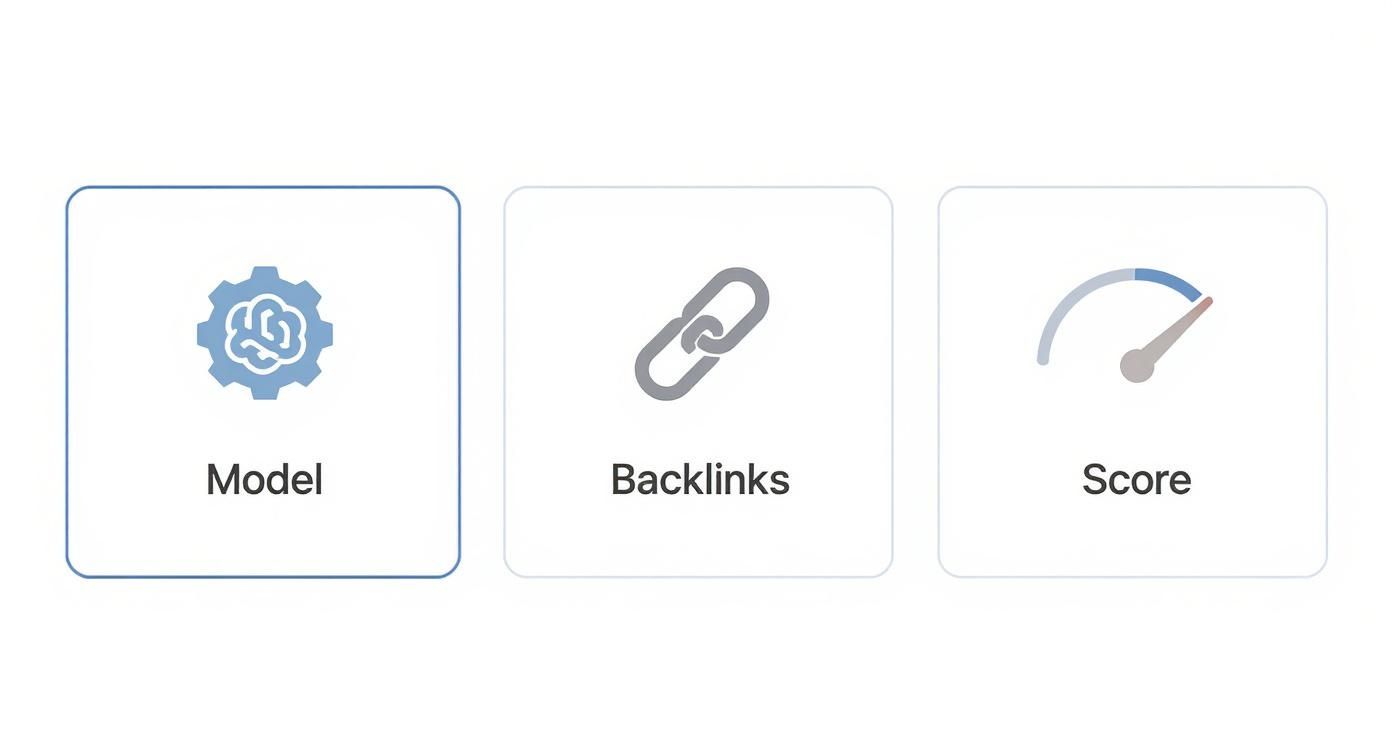
As you can see, DA isn't just a simple link count; it's the output of a machine-learning model that's trying to predict ranking potential based on a whole lot of backlink data.
H3: Different Link Indexes, Different Results
The biggest reason DA and DR scores don't match up comes down to their link indexes—the massive, private libraries of the internet that each company builds and maintains. Moz and Ahrefs both have armies of web crawlers mapping the web, but they don't see the exact same map. Ahrefs has a reputation for having a larger, more frequently updated index, which often gives it a slight edge in spotting new links faster.
This is why Ahrefs' DR can feel a bit more responsive. You might wrap up a successful link-building campaign and see your DR jump a few points fairly quickly, while your DA might take a little longer to catch up. That's not a knock on Moz; its update cycle is just designed to be more stable and less reactive to every little fluctuation.
Think of it like this: DR is the live stock ticker, bouncing around with every trade. DA is more like a quarterly earnings report—it smooths out the daily noise to give you a more stable, long-term view of performance.
H3: The Great Debate: Quantity vs. Quality
Another fundamental difference is what each tool values most in a link. Ahrefs’ DR is heavily influenced by the sheer quantity of unique websites (linking root domains) pointing to a site. While the strength of those linking sites matters, the algorithm is fundamentally wired to reward link popularity. Get more unique domains to link to you, and your DR will almost certainly go up.
Moz, on the other hand, especially after its big DA 2.0 update, leans much more into link quality. It uses machine learning to look at things like spam signals and, most importantly, the actual correlation with Google rankings. It’s less concerned with "How many sites link here?" and more focused on answering, "How likely is this domain to actually rank for its keywords?"
This means DA tends to be tougher to game with low-quality links. You might be able to pump up a site's DR with a blast of cheap, spammy links, but you'll have a much harder time fooling the DA algorithm unless those links come from genuinely authoritative places.
H3: How They Handle "Nofollow" Links
The way each platform treats rel="nofollow" links also tells you a lot about their philosophies. For a long time, Ahrefs took a hard line: nofollow links were completely ignored in its DR calculation. If a link had that attribute, it passed no "link juice" and, therefore, didn't count. Simple as that.
Moz has a more modern take. Ever since Google announced that it treats "nofollow" as more of a "hint" than a strict command, Moz's algorithm has adapted. It might give some credit to nofollow links, especially if they're coming from monster sites like Wikipedia or a major news publication. This lines up better with reality, where even a nofollow link can drive real traffic and build brand awareness.
Ultimately, the smartest approach is to look at both metrics. They give you a more rounded view of a domain's health.
I find it's helpful to lay it all out side-by-side to really see the differences.
Moz Domain Authority (DA) vs. Ahrefs Domain Rating (DR)
| Feature | Moz Domain Authority (DA) | Ahrefs Domain Rating (DR) |
|---|---|---|
| Primary Focus | Link Quality & Ranking Prediction: Predicts how well a site will rank in search results. | Link Popularity & Quantity: Measures the strength of a site's backlink profile based on unique linking domains. |
| Link Index | Large and established, but updates can be less frequent than Ahrefs. | Known for being one of the largest and fastest-updating link indexes in the industry. |
| Calculation | A machine-learning model that analyzes multiple factors, including link quality and spam signals. | A logarithmic calculation heavily weighted by the number and DR of linking root domains. |
| "Nofollow" Links | May pass some value, reflecting Google's "hint" model. | Traditionally ignores them completely; they do not contribute to the DR score. |
| Volatility | More stable and less prone to rapid fluctuations. | More reactive; can change quickly in response to new link acquisition or loss. |
| Best Use Case | Assessing a domain's overall ranking potential and resilience to low-quality link schemes. | Getting a quick, real-time pulse on link-building momentum and overall link volume. |
Using DR gives you that quick-glance check on your link-building velocity, while DA provides a more stable, quality-focused assessment of a site's true potential in the SERPs. When you're evaluating domains on NameSnag, using both gives you the full story.
Using Moz DA To Find High-Value Domains

Alright, let's shift from theory to action. Understanding what Domain Authority is and how it’s calculated is great, but the real fun begins when you use it as a secret weapon in your domain-hunting adventures. A solid DA score can be the difference between starting from scratch and hitting the ground running.
Imagine you want to open a new restaurant. You could pick an empty lot and build from the ground up—a project that takes a ton of time and money. Or, you could take over a location that was already a beloved local spot, complete with a great reputation and a line of regulars.
Finding an expired domain with established DA is exactly like that. You’re inheriting authority that someone else spent years building, giving you a massive head start in the SEO race.
Your Game Plan for Finding SEO Gold
So, how do you put this into practice? On a platform like NameSnag, this process is incredibly simple. You can filter the vast sea of domains to find the ones that already have the SEO muscle you need. It’s all about setting your standards and letting the tools do the heavy lifting.
Here’s a simple, step-by-step strategy to get started:
- Set Your Minimum DA: First, decide on a baseline Domain Authority score. For a new project, a DA of 20+ is a fantastic starting point. It's high enough to have some real ranking potential but not so high that the domains are impossible to find or afford.
- Filter and Find: Head over to the domain lists on NameSnag. You can hunt for domains that were just dropped and are ready to be registered right now by checking out the Available domains. Or, if you want to get a jump on the competition, browse the Expiring domains to see what’s about to drop. Use the filters to show only domains that meet your minimum DA.
- Adjust Your Timeline: Both lists have time filters like Today, 3 Days, or even 30 Days. This lets you narrow your search from a massive pool to a manageable list of fresh opportunities.
This filtering process alone will save you countless hours of manual checking. You’re no longer sifting through digital junk; you’re browsing a curated list of domains with proven authority.
Look Beyond the Score: Vet the Backlinks
Finding a domain with a good DA score is step one. Step two is making sure that authority is squeaky clean. A high score is great, but not if it was built on a foundation of spammy, irrelevant, or downright toxic backlinks. You have to peek under the hood and inspect the backlink profile.
The real value of a high-DA expired domain isn't just the number—it's the story behind the links that created it. A clean, relevant backlink profile is the true prize.
Think of it like buying a used car. A shiny exterior is nice, but you absolutely need to check the engine and the service history. In the domain world, the "service history" is its backlink profile. You’re looking for links from reputable, relevant websites in a similar niche. A domain about gardening with links from university agricultural departments? That's gold. A domain about gardening with links from online casinos? That’s a huge red flag.
The power behind Moz's DA comes from its gigantic link index, which contains over 45.5 trillion links across 8.7 trillion URLs and 1 billion domains. This massive dataset allows the machine-learning model to spot patterns and assign authority with incredible accuracy. You can learn more about the scale of this operation by checking out Moz's detailed domain analysis tools.
So, how do you properly vet these links? You need to dig in and look for quality signals. Are the links from real websites? Is the anchor text natural? Is the domain's history free of penalties? For a complete walkthrough, check out our guide on how to check backlink quality to ensure you're making a safe and powerful investment. This extra diligence is what turns a good find into a game-changing asset.
Common Myths And Misconceptions About DA
Domain Authority is one of the most name-dropped metrics in SEO, but its popularity has also stirred up a lot of confusion. It’s an incredibly helpful tool, but only if you understand what it’s really telling you.
Let's clear the air and bust some of the biggest myths floating around.
The absolute biggest misconception is that DA is a direct Google ranking factor. It's not. Google doesn't peek at your DA score to decide where your site should land in the search results.
Instead, think of DA as a predictor of your ability to rank. Moz built it to correlate with what they see in Google's results, making it a powerful forecast of your site's competitive strength. A high DA score is a sign you're doing the right things, but it’s those things—like earning quality backlinks—that Google actually cares about.
Myth 1: DA Is A Static Score
Another common misunderstanding is treating DA like a fixed grade on a report card. People often panic when their score drops a few points, assuming they did something terribly wrong. But Domain Authority is a living, breathing metric that’s entirely comparative.
Your score exists only in relation to every other website in Moz’s massive index. That means your DA can change even if you haven't touched your website in weeks.
Think of it like a leaderboard in a video game. You might be holding the #10 spot with 50,000 points. If other players suddenly start scoring 60,000 points, you’ll get pushed down the rankings even though your own score hasn't budged.
DA works the same way. If a few big competitors go on a link-building tear and scoop up tons of high-quality links, the entire "curve" shifts. This can cause your DA to dip, not because your site got weaker, but because the competition simply got stronger.
Myth 2: You Can Boost Your DA Score In A Week
In a world of instant gratification, everyone wants fast results. I get it. But building real, lasting authority is a marathon, not a sprint. The idea that you can meaningfully boost your DA in a week is pure fantasy.
Genuine authority is built on a foundation of trust, and trust takes time. It comes from consistently creating valuable content that attracts high-quality, relevant backlinks from other reputable sites. There are no shortcuts here. Any service promising to skyrocket your DA overnight is almost certainly using spammy tactics that will hurt you in the long run.
Focus on a steady, sustainable strategy instead:
- Create link-worthy content: Think original research, in-depth guides, or unique resources that people in your industry will genuinely want to reference.
- Build real relationships: Do the hard work of genuine outreach to connect with other site owners, editors, and journalists.
- Be patient: Authority is earned over months and years, not days.
Myth 3: Old DA Data Is Always Relevant
When you're digging through domains on NameSnag, you might stumble on one with a history of a high DA. While that can be a great starting point, you have to focus on recent trends, not ancient history. A domain's authority can fade quickly if it's not actively maintained.
Besides, historical DA data has its limits. Moz only stores about a year of historical DA data in its public tools, and scores are recalculated every few weeks. This is especially important because of a major algorithm update back in 2019, which makes any DA score from before then not really comparable to today's metric. If you want to dive deeper, you can explore the specifics of how historical Domain Authority is tracked and updated.
When you're evaluating a domain, always prioritize its current DA and recent backlink activity. That gives you a much more accurate picture of its present-day value and potential. By understanding what DA can and cannot do, you can set realistic goals and build a much smarter, more effective strategy.
Frequently Asked Questions About Moz DA
We’ve covered a lot of ground, from the nuts and bolts of Moz's Domain Authority to how you can use it to spot promising domains. Still, a few common questions always seem to pop up.
Think of this last section as a quick reference guide. Here are the clear, straight-to-the-point answers you’ll need.
How Can I Check Moz Domain Authority For Free?
Good news: you don't need to pay for a subscription to get a quick DA check. Moz gives everyone access to a pretty powerful free tool called Link Explorer.
It’s dead simple to use:
- Head over to the Moz Link Explorer.
- Pop the full URL of the domain you're curious about into the search bar.
- Hit "Analyze," and you'll see the DA score right there, along with other useful tidbits like Linking Domains and Spam Score.
You'll also find a ton of third-party websites offering free DA checkers. Most of them just plug into Moz's data, giving you another quick way to check a score on the fly without even needing a Moz account.
What Is Considered A Good Domain Authority Score?
Ah, the million-dollar question. The honest answer? It's completely relative. A "good" DA score doesn't exist in a bubble. Its real value comes from how it stacks up against the competition in your specific niche.
A local bakery might be crushing their local search results with a DA of 25. In that pond, they're a big fish. But a global e-commerce brand could be struggling with a DA of 65 because all its main rivals are sitting in the 70s and 80s.
The only way to define a "good" DA is to benchmark it against your direct competitors. A good score is one that gets you on the same playing field—or even gives you a slight edge—over the sites already ranking for your target keywords.
Forget about chasing some arbitrary number like 50 or 60. Instead, go look at the top-ranking sites in your industry. Your target DA is whatever score is competitive within that group.
How Can I Improve My Website's Domain Authority?
Improving Domain Authority is a marathon, not a sprint. And if there's one thing to focus on, it's this: earning high-quality backlinks. Since DA is, at its core, a reflection of your backlink profile, that's where you need to put in the work.
Here are a few real, ethical ways to do it:
- Create Killer Content: Make stuff that's so genuinely useful, original, or insightful that other authoritative sites in your field want to link to it. Think original research, exhaustive guides, or unique free tools.
- Do Smart Outreach: Don't just blast out emails. Build real relationships with editors, journalists, and other site owners. Lead by offering them value, not by asking for a link.
- Embrace Digital PR: Run campaigns that are newsworthy enough to get media coverage. A single link from a major news outlet can move the needle more than dozens of smaller links.
Just remember, real authority isn't built overnight. It's the result of consistent effort and an unwavering focus on quality.
Why Did My Domain Authority Score Go Down?
Seeing your DA score drop can be a little jarring, but it doesn't automatically mean your site is in trouble. DA is a comparative metric, so your score can wiggle around for reasons that have nothing to do with you.
Here are the usual suspects when a DA score takes a dip:
- Your Competitors Leveled Up: If other sites in your space went on a link-building spree and landed some amazing backlinks, they essentially raised the high score for everyone. Your score might drop simply because the curve got steeper.
- Moz Updated Its Index: Moz is constantly crawling the web. When they refresh their massive link index, they might find new links, discount old ones, or just tweak their algorithm. These updates can cause scores across the entire internet to shift.
- You Lost Some Good Backlinks: Of course, the drop could be because your site actually lost a few of its most powerful backlinks. It's a good time to run a backlink audit to see if any heavy-hitters have disappeared and if you can get them back.
The key is not to panic over small dips. Focus on the long-term trend and keep doing the work to build a healthy, diverse backlink profile.
Ready to stop reading and start finding your next high-authority domain? NameSnag is built for this. Forget wasting hours doing manual checks—you can filter thousands of domains with proven SEO value in an instant. Whether you’re hunting for domains that just dropped or getting a jump on ones about to expire, we have what you need.
- Find powerful, SEO-ready domains you can register immediately on our Available domains page.
- Beat the competition to high-value domains dropping soon on our Expiring domains page.
Find Your Perfect Domain
Get access to thousands of high-value expired domains with our AI-powered search.
Start Free Trial