
Doing a background check on a domain name is the secret weapon that separates successful SEOs and domain investors from everyone else. It's about peeling back the layers to see a domain's past owners, what kind of content it hosted, and what its reputation looks like. This isn't just trivia; it's how you find aged domains that give you an immediate, and often massive, competitive advantage.
Why a Domain's Past Is Your Competitive Edge
Ever get that sinking feeling that every decent domain name is already taken? The good news is, the best opportunities often aren't brand new domains. They're aged domains with powerful histories, just waiting for a savvy pro like you to see their potential.
Think of it like buying a classic car. A new car starts with zero mileage and no story. But a well-maintained classic? It comes with character, a history, and a certain prestige you just can't manufacture overnight. An aged domain with a clean, authoritative history works the same way. It might already have backlinks from trusted sites, established domain authority, and even some leftover traffic trickling in. This isn't a shot in the dark; it's about using data to find a domain that can fast-track your rankings, become a valuable brand, or be flipped for a tidy profit.
The Untapped Market of Expired Domains
The digital real estate market is always in motion. There's a mind-boggling 362.3 million registered domain names out there, and a huge chunk of them expire every single day. While legacy extensions like .com and .net have seen registrations dip a bit (creating a flood of expired domains), newer extensions surged by 17.4%. This churn creates a massive pool of opportunities for anyone who knows what to look for. If you're curious about these trends, OpenProvider has some great data on the state of the domain market.
Once you learn to see these expiring domains as untapped assets instead of risks, you've changed the game entirely. You're not starting from scratch; you're building on a foundation someone else already paid to lay.
A domain's history is its digital DNA. It tells you whether you're acquiring a thoroughbred racehorse ready to win or a project that will drain your resources. Understanding this story is the difference between a smart investment and a costly mistake.
Finding Your Next Digital Asset
The trick is knowing where to look and, more importantly, what to look for. Sometimes you're hunting for a domain that just dropped and is ready for immediate registration. These are perfect for getting a new project off the ground today. Other times, you want to get ahead of the pack by spotting domains that are about to expire but haven't hit the open market yet.
This is where you get strategic:
- Find Available domains: These are domains that were just released and can be registered instantly at any registrar. They offer a quick way to acquire an aged asset without the wait. Check out the ones that dropped Today or expand your search to the last 7 Days to see what's out there.
- Find Expiring domains: These are domains in a grace period. The original owner might not renew, giving you a chance to snag them the moment they become available. You can scout domains set to drop in the next 3 days to get a jump on the competition.
A proper domain history search is the filter you need to sift through the millions of options and find the handful that are actually worth your time. It’s the first, most critical step in turning someone else's forgotten digital property into your next big success.
Your Digital Archaeologist's Toolkit
Alright, let's roll up our sleeves and dig into a domain's past. Think of yourself as a digital archaeologist. To really uncover the story buried within a domain, you need the right set of tools. It's never about using just one; the real magic happens when you combine their findings to build a complete, undeniable picture of a domain's history.
Your first and most crucial stop is the Wayback Machine. This is your time machine, plain and simple. It takes snapshots of websites over the years, showing you exactly what the domain was used for. Was it a respected industry blog packed with quality content, or was it a sketchy link farm plastered with spam? You can learn so much just from its visual history.
This is a great starting point, but it's only one piece of the puzzle. You'll need more to get the full story.
Peeking Behind the Curtain with WHOIS History
While the Wayback Machine shows you what a site looked like, WHOIS history tells you who owned it. Think of this as the domain's paper trail. A stable ownership history, where a domain was held by the same person or company for years, is a fantastic sign. It suggests consistency and a long-term project.
On the other hand, a domain that has changed hands every six months? That's a massive red flag. Frequent, short-term owners often mean the domain was used for churn-and-burn SEO tactics, likely getting penalized and then quickly dropped. These are the domains you want to avoid at all costs.
And there’s a mind-boggling amount of data to sift through. Historical databases track the lifecycles of over 897 million domains across major TLDs going all the way back to 2000. Modern WHOIS archives contain a whopping 25.5 billion records just from 2010 onward, capturing every single ownership shift and registrar change.
Gauging SEO Power with Backlink Analysis
The true SEO horsepower of an aged domain is in its backlink profile. Backlinks are essentially votes of confidence from other websites, and they are a primary driver of search engine rankings. This is where tools like Ahrefs, Majestic, and Moz are indispensable. They act like an X-ray, letting you see the quality and quantity of links pointing to the domain.
What you're hunting for is a profile with links from relevant, authoritative sites in your niche. A handful of links from trusted sources is infinitely more valuable than thousands of links from spammy, irrelevant websites. This analysis is where you separate the domains with real authority from those with artificially inflated metrics.
And you don't have to stop at traditional records. Modern tools like AI Search Tracker Tools can add another layer to your digital archaeology, offering insights into a domain's past performance and current trends.
This handy visual shows how a domain's history and authority directly contribute to its value as a digital asset.
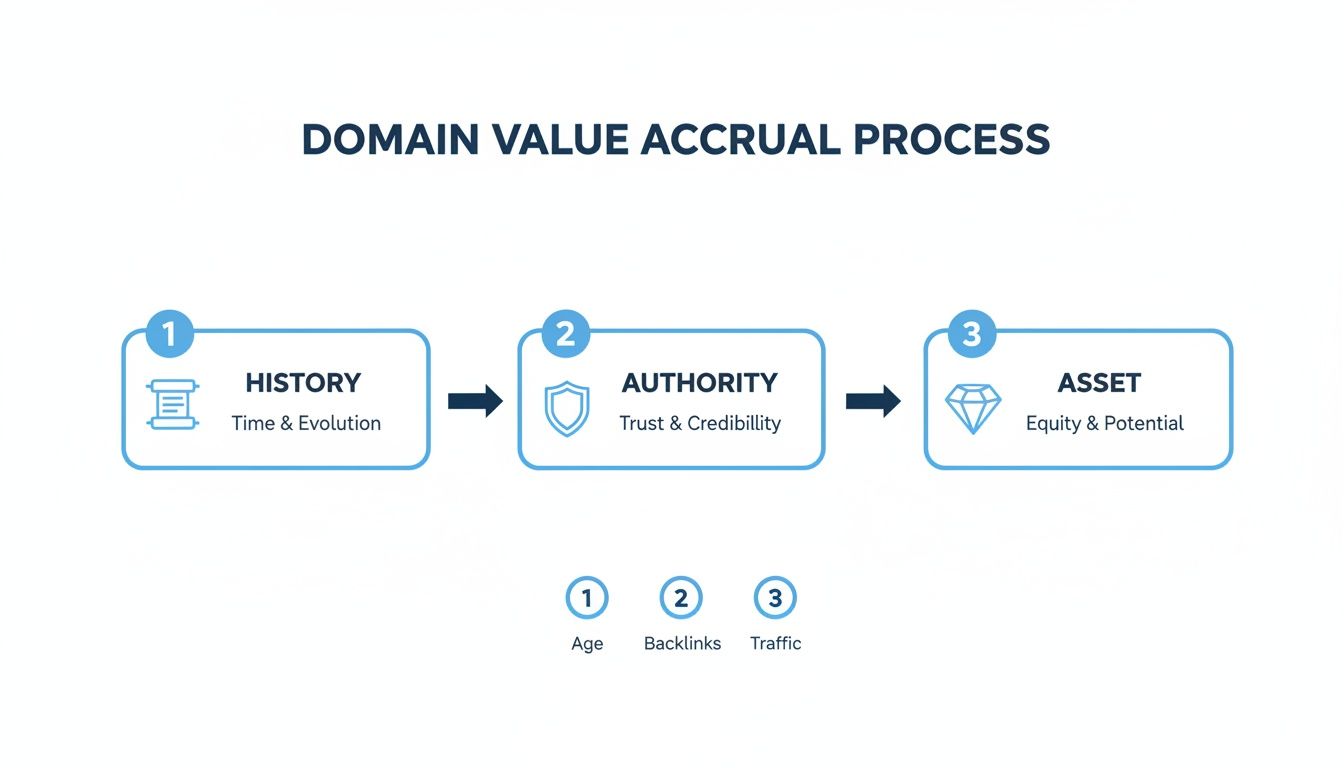
As you can see, a solid history builds authority, which is what transforms a simple domain name into a valuable asset.
When you put all of these tools together, you get a 360-degree view. You see what the site looked like, who owned it, and how respected it was by other sites on the web. This multi-faceted approach turns you into a digital detective, equipped to confidently separate the treasure from the trash. For a deeper dive into one of the most essential tools in your kit, check out our guide on using the Archive.org Wayback Machine for domain research.
How to Spot a Toxic Domain History
Not every aged domain is a winner. Far from it. Some are digital gold, ready to give you an SEO boost right out of the gate. But others? They're digital landmines, cleverly disguised by shiny but ultimately meaningless metrics.
Learning to tell the difference is probably the most critical skill in this game. This is your field guide to sniffing out those toxic domains before they torch your time, money, and sanity.
Think of yourself as a home inspector for a digital property. You're not just admiring the fresh coat of paint—like a high Domain Authority score. You're getting into the crawlspace and checking the foundation for cracks. A domain with a toxic history can drag down a new project with problems that are next to impossible to fix.
The Spammy Backlink Profile
The biggest, brightest red flag you'll ever see is a spammy backlink profile. This is the calling card of a domain that was used and abused in some "black hat" SEO scheme, trying to manipulate search rankings with junk links.
If you see a domain with thousands of links but they all look sketchy, run. Fast.
Here's what to look for:
- Irrelevant Niches: A domain about organic dog food with hundreds of links from online casinos, payday loan sites, or weird foreign-language forums? Massive red flag.
- PBNs (Private Blog Networks): These are networks of throwaway websites built for one reason: to pass link equity. They usually have thin content, generic themes, and an unnatural number of outbound links. Spotting them is an art, but they're a dead giveaway of manipulation.
- Over-Optimized Anchor Text: If every single backlink uses the exact same keyword—like "best running shoes for men"—it’s a clear sign of spam that Google almost certainly penalized years ago.
A healthy backlink profile looks natural. It looks earned. You should see a mix of branded anchor text (the site's name), naked URL links, and a variety of relevant keywords. Anything that looks too perfect is almost certainly manufactured.
If you're not sure what you're looking at, you're not alone. Backlink analysis is a deep rabbit hole, which is why a good domain spam score checker can be a lifesaver.
Ghosts of Content Past
The Wayback Machine is your absolute best friend for digging up a domain's shady past. What the site used to be matters. A lot.
A quick trip back in time might reveal that the domain you're eyeing was once a hub for adult content, illegal file sharing, or a sketchy online pharmacy.
Even if that content is long gone, the digital residue remains. Lingering backlinks from those unsavory corners of the web can permanently tarnish a domain's reputation, making it toxic for any legit project. It's like finding out your dream house was a former meth lab—no amount of cleaning will ever make it feel right.
Suspicious Ownership and Drop History
Here's another big one: a domain that has changed hands more times than a hot potato. A quick WHOIS history check can reveal the ownership timeline.
If a domain was registered and dropped multiple times over just a few years, it’s a pretty strong indicator that previous owners spammed it, got it penalized, and then dumped it.
Stable, long-term ownership is a green flag. It suggests the domain was part of a legitimate, long-running project. Frequent drops, on the other hand, just scream "problem." Why would someone let a valuable asset expire unless it was broken?
The Misleading Metrics Trap
Finally, do not get suckered in by a high Domain Authority (DA) or Domain Rating (DR). While these metrics from Moz and Ahrefs can be useful starting points, they are ridiculously easy to manipulate.
Spammers are experts at inflating these numbers. They'll blast a domain with a high volume of junk links from high-authority (but irrelevant or spammy) sites just to make a worthless domain look valuable to an unsuspecting buyer.
A domain might flash a DA of 50, but if that score is built on a foundation of spammy PBN links, it’s not just worthless—it’s a liability. You have to look past the surface-level numbers and dig into the actual backlink profile and content history. The real value is in the quality, not the quantity.
Alright, you've learned how to sidestep the digital landmines. Now for the fun part: uncovering the hidden gems.
Spotting a toxic domain is all about avoiding the bad stuff. Finding a high-value one is about recognizing the positive signals that just scream potential. This is where you switch from being a cautious inspector to a savvy treasure hunter.
A Backlink Profile That Speaks Volumes
It all starts with backlinks. Think of them as recommendations, and you want recommendations from the most respected players in the game.
A link from a trusted, authoritative source like a university (.edu) or a government agency (.gov) is the absolute gold standard. These links are incredibly difficult to get and signal immense trust to search engines. Finding a domain with even a few of these gives it a serious SEO head start.

Honestly, a handful of these high-quality links are worth more than thousands of spammy ones. When your domain history search turns up a profile rich with these kinds of authoritative links, you know you’ve found something special.
Relevant History Trumps Age Every Time
People love to talk about domain age as a key metric, but let's be real: age by itself is useless. A 15-year-old domain that just sat parked or was used for some spammy affiliate site has no real value.
The magic happens when that age is combined with a consistent, relevant history.
Imagine finding a 10-year-old domain that was once a respected blog in your exact niche. It already has topical authority, relevant backlinks, and a history that lines up perfectly with what you want to do. That’s an incredible find. You're not just buying a name; you're acquiring a decade of established credibility.
A quick spin through the Wayback Machine will tell you its story. If the old content was high-quality and the topic has been consistent over the years, you've struck gold. This is the kind of domain that can rank new content faster and give you a massive leg up from day one.
Don't Forget Brandability—It Matters More Than You Think
Metrics like Domain Authority are important, but they don't tell the whole story. The best domains blend strong SEO signals with fantastic brandability. After all, your domain name is the foundation of your entire online identity.
Just ask yourself a few simple questions:
- Is it memorable? Does it stick in your head?
- Is it easy to spell and say? Anything complicated is a killer for word-of-mouth.
- Is it short and snappy? Shorter is almost always better.
- Does it sound trustworthy? The name itself should inspire confidence.
A name like ProGardenTips.com feels like a brand. Best-Gardening-Tips-For-2024.net feels like a keyword string. A truly valuable domain is one you can actually build a business around. Recognizing these qualities helps you understand how to value domain names beyond just the raw SEO metrics.
A great domain is the perfect marriage of art and science. It has the SEO metrics to perform well in search and the brandability to capture the hearts and minds of your audience. Don't sacrifice one for the other.
How to Automate Your Search with NameSnag
Let's be honest, manually digging through a domain's history is a soul-crushing grind. You're juggling a dozen tabs—the Wayback Machine, WHOIS lookups, Moz, Majestic—for every single domain. It’s slow, it's tedious, and it’s a surefire way to burn out before you find anything good.
This is where you need to work smarter, not harder. A dedicated platform like NameSnag completely changes the game by automating the entire domain history search. It pulls all that critical data together into a single, clean dashboard so you can stop being a data-entry clerk and start being a strategist.
Instead of spending hours piecing together clues from different sources, you get an instant, holistic view of a domain's past life. It cuts out about 90% of the grunt work, freeing you up to focus on what actually matters: spotting real opportunities.
From Hours of Research to a Single Click
The manual process is just brutal. You spot a promising domain, and the multi-tool marathon begins. First, you check its age. Then you jump over to the Wayback Machine to see what it used to be. Next, you open another tab for Ahrefs or Moz to check its authority and backlink profile. And then it’s off to yet another tool to check for spam signals.
You have to repeat this for every single domain you consider. It’s not just inefficient; it’s unsustainable if you're serious about finding high-value domains at any kind of scale.
NameSnag does all of this for you. By analyzing over 170,000 domains daily, it handles the heavy lifting behind the scenes. All those disparate metrics—Domain Authority, Trust Flow, referring domains, age, brandability—get rolled into one simple, powerful metric: the SnagScore. It’s an at-a-glance quality score that lets you instantly filter out the junk and zero in on the gems.
Trying to decide between a manual slog and an automated workflow? Here’s a quick look at what that really means for your time.
Manual Domain Research vs The NameSnag Workflow
| Research Task | Manual Process (Time & Tools) | NameSnag Process (Time & Tools) |
|---|---|---|
| Initial Screening | 15-20 min/domain (Registrars, Expired Domain Lists) |
< 1 min (NameSnag Dashboard & Filters) |
| History Check | 10-15 min/domain (Wayback Machine, Google Search) |
Instant (Included in SnagScore Analysis) |
| SEO Metrics | 10 min/domain (Moz, Ahrefs, Majestic) |
Instant (All metrics in one view) |
| Spam/Penalty Check | 5-10 min/domain (Google Search Console, various spam checkers) |
Instant (Spam-free verification badge) |
| Total Time per 10 Domains | ~6-8 hours | ~10 minutes |
As you can see, the difference is staggering. One is a full day of tedious work; the other is a coffee break. Automation doesn't just save time—it makes scalable domain hunting possible.
Finding Domains You Can Register Today
One of the best parts of automating your search is finding domains that are ready for the taking right now. These are domains that just finished their expiration cycle and are available for immediate, standard-fee registration at any registrar. No auctions, no backorders, no fuss.
A simple filter inside NameSnag shows you a list of these freshly dropped domains, complete with all their key metrics laid out for you. You can find Available domains that dropped today, in the last 3 days, 7 days, or even longer, giving you a massive pool of opportunities to pick from.
You can immediately see the SnagScore, age, and other critical data points, which means you can make quick, informed decisions without ever leaving the platform.
Get Ahead of the Competition with Expiring Domains
While grabbing available domains is great for quick projects, the real strategic advantage often comes from spotting opportunities before they hit the open market. These are expiring domains—domains that are in their grace period but haven't officially dropped yet.
This is where you can play chess while everyone else is playing checkers. By identifying valuable expiring domains early, you can:
- Prepare your strategy. You get a crucial head start to do deeper research and decide if you want to backorder the domain or try to acquire it the moment it drops.
- Avoid the rush. High-value dropped domains are often snapped up by automated bots within seconds. Watching the expiring list lets you get ahead of that frenzy.
- Discover hidden gems. Many of the best domains never even make it to the "available" lists because savvy investors snag them during the expiration process.
Switching between these filters is effortless. You can check for Expiring domains dropping soon and tailor your search to whatever you need, whether it's a domain for a project today or a watchlist of future assets. When you're automating any kind of domain research, especially at scale, it's critical to know how to scrape websites without getting blocked to ensure your tools can operate without a hitch.
Automation isn't about being lazy; it's about being efficient. It frees you from the mundane task of data collection so you can excel at the creative task of opportunity recognition.
By using a platform that centralizes all this information, you transform your workflow from a reactive, time-sucking chore into a proactive, strategic hunt for the best digital assets on the web.
Common Questions About a Domain's Past
Once you start digging into a domain's history, questions pop up left and right. It really does feel like you're a detective, and every new clue just leads to more questions. Let's walk through some of the most common ones I hear from people getting into this.
Think of it like buying a house. You wouldn't dream of signing the papers without a proper inspection, right? A domain history search is that inspection. These questions are what you'd be asking the inspector to make sure you're not buying a money pit.
Is an Older Domain Always Better?
This is a classic. The short answer? No, not necessarily.
While a domain's age can be a fantastic signal for trust and authority in Google's eyes, what really matters is the quality of its history.
Picture two domains. One is 10 years old, but it spent most of its life as a spammy, auto-generated blog filled with garbage content. The other is only 3 years old but was once a respected, well-cited resource in your niche. I'd take the younger domain every single time. Age is just one data point; you always have to verify what was on the site and who was linking to it.
What If a Good Domain Has Some Bad Backlinks?
Pretty much any aged domain you find will have a few sketchy links hiding in its past—that’s just the nature of the internet. Don't panic. The key here is the ratio. If the backlink profile is overwhelmingly strong and you just have a small percentage of low-quality links, it's often a situation you can manage.
You can clean up these minor messes using Google's Disavow Tool once you own the domain. But if the domain is absolutely drowning in toxic links from manipulative PBNs or completely irrelevant niches, the recovery effort is almost never worth the risk or the time.
A few weeds in a beautiful garden can be pulled. A garden that's nothing but weeds needs to be bulldozed. Know the difference before you buy.
Expiring vs. Available Domains: What's the Difference?
This one is crucial and will shape your whole strategy. An expiring domain is one that's past its renewal date but is still in a "grace period," which usually lasts 30-40 days. The original owner can still swoop in and reclaim it, so you can't just register it. This is your chance to find gems, watch them, and plan to grab them the second they drop.
An available domain, on the other hand, has made it through all the grace periods and has been released back into the wild. It’s fair game. You can register it immediately at any standard registrar. We make it easy to hunt for both—you can find Available domains to register today or scout out promising Expiring domains before anyone else gets to them.
Ready to stop guessing and start finding high-value domains with clean histories? NameSnag does the heavy lifting for you, analyzing over 170,000 domains daily to uncover the best opportunities. Find your next digital asset on NameSnag today.
Find Your Perfect Domain
Get access to thousands of high-value expired domains with our AI-powered search.
Start Free Trial