
Let's be real: buying an expired domain sounds a bit like digital grave-robbing, but it's actually one of the smartest SEO strategies out there. At its core, you're finding domains someone else let go, checking them for hidden treasure (like backlinks and authority), and then snagging them through auctions, backorder services, or sometimes just by registering them like any other domain.
It’s a strategy that gives you a massive, almost unfair head start. You get to build on top of a domain's existing digital footprint instead of starting from a blank slate. Ready to learn the ropes?
Unlocking the Power of Digital Real Estate

Here's the best way I can explain it: buying an expired domain is like purchasing a storefront in a busy part of town. The address is already known, roads lead right to it, and people have been there before. Registering a brand-new domain? That’s like buying an empty plot of land out in the middle of nowhere and having to build everything—the building, the roads, everything—from scratch.
An expired domain has a history, and if you find the right one, it's a valuable history. It probably has a decent backlink profile, some established domain authority, and maybe even a trickle of leftover traffic from its past life.
This pre-built "link equity" is a collection of trust signals that search engines like Google already recognize. When you acquire the domain, you inherit that authority.
The Unfair Advantage in SEO
Starting a new website from zero is a slow, painful grind. It takes forever to build authority, earn your first real backlinks, and convince search engines that your site is trustworthy. An expired domain lets you skip a huge chunk of that initial struggle.
Instead of waiting months or even years to see any real movement, you can put the domain's history to work in a few different ways:
- Boost an Existing Site: 301 redirect the expired domain's authority over to your main website. It's one of the fastest ways to get an SEO lift.
- Build a New Authority Site: Launch your next project on a domain that already has a solid foundation. You'll find it ranks much faster.
- Create a Private Blog Network (PBN): You can develop a network of authoritative sites to support your primary online projects.
This isn't some secret trick; it's a well-established strategy. The domain aftermarket is exploding, valued at around USD 0.64 billion and expected to climb to USD 1.17 billion by 2033. This growth is driven by smart marketers and business owners who get just how valuable a domain with a pre-existing reputation can be.
The core idea is brutally simple: Why build authority from the ground up when you can just buy it? A clean, aged domain with relevant backlinks is one of the most powerful tools you can have in your SEO arsenal.
Expired Domain vs. New Domain at a Glance
Let's break down the immediate advantages of choosing an expired domain over starting from a clean slate. The difference is pretty stark once you see it laid out.
| Attribute | Expired Domain | New Domain |
|---|---|---|
| SEO Authority | Inherits existing authority (DA/DR) | Starts at zero |
| Backlinks | Comes with an established backlink profile | Has to earn every link from scratch |
| Indexing Speed | Often indexed and ranking faster | Can take weeks or months to get indexed |
| Age | Has an established history with search engines | No history, needs to build trust over time |
| Content Potential | Can be used for 301 redirects or new sites | Limited to new site builds only |
Understanding these differences is crucial. It’s why learning how to buy expired domains is such a game-changing skill for anyone serious about SEO. One path gives you a running start, while the other begins at a dead stop. If you want to go deeper on this, our guide on using domains for SEO breaks it down even further.
To really get a handle on the digital real estate game and explore further insights on domain acquisition strategies, there are some great resources out there that can take your knowledge to the next level.
Where to Find High-Value Expired Domains
Alright, you're sold on the idea of tapping into a domain's past glory. The big question is, where do you actually find these digital treasures? It’s a bit like treasure hunting; you can wander around with a shovel and hope for the best, or you can use a map that points you right to the gold.
Knowing where to look is half the battle. The playing field has a few different arenas, and your strategy will depend on your budget, your goals, and how much competition you're willing to stomach.
The Classic Hunting Grounds
For years, the go-to spots for expired domains were auctions and backorder services. These are the traditional marketplaces where expiring domains with serious demand often land.
Domain Auctions: Think eBay, but for domains. When a valuable domain expires, registrars often toss it into an auction. You bid against other interested buyers, and the highest bidder wins. This is where you'll find the heavy hitters with monster backlink profiles, but you’d better be ready for a bidding war.
Backorder Services: This is like calling "dibs." You place a backorder on a domain that’s about to drop. If the current owner doesn’t renew, the service tries to snatch it for you the very second it becomes available. If you're the only one who backordered it, it's all yours. If there are multiple bidders, it usually goes to a private auction between you.
These methods work, no doubt. But they often require a ton of patience and a bigger budget. The competition is fierce, and it's shockingly easy to get caught up in the excitement and end up overpaying.
A Smarter Way to Discover Domains
While auctions are great for the high-profile domains, there's a whole world of valuable domains that slip through the cracks every single day. This is where modern discovery platforms completely change the game, letting you find diamonds in the rough without the high-stakes bidding.
This approach splits the hunt into two main categories, each with its own strategic edge.
Pro Tip: Your ideal hunting ground depends entirely on your goal. An agency needing a powerhouse domain for a client's SEO might brave the auctions. But a blogger just looking for a cool, brandable name for a new project can find incredible value by catching domains right as they become available.
The key is matching your discovery method to your specific needs. This is where a focused approach saves you a ton of time and cash. For a deeper dive into the tools that can make this process a breeze, you can check out our detailed guide on using an expired domain finder.
Snagging Instantly Available Domains
This is my personal favorite tactic because it's the most straightforward and cost-effective method out there. These are domains that have gone through the entire expiration lifecycle—the grace period, the redemption period, the auction (if there was one)—and were never claimed. They have officially "dropped" and are now available for anyone to register at the standard price.
No bidding. No backorders. You just find one you like and register it at your favorite registrar like any other new domain.
Imagine finding a domain with a handful of quality backlinks and a squeaky-clean history, just sitting there waiting for you to register it for about $12. It happens way more often than you'd think. Using a tool like NameSnag, you can filter for these Available domains that dropped today, in the last 3 days, or even over the past month.
Getting a Head Start with Expiring Domains
If you want to be a bit more proactive, you can hunt for Expiring domains. These are domains that have expired but are still in their grace or redemption period. The original owner can still renew them, but if they don't, these domains will soon be up for grabs.
This approach gives you a massive head start. You can spot a powerful domain before it ever hits a public auction or the open market. By identifying these gems early, you can plan your move, decide whether to place a backorder, or just watch and wait for it to drop. It’s like getting a sneak peek at tomorrow's inventory, giving you a strategic edge over everyone else. For example, on NameSnag, you can filter for domains expiring within the next 3 days, 7 days, or even up to 30 days out.
The Art of Vetting Your Domain Prospects
So, you’ve found a promising domain. It looks good on the surface—maybe it has a catchy name or some impressive-looking metrics. But hold on a second. Buying an expired domain without doing your homework first is like buying a used car without even looking under the hood. It might look shiny, but you could be inheriting a whole heap of trouble.
This is probably the most critical part of the whole game. Honestly, finding domains is the easy part; the real skill that separates seasoned pros from people who just waste money on digital junk is knowing how to verify their quality. We have to become domain detectives and figure out if we’ve stumbled upon a hidden gem or a cleverly disguised lemon.
The process goes way beyond just glancing at vanity metrics. Sure, a high Domain Authority (DA) or Trust Flow (TF) is a decent starting point, but those numbers absolutely do not tell the whole story. We’ve got to dig deeper.
Peeking into the Domain's Past Life
Every expired domain has a history, and you really need to know what it is. The single best tool for this is the Wayback Machine (Archive.org). Think of it as a digital time capsule for the internet, showing you snapshots of what a website looked like over the years.
Your mission here is pretty simple: look for red flags.
- Shady Content: Was the site previously used for gambling, adult material, or selling sketchy pharmaceuticals? If the answer is yes, just walk away. That kind of history is toxic and can stick to the domain forever.
- Weird Pivots: Did it start as a respectable blog about baking and then suddenly transform into a foreign-language casino site? That’s a massive red flag. It’s a classic sign it was hijacked for spammy SEO tactics.
- Thin or Spammy Content: Click through a few of the historical snapshots. If the site was always just a dumping ground for auto-generated, nonsensical articles, its "authority" is built on a foundation of sand.
What you're hoping to find is a clean, consistent history. A domain that stayed on-topic and actually provided some real value in its past life is a much, much safer bet.
Analyzing the Backlink Profile
The backlinks are where the real power of an expired domain comes from. But just like its history, not all links are created equal. A domain with 1,000 spammy, low-quality links is far less valuable than one with 10 powerful links from trusted, authoritative sites in your niche.
When you start digging into the backlink profile, you’re looking for quality, not just quantity.
- Relevance is King: Are the links coming from sites that are actually related to your industry? A single link from a major marketing blog is gold for a business site, but a link from some random Russian forum is completely worthless.
- Anchor Text Diversity: Take a look at the anchor text (the clickable words in a hyperlink). If 90% of the links use the exact same keyword, it screams manipulation and could be a sign of a past penalty.
- Link Quality: Look for links from real, reputable websites. A single link from an .edu or .gov site, or a well-known industry publication, can be worth more than hundreds of garbage links combined.
This process used to be a painstaking manual chore, but the shift toward specialized discovery platforms has been a game-changer. Researchers have shown that while there might be 1.7 million domains out there with live backlinks from authority sites like Forbes, the real trick is finding the handful that are actually clean and valuable. In one case study, a researcher sifted through 30,000 domains in under 30 minutes to find just two worth registering—that shows you how vital efficient vetting is. You can read the full research on this advanced methodology to see just how deep this rabbit hole goes.
Checking for Google Penalties
A Google penalty is the ultimate deal-breaker. A domain that's been penalized is essentially worthless from an SEO perspective. It's been sent to the digital doghouse, and getting it out is nearly impossible.
There’s no magic button that flashes "Penalty Found," so you have to learn to spot the signs. A sudden, catastrophic drop in traffic or rankings in its history is a major clue. You can also do a simple search on Google: site:yourdomain.com. If nothing shows up at all, the site might be de-indexed. That's the kiss of death.
Key Takeaway: Vetting isn't about finding a perfect domain; it's about avoiding a disastrous one. You can clean up a few questionable links, but a history of spam or an active Google penalty is a non-starter. Your goal is to find a domain with a net positive history you can build on.
This whole process—evaluating history, backlink quality, and penalty risk—is foundational to figuring out what a domain is actually worth. If you're wondering how all these factors translate into a dollar figure, our guide on how to value domain names provides a solid framework for putting a price on your prospect.
To give you a clearer picture of where to start your hunt, here's a simple decision tree that maps out the different paths you might take.
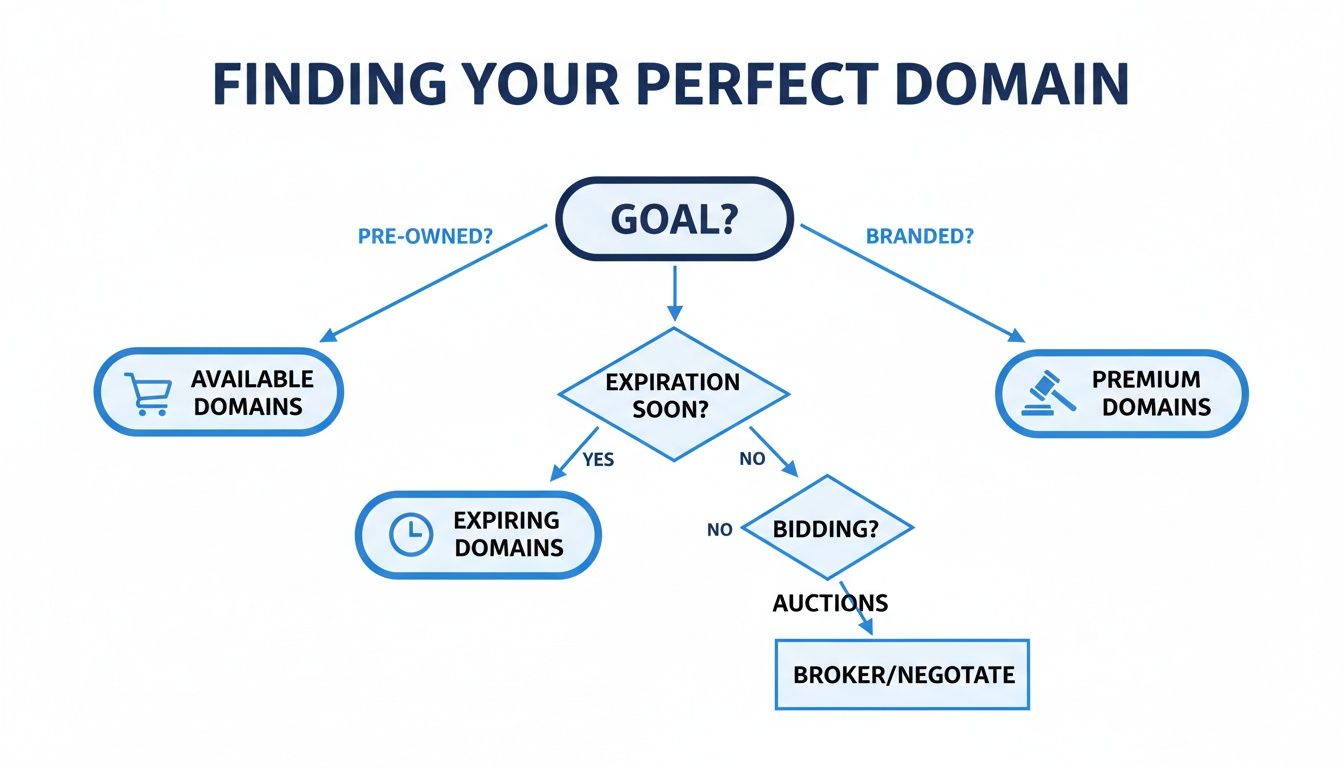
This flowchart simplifies the starting point of your search, guiding you toward the right category—available, expiring, or auction—based on what you're trying to achieve right now.
Let's Get That Domain! Your Acquisition Playbook
You’ve done the hard work. After sifting through countless options and putting your top prospects through a rigorous vetting process, you've finally landed on a winner. Now comes the exciting part—making that domain yours.
The acquisition process can feel a bit intimidating at first, but it really boils down to three main paths, each suited for a different situation. Figuring out how to buy an expired domain is less about a single method and more about matching your approach to the domain's current status. Is it heading to a high-stakes auction, about to drop, or already available for anyone to grab? Your strategy will flow from there.
The Easiest Win: The Available Domain
Let's start with the simplest and most satisfying scenario. Sometimes, a great domain makes it through the entire expiration cycle without anyone noticing. It drops from the registry and becomes available for anyone to register for a standard fee, usually around $10-15.
When you find one of these gems, there’s no auction or complicated process.
- Spot it: You might find it on a platform like NameSnag by filtering for Available domains that dropped today or in the past few days.
- Verify it: Always double-check that it's truly available by searching for it on your favorite registrar (like Namecheap, GoDaddy, etc.).
- Buy it: If it's open, just purchase it like you would any brand-new domain. Simple as that.
This is the fastest and cheapest way to acquire a domain with an existing history. You get all the SEO benefits without any of the competitive stress.
Playing the Waiting Game with Backorders
What if the domain you want hasn't dropped yet? If you've identified a valuable domain in the Expiring domains category, you can place a backorder. Think of this as calling "dibs." You're telling a service, "If the current owner doesn't renew this, I want you to try and catch it for me the second it becomes available."
If you're the only person who placed a backorder, the domain is yours once the service successfully snags it. If multiple people placed a backorder, however, the domain typically goes into a private auction just for those bidders. It's a great way to get a shot at a domain before it hits the public chaos of a major auction house.
Entering the Auction Arena
For the most coveted domains—the ones with incredible metrics, brandability, and history—you'll almost certainly end up in an auction. This is where things get competitive. It's easy to get caught up in the heat of the moment and blow your budget, so you need a smart approach.
A crucial tactic in domain auctions is proxy bidding. Instead of manually increasing your bid every time someone outbids you, you set the absolute maximum price you're willing to pay. The system then automatically bids on your behalf, always keeping you in the lead by the smallest possible increment, right up to your limit.
This automated approach is your best defense against emotional overspending. It forces you to decide on a domain's value beforehand and stick to it, preventing you from making a costly mistake in a last-minute bidding war.
Once you've successfully acquired an expired domain through any of these methods, you'll need to transfer it to your control. This is a standard procedure, but having a clear walkthrough can be a lifesaver. For that, this practical guide to domain name transfer is an excellent resource that breaks down all the necessary steps.
Maximizing the Value of Your New Domain
So, you did it. You waded through the auctions, did your due diligence, and snagged a great expired domain. The transfer is complete, and it’s sitting patiently in your registrar account.
Now the real fun begins.
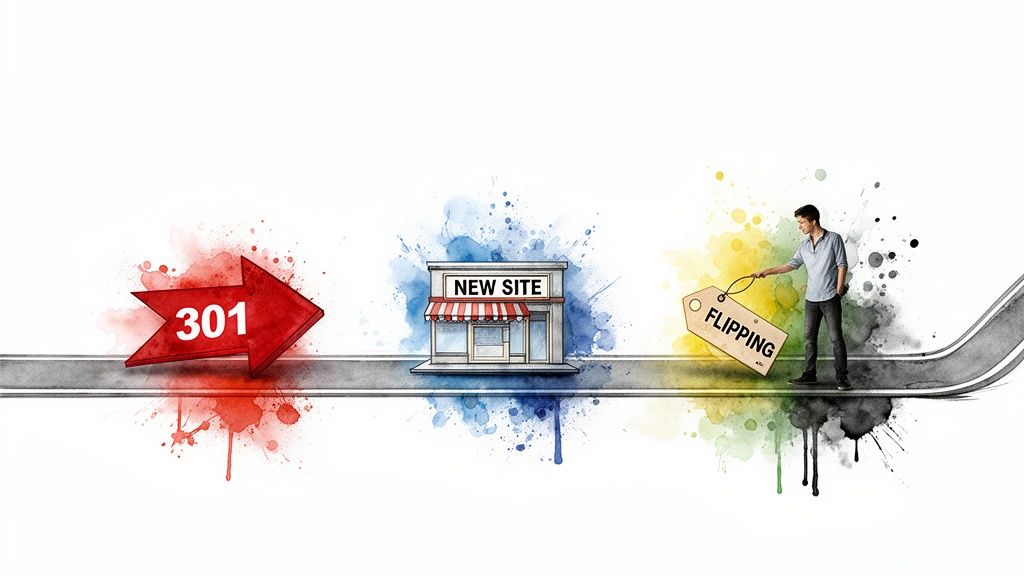
Getting the domain is just the opening move. The real prize is putting that digital asset to work and unlocking the value you just paid for. You've got three main paths you can take, and your choice really boils down to your goals: are you trying to boost an existing project, start something new from scratch, or just turn a tidy profit?
The Power of the 301 Redirect
This is probably the most common play, and for good reason. A 301 redirect is a permanent forward that essentially tells search engines, "Hey, this old domain? It now lives over here at my main website." It's a direct way to funnel all of that domain's "link equity"—or "link juice," as some call it—straight to your primary site.
If you found a domain with a handful of powerful, relevant backlinks, this strategy can give your main site a noticeable bump in authority almost overnight.
The keyword here is relevance. Redirecting an old pet grooming blog to your new crypto SaaS startup is a waste of time. But if you’re a digital marketing agency and you scoop up a defunct marketing blog with solid links? That's a logical connection Google will understand and reward.
Building a New Authority Site
Every so often, you’ll find a domain that’s just too good to be a simple redirect. Maybe it’s highly brandable, has a name you can't forget, and sports a killer backlink profile. This is the perfect foundation for a brand-new website.
Building a niche site on a seasoned domain gives you an almost unfair advantage. You get to skip the dreaded Google "sandbox"—that frustrating period where new sites seem to languish for months with zero visibility.
Because the domain already has a history and some built-in trust, you can often start ranking for valuable keywords much faster than you would with a fresh domain. This is the go-to strategy for affiliate marketers, niche bloggers, or anyone wanting to launch a new project with a serious head start.
Flipping Domains for Profit
The third path is pure investment. Think of it as digital real estate flipping: buy an undervalued asset, maybe sit on it for a bit while the market heats up, and then sell it for a profit.
If you have a knack for spotting domains with strong commercial appeal or untapped brand potential, this can be a seriously lucrative side hustle. The game is to identify names that another business would find incredibly valuable and be willing to pay a premium for. This requires a sharp eye for market trends and an understanding of what makes a domain name truly desirable.
For instance, the market for classic TLDs is getting crowded. Combined registrations for legacy .com and .net domains have actually dipped by 2.1% year-over-year. But here's the kicker: the retention rate for these domains is a whopping 73.8%. That tells you that once a brand is built on a good domain, it becomes an indispensable asset worth paying top dollar for. You can dig into more domain market trends here to sharpen your flipping strategy.
Your Post-Purchase Checklist
Whatever path you choose, don't let any value slip through the cracks. As soon as that domain hits your account, run through this quick checklist to lock it down.
- Update Contact Info: First thing's first. Make sure the domain's WHOIS info is updated with your correct details.
- Set Up Google Search Console: Add the domain as a new property in GSC. This lets you monitor its health, check for any old manual penalties, and see how Google is crawling it.
- Monitor the Backlink Profile: Use your favorite SEO tool to keep an eye on the existing backlinks. You want to make sure the good ones stay put and disavow any toxic links you might have missed during your audit.
- Secure the Domain: This is non-negotiable. Enable the registrar lock and turn on auto-renew. Your new asset is far too valuable to lose over a missed renewal email.
Still Have Questions About Buying Expired Domains?
Jumping into expired domains can feel like you've found a secret level in the SEO game. But like any new strategy, you’re bound to have questions. Let's get the common ones out of the way so you can get started without making any rookie mistakes.
Is Buying Expired Domains a Black Hat SEO Tactic?
Not if you do it right. When you’re hunting for domains with clean histories and real relevance to your niche, buying expired domains is a totally legitimate white hat SEO strategy.
You wander into "black hat" territory when you knowingly scoop up spammy, penalized domains to build manipulative schemes, like a low-quality PBN designed purely to trick search engines. That’s not what we’re doing here. Our focus is on respectfully inheriting the authority of a quality digital asset—a practice even Google's own folks have said is perfectly fine.
Think of it this way: you're buying an established storefront in a great part of town. You're not building a flimsy, fake facade just to fool people into thinking you're the real deal.
How Much Should I Expect to Pay for a Good Expired Domain?
This is the classic "it depends" answer, but I can give you some real numbers. The price can be anything from a standard $10 registration fee for a domain that just dropped, all the way up to thousands of dollars in a heated auction.
For a solid domain you’d actually use for an SEO project—think something with a DA of 20+ and a TF of 15+—you can find some great options in the $50 to $300 range at auction. It really comes down to your goals.
- For a simple 301 redirect: A cheaper domain with a handful of relevant links can do the job beautifully.
- For building a new brand from scratch: It might be worth investing more in a premium, brandable name to give yourself a serious head start.
The absolute best deals, though, are found by catching quality domains the second they become Available. You get all the SEO value for the price of a normal registration.
What Is the Biggest Mistake to Avoid When Buying an Expired Domain?
Hands down, the single biggest, most expensive mistake you can make is failing to check the domain's history. This isn't just a suggestion; it’s a non-negotiable step.
High authority metrics can be a trap. A domain might look incredible on paper, but if its past life involved spam, adult content, or something totally unrelated to your industry, it's poison. Skipping a check on the Wayback Machine and a thorough backlink audit is just asking for trouble.
You could end up inheriting a Google penalty that renders the domain completely worthless. The five minutes you save by skipping this step could cost you hundreds of dollars and weeks of wasted effort. Always, always, always investigate before you invest a dime.
How Quickly Will I See SEO Results?
The timeline really depends on how you use the domain. There's no magic button, but it’s definitely a shortcut compared to starting from zero.
If you’re using a 301 redirect, you could see a lift in your main site's rankings in just a few weeks to a couple of months. That's usually enough time for Google to crawl the old domain, process the redirect, and pass the link equity over to your site.
If you build a new site on the expired domain, you’re basically skipping the dreaded "sandbox" period. You can start ranking for your keywords much faster than you ever could with a brand-new domain. Of course, you still have to put in the work and create great content to see real, lasting results.
Ready to stop searching and start finding? With NameSnag, you can ditch the endless manual checks and discover high-value domains with a clean history and real SEO potential. Find your next winning domain today by exploring our lists of Available domains or getting a head start on Expiring domains.
Find Your Perfect Domain
Get access to thousands of high-value expired domains with our AI-powered search.
Start Free Trial