
When you stumble upon a domain with the status "domain name deleted," it means the name has been officially wiped from the registry's master database. This isn't some temporary glitch or a brief outage; it’s a permanent change. The domain is now back in the wild, up for grabs by anyone.
It's the last stop on a long journey that starts the moment a domain isn't renewed.
The Journey to a Deleted Domain
There’s a real gut-punch feeling that comes from realizing you forgot to renew a valuable domain, only to see it get deleted. But for sharp-eyed entrepreneurs and SEO pros, one person's oversight is another's golden ticket. A deleted domain isn't just an empty space—it’s a piece of digital real estate re-entering the public market, often dragging its entire history, both good and bad, along with it.
Think of it like a popular coffee shop on a prime corner suddenly closing its doors. The business is gone, the sign comes down, but the physical location is still there. That spot might have a great reputation and tons of foot traffic. The next person to lease it gets an instant head start. A deleted domain is no different; it might come with a killer backlink profile, established authority, and a history of ranking for valuable keywords.
This whole process follows a predictable, slow-moving timeline, which gives the original owner plenty of chances to save their domain before it’s gone for good.
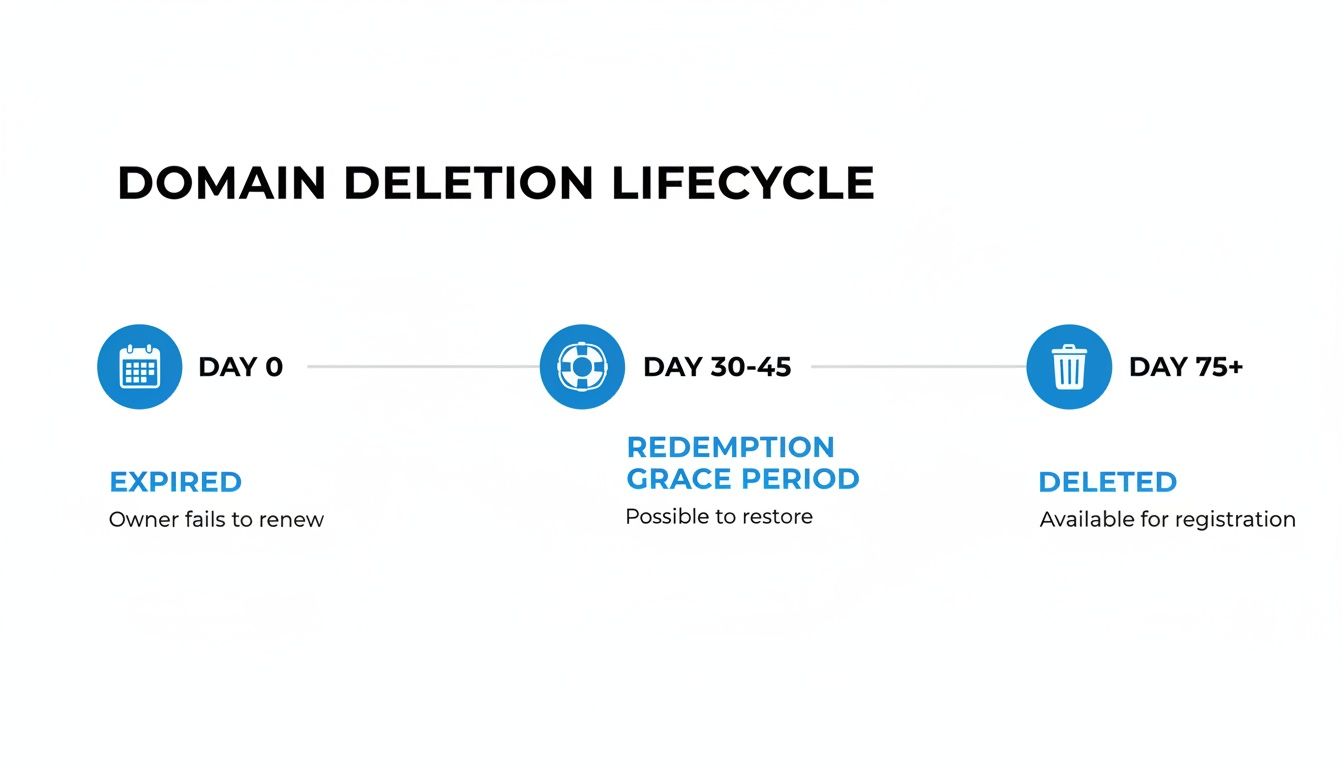
As you can see, deletion is the final, irreversible stage. It only happens after multiple grace periods and recovery windows have slammed shut.
The Lifecycle of Deletion
The path from a registered domain to a deleted one is a standardized dance between registrars (like GoDaddy or Namecheap) and the registries (like Verisign for .com). It’s deliberately designed to give the original owner every opportunity to renew. Once those chances are exhausted, though, the domain is released.
Here’s how it usually plays out:
- Expired: The second the registration period ends, the domain expires. Typically, the website and any associated emails stop working almost immediately. The owner can still renew, usually at the standard price, with no penalty.
- Redemption Grace Period (RGP): If the domain isn't renewed during the initial grace period (which varies by registrar), it slips into a hold state for about 30 days. The original owner can still get it back, but it's going to cost them—often a hefty redemption fee is tacked on to the normal renewal cost.
- Pending Delete: This is the point of no return. Lasting for about 5 days, the domain is locked down. Nobody can touch it, nobody can recover it. It’s just sitting in limbo, waiting for the registry to perform the final deletion.
Once that five-day window closes, the domain name is deleted. It's officially a free agent, available for anyone to register on a first-come, first-served basis.
To get a more granular look at these timelines, we break it all down in our guide on when a domain officially expires.
For a quick reference, here’s a table that summarizes the entire lifecycle.
The Domain Deletion Lifecycle at a Glance
This table gives you a snapshot of each stage, what it means for you as an owner or a potential buyer, and what your options are.
| Stage | What It Means for You | Typical Duration | Can You Recover It? |
|---|---|---|---|
| Expired | Your website/email is down, but renewal is easy. | 0-45 days | Yes, at the standard renewal price. |
| Redemption Grace Period | Last chance for the original owner to reclaim it. | ~30 days | Yes, but with a significant redemption fee. |
| Pending Delete | The domain is locked and awaiting deletion. | ~5 days | No, recovery is impossible at this stage. |
| Deleted | The domain is released and available for public registration. | N/A | No, but you can try to register it like any new domain. |
Understanding these phases is crucial. Whether you're trying to save your own domain or snag a promising one that's about to drop, timing is everything.
The Hidden Stories Behind Deleted Domains
When you hear "domain name deleted," it's easy to assume the owner just forgot to pay the renewal bill. That happens a lot, but it’s only the beginning of the story. The world of deleted domains is filled with far more interesting tales, and understanding them is crucial for anyone hunting for digital treasure.
Some domains don't just fade away—they're intentionally pushed off a cliff.
This is the world of early deletions, where an owner proactively asks their registrar to wipe a domain clean before its expiration date. Why on earth would someone do that? Often, it's a strategic retreat. Maybe the domain got blacklisted for spam, flagged for abuse, or is attracting so much negative attention that the owner decides to just cut their losses and run.
The Not-So-Accidental Deletion
Ditching a toxic domain is a common reason for an early exit. Imagine a domain used for a short-lived marketing campaign that went sour, or one that was hijacked and used to blast out thousands of spam emails. Its reputation is completely shot. By deleting it early, the owner washes their hands of the problem, leaving the tainted asset behind for someone else to deal with.
This isn't just a fringe practice, either. A comprehensive USENIX study found that a surprising 6.4% of all dropping domains are actively deleted before they naturally expire. That works out to an average of 8,252 early deletions every single day, which shows just how many owners are making the deliberate choice to abandon their digital properties. You can dig into the full research into early domain deletions to see the full scale of this trend.
Key Takeaway: A "domain name deleted" status isn't always a simple mistake. It could be a massive red flag signaling a toxic history you absolutely need to investigate before you even think about acquiring it.
Echoes of the Domain Tasting Era
Another fascinating backstory comes from the "domain tasting" era of the mid-2000s. Back then, a registrar loophole let people register millions of domains, "taste" them for a few days to see if they attracted any traffic, and then get a full refund if they didn't. This created a massive graveyard of domains that were registered and deleted within a week.
Many of these domains are still cycling through the system today. While most are absolute junk, some might have hidden potential that was overlooked during that initial gold rush.
This history is why a domain's story matters so much. Are you looking at a forgotten gem or a toxic liability? The answer often lies in the real reason it was deleted in the first place. Whether you're hunting for freshly Available domains that just dropped or keeping an eye on Expiring domains about to become available, understanding its past is your best defense.
Uncovering the SEO Ghost in the Machine
When a domain’s registration finally gives out, its digital footprint doesn’t just puff into smoke. It leaves behind a kind of ghost—a faint echo of its old authority, its backlinks, and its search engine rankings. For anyone who knows what they're looking for, this "SEO ghost" is where the real treasure is buried.
Think of it like a beloved restaurant in a historic building that suddenly shuts down. The business is gone, the chefs have moved on, and the doors are chained. But that location is still printed in old travel guides, food blogs still link to its Yelp page, and it has years of glowing reviews baked into its reputation. Whoever moves into that space next gets to inherit all that built-in buzz and an audience that already knows where to find them.
Inheriting Digital Authority
A deleted domain works pretty much the same way. Over its life, it might have picked up a powerful backlink profile from authoritative places like universities, major news outlets, or respected industry blogs. These links are basically votes of confidence that search engines use to figure out how credible a site is. When a domain name is deleted, those votes don't always just disappear.
This is the whole idea behind inherited link equity, what people in the know often call "SEO juice." It's the residual authority that sticks to a domain long after the original website has been wiped clean. For the person who let it expire, this is a total loss—a sunk investment in years of content and outreach, all down the drain. But for a savvy new owner, it’s a monumental head start.
You’re not just buying a name; you’re potentially acquiring years of established trust and authority, letting you sidestep the long, slow grind of building an SEO foundation from the ground up.
The Value of a Digital Echo
This digital echo can show up in a few incredibly valuable ways, turning a simple domain registration into a real strategic asset.
- A Powerful Backlink Profile: It could have hundreds or even thousands of links from high-authority sites that would otherwise cost a fortune to earn.
- Established Domain Authority (DA): Metrics from tools like Moz often stick around, giving you an instant credibility bump in the eyes of search engines.
- Keyword Ranking History: The domain might still have a faint memory of the keywords it once ranked for, making it easier to reclaim those top spots with fresh content.
To really dig in and uncover a domain's past performance—to find that "SEO ghost in the machine"—you need to piece together its history. Using large-scale web scraping techniques can be a huge help here, allowing you to gather historical data and spot valuable assets that aren't obvious on the surface. It’s all about connecting the dots from the domain’s past to predict its future potential.
How to Vet a Deleted Domain Before You Buy
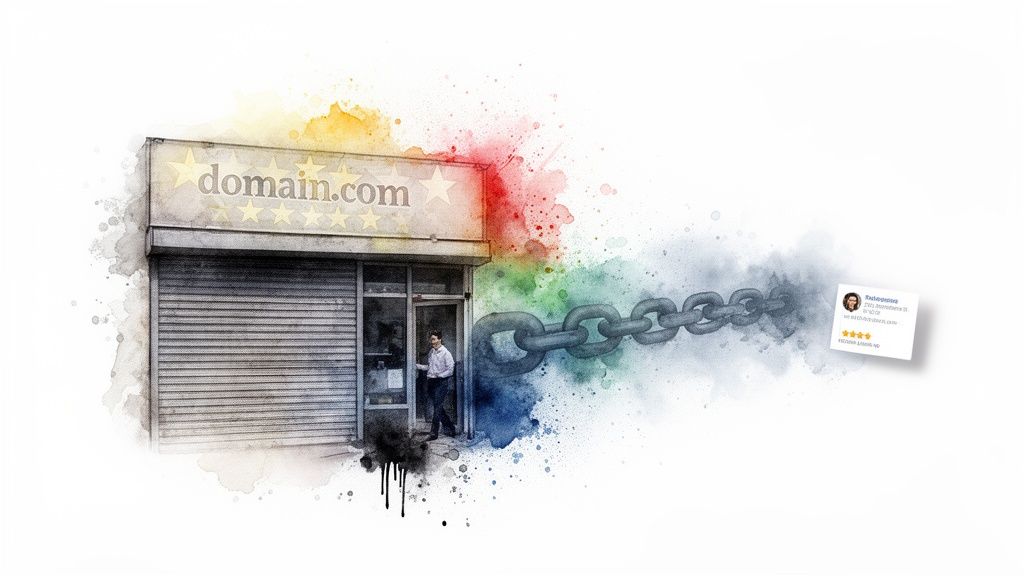 Jumping on a freshly deleted domain without a thorough background check is like buying a used car sight unseen. It might look great on paper, but you could be inheriting a world of trouble under the hood. Proper vetting is what separates a game-changing asset from a money pit weighed down by a toxic past.
This due diligence is absolutely non-negotiable. You’re not just glancing at a few metrics; you're playing detective, piecing together the domain's entire history to figure out if it's a hero or a villain. The number of domains re-entering the market is just staggering, creating a massive digital graveyard full of both treasure and trash.
Just to give you a sense of scale, data from HosterStats.com tracks nearly 900 million active and deleted domains. Diving into the historical DNS data they track shows just how much digital real estate is constantly changing hands, making a smart, data-driven decision more critical than ever.
Your Essential Vetting Checklist
To avoid a serious case of buyer's remorse, you need a repeatable process. The whole point is to uncover any red flags before you commit your cash. A few key areas will tell you pretty much everything you need to know about a domain's past life.
Here are the absolute must-do checks:
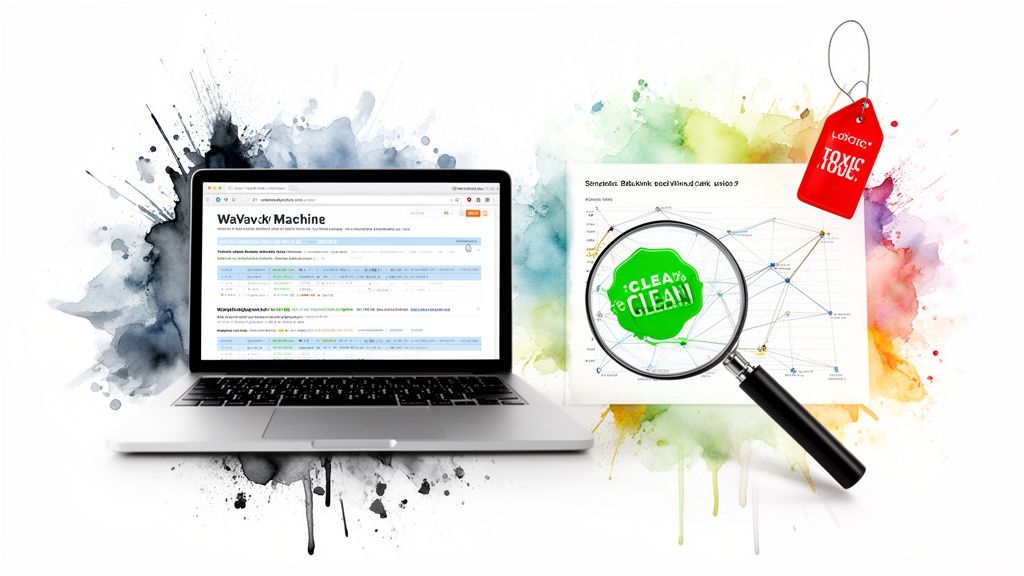
- Analyze Its Past with the Wayback Machine: The Internet Archive's Wayback Machine is your personal time machine. It shows you what the website actually looked like over the years. Was it a legitimate business, a spammy affiliate site, or something much worse? A clean, consistent history is a fantastic sign.
- Scrutinize the Backlink Profile: This is arguably the most important step of all. A strong backlink profile from authoritative, relevant sites is the source of that "SEO juice" you're after. On the flip side, thousands of low-quality links from spammy foreign sites are a huge red flag that Google has likely penalized the domain into oblivion.
- Verify It's Spam-Free: Was the domain ever used to blast out spam? A quick check against common blacklists is essential. A tainted history here can make it nearly impossible for your future emails to ever reach an inbox.
- Check for Trademark Infringement: This is a legal landmine waiting to happen. Make sure the domain name doesn't step on an existing trademark. A quick search on the USPTO database can save you from a costly legal battle you don't want to fight.
Pro Tip: A domain with a great history but no content is far more valuable than a domain with a shady past. It's always easier to build something new on a clean foundation than it is to clean up someone else's toxic mess.
The Smart Way to Vet a Domain
Performing these checks manually is, to put it mildly, a slog. You’ll find yourself jumping between a half-dozen different tools, trying to stitch together a coherent picture from often conflicting data. This is where a specialized platform becomes your secret weapon.
Manually vetting domains is a time-consuming puzzle. The smart approach is to use a tool that does the heavy lifting for you, consolidating all the essential checks into one clear, actionable view.
Your Deleted Domain Due Diligence Checklist
| Essential Check | The Hard Way (Manual Method) | The Smart Way (NameSnag Method) |
|---|---|---|
| Historical Content | Sift through years of snapshots on Wayback Machine, looking for red flags. | Automated history scan flags suspicious content for you. |
| Backlink Quality | Export data from Ahrefs/SEMrush, manually analyze hundreds of links. | Instant backlink profile analysis from top-tier data providers. |
| Spam & Blacklists | Check multiple blacklist databases one by one. | Integrated checks against all major spam and malware databases. |
| Trademark Risk | Manually search government trademark databases for potential conflicts. | Automatic alerts for potential trademark infringements. |
| Overall Health | Guess based on piecing together data from 5+ different tools. | Get a single, easy-to-understand SnagScore for an at-a-glance verdict. |
Tools like NameSnag are built for this exact purpose. Instead of you doing all the grunt work, the platform pulls in all this critical data automatically. It checks a domain's history, analyzes its backlink profile, and verifies it against spam databases.
All this information is then rolled into a single, easy-to-understand metric—the SnagScore. This score gives you an instant verdict on whether a domain is a safe bet or a risky gamble. By simplifying the research, you can vet dozens of potential domains in the time it would take to manually investigate just one. For a deeper dive, learn more about how to check a domain's complete history in our detailed guide. This approach transforms a high-stakes guessing game into a calculated investment.
Alright, you've done the detective work. You've vetted a domain with a squeaky-clean past and confirmed it has the kind of SEO juice worth fighting for. Now for the fun part—actually getting your hands on it.
When a domain name is deleted, snagging it isn't a one-size-fits-all game. Your strategy will depend entirely on timing and just how many other people want the same thing. The whole process can feel chaotic, but with the right approach, it becomes a calculated, tactical move. It all boils down to understanding the different stages a domain can be in and picking the right tool for the job.
The Instant Gratification Method
The most straightforward way to grab a deleted domain is to catch it the second it officially drops and becomes public. These are the domains that have run the full gauntlet of the deletion cycle and are now on the open market, ready for anyone to register at a standard place like GoDaddy or Namecheap.
This approach works great for domains that fly under the radar—think quirky brandables or hyper-specific niche names. Speed is everything here. You need a way to see what's available right now.
A real-time feed is your best friend for this. Using a platform like NameSnag, you can filter for Available domains that literally just dropped today. That list is your hunting ground for gems you can register on the spot, no waiting required.
Playing the Long Game with Expiring Domains
But what about those heavy hitters? The domains you know other people are eyeing? For these, you need to get a head start. Instead of waiting for the domain to be deleted, you start watching it while it's still in its grace or redemption period. It’s the strategic way to prepare for its release.
By keeping tabs on domains that are on their way out, you can get your acquisition plan lined up before the madness begins. This gives you time to finalize your due diligence and decide if you're really ready to commit when the time comes.
This is where specialized tools really shine. For instance, you can dive into lists of Expiring domains on NameSnag to see what’s coming down the pipeline in the next 7, 14, or 30 days. This forward-looking approach lets you prepare for the main event. You can learn more about this whole process in our guide on how to find expiring domain names.
Winning the Bidding War for Premium Names
Now, for the most competitive domains—the short, memorable .coms with epic backlink profiles—trying to register them manually is a fool's errand. These prized assets are almost always snapped up by automated "drop catching" services the millisecond they become available.
To even have a shot, you have two main options:
- Backordering Services: You place a "backorder" with a service like DropCatch or NameJet. They use their high-speed connections to hammer the registry and try to register the domain for you the instant it drops. If you're the only one who backordered it, you get the domain. If multiple people did, it goes to a private auction between you all.
- Public Auctions: If a domain is valuable enough, it will often end up in a public auction where anyone can bid. This is common for names with obvious commercial potential.
Key Insight: For top-tier domains, a backorder isn't just an option; it's a necessity. It’s your ticket to the show—your only real chance at claiming a highly contested piece of digital real estate.
Using a platform that helps you watch these domains and get alerts is critical. Setting up a watchlist in NameSnag for domains you're tracking gives you real-time alerts. This makes sure you never miss the window to place a backorder or jump into an auction, turning a chaotic free-for-all into a manageable, strategic acquisition.
To really wrap your head around the market for deleted domains today, you need to understand a bit of its wild, wild west history. Let’s jump back to the mid-2000s, a chaotic period defined by a practice called “domain tasting.” It was a gold rush that permanently changed the game.
See, back then, ICANN had a policy loophole that gave registrars a five-day grace period to delete a new domain and get a full refund. This was all the opening speculators needed. They unleashed automated systems that registered millions of domains, “tasted” them for a few days to see if any pulled in accidental "type-in" traffic, and then just deleted the ones that didn't for free. It was a zero-risk, potentially high-reward free-for-all.
The Great Domain Dump
This got out of control, fast. It created a massive glut of domains that were registered and then dropped almost immediately. The market was flooded with literally hundreds of millions of names that technically existed for less than a week, creating a huge digital junkyard. This is why you’ll often stumble across domains today with a weirdly short, seemingly pointless registration history from that time.
The numbers from this era are staggering. At the peak of the frenzy in early 2007, GoDaddy reported registering a mind-boggling 55.1 million domains but only holding on to 3.6 million of them. That means domain tasting accounted for something like 94% of their registrations. The hangover from that party is a footprint of over 380 million deleted gTLD domain names that are now just ghosts in the machine. You can dig into the fascinating breakdown of the domain tasting aftermath to see the full scale of the madness.
This history isn't just a fun fact; it's critical context. It shows why you absolutely need modern tools that can intelligently sift through all this digital noise to find the handful of names with real, lasting value instead of worthless relics.
This is where targeted discovery becomes so powerful. Instead of digging through a decade-old junkyard by hand, you can focus your search where it matters. A great place to start is by filtering for Available domains that just dropped today. That way, you know you’re looking at fresh opportunities, not dusty artifacts from a bygone era.
Got Questions About Deleted Domains? Let's Talk.
Still have some lingering questions about what really happens when a domain name gets deleted? It's a confusing corner of the internet, for sure. Let's walk through the most common questions I hear so you can navigate this process like a pro.
How Soon Can I Register a Deleted Domain?
The second a domain is officially deleted by the registry, it's fair game. It goes from "pending delete" to "available" in a flash, and for less competitive names, you can often just search for it at any registrar and register it like new moments after it drops.
The tricky part is that for any domain with even a little bit of value, automated services are waiting to snatch them up the millisecond they become available. We're talking about a completely automated land rush. In those cases, your only real chance is to use a backordering service to get in the queue.
Is Buying a Deleted Domain a Safe SEO Strategy?
It absolutely can be, but you have to go in with your eyes wide open. Think of it like buying a used car. You might find a hidden gem that runs beautifully for a fraction of the price, or you might end up with a lemon that costs you a fortune.
A great deleted domain can give you a massive SEO head start. A toxic one can poison your project before it even begins. The key is doing your homework:
- Dig into its past. What was this website before? Use the Wayback Machine to check for spam, shady topics, or anything you wouldn't want associated with your brand.
- Analyze its backlinks. Are they from high-quality, relevant sites, or a sea of spammy directories from 2008? A bad backlink profile is a red flag.
- Check for trademark trouble. The last thing you want is a legal headache because the old domain was tied to a registered trademark.
Can I Recover My Own Domain After It Is Deleted?
This is the hard one. Unfortunately, the answer is no. Once a domain makes it all the way through the "Pending Delete" phase and is officially dropped by the registry, the original ownership is gone for good. It's wiped clean, reset to zero, and released back into the wild.
Your only move at that point is to try and re-register it the moment it becomes available. But remember, you'll be in line with everyone else who might have their eye on it.
Ready to find high-value domains without all the guesswork? NameSnag uses AI-powered analysis to bring the best expiring and deleted domains to the surface, complete with a SnagScore that makes your research a whole lot simpler. Find your next digital asset by exploring Expiring domains today.
Find Your Perfect Domain
Get access to thousands of high-value expired domains with our AI-powered search.
Start Free Trial