
So, you've stumbled upon the perfect domain name, but it's already taken. Bummer. But the real question isn't just if you can get it, but when. This is your launchpad into the world of domain expiration, where a little intel and good timing can make all the difference.
Your Guide to Finding Domain Expiration Dates
Knowing a domain's expiration date gives you a serious strategic advantage. It’s not about just sitting around and waiting; it's about making calculated moves at the right time.
Whether you're an SEO pro hunting for domains with juicy backlink profiles, an investor looking for the next big flip, or a founder dead-set on securing the perfect brand name, this information is your secret weapon.
Why Expiration Dates Matter
Understanding the lifecycle of a domain gives you a massive edge. Instead of guessing, you can anticipate when a valuable piece of digital real estate might hit the market.
This knowledge is gold in a market that's only getting more crowded. The global domain market is projected to hit 510 million registrations by 2030, and thousands of domains expire every single day. Each one is a potential opportunity to snap up a name with existing authority—a huge boost for any SEO campaign.
The thrill of the hunt is real. A domain isn't just a web address; it's a piece of digital real estate. Knowing its expiration date is like knowing when a prime property might go on the market—it lets you prepare your strategy ahead of everyone else.
The first step is usually a WHOIS lookup, which pulls public registration data, including the crucial "Registry Expiry Date." This tells you the exact day the current registration period ends, giving you the first clue as to when it might become available.
This guide will turn you from a curious searcher into a savvy domain strategist. We'll break down the practical methods for finding expiration dates and make sense of the entire timeline, from expiration to actual availability. For a deeper dive, you can also check out our guide on understanding when a domain will truly expire.
Mastering the Classic WHOIS and RDAP Lookups
Alright, let's get our hands dirty with the old-school, tried-and-true method for checking a domain's vitals: a WHOIS lookup. Think of it as the public library card for every domain on the internet. It's a foundational skill for anyone serious about domain intelligence.
The WHOIS protocol is simply a system that queries databases to pull up the registration details for a domain name. It’s been the standard for decades. Its modern, more structured successor is RDAP (Registration Data Access Protocol), which pretty much does the same job but serves up the info in a cleaner, machine-readable format. For our purposes, they both get you to the same place.
Finding the Expiration Date in a WHOIS Record
When you run a lookup using a web-based tool, you'll get a block of text that can look a bit intimidating at first. Don't sweat it. You only need to hunt for one specific line.
Scan the results for phrases like:
- Registry Expiry Date
- Expires On
- Expiration Date
This is your golden ticket. It tells you the exact date the current registration period ends. This date is your first and most important clue in figuring out when a domain might drop.
Pro Tip: Don't just glance at the expiration date; check the "Created On" or "Registration Date" too. A domain with a long history often carries more authority and SEO juice, which can be a huge bonus.
The Frustrating Reality of WHOIS Privacy
Now for the catch. Sometimes, you'll run a WHOIS lookup and find that all the juicy details—like the owner's name, email, and sometimes even the expiration date—are hidden. This is thanks to WHOIS privacy protection, a service registrars sell to shield an owner's personal info from public view.
It’s a double-edged sword. Great for the domain owner's privacy, but a major roadblock when you're trying to figure out a domain's expiration.
Here’s a quick comparison of what you might see:
| Data Point | Public WHOIS Record | Private WHOIS Record |
|---|---|---|
| Registrant Name | John Smith | "REDACTED FOR PRIVACY" |
| Registrant Email | john.smith@email.com | privacy@registrar.com |
| Registry Expiry Date | 2026-10-15 | Sometimes visible, sometimes hidden |
When you hit a privacy wall, it means you can't directly contact the owner and might not even see the expiration date. This is where you have to get more creative, but just understanding this limitation is the first step.
Keep in mind that while generic WHOIS tools cover most domains, some country-specific extensions require a dedicated tool. For a .be domain, for example, you might need to use a specific DNS Belgium WHOIS service to get accurate details.
Even with privacy services getting in the way, you’ve now learned the fundamental process. You know what to look for and what it means when the data is hidden. This knowledge is crucial before we move on to the more advanced tactics for uncovering domain intel.
Advanced Strategies for Uncovering Domain Intel
So, a simple WHOIS lookup hits a brick wall, probably thanks to a privacy shield. Now what? It's time to put on your detective hat. When the front door is locked, you need to find other ways to piece together clues and figure out a domain's future.
One underrated tactic is going straight to the source: the domain's registrar. It's not a guaranteed win, but some registrars have public-facing tools or status pages that can offer more clarity than a generic WHOIS directory. Think of it as skipping the middleman.
The real key, however, isn't finding one magic tool. It's understanding the entire domain life cycle. That "Registry Expiry Date" you see in a WHOIS record is just the start of the story, not the end.
This timeline gives you a visual of how a basic WHOIS search flows, from the initial query to the data you get back, and shows exactly where privacy guards can throw a wrench in the works.
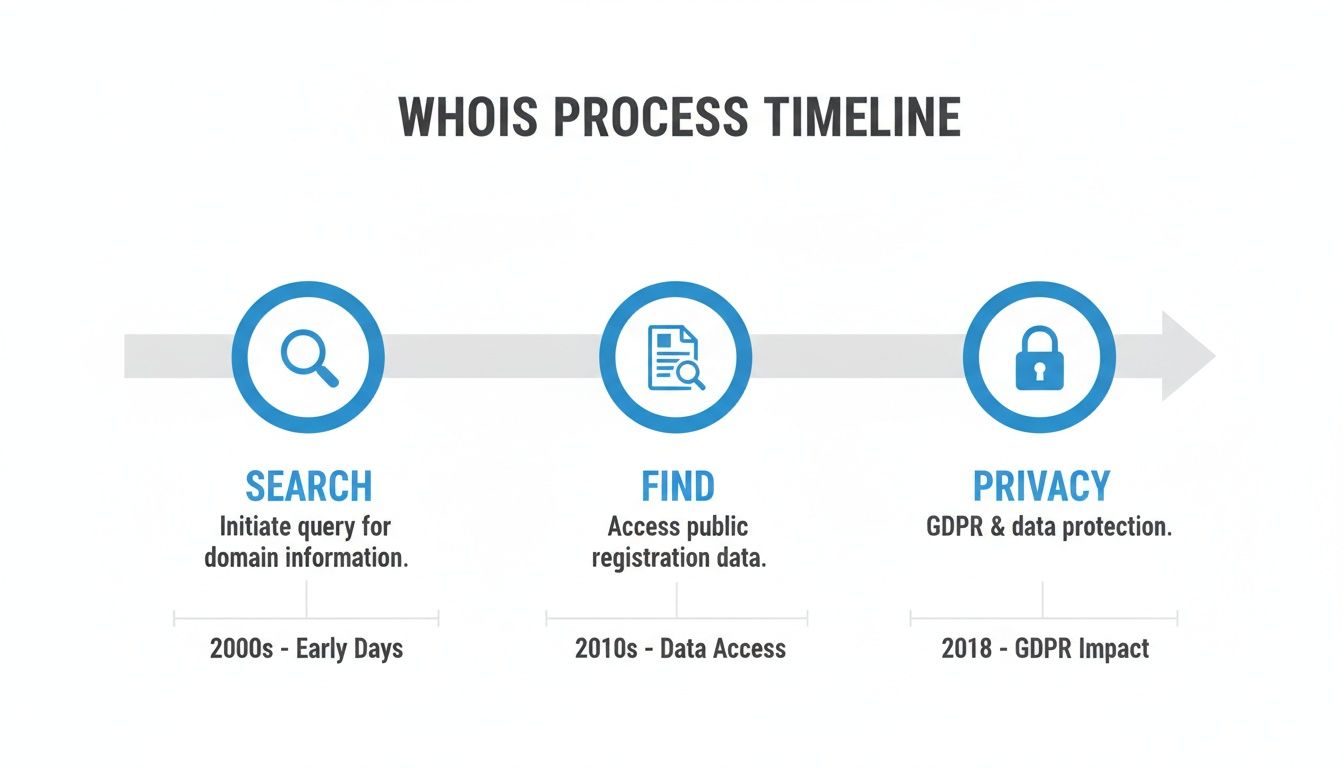
This process is precisely why hitting a privacy roadblock means you just need to dig a little deeper.
Deconstructing the Domain Life Cycle
A domain doesn't just pop back onto the market the day after it expires. It enters a surprisingly long, multi-stage process designed to give the original owner every possible chance to renew. Knowing these stages is your secret weapon.
- Expiration Date: This is day zero. The registration officially ends. In most cases, the website and associated emails go dark.
- Grace Period: Immediately after expiration, the domain enters a grace period. This window typically lasts 0-45 days (30 is common), during which the owner can renew at the standard price, no questions asked. The domain is essentially on hold.
- Redemption Period: If the owner misses the grace period, things get more serious. The domain falls into redemption, a phase that usually lasts around 30 days. The owner can still get it back, but it's going to cost them a hefty fee on top of the regular renewal cost.
- Pending Deletion: This is the final, nail-biting stage, lasting about five days. At this point, the domain is locked. No one can recover it. Once these five days are up, the registry "drops" the domain, and it's finally released for public registration.
The biggest rookie mistake is seeing an expiration date and assuming the domain will be up for grabs the next morning. In reality, you could be waiting anywhere from 60 to 80 days—or even longer—before you get a shot at it.
To keep these stages straight, here’s a quick cheat sheet that breaks down a domain's journey from expired to available.
Domain Lifecycle Cheat Sheet From Expired to Available
| Stage | Typical Duration | What It Means for You |
|---|---|---|
| Grace Period | 0-45 Days | The domain is not available. The original owner can easily renew it at the standard price. Just wait and watch. |
| Redemption Period | ~30 Days | Still not available. The owner can pay a penalty to get it back. The odds of it dropping are getting better. |
| Pending Deletion | ~5 Days | The final countdown. The domain is locked and about to be deleted. Get ready, because it will become available soon. |
| Dropped & Available | - | It's go-time. The domain is now available for anyone to register on a first-come, first-served basis. |
Knowing this timeline prevents a lot of wasted energy and helps you plan your move at just the right moment.
How to Use Renewal Rates to Your Advantage
It also helps to play the odds. Understanding which types of domains are most likely to be dropped is a game-changer. Renewal rates vary wildly across different extensions.
For instance, legacy TLDs like .com have sky-high renewal rates—hovering around 75%. Businesses are deeply invested in them and rarely let them go. On the other hand, many of the newer gTLDs have much lower renewal rates, sometimes closer to 32%, according to research from sources like Cybernews.com.
This kind of data helps you set realistic expectations. You know that snagging a great .com from an established owner requires a ton of patience and a bit of luck. Meanwhile, the constant churn in newer TLDs presents more frequent opportunities.
Digging into a domain's past can also offer clues about its future. For a deeper dive, our guide on how to perform a domain history search will give you even more intel to work with.
The Smart Way: Automating Your Search with Tools
Let's be honest, manually checking dozens of domains for their expiration dates is a serious grind. It’s repetitive, mind-numbingly dull, and the fastest way to miss out on the best opportunities. This is where you graduate from casual searching to professional hunting.
The real power move is to automate the entire process. Tools like NameSnag are built specifically to do this heavy lifting. They shift your strategy from being reactive (checking one domain at a time) to proactive (monitoring thousands of high-potential domains at once). It's a fundamental change in how you operate.
Beyond the Expiration Date: Full Domain Intelligence
These platforms do way more than just tell you how to see when a domain expires. They deliver a full intelligence report on a domain's actual value, saving you hours of painful manual research.
Instead of just getting a date, you get a complete profile with crucial metrics that actually matter:
- SEO Power: Instantly see a domain's authority, Trust Flow, and other key SEO scores.
- Backlink Quality: Get a snapshot of its backlink profile, including any valuable .edu and .gov links.
- Spam Checks: A built-in verification system flags domains with shady pasts, so you avoid inheriting someone else’s penalties.
This isn't just about finding expiring domains; it's about finding valuable expiring domains without wasting half your day cross-referencing data from a dozen different tools.
The goal is to spend your time analyzing opportunities, not just finding them. Automation lets you focus on strategy, like deciding whether a domain is better for a niche site, a 301 redirect, or a quick flip.
Finding Domains Before They Drop
This is where the real strategic advantage comes into play. Instead of waiting for a domain to become publicly available, you can get a head start by monitoring domains that are on their way out.
Platforms like NameSnag give you specialized filters to target domains at different stages of the expiration cycle. The Expiring domains filter is your secret weapon here. It shows you domains that have already expired but are still in their grace or redemption period. These are the ones that will be dropping soon, giving you time to prepare your bid or registration strategy. You can even filter by when they are predicted to drop, like Today, in the next 3 Days, or even up to 30 Days out.
This proactive approach is crucial for getting ahead of the competition. For an in-depth look at how this works, our guide on using a domain name monitor can provide even more strategic insights.
Snagging Gems the Moment They Become Available
What about the domains that have just completed the entire expiration cycle and are ready to be registered right now? That's where a different kind of automation comes in handy.
The Available domains filter shows you a curated list of domains that have just dropped and can be registered immediately at any registrar. You can even filter this list to see what dropped Today, in the last 3 Days, or over the past week.
This feature is perfect for scooping up valuable assets the second they hit the market, often before anyone else even realizes they're available.
If you're technically inclined and want to build your own custom tools, learning how to web scrape with Python can open up a world of possibilities for extracting domain data on a massive scale. By automating your search, you multiply your chances of finding that perfect domain.
Putting It All Together: Your Domain Snagging Playbook
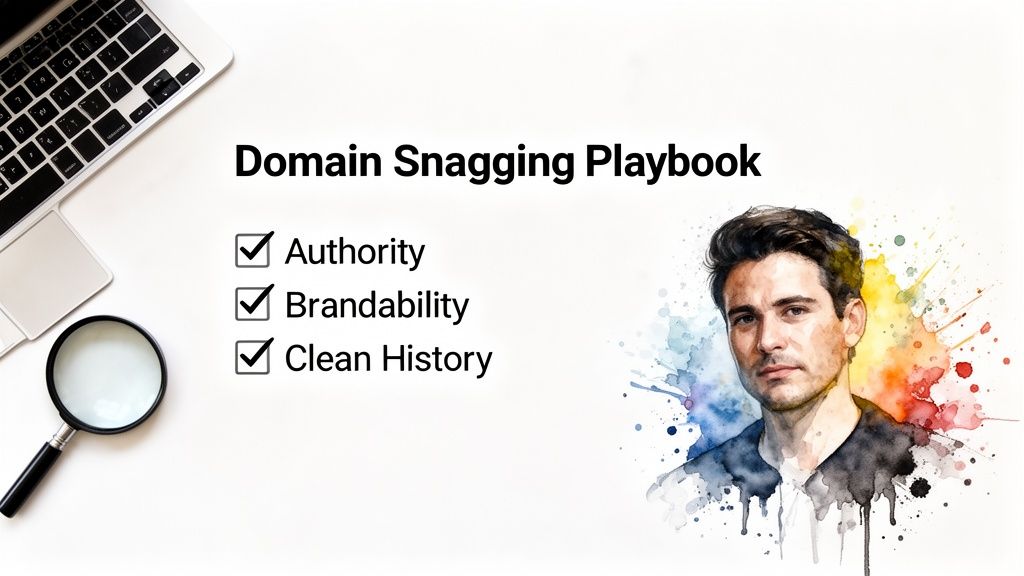
Alright, you've learned the tactics, so now it's time to build your strategy. Knowing how to find a domain's expiration date is one thing. Knowing what to do with that information is what separates the amateurs from the pros. This is your playbook for turning data into a decisive advantage.
Let's be clear: not all expired domains are created equal. Your mission dictates which ones are actually worth your time and money. The playbook for an SEO professional looks wildly different from that of a startup founder.
An SEO expert, for instance, is hunting for metrics. They're on the lookout for domains with high authority, a squeaky-clean backlink profile (think .edu and .gov links), and a history that's relevant to their niche. Their goal is to acquire a ready-made asset that can give their rankings a serious boost.
The startup founder is playing a different game entirely. Their top priority is brandability. They need a name that's short, memorable, and has zero spam baggage from a past life. SEO metrics are a nice bonus, but they're not the main event.
Your Tactical Checklist
No matter your end goal, a solid checklist prevents costly mistakes. Before you even think about registering an expired domain, you need to run through these essential dos and don'ts. It's about protecting your investment and, just as importantly, your time.
The Do's of Domain Hunting:
- Do Vet the History: Always, always check a domain's past life. Use tools like the Wayback Machine to look for spammy content, past penalties, or weird niche pivots that could come back to haunt you.
- Do Set Up Alerts: Don't just hunt; let the opportunities come to you. Set up alerts for specific keywords or domains you're eyeing. You'll get notified the second they become available.
- Do Focus on Quality: A handful of powerful, natural backlinks is worth more than thousands of spammy, low-quality links. Quality always, always trumps quantity here.
The Don'ts to Avoid Pitfalls:
- Don't Ignore Trademarks: This is a big one. Registering a domain that infringes on an existing trademark is just asking for a cease-and-desist letter from a lawyer. Don't do it.
- Don't Forget the Auction: If a domain has any real value, it's probably going to auction. Don’t just sit around waiting for it to drop. Understand the auction process and be ready to bid.
- Don't Act on Impulse: FOMO (fear of missing out) is real in this game, but impulse buys are dangerous. Stick to your strategy and only go after domains that tick all your boxes.
A great domain snagging strategy isn't about finding expiring names; it's about filtering out 99% of the noise to find the 1% that will actually move the needle for your project.
Tailoring Your Search for Maximum Impact
With your playbook in hand, you can start using automated platforms way more effectively.
If you're that startup founder, you'll be filtering for brandable names and probably refreshing the Available domains list daily, watching for newly dropped gems that fit your vision.
If you're the SEO pro, your world revolves around the Expiring domains section. This is where you can dig into the metrics of powerful domains before they hit the open market, letting you plan your acquisition and integration strategy well ahead of time. It’s all about having a plan and executing it with precision.
Common Questions About Finding Domain Expiration Dates
Even with a solid game plan, you're bound to run into a few curveballs when hunting for domains. Let's walk through some of the most common questions I hear to clear up any confusion and get you searching with confidence.
Can I See the Expiration Date If WHOIS Is Private?
This is the million-dollar question, and the answer is almost always a hard "no." WHOIS privacy services exist for one reason: to hide registration details from public view, and that almost always includes the expiration date. When you run a lookup and hit that privacy wall, your direct route is officially blocked.
But that's okay. This is precisely why you can't just rely on a simple WHOIS lookup. You have to get a little more creative by monitoring the domain's status, keeping an eye out for DNS changes, or using a dedicated platform that tracks domains as they fall into the expiration cycle. The direct answer might be hidden, but the clues are still out there if you know where to look.
What’s the Difference Between "Expiring" and "Expired"?
This is a critical distinction that trips up a lot of newcomers. It seems simple, but getting it wrong can cost you the domain you're after.
Think of it like this:
- Expired: The clock has officially struck midnight on the registration date. The domain is now inactive, the website is offline, and it has just slipped into the registrar's grace period.
- Expiring: This is a much broader term. It describes any domain that's in the process of becoming available again. It could be in the grace period, the redemption period, or another status, but the key takeaway is that it's not available for you to register... yet.
Tools like NameSnag help you monitor these Expiring domains, so you can be ready to pounce the second they actually drop.
Why Do Some Domains Go to Auction Instead of Dropping?
You'll quickly notice that high-value domains—the ones with great names, strong metrics, or a history of traffic—rarely just drop back into the public pool for anyone to grab. There's a simple reason for this: money.
Registrars know when they're sitting on a valuable asset. Instead of letting it go for a standard registration fee, they'll list it on an auction platform. This lets them sell it to the highest bidder, turning a routine expiration into a significant payday. If you're chasing a premium domain, you need to be prepared for a bidding war, not a simple click-to-register race.
Can I Get a Domain the Day After It Expires?
In a word: no. This is probably the single biggest misconception in the world of domain hunting. A domain's expiration date isn't the finish line; it's the starting gun for a long, winding process.
Remember the domain life cycle we talked about. After the expiration date comes the registrar grace period (up to 45 days), then the redemption period (another 30 days or so), and finally the pending delete phase (about 5 days). You're realistically looking at a 60–80 day wait before that domain is actually available for anyone to register.
Patience isn't just a virtue in this game; it's a fundamental part of the strategy. It’s all about knowing the timeline and using it to your advantage.
Ready to stop guessing and start snagging high-value domains with precision? NameSnag gives you the tools to find, analyze, and monitor the best expiring and available domains before anyone else. Find your next winning domain today.
Find Your Perfect Domain
Get access to thousands of high-value expired domains with our AI-powered search.
Start Free Trial