
You search cafe 88 livingston nj because you want a meal, a menu, maybe Sunday dim sum, maybe just confirmation the place is open before you get in the car.
That simple search should be boring. It isn’t.
Local business queries like this are where real-world reputation, messy directory data, expired domains, and underbuilt content collide. If you’re an SEO, affiliate builder, agency owner, or domain investor, Cafe 88 is the kind of business you should study closely. Not because it’s trendy. Because it’s durable, branded, and imperfect online. That combination creates opportunity.
Meet Cafe 88 A Livingston Legend
Some local businesses are just listings. Cafe 88 isn’t one of them.
Founded by Taiwanese immigrants and established in 1988, Cafe 88 has become one of the longest-operating authentic Chinese restaurants in Essex County, with a 4.6/5 Google rating from over 1,200 reviews according to Source 1. That matters. Longevity plus strong review sentiment is exactly how a local brand builds search gravity over time.

Why this business name carries weight
“Cafe 88” sounds simple. That’s why it works.
It’s short, memorable, and tied to a real place people already know. Local search rewards brands that people remember enough to type directly. Domain markets do too. If you want to understand how old business names keep value online, you should spend time with the Wayback Machine domain history playbook and study how a site changed over time.
Here’s the practical lesson. A domain becomes valuable when a real business gives it meaning over years. Cafe 88 did that offline first.
Practical rule: Don’t chase random expired domains with decent metrics. Chase names attached to businesses people already remember.
What SEOs should notice
Cafe 88 isn’t just surviving on nostalgia. It has the kind of local brand equity that most businesses would kill for.
A business that stays relevant for decades tends to leave signals everywhere:
- Branded search behavior: People search the name directly, not just “Chinese restaurant Livingston NJ.”
- Directory persistence: Old citations stick around for years.
- Review momentum: Review count plus rating creates trust before a click even happens.
- Content demand: Users want current hours, reservations, parking, and menu specifics from a business they already trust.
That’s the setup. The restaurant earned the brand. The web is still catching up.
The Digital Ghost of Cafe88.com
The most interesting thing about local search often isn’t the current website. It’s the one that got away.

The original cafe88.com was used by the business for 10 years, then expired in 2015, and later resold for $8,800 in 2017 according to the same [Source 1](Source 1). That is the entire expired-domain lesson in one line. Age matters. Brand fit matters. Numeric branding matters. Real business history matters.
Why that domain had real value
Aged domains don’t become valuable because domain investors wish really hard. They become valuable when the name sits on top of established demand.
Cafe88.com had several traits investors want:
| Factor | Why it matters |
|---|---|
| Age | Older domains often carry historical trust and archived usage |
| Brand relevance | Exact match with a known business name |
| Memorability | “88” is compact, distinctive, and easy to recall |
| Commercial intent | A restaurant name can support direct navigation, branded search, and lead-gen angles |
That’s not theory. That’s market behavior.
A lot of people see an expired local-business domain and think, “Too niche.” Wrong. Local exact-match or near-exact brand domains can be ideal for a directory, lead-gen page, local guide, or even a resale to a relevant operator.
What to check before you get excited
An expired domain with a real history deserves a proper audit. Start with three checks.
- Archive history: Was the site used for the business, or was it spammed later?
- Brand conflict: Is the name still strongly tied to an active business?
- Intent fit: Can you build something useful, or are you just hoarding a string?
If you’re still tempted to buy first and think later, read this on what a domain not found error can really signal. A dead website is not always a dead asset.
Later in the process, a simple visual history check helps separate nostalgia from junk.
Old local domains are often worth more than broad generic names because the demand is narrower but far more intentional.
What A Closed Cafe Teaches Us About Domain Value
Now switch businesses. Here, people get sloppy.
Cafe 88 is active and established. 88 Cafe is different. It’s listed as permanently closed on MenuPix’s Livingston listing for 88 Cafe. That’s bad news for the business owner. For a domain hunter, it can be the start of a smart watchlist.

Active brand versus closed brand
Here’s the distinction most beginners miss.
| Situation | Better move |
|---|---|
| Active local brand | Be careful. Trademark and reputation issues matter more |
| Closed local business | Watch the domain. Residual citations can still carry SEO value |
| Messy in-between status | Verify closure across directories before doing anything |
A closed business domain can still have useful leftovers. Directory links. Historic mentions. Branded anchor text. Local relevance. That’s the kind of residue that can support a small local content site if the history is clean and the use case is legitimate.
My advice for investors
Don’t wait until a domain hits a public auction and everybody piles in.
Build a habit of monitoring local businesses that are clearly fading or already closed. Then estimate value the boring way. Check citation trails, archive snapshots, anchor language, and whether the domain could support a useful local resource without confusing users.
A decent primer on this process is how to value domain names. The big mistake is assuming every old local domain deserves a bid. Most don’t. A few absolutely do.
Use this filter before you care:
- Can you verify the business is closed?
- Did the domain likely earn real local mentions?
- Can the name be repurposed without pretending to be the old business?
- Would a local service page, directory, or guide make sense on that domain?
If the answer is no, move on.
Spotting Your Own Cafe 88 Content Gaps
The SEO angle now gets fun.
Search results for Cafe 88 still leave obvious questions unanswered. The available info lacks a unified operations guide, and a better page covering hours, payment methods, reservation policies, and parking would directly match user intent, as noted in this content-gap reference.
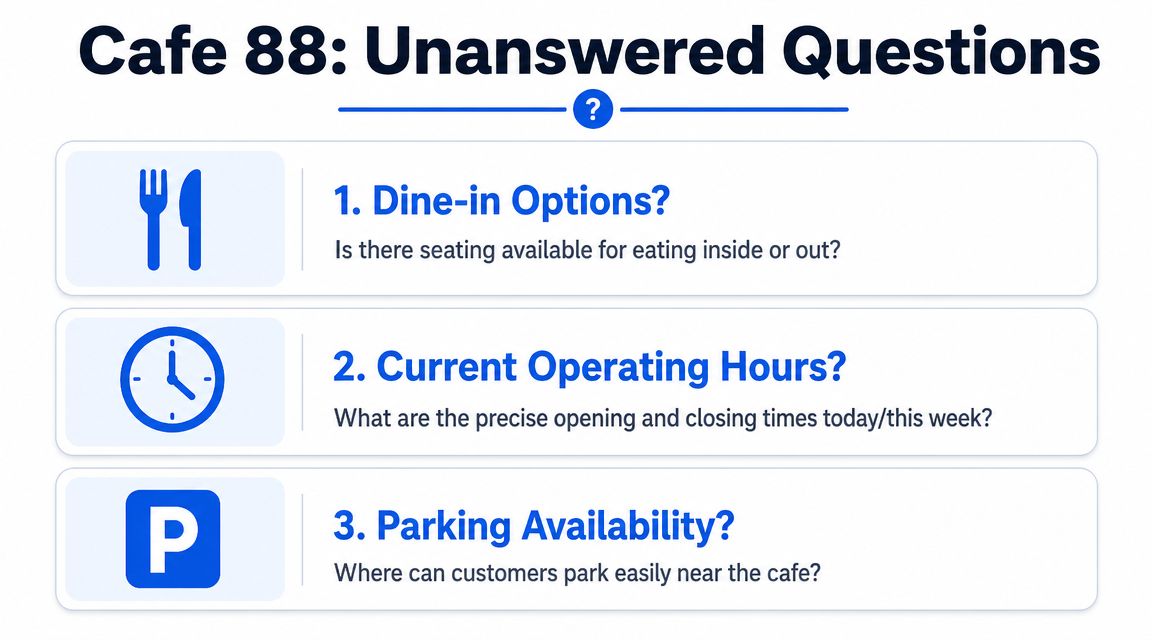
The gap is obvious
A lot of local SERPs are weak in the same way. Reviews say the food is good. Directories have partial details. Nobody has assembled the practical stuff that helps someone visit today.
That means a useful page could target questions like:
- Current hours: Not generic hours copied from a stale profile. Today’s operating status.
- Reservations: Can you reserve, especially for larger groups?
- Parking: Easy lot, awkward lot, street parking, overflow. People care.
- Payment details: Cards, digital payments, takeout workflow, and common friction points.
Users don’t just want “best restaurant.” They want “can I go right now without guessing.”
How I’d build the page
I’d create a clean local operations guide and structure it around actual user decisions, not fluffy restaurant copy.
A simple build works best:
Lead with operational facts users look for first
Hours, reservation notes, parking, and dine-in status should sit above the fold.Add a short “what to expect” section
Explain traffic patterns, busy windows, and who the place suits best.Use FAQ schema carefully
Only answer questions you can maintain accurately.Refresh it often
Stale local content dies fast.
If you want help shaping the page so it covers the right subtopics without bloat, this Surfer SEO review from EntreResource is worth a skim for content planning ideas.
Your Ultimate Guide to Visiting Cafe 88
If you’re going to Cafe 88, don’t overcomplicate it. Go for what the place is known for.
Dim sum is the star, accounting for 55% of Cafe 88’s revenue, and the Sunday brunch can serve up to 850 customers, helping explain its 42% local Chinese restaurant market share, according to Source 2. Translation: the market has already voted. Order the dim sum.
What to do if you want the best experience
Your first decision is simple. Do you want energy or ease?
- Go on Sunday brunch if you want the full buzz: This is the big-show version.
- Pick a calmer visit if you hate crowds: You’ll probably have a smoother experience.
- Bring people who like sharing food: Dim sum is a social format. Ordering solo misses half the fun.
What I’d tell a friend before they go
Don’t show up expecting a quiet coffee shop vibe. Show up ready to eat.
The smartest move is to lean into the specialties instead of trying to assemble a random order from every category. Restaurants reveal their strengths through customer behavior, and at Cafe 88 the signal is loud. People come for dim sum.
A few practical tips matter more than menu theory:
| Situation | Better choice |
|---|---|
| First visit | Focus on dim sum over scattered entrees |
| Crowd-averse diner | Avoid peak brunch energy |
| Family or group outing | This is the ideal format |
| Large party planning | Call ahead and confirm policies directly |
What local businesses can learn from this
Cafe 88 also highlights a common issue. A popular business can still leave basic discovery and conversion work on the table.
If you run a local business, fix your visibility before someone else builds the better information page around you. This guide on optimizing your Google Business Profile is a useful reminder that local SEO often comes down to operational clarity, not clever branding.
A business can dominate offline and still leak easy wins online through missing basics.
For searchers, that means verify details before you go. For marketers, it means the opportunity is sitting in plain sight.
Your Next Great Idea Is A Local Search Away
A search for cafe 88 livingston nj looks small. It isn’t.
It reveals how a real business creates domain value over time, how a closed business can leave behind useful digital residue, and how weak operational content opens the door for better pages to rank. That’s the whole game in local SEO. Attention follows usefulness, and usefulness is usually hiding in plain sight.
If you want a repeatable edge, stop waiting for some glamorous niche. Start with the businesses around you. Restaurants, salons, dentists, auto shops, old cafes, closed boutiques. Search them, audit the SERP, inspect the domain history, and look for missing information. That’s where practical projects come from.
For a broader refresher on what matters in small-market search, these local SEO best practices from The Pulse Morristown are a solid complement to the lessons here.
The next domain opportunity you spot probably won’t come from a trend report. It’ll come from a local search you almost ignored. If you want a faster way to spot clean opportunities, monitor dropped names through NameSnag, browse available domains for names you can register right now, and keep an eye on expiring domains before they drop. Use the time filters to narrow by Today, 3 Days, 7 Days, 14 Days, 30 Days, or All, then focus on names with real local relevance instead of junk metrics.
Find Your Perfect Domain
Get access to thousands of high-value expired domains with our AI-powered search.
Start Free Trial