You find a great name, check the .com, and get the same result everyone gets. Taken, overpriced, parked, or wrapped in a broker page that looks like a ransom note.
That’s often the moment people make a bad decision. They add a random word, tack on a hyphen, or settle for a forgettable new gTLD they don’t even like. A better move is to open up the country domain extension list and treat it like a map, not a directory.
Many believe ccTLDs are niche. They’re not. Country code top-level domains reached 140.0 million registrations by the end of Q2 2024, accounting for about 38.6% of the 362.4 million total domain registrations worldwide according to the Domain Name Industry Brief Q2 2024. That’s a large, active slice of the market, and serious investors have known for years that some of the best opportunities live outside .com.
A good ccTLD can do three things at once. It can fit a local market better, create a cleaner brand, and open up acquisition angles that are impossible in crowded .com territory. If you want a refresher on the fundamental principles of domain names, that’s a useful grounding before you start judging extensions by trust, fit, and resale potential instead of habit.
Your World of Domains Beyond Dot Com

The first time a founder sees their perfect .com listed at a painful price, they often assume the name itself is gone. It often isn’t. Only one lane is blocked.
That’s where ccTLDs change the game. A startup serving Germany may be stronger on .de than on a compromised .com. A media brand may fit naturally on .tv. An AI product may feel sharper on .ai than on a longer .com with filler words.
The mistake is treating country domains like leftovers. Experienced investors treat them like contextual assets.
Why smart buyers keep a ccTLD shortlist
Some domains win because of geography. Others win because the extension completes the brand.
Here’s the practical lens I use:
- Local operators often benefit from matching the audience’s country expectations.
- Global startups can use open ccTLDs for cleaner, shorter branding.
- Investors can spot underpriced names where the extension adds meaning, not just availability.
- SEOs can inherit region-specific authority from expired domains that would be harder to reproduce from scratch.
A weak .com isn’t automatically better than a strong ccTLD. Fit matters more than habit.
The country domain extension list becomes useful when you stop asking, “What’s available?” and start asking, “Which extension helps this name do its job?”
What simple directories miss
Most lists stop at country and code. That’s trivia. What matters in the field is different:
- Is the extension open or restricted?
- Does it carry local trust?
- Is it overused by spam?
- Does it work as a brand hack?
- Are the registry rules manageable for the buyer?
Those questions separate a smart purchase from a headache.
Understanding Country Code Top-Level Domains
A country code top-level domain, or ccTLD, is a two-letter domain extension tied to a country, territory, or similar jurisdiction. Think .de, .fr, .jp, .ca.
They aren’t random abbreviations. They follow the ISO 3166-1 alpha-2 standard, which is why the structure feels consistent across the country domain extension list.
The basic mechanics
There are over 316 ccTLDs delegated in the DNS root zone as of June 30, 2024, and they all use two-letter ISO country codes. That total rose from 255 in 2017, largely because of the addition of IDNs, according to DomainNameStat’s country TLD statistics.
That matters for two reasons:
- Coverage is broad. You’re not working with a tiny corner of the naming system.
- Language support is wider. IDNs opened the door for more natural naming in non-Latin scripts.
How ccTLDs differ from gTLDs
A gTLD such as .com, .org, or .net is generic by design. It doesn’t signal a country on its own.
A ccTLD carries baggage in the useful sense. It can imply local relevance, local rules, local trust, or all three. That’s why the same exact second-level name can feel completely different depending on the extension.
For technical beginners, it helps to also understand how domain records connect to the rest of the web stack. This explainer on what are DNS entries gives the clean version without turning it into a networking lecture.
The investor’s translation
When I look at a ccTLD, I’m not just seeing geography. I’m seeing policy, buyer pool, resale friction, branding range, and SEO intent.
Here's a concise explanation:
| Term | What it means in practice |
|---|---|
| ccTLD | Country-linked extension with local or brandable value |
| gTLD | Generic extension with broad recognition |
| IDN | Internationalized naming for non-Latin scripts |
| Registry policy | The primary gatekeeper for who can buy and keep the domain |
If you skip the policy side, you’ll misprice the asset.
Open Versus Restricted ccTLDs
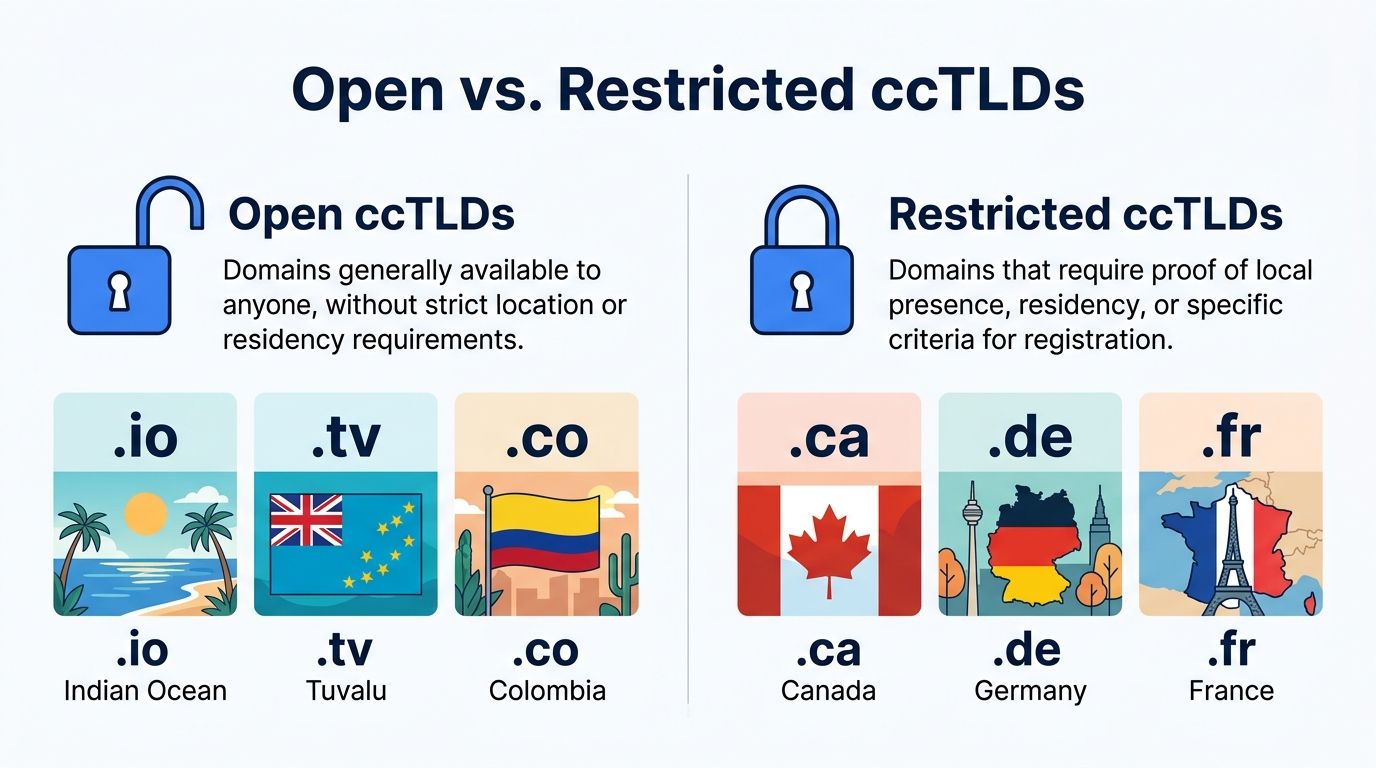
This is the line that catches beginners. Two ccTLDs can look equally attractive and behave completely differently in practice.
Some are easy to register from almost anywhere. Others expect proof that you belong in the market.
Open ccTLDs
Open ccTLDs are the crowd favorites for branding and resale. They’re generally available without strict local presence rules.
Per AWS Route 53’s geographic TLD guidance, registration policies are defined by local registries, and some unrestricted ccTLDs such as .io and .ai allow global registration, which is a big reason domain investors chase them for brandable use cases in tech and startup markets: AWS Route 53 registrar TLD list by geography.
These are the names that show up in pitch decks, launch pages, and clever one-word brands.
Common strengths:
- Shorter branding: buyers can often get a tighter name than they could on .com.
- Category fit: .ai feels native for AI products, .tv fits media, .me fits personal brands.
- Broader buyer pool: you’re not limited to local businesses in one country.
Restricted ccTLDs
Restricted ccTLDs come with friction. That friction can be annoying for speculators, but it can also create value.
If a registry requires local presence, residency, or a business nexus, casual buyers drop out. That often means less noise and a stronger identity signal for businesses that do qualify.
Examples people need to verify carefully include:
- .ca for Canadian presence
- .fr where local criteria may apply
- .us with nexus requirements
- .eu for eligibility tied to the relevant region
Practical rule: Restriction reduces convenience, but it can increase trust and reduce junk competition.
Which side wins
Neither. They solve different problems.
Use this filter:
| If your goal is... | Lean toward... |
|---|---|
| Local trust in one country | Restricted ccTLDs |
| Startup branding and resale | Open ccTLDs |
| Easier transfer and broader liquidity | Open ccTLDs |
| Defensible local identity | Restricted ccTLDs |
What doesn’t work is buying a restricted ccTLD first and learning the rules later.
The Strategic Advantages of ccTLDs
A strong ccTLD does more than give you another way to register a name. It changes how the brand is perceived before anyone reads a headline or clicks a product page.

They sharpen local intent
For businesses targeting one country, the right extension can remove ambiguity. Users often trust what feels local. So do advertisers, partners, and in many cases the local market itself.
That doesn’t mean a ccTLD is magic. It means the domain starts with a stronger context.
They protect the brand from obvious gaps
A brand that operates internationally but ignores country domains leaves loose ends behind. Competitors, affiliates, copycats, and opportunists notice those gaps quickly.
A defensive registration strategy often makes sense when:
- You’re entering a new market
- You already own the matching .com
- Your name is short and commercially obvious
- Local impersonation would be expensive to clean up
They create naming options that .com can’t
They create naming options that .com can’t. This attracts investor interest. A lot of sharp, memorable names are gone in .com and still workable in the country domain extension list.
Sometimes the extension is just a fallback. Sometimes it’s the whole brand.
Examples of where ccTLDs can outperform a compromised .com choice:
- Cleaner spelling
- Shorter domain length
- Category alignment
- Better recall in ads and social bios
They can inherit useful local authority
Expired ccTLDs with a clean past can carry region-specific backlinks, mentions, and relevance that are difficult to rebuild manually. That isn’t a reason to buy blindly. It is a reason to inspect old ccTLDs with more care than typically observed.
The best ccTLD buys often feel obvious in hindsight. The extension fits the market, the name is easy to say, and the history doesn’t fight the project.
That combination is rarer than it looks. When you find it, move fast.
The Complete Country Domain Extension Reference Table
A country domain extension list is only useful if you can make decisions from it quickly. That means ignoring decorative fields and focusing on the four columns that change outcomes.
How to read the table
Use this quick reference format when building your own spreadsheet or review doc:
| ccTLD | Country or Territory | Registration Rules | Common Use / Brandability Notes |
|---|---|---|---|
| .ai | Anguilla | Open | Strong for AI startups and modern SaaS branding |
| .io | British Indian Ocean Territory | Open | Popular in tech, developer tools, and startups |
| .co | Colombia | Open | Reads like “company,” widely used as a business brand |
| .tv | Tuvalu | Open | Natural fit for video, streaming, and media projects |
| .me | Montenegro | Open | Strong for personal brands and call-to-action domains |
| .ca | Canada | Restricted | Best for Canadian companies that want local trust |
| .de | Germany | Restricted or local-policy driven | High local credibility for German market targeting |
| .fr | France | Restricted or local-policy driven | Useful when local identity matters |
| .us | United States | Nexus required | Better for US-specific identity than broad global branding |
| .eu | European Union | Eligibility based | Useful for region-wide European positioning |
That format keeps the decision practical.
What to look for
When reviewing a ccTLD table, prioritize these signals:
- Registration rules: can you own it directly, or do you need local presence?
- Brandability notes: does the extension add meaning or just availability?
- Market fit: is this for local SEO, resale, or a brand hack?
- Operational friction: renewal, transfer, and compliance should not be an afterthought.
A giant master list is nice. A filtered working list is what gets deals done.
How to Find Valuable ccTLDs with NameSnag
Many search domains backward. They start with a random idea, then hunt for anything close. Better results come from searching the market for assets with real upside.

Start with dropped names you can register now
The cleanest first pass is the Available domains view. That surfaces domains that have already dropped and can be registered immediately.
Use this when you want speed:
- Browse Available domains
- Narrow by your preferred time window such as Today, 3 Days, 7 Days, or longer
- Filter by extension patterns you care about
- Review naming fit before you obsess over metrics
For ccTLD hunting, I like this mode when testing branding ideas. You can move from discovery to checkout without waiting on the drop cycle.
Use expiring names when you want a better edge
The Expiring domains view is where more strategic buyers spend time. These domains are expired but still in a grace period, which gives you time to inspect history and shortlist stronger candidates before they become available.
Use this workflow:
- Open Expiring domains
- Choose a time filter that matches your pace
- Pull a list of ccTLDs that match your sector or geography
- Review backlink quality, age, and spam indicators
- Save the best names for follow-up
What to prioritize in a ccTLD scan
Metrics matter, but not all metrics matter equally for country domains.
Check these first:
- Local backlink relevance: a few strong regional links can mean more than a bloated generic profile.
- Clean history: avoid names that switched niches repeatedly or show obvious spam residue.
- Commercial fit: the extension should help the buyer story.
- Renewal practicality: some names look great until policy and admin burden show up.
Most ccTLD mistakes happen before purchase. Buyers fall in love with the string and forget to audit the extension.
A simple working routine
I’d split the hunt in two lanes.
| Search mode | Best use |
|---|---|
| Available | Fast brand discovery, immediate registration |
| Expiring | Higher-upside research, history-first investing |
That keeps your country domain extension list from turning into a pile of tabs and guesswork.
SEO and Investment Strategies for ccTLDs
A founder wants to rank in Germany, build trust with local buyers, and avoid paying a premium for a tired .com. A domain investor looks at the same situation and asks a different question first. Does the ccTLD create real commercial advantage, or just look clever on a shortlist?
That distinction matters.
The best ccTLD buys work because the extension, market, and buyer intent line up. If the goal is local SEO, a country code can strengthen geographic relevance. If the goal is resale, the same name might be weak if the registry is restrictive, renewals are expensive, or the buyer pool is too small. Good ccTLD investing is part search strategy, part policy reading, part risk control.
Where ccTLDs help SEO
A country code domain can send a strong local signal, especially for businesses serving one country with local content, local links, and local customer proof. I have seen country-specific domains help click-through rates because users trust a familiar extension. That trust matters in markets where buyers expect a local business presence before they enquire or purchase.
The opposite is also true. A ccTLD can limit a site if the business wants international reach but keeps projecting itself as country-bound. A startup selling across Europe may lose more from that mismatch than it gains from the local signal.
For a practical overview of how domains affect rankings, brand trust, and search visibility, keep this guide on domains for SEO beside your shortlist. For small businesses trying to understand why local relevance and search visibility matter in the first place, this piece on understanding why SEO is important for businesses is a useful plain-English reminder.
A simple rule works well here. Match the ccTLD to the actual footprint of the business, not the founder's preference.
How investors separate good ccTLD assets from traps
Investors do not get paid for spotting interesting strings. They get paid for buying names another buyer can use, hold, and justify.
That pushes the evaluation past the name itself. A strong ccTLD asset usually has clear commercial intent, clean historical use, and registry terms that do not create friction at transfer time. I pay close attention to who the likely end buyer is. A .de buyer often wants local credibility and legal clarity in Germany. A .co buyer usually wants a startup-friendly brand. A .me buyer may care more about memorability than geography.
Those buyer motives shape pricing. They also shape liquidity.
The primary trade-off: ranking signal versus resale flexibility
Some ccTLDs are best treated as operating assets. Others behave more like brand inventory. Confusing the two leads to bad purchases.
If a bakery in Paris buys a strong .fr, the value comes from trust, relevance, and conversion inside one market. If an investor buys a short .tv or .me, the upside often comes from broader branding demand, but the SEO case may be secondary. That is why I separate ccTLDs into two buckets before I spend any money:
- Local operators: country-specific names bought to rank, convert, and look native in one market
- Brand investors: open or broadly adopted ccTLDs bought for memorability, hack potential, or startup resale
- Hybrid opportunities: names with local relevance today and broader buyer appeal later, which are rarer than they look
The hybrid category gets overvalued all the time. Sellers assume every good local keyword has global upside. Usually it does not.
My screening questions before buying
Before I buy an expired or aged ccTLD, I want clean answers to a few practical questions:
- Can the buyer legally hold it? Some registries are open until transfer or renewal rules get in the way.
- Does the history support the current use case? Old content in the same niche is a good sign. Repeated topic changes are not.
- Are the backlinks locally relevant or just numerous? Ten solid links from the target country can beat a messy profile full of unrelated domains.
- Would a real business want this extension? Investor logic and operator logic are not always the same.
- Is there a realistic exit? If resale is the plan, identify the buyer class before registration, not after.
One good ccTLD can carry a local launch, a lead generation site, or a clean brand flip. A bad one ties you to renewal fees, registry headaches, and a story no buyer wants to hear.
That is the investor's playbook. Use country codes where they create an advantage in search, branding, or buyer intent. Skip them when the extension adds friction without adding value.
Creative Branding with Domain Hacks
This is the fun part of the country domain extension list. Some ccTLDs aren’t just geographic markers; they’re part of the word.
That’s what makes a domain hack work. The extension completes the name and turns a standard URL into a brand people remember.
Why some hacks stick
The famous examples didn’t work because they were cute. They worked because the domain was short, sayable, and easy to repeat.
Names such as del.icio.us, instagr.am, and meet.me showed the pattern clearly. The extension wasn’t decorative. It finished the idea.
The strongest hacks often share a few traits:
- They sound normal when spoken aloud
- They remove clutter instead of adding it
- They match the product tone
- They don’t require too much explanation
Extensions that pull more than their weight
A few ccTLDs have become reliable raw material for creative naming:
| Extension | Typical branding angle |
|---|---|
| .me | Personal identity, direct-response branding |
| .tv | Video, entertainment, broadcasting |
| .it | Verbs and action phrases |
| .ly | Adverbs, shortener-style brands |
| .es | Plurals and playful word endings |
A good hack feels effortless. A bad one feels like the founder is forcing a pun no one asked for.
What doesn’t work
The trap is choosing a hack that looks clever in a pitch deck and awkward everywhere else.
Avoid names that:
- Need constant spelling corrections
- Split the word in a confusing place
- Depend on an extension with policy risk you haven’t checked
- Only make sense to domain people
The best domain hack still has to survive a podcast mention, a radio read, and a typo from a distracted customer.
If it can’t do that, it’s not a brand. It’s a novelty.
A Closer Look at Popular Country Domains
Not every ccTLD earns the same kind of attention. Some are local powerhouses. Others became category shorthand far beyond their home territory.
The local heavyweights
.de has long been one of the serious country domains. It carries strong local credibility and tends to attract buyers who care about Germany first, not generic global branding.
.uk works similarly in the UK market. It has broad public familiarity and a practical business identity. Buyers often care less about novelty and more about legitimacy.
.cn deserves respect because of sheer scale. In the verified data provided, .cn led with a substantial number of registrations by September 2025, making it the largest ccTLD in that source set. If China is relevant to your strategy, it’s useful to understand the specifics around the extension, and this overview of how to register a .cn domain helps frame the operational side.
The global brand darlings
Then you have the ccTLDs that escaped geography and became brand categories.
.io became a default look for software tools, dev platforms, and startup launches. It signals “tech” to a lot of buyers whether they know the territory behind it or not.
.ai now carries obvious branding value for AI products. The extension does heavy lifting in positioning, which is exactly why investors and founders both chase it.
.co works because it reads naturally as company, corporation, or startup shorthand. It’s one of the cleaner alternatives when .com is unavailable and the founder doesn’t want something weird.
A quick investor read on each
.de Best for local market seriousness. Less about hacks, more about trust.
.uk Strong for British businesses and organizations that want familiar national identity.
.cn Important when China is part of the business plan. Requires more operational awareness than casual buyers expect.
.io Strong startup optics. Brandable, but pricing and competition can be aggressive.
.ai Category-defining for AI brands right now. Great fit when the product really belongs there.
.co Flexible and business-friendly. Often the easiest ccTLD to explain to a non-domain buyer.
The hidden rule behind popularity
Popularity isn’t enough. Every one of these can become a bad buy if the name is weak, over-optimized, trademark-heavy, or carrying bad history.
The strongest purchases happen when three things line up:
- The extension matches the buyer’s intent.
- The name is commercially usable.
- The domain’s past doesn’t sabotage the future.
That sounds obvious. It’s still where most mistakes happen.
Common Questions About Country Domains
Are free ccTLDs ever good for serious projects
Typically, I’d be careful. Free or ultra-loose registrations often attract low-effort use, abuse, or churn. That doesn’t automatically make every domain under those extensions worthless, but it raises the burden of proof. If you’re building a serious brand, trust signals matter.
What’s the difference between .uk and .co.uk style domains
A top-level country code such as .uk sits at the country extension level. A second-level structure like .co.uk nests under it. In practice, that changes how the namespace is organized and how names are distributed, but the buyer question is simpler: which version does the local market recognize and trust more for your use case?
Does .eu work like a normal country domain
It’s a special case. It represents a regional bloc rather than a single country. That can be useful when your brand positioning is Europe-wide, but it doesn’t replace country-specific trust in every local market.
Are ccTLDs losing relevance because search is more localized now
They’re still relevant, just not for simplistic reasons. Search engines got better at understanding local intent without relying only on the extension. But users still react to domains, registries still enforce country-level rules, and brand context still matters.
How do you decide if a ccTLD is worth buying
Use a short filter:
- Fit: does the extension help the project?
- Policy: can you register and keep it?
- History: is the past clean?
- Buyer pool: who would want it later?
- Clarity: does the name sound natural when spoken?
If the answer is muddy on three of those, skip it.
Is the country domain extension list still worth studying in a crowded market
Yes, because many buyers still look where everyone else looks. The country domain extension list is where you find local trust plays, brand hacks, and acquisition angles that a .com-only search will never surface.
If you’re ready to stop digging through junk manually, NameSnag is a smart place to search for high-potential dropped and expiring domains with real SEO and branding value. Use it to spot cleaner opportunities faster, especially when you're scanning ccTLDs for local authority, resale potential, or brandable hidden gems.
Find Your Perfect Domain
Get access to thousands of high-value expired domains with our AI-powered search.
Start Free Trial