
Most advice about finding a short domain is backwards. People obsess over availability first, length second, and everything that determines value gets treated like homework for later.
That's how buyers end up with a cute little domain that has no resale appeal, no trust, no history worth inheriting, and sometimes a nasty backlink profile lurking under the hood. A short name can be an asset. It can also be a polished piece of junk.
A good short domain finder helps, but only if you use it like an investor instead of a lottery player.
Why Your Next Big Idea Deserves a Great Domain
A short domain still matters. It's easier to remember, easier to type, and usually easier to say out loud without spelling gymnastics. But “short” by itself isn't the prize. Useful, credible, brandable, and clean is the prize.
The domain market is crowded enough that manual hunting has become a waste of time. By Q3 2025, there were 378.5 million domain registrations worldwide, up by 10.1 million domains in two quarters, with roughly 33,000 new domains registered daily according to Wix's domain statistics roundup. That's a giant, noisy haystack. A short domain finder exists because browsing that haystack by hand is a bad use of anyone's afternoon.

Why the usual advice falls apart
The standard playbook sounds simple. Search for short names. See what's available. Register one before someone else does.
That works if your only goal is to own something short. It fails if your goal is to buy a domain that can help a business, a content site, or a resale portfolio.
A strong domain gives you at least one of these advantages:
- Brand strength because the name is clean, pronounceable, and easy to repeat
- Trust signals because it doesn't look like a throwaway registration
- SEO upside if the domain has a usable history and a sane backlink profile
- Resale appeal because another buyer can immediately see the commercial use case
Practical rule: If the only thing good about a domain is that it has few characters, keep looking.
What a short domain finder should really do
A real short domain finder isn't just a search bar. It's a filter for scarce digital assets.
That matters because the market now spans huge numbers of domain registrations and a wide range of extensions. The smart move isn't to chase every short string. It's to narrow the field fast, then inspect quality with discipline.
The buyers who win tend to do three things well:
- They search by strategic patterns, not random inspiration.
- They eliminate junk quickly, especially domains with obvious spam baggage.
- They make decisions fast once a strong candidate appears.
That's the shift. Stop acting like you're picking a username. Start acting like you're acquiring property.
The Hidden Power of a Short Domain Name
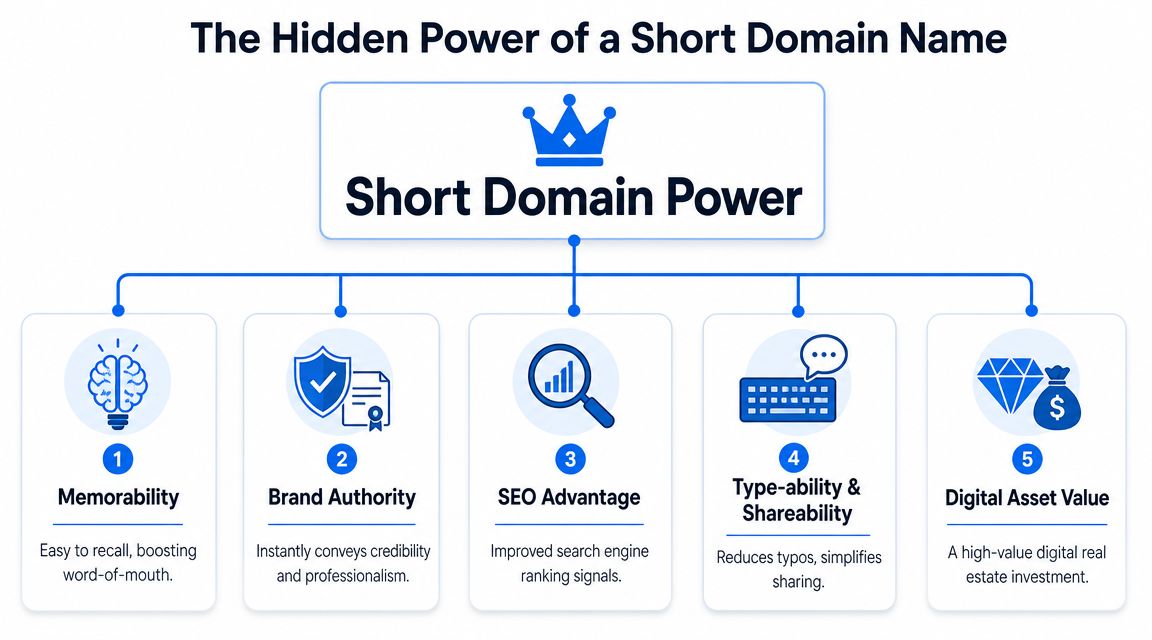
A good short domain is digital real estate. Not metaphorically cute real estate. Actual scarce, commercially useful real estate on the internet.
That's why serious buyers chase them so aggressively. The scarcity is brutal. There are only 676 possible two-letter .com combinations, and industry guides note that many two- and three-letter .com names sell for six to seven figures, while .com reached 157.2 million registrations as of March 2025 according to NameExperts.
What buyers are really paying for
People say short domains are valuable because they're memorable. True, but that's only the surface-level answer.
The deeper value usually comes from a stack of advantages working together:
- Cleaner branding. Short names look intentional. They feel established, even when the company is new.
- Less friction in speech. If someone hears the name once on a podcast, in a meeting, or at an event, they have a better chance of getting it right.
- Fewer typing mistakes. Every extra character creates room for confusion.
- Broader buyer pool. A short, flexible name can fit startups, agencies, apps, holding companies, niche sites, and investors.
- Stronger perceived authority. Fair or not, buyers and users often judge the business by the domain.
For founders, this goes beyond aesthetics. If you want a sharper breakdown of naming trade-offs, these domain insights for SaaS are useful because they frame the name as part branding decision, part business asset.
Why short beats clever
Clever names often age badly. Short names usually don't.
A domain investor learns this pretty quickly. The market rarely rewards over-explained domains stuffed with trend words, hacks, or forced spelling. It rewards names that are compact, usable, and easy to imagine on a logo, in a browser bar, or on a business card.
The best short domains feel obvious in hindsight. That's usually a good sign.
There's also a practical midpoint most buyers should target. If you're not shopping at the absolute premium end, four-letter domains are often where branding flexibility and realistic acquisition opportunities start to overlap. This guide to available four-letter domains is worth reading if you want examples of how investors think about that sweet spot.
SEO value needs a footnote
A short domain does not magically rank because it's short.
What it can do is make the brand easier to remember, easier to search for directly, and easier to trust. If the name also comes with a clean, aged history, then the domain may carry useful equity. That's where the real opportunity starts.
A short domain isn't a vanity buy when it checks those boxes. It's infrastructure.
Look Past Length Key Metrics for Finding a Gem
Length gets you onto the shortlist. Quality metrics decide whether the domain belongs in your cart.
Most beginners get smoked when they find a tidy three- or four-letter domain, assume scarcity equals value, and skip the boring part. Then they discover the domain used to host junk, attract terrible links, or bounce around owner to owner like a cursed baseball card.
As Atom notes in its short-domain marketplace overview, scarcity ramps up fast as names get shorter. Two-character strings are often fully allocated, three-character names are scarce and premium-priced, and that's why finders tend to focus on 3-to-5-character names. At that point, quality metrics become the separator.
The metrics that actually matter
You don't need to become a forensic analyst. But you do need to know what each signal is trying to tell you.
| Metric | What It Measures | Why It Matters |
|---|---|---|
| Domain age | How long the domain has existed | Older domains can be more credible, but age alone proves nothing |
| Referring domains | How many sites link to the domain | A broader link base can signal real history, or fake history if the links are junk |
| Trust-style metrics | The quality and trustworthiness of the link profile | Useful for spotting whether authority looks natural or manipulated |
| Authority-style metrics | A general estimate of domain strength based on backlinks | Helpful for comparison, but not enough on its own |
| Anchor text profile | The words other sites used when linking | Spammy anchors can expose old abuse fast |
| Drop history | Whether the domain has been repeatedly abandoned and re-registered | Frequent drops often suggest weak value or prior problems |
| Brandability | How usable the name is as a business asset | A domain can be clean and still be awkward, forgettable, or hard to pronounce |
How to read the signals together
Here's the trap. Buyers often see one strong metric and stop thinking.
That's a mistake.
A short domain with decent authority-style numbers but ugly anchors is risky. A nice-looking brandable with zero signs of abuse might still be a good buy for a startup even without inherited SEO value. A domain with age plus a natural-looking spread of referring domains can be attractive, but only if the old use makes sense and the history isn't weird.
Use metrics in combination:
- Age plus clean links can be useful
- Age plus spam anchors is not a bargain
- Strong authority plus weak brandability might fit SEO buyers, but not startup buyers
- Great brandability plus no history can still be worth registering if the use case is strong
Investor habit: Don't ask “Is this domain good?” Ask “Good for what?” Branding, SEO, resale, and lead generation buyers do not value the same thing.
Why composite scoring helps
This is where composite scoring systems earn their keep. A tool that blends age, link quality, authority, and brandability is more useful than a simple availability checker because it reduces false excitement. It helps you compare domains the way experienced buyers do, with multiple lenses at once.
If you want a deeper framework for pricing and evaluation, this guide on how to value domain names gives a useful investor-style lens.
The short version is simple. A short domain is only a gem when the history, metrics, and name quality line up.
The Hunt A Step-by-Step Discovery Workflow
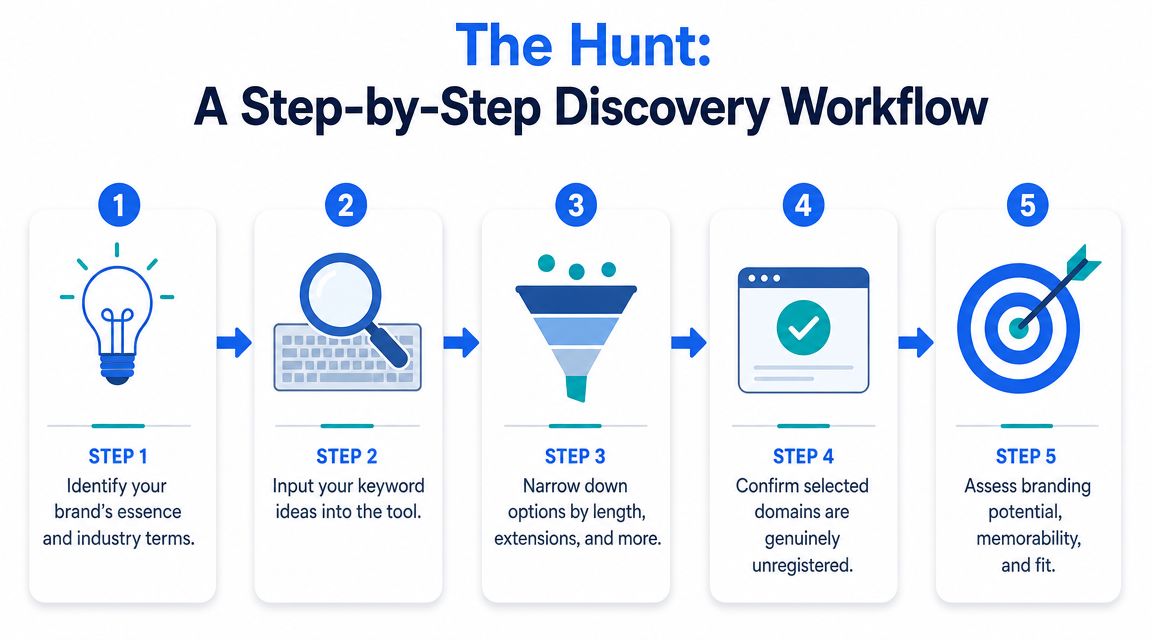
This is the part people love to overcomplicate. The workflow is simple. The discipline is the hard part.
Start with demand, not the domain. If you chase random short strings with no market logic behind them, you'll build a watchlist full of names that nobody wants.
Step 1: Build a search thesis
Don't brainstorm only “cool names.” Brainstorm buyer intent, niche language, and naming patterns.
For startup and brand buyers, that may mean:
- Pronounceable letter combos
- Clean four-letter patterns
- One-syllable sounds
- Industry-adjacent fragments
For SEO buyers, it may mean:
- Aged domains with clear past use
- Short names tied to commercially useful niches
- Expired assets with clean backlinks and obvious rebuilding potential
If your idea generation is weak, sharpen it first. This primer on keyword research strategies is helpful because it pushes you to think from demand and language, not just vibes.
Step 2: Split your hunt into two lanes
Treat available domains and expiring domains as different games.
Freshly dropped names can be registered immediately, which makes them ideal when you want speed and direct action. You can browse available domains when you want names that have already dropped and can be registered right away.
Expiring domains are different. They've expired but are still moving through the grace period before dropping. That gives you time to research, compare, and prioritize. You can track expiring domains when you want to get ahead of the public rush.
Step 3: Use time filters like a sniper, not a tourist
Most buyers drown because they search too broadly.
Time filters fix that. Looking at today's drops gives you the freshest inventory. Expanding to the last few days can help when you're searching by pattern, while a longer window helps if you're researching a niche or testing what types of names keep appearing.
Use short windows when you want:
- Speed
- Low clutter
- Fast daily review
Use wider windows when you want:
- Pattern recognition
- Better comparison
- Niche-specific prospecting
A lot of hunters miss good names because they only search once and never build a routine.
Here's a useful walkthrough before you start screening:
Step 4: Vet history before you get emotionally attached
The central idea of this article is that Availability is the easy part. Quality control is the crucial work.
As Dynadot's short-domain guide notes, most guides focus on availability, but the harder problem for SEO buyers and investors is checking whether the domain's history includes spam or malware risk. That means your workflow needs a due-diligence layer before you buy, not after.
Check for:
- Past site topic alignment. Did the domain previously host something legitimate and coherent?
- Backlink sanity. Do the links look earned, or do they scream manipulation?
- Anchor text weirdness. Pharma, casino, adult, and hacked-language anchors are obvious warnings.
- Brand fit. Could a real business use this without explaining it three times?
- Trademark tension. If a name looks too close to someone else's brand, move on.
A short domain that needs a paragraph of explanation is not a brand asset. It's a compromise.
Step 5: Keep a shortlist and act fast
Good names disappear because buyers hesitate after doing all the right research.
Keep a shortlist with simple labels like:
- Buy now
- Watch
- Good brand, weak SEO
- Good SEO, weak brand
- Needs deeper history check
If expired inventory is part of your strategy, this guide to an expired domain finder adds context on how investors approach those opportunities.
The workflow isn't glamorous. It is effective.
Red Flags to Watch For Before You Buy
The domain market has a special talent for making bad assets look exciting. Short names are especially dangerous that way because scarcity makes people lower their standards.
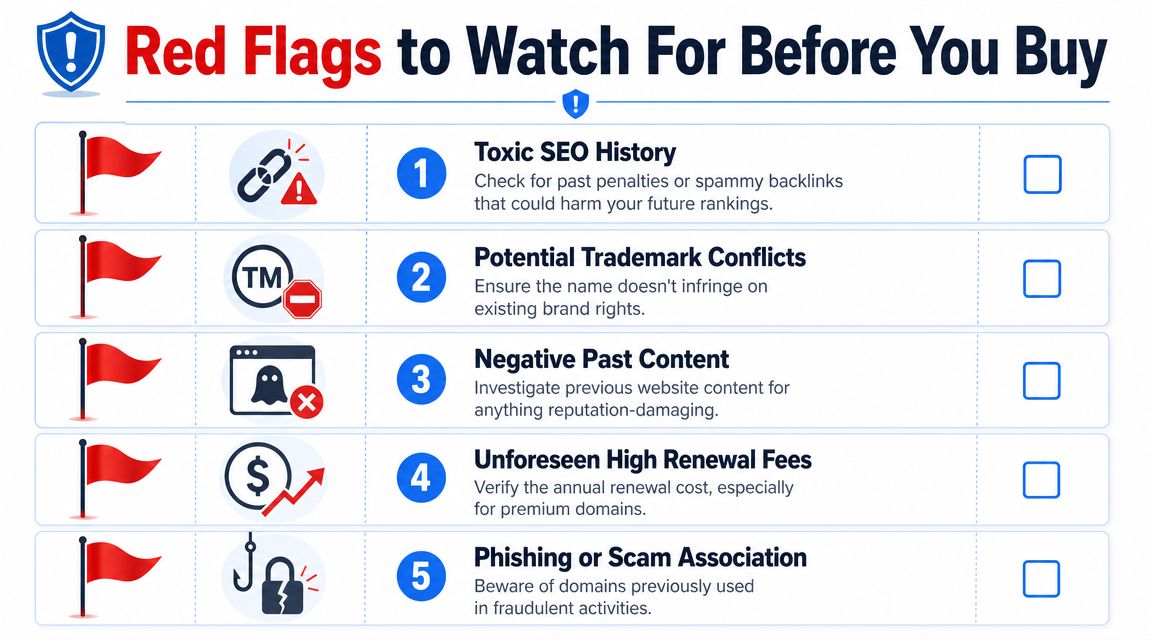
That's why you need a kill list. Not a wishlist. A kill list.
The five red flags that matter most
The best tools speed up the search because speed matters. Instant Domain Search says a system can check availability across 800+ extensions in about 25 ms, which is why fast filtering matters when competition is tight and inventory moves quickly on Instant Domain Search. But fast search is only useful if you also know when to stop yourself from buying.
Here's what should make you pause.
- Toxic SEO history. If the backlink profile is full of obvious junk, inherited trust can turn into inherited damage.
- Trademark collision risk. If the name leans too close to an existing brand, legal headaches can wipe out any upside.
- Bad past content. Old use matters. Scammy, offensive, or deceptive history can poison a domain's future.
- Surprise renewal costs. Some buyers focus so hard on acquisition that they ignore what it costs to keep the asset.
- Phishing or fraud associations. If a domain was previously used for shady activity, rebuilding trust is an uphill fight.
Quick screening habits that save money
You don't need an elaborate ritual. You need a few ruthless habits.
Check the old use
Look at archived versions if they're available. Was this a real business, a parked page, a churn-and-burn affiliate site, or something worse? Context matters more than fantasy.
Scan the anchors
A quick anchor text review can kill a bad idea in minutes. If the profile looks unnatural, the domain probably isn't a hidden gem. It's just hidden damage.
Say the name out loud
This catches weak brandability fast. If the name sounds awkward, confusing, or impossible to spell when spoken, it won't get easier after you buy it.
Cheap domains are expensive when you have to replace them later.
The contrarian move
Most buyers think the win is finding a short available domain before someone else does.
The key win is rejecting the bad ones faster than everyone else.
That's the edge. Not excitement. Not FOMO. Judgment.
Go Find Your Perfect Short Domain
A short domain finder is useful. But the finder is not the strategy.
The strategy is knowing what kind of asset you're trying to buy, filtering aggressively, and refusing to confuse scarcity with quality. This is a common pitfall. The assumption is that the hunt ends when a short name is found. In practice, that's when the actual evaluation starts.
The best short domains do more than look clean in a browser bar. They support branding, make trust easier, improve resale appeal, and sometimes carry useful SEO value if the history checks out. The bad ones waste time, money, and momentum.
Keep your standards high:
- Short is good
- Clean is better
- Brandable and clean is where the magic starts
- Brandable, clean, and historically sound is where real value lives
If you're buying for a startup, think about memorability and flexibility. If you're buying for SEO, think about history and link quality. If you're buying for resale, think about who the next buyer is and why they'd want it.
That mindset turns domain hunting from guesswork into a repeatable process.
If you want a faster way to surface strong opportunities without digging through junk manually, NameSnag is worth a look. It's built for buyers who care about more than availability, with tools for spotting valuable available and expiring domains, filtering by quality signals, and narrowing the list before someone else grabs the good stuff.
Find Your Perfect Domain
Get access to thousands of high-value expired domains with our AI-powered search.
Start Free Trial