
If you're thinking about planting a flag in China's digital market, just translating your website won't cut it. You need a strategic digital footprint, and your first, most critical move is securing a .cn domain. It’s more than a web address—it's a powerful signal of commitment to over a billion internet users.
This isn't just about appearances. A country-code top-level domain (ccTLD) like .cn immediately tells Chinese consumers you’re serious about their market. It builds instant trust in a place where local presence is currency. You'll find that businesses using .cn domains are often seen as more reliable and authentic than those sticking with a generic .com.
Why a .CN Domain Is Your Key to the Chinese Market
Here's a quick summary of who can register a .cn domain and the typical documentation needed to get started.
Quick Glance .CN Domain Registration Requirements
| Registrant Type | Eligibility | Required Documentation |
|---|---|---|
| Individual | Chinese Citizens | National ID Card (身份证 or shēnfènzhèng) |
| Individual | Foreign Nationals | Passport |
| Company | Chinese Businesses | Business License (营业执照 or yíngyè zhízhào) |
| Company | Foreign Businesses | Business Registration Certificate |
Keep in mind, these are the basics. The real legwork starts with the verification process, which we’ll get into.
The Baidu SEO Advantage
One of the biggest wins you get with a .cn domain is a serious performance boost on local search engines, especially Baidu. Chinese search algorithms are wired to favor websites that show a clear connection to China, and a .cn address is an unambiguous signal of local relevance.
This isn't a minor tweak. It can lead to:
- Faster Indexing: Baidu’s crawlers often prioritize .cn domains, getting your site into search results much quicker.
- Higher Rankings: A .cn domain can be the tie-breaker that pushes you ahead of competitors with .com or other generic TLDs.
- Better Click-Through Rates: Chinese users just trust a .cn link more. It feels familiar, and they’re more likely to click it.
That SEO benefit alone is often enough to justify the effort. It gives you a competitive edge that's incredibly difficult to get otherwise.
A Market Ripe with Opportunity
The sheer scale of China's digital economy creates some incredible opportunities, not just for entrepreneurs but for domain investors, too. The .cn domain has become the world's most registered ccTLD, with over 21 million registrations. That kind of volume means a constant churn of newly available and expiring domains—a goldmine if you know where to look.
For savvy investors, this isn't just about quantity; it's about quality. The sheer number of active businesses means a steady supply of aged domains with clean histories and valuable backlinks from authoritative Chinese sites hitting the market.
To really penetrate the Chinese market, your .cn domain is just the start. You'll often find yourself needing local services that require verification, where tools like temporary phone numbers for Chinese online services become surprisingly crucial. Whether you're building a brand from scratch or hunting for undervalued digital assets, the .cn ecosystem is a dynamic and rewarding landscape if you play your cards right.
Mastering the .CN Registration Process
Alright, let's get down to brass tacks. You're ready to domain register cn and plant your flag. This isn't like grabbing a .com during your lunch break; it's a process with its own set of rules, and the biggest gatekeeper is something called Real-Name Verification.
Think of it as the bouncer at the club. It's a mandatory check required by the China Internet Network Information Center (CNNIC), and it's non-negotiable. Get this wrong, and your domain is dead on arrival. It simply won't resolve. A little prep work here will save you a world of hurt later.
Registering a .cn domain is just one piece of a much larger puzzle for entering the Chinese market. It’s a foundational step that opens the door to better local SEO and, more importantly, building trust with Chinese consumers.
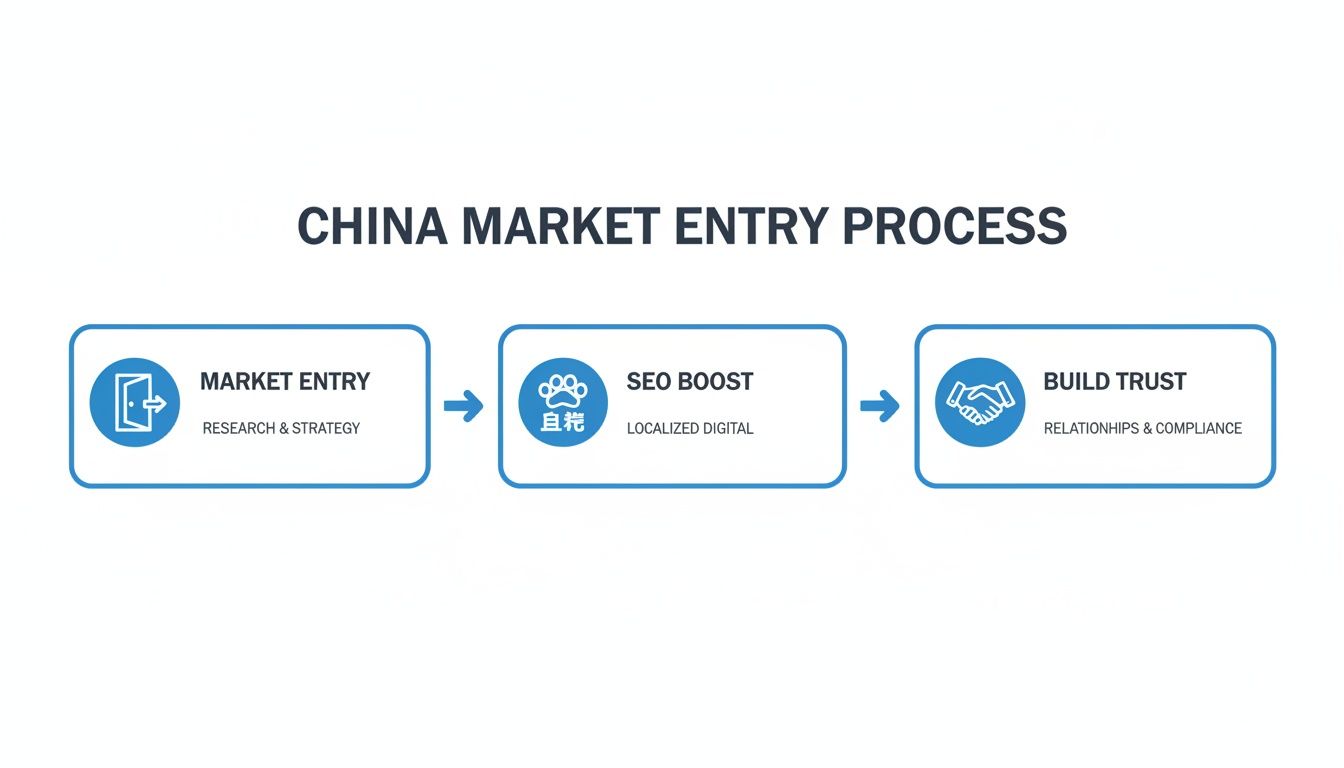
As you can see, it's a key that unlocks the next stages. So let's get it right.
Clearing the Real-Name Verification Hurdle
The secret to sailing through verification is being ridiculously meticulous. The documents you submit need to be perfectly clear and match your registration info to the letter. A single typo or a blurry ID scan is a guaranteed rejection, sending you right back to square one.
Here’s the specific documentation you'll need:
- For Individuals: If you're not a Chinese national, your passport is the key. You'll need a high-quality, full-color scan where every single character is crisp and legible. Chinese citizens will provide their national ID card (身份证).
- For Businesses: A foreign company needs to show its business registration certificate. This is your Certificate of Incorporation, Articles of Organization, or whatever the official equivalent is in your home country.
A critical tip from years of seeing this go wrong: Don't get cute with company names. If your legal entity is "Global Innovations Ltd.," your registration must be for "Global Innovations Ltd." Not "Global Innovations" and definitely not "GI Ltd." The system is automated, and any discrepancy will get flagged for an immediate failure.
The waiting game for approval varies. A Chinese registrant might get the green light in 24-72 hours. As a foreign entity, you should budget for 5-7 business days. This is where your choice of registrar really starts to matter.
Choosing the Right Registrar for .CN
Not all registrars are built the same, especially when you step outside the world of .com. To domain register cn, you absolutely need a registrar that lives and breathes CNNIC's rules, not one that treats it as an exotic afterthought. A generic registrar might sell you the domain, but they'll be useless when your verification gets stuck in limbo.
Here's what I look for in a registrar for .cn domains:
- CNNIC Accreditation: Make sure they're an officially accredited partner. This isn't just a logo; it means they have a direct relationship with the registry and actually understand the process.
- Proven Foreigner-Friendly Process: Ask them point-blank about their experience with foreign companies. Do they have clear guides? Is their support team trained to handle passport and international business certificate submissions?
- Knowledgeable, Responsive Support: Before you spend a dime, test their support. Ask a specific question about Real-Name Verification. If you get a canned response or someone who sounds confused, run.
- Trustee Services (A possible shortcut): While not as necessary as it once was for foreign registrants, some registrars offer a "local agent" or trustee service. This can sometimes smooth over unique compliance issues, but for most, it's overkill.
Picking the wrong registrar can mean weeks of frustrating back-and-forth. The right one makes the process feel almost as straightforward as any other domain registration.
Demystifying the ICP License and Hosting
Finally, let's tackle the big, scary monster in the room: the ICP License. You've probably heard about it, and it sounds like a bureaucratic nightmare.
Here’s the deal: An ICP (Internet Content Provider) license is only required if you plan to host your website on a server inside mainland China.
Read that again. It's a critical distinction. You can absolutely register a .cn domain and point it to a server in Hong Kong, Singapore, Los Angeles, or London. If you do that, you do not need an ICP license. This is the go-to strategy for companies that are testing the Chinese market or primarily targeting customers from outside the mainland.
However, if you're dead serious about the best possible site speed and SEO performance within mainland China, local hosting is the endgame. That path involves setting up a Chinese business entity and then applying for an ICP license. It's a much bigger commitment, but it's standard procedure for any major player.
For now, just know that owning the .cn domain itself doesn't force you into the ICP process. Your hosting decision is what pulls that trigger.
The Investor's Playbook for Finding Hidden .CN Gems

Alright, this is where the real fun begins. If you’re a domain investor, affiliate marketer, or SEO pro, registering a brand-new .cn domain is just one way to play the game. The more thrilling path—and often the one that pays off big—is hunting for aged domains that already have some history.
Why start from scratch when you can jump right to level ten?
The expired domain market is a high-reward game, and that’s especially true in the .cn space. You’re sifting through dropped properties to find a forgotten mansion with solid foundations.
This isn’t just about finding old domains; it's about finding valuable old domains. Many of them come packed with powerful backlinks, established traffic, and an age that search engines like Baidu already trust. This gives you a massive head start, whether you're building a niche site, a private blog network, or just flipping the domain for a quick profit.
Riding the Market Waves
The .cn domain market is anything but calm. It's a turbulent ocean, and for a savvy investor, that volatility is a goldmine. China’s domain landscape sees wild swings, driven by everything from economic shifts to the registry’s own semi-annual purges of non-compliant domains.
Take the second half of 2025, for example. .cn registrations blew up by over 1.2 million, while the global .com market actually shrank. This surge came right after a period where millions of domains were wiped from the registry. This constant churn means a steady stream of expired .cn domains—many with real authority—are hitting the market every single day. For a smart investor, that chaos is just opportunity knocking.
Hunting for Gold with NameSnag
Let’s be real: manually tracking thousands of dropping domains is a fool's errand. This is where a tool like NameSnag becomes your best friend. Instead of getting lost in endless spreadsheets, you can use smart filters to zero in on domains that actually fit your strategy.
The two filters you'll live by are Expiring and Available.
- Expiring domains are the gems in their grace period. The owner forgot to renew, and the clock is ticking. This is your chance to research and get ready to pounce the second they drop. You can find these domains on NameSnag by heading to the expiring domains list.
- Available domains have already dropped and are ready for immediate registration at any registrar. No waiting, no auctions. Just find, vet, and grab. You can snap these up right now from the available domains list.
From there, you can narrow your search with timeframes like "Today," "3 Days," or "7 Days" to catch the freshest drops before the competition even wakes up.
Pro Tip: Don't get seduced by a good name. The real value is in the domain's history. An aged domain with a killer name might have been used for spam, which will absolutely torpedo its SEO value. Always, always do your homework.
Figuring Out What a Domain Is Really Worth
Finding a dropped .cn domain is the easy part. The real skill is in the evaluation. A pretty name is worthless if its past is toxic.
Here's a quick mental checklist for sizing up a potential .cn acquisition:
- Check the Backlink Profile: Is it loaded with quality links from relevant Chinese sites, or is it a mess of spam from junk blogs? NameSnag's integrated metrics can give you a quick read on this.
- Look at Its Past Life: Use the Wayback Machine (Archive.org) to see what the site used to be. Was it a legit business, a personal blog, or a spam-filled link farm? If you see anything shady, just walk away. It’s not worth the headache.
- Search for Penalty Flags: Has the domain been slapped by Google or Baidu? A penalized domain is a reclamation project, not an investment. NameSnag’s built-in spam checks are a great first line of defense here.
By combining the discovery power of NameSnag with a disciplined vetting process, you move beyond just registering domains. You become a strategic investor, snapping up digital assets that already have value baked in. While some domains are worth backordering, many of the best finds are won in the trenches of online auctions. Getting familiar with the top domain auction sites will give you a huge advantage in securing those high-value .cn domains.
Getting Your .CN Domain Ready for the Long Haul
So you've jumped through all the hoops and finally snagged your .cn domain. Good. But don't pop the champagne just yet. Owning the domain is just the entry ticket; now you have to make sure it actually works and, more importantly, that you don't lose it.
Your first job is to get your Domain Name System (DNS) records pointed in the right direction. DNS is essentially the internet's giant address book, telling browsers how to find your website. Once you update the settings at your registrar, the changes have to spread across the globe in a process called propagation.
This can take a few minutes or drag on for up to 48 hours. My advice? Don't sit there hitting refresh. Go do something else. The internet works at its own pace, and you can't rush it.
The Unique Headaches of a .CN Domain
Owning a .cn domain comes with its own set of rules you won't find with your average .com. The CNNIC registry takes compliance very seriously, with a major focus on stamping out fraud. They conduct periodic checks to make sure the site's content actually matches what you claimed during registration. This is not a drill.
What this means for you is that you can't just register a domain for an e-commerce shop and then turn it into a gambling site six months later. If your site's purpose drifts too far from what you declared, you’re practically begging for a manual review, and that’s a headache you don’t want.
The number one reason a .cn domain gets suspended isn't some technical bug; it's a compliance screw-up. The registry will flag a domain if the content looks fraudulent, breaks Chinese law, or completely mismatches the owner's verified identity. Keeping your domain is all about being transparent and consistent.
The best way to avoid trouble is simple: keep your registration info current and make sure your site's content stays in its lane. It’s a bit of administrative hygiene that will save you from a world of pain. If you want to get into the weeds on how DNS ties this all together, you can learn more about DNS entries in our detailed guide.
Managing the Lifecycle: Renewals and Transfers
A domain isn't a "buy it and forget it" asset. It’s something you have to actively manage, and the two most critical moments are renewal and transfer. Messing these up is the fastest way to lose your domain for good.
Staying on Top of Renewals:
- Turn on Auto-Renew: This is non-negotiable. It’s your first and best defense against accidentally letting your domain expire because you missed an email.
- Set Your Own Reminders: Don't just trust your registrar. I set calendar alerts for 90, 60, and 30 days before any important domain expires.
- Update Your Payment Method: An expired credit card is the silent killer of auto-renewals. Make it a yearly habit to check that your payment information is still valid.
Moving Your Domain
Sooner or later, you might want to sell your .cn domain or just switch to a registrar you like better. The transfer process is mostly straightforward, but it demands attention to detail. First, you'll need to unlock the domain at your current registrar and get an authorization code, often called an EPP code.
You hand that code over to the new registrar, and they kick off the transfer, which usually takes about 5-7 days. You'll get a flurry of confirmation emails that you have to click to approve. Don't ignore them.
This process is also why you'll see valuable domains pop up in a "grace period" after expiration. It's the perfect window to add a domain to your watchlist on NameSnag's expiring domains list and be ready to pounce the second it drops.
Advanced Strategies for Monetizing and Flipping .CN Domains
Alright, so you’ve figured out how to register a .cn domain without getting tangled in the red tape. Now what? Owning a domain is one thing; turning that digital real estate into actual money is a completely different ballgame. This is where we move past the basics and into the strategies that separate the hobbyists from the serious investors.
The goal isn't just to snag a name you think is cool. We're talking about acquiring domains with proven, built-in value and knowing exactly how to package them for a sale or build on them for a long-term return. It’s a game of foresight, deep research, and frankly, having the right tools to find the gems before the rest of the market does.
Beyond Basic Metrics in Domain Valuation
Look, valuing an expired .cn domain is more art than science, and it goes way beyond just glancing at its Domain Authority or backlink count. Those metrics are a decent starting point, but the real money is made when you understand the quality and context behind those numbers. A domain with 10 solid links from trusted Chinese industry sites blows one with 100 links from spammy forums out of the water. It’s not even a contest.
When you’re sizing up a potential flip, you need to play detective. Ask yourself a few critical questions:
- What was its past life? Fire up the Wayback Machine and see what the site actually was. Was it a legitimate business? A well-read blog? Or just a parked page that someone forgot about? A history of real, quality content is a huge green light.
- Who is linking to it? This is huge. Are the backlinks from authoritative sources inside China? Links from educational sites (edu.cn) or government bodies (gov.cn) are the absolute gold standard. Even links from respected commercial sites in your niche carry serious weight.
- Is the name itself any good? A short, memorable, keyword-rich .cn domain is the holy grail. Think about it from a buyer's perspective: how easily could a new company build a brand on this name?
A critical piece of the puzzle—and I can't stress this enough—is the domain's history with Baidu. A domain that's been penalized is a toxic asset. It's like buying a beautiful car with a salvaged title; you might get it running, but it's never going to be worth what you put into it. A clean history is non-negotiable.
Spotting the Red Flags of a Penalized Domain
A penalized domain is a money pit, plain and simple. The problem is, the warning signs aren't always blinking in bright neon. The most common red flag I see is a massive, unnatural-looking backlink profile that seemingly appeared overnight and then vanished just as quickly. That screams past spamming activity.
Another dead giveaway is a history of hosting shady content. If the Wayback Machine shows the domain was ever home to gambling, a link farm, or anything else that violates Chinese internet regulations, you need to walk away. Fast. The risk of that penalty sticking to the domain is just too high to gamble on. This is exactly why a tool with built-in spam checks is so essential—it’s your first line of defense against buying a worthless asset.
Gaining an Edge with Automated Alerts
In the domain flipping world, speed is everything. The best .cn domains—the ones that are practically guaranteed profit—are often snatched up within minutes of dropping. Manually sifting through expiring lists every day is a recipe for burnout and missed opportunities. You have to work smarter, not harder.
The only effective strategy is setting up automated alerts. Using a platform like NameSnag, you can create "Watchers" for the exact criteria that fit your investment model. This is the part that feels like a superpower.
For example, you can get an instant notification the moment a .cn domain with specific keywords, a minimum number of backlinks, or a certain age is about to expire. Imagine setting an alert for any expiring domains containing the word "shanghai" with over 20 referring domains. The second a domain matching that profile hits its grace period, your phone buzzes. This gives you a massive head start to do your due diligence and get ready to pounce. The same applies to names that have just dropped and are on the available domains list, ready for immediate registration.
This automated approach shifts you from being a passive browser to an active hunter. You’re no longer picking through the leftovers; you're first in line for the prime cuts. For anyone serious about the art of buying and selling digital real estate, our guide on how to flip domains for profit offers even more battle-tested tactics. This kind of proactive monitoring is the secret weapon that separates the dabblers from the investors who consistently lock in high-ROI domains.
A Few Lingering Questions About .CN Domains
Got a few questions still rattling around? Let's get them sorted. These are the common sticking points I see people run into when they first dive into the world of domain register cn.
Can a Foreigner Really Register a .CN Domain?
Yes. Full stop. The old myth that you need to be a Chinese citizen or have a local company is just that—a myth. It's long outdated. Foreign individuals and companies can absolutely register .cn domains.
The one thing that's non-negotiable is the Real-Name Verification (RNV) process. It sounds intimidating, but it's usually straightforward. For an individual, you'll need to upload a clean, color scan of your passport. For a business, it’s a copy of your business registration certificate.
An experienced registrar makes this whole ordeal surprisingly painless. A bad one can make it a nightmare. Choose wisely.
Do I Need an ICP License to Use My .CN Domain?
Here's the simple rule: you only need an ICP (Internet Content Provider) license if you plan to host your website on a server inside mainland China.
If you point your .cn domain to a server anywhere else—Hong Kong, Singapore, the US, wherever—you do not need an ICP license. This is an extremely common strategy for companies who want the SEO and branding power of the .cn TLD without getting tangled in the administrative net of Chinese hosting.
Think of your hosting location as the trigger. The ICP license isn't tied to the domain name itself; it’s a permit for the server's physical location.
What Happens If My Real-Name Verification Fails?
If your RNV gets rejected, your domain's DNS just won't resolve. In plain terms, your website will be dead in the water, and your domain will be stuck in a useless limbo state until you fix it.
Don't panic, though. Any decent registrar will ping you right away and let you resubmit your documents. The most common reasons for failure are almost laughably simple:
- A blurry, low-quality scan of your ID or business license.
- The information on your document doesn't exactly match the details you used for registration.
My advice? Triple-check every character before you hit submit. It’ll save you a world of headache and delays.
Is It Better to Register a New .CN Domain or Buy an Expired One?
This is the classic "build versus buy" dilemma, and there's no single right answer. It comes down to your goals.
If you’re a new business building a brand from scratch, a fresh, clean domain is the way to go. It’s a blank slate.
But for an SEO strategist or a domain investor, an expired domain can be a goldmine. Finding a dropped .cn domain with an existing backlink profile and a clean history can give you a massive, immediate head start. It’s like buying a house where someone else already did all the landscaping for you.
The real trick is finding those gems without drowning in a sea of worthless, spammy names. Doing it manually is a fool's errand. You can spot domains that just became available by checking the available domains list on NameSnag, or you can get a jump on the competition by watching the expiring domains list. This is how the pros work efficiently.
Ready to find your own hidden .cn gems? NameSnag uses AI to analyze over 170,000 domains daily, filtering out the junk to show you expired and expiring domains with real SEO value. Start your search and snag your perfect domain today at https://namesnag.com.
Find Your Perfect Domain
Get access to thousands of high-value expired domains with our AI-powered search.
Start Free Trial