You open an expired domain list, sort by authority, and immediately hit the usual junkyard. Casino anchors. Weird pharma history. Trademark bait. Domains that looked strong in a dashboard but fall apart the second you inspect the backlinks.
Then one shows up that makes you stop scrolling.
The name is clean. The old topic makes sense. The links look like they came from real sites, not automated sludge. That is the moment people get hooked on traffic from expired domains. Not because every expired domain is valuable. Most are not. It is because a small minority still carry something useful: relevance, links, and enough residual demand to justify the buy.
The catch is that expired domain traffic is full of mirages. Historical estimates get mistaken for current visitors. Vanity metrics get confused with recoverable value. Buyers pay for the memory of traffic, not the ability to earn it again.
That is where the edge lives. The game is not finding a domain that used to rank. The game is finding a domain whose old signals can still be converted into something useful today.
The Treasure Hunt for Ghost Traffic
Open any expired-domain feed during a busy drop window and the pattern shows up fast. Hundreds of names look promising for ten seconds. Then the history check starts. Old spam. Broken relevance. Link profiles that only worked in a previous SEO cycle. The market is active because a few domains still carry recoverable value, but the lists are packed with names that only preserve the memory of traffic.
This is the core challenge.
Expired domains get so much attention because buyers are chasing remnants that can still be turned into visits, rankings, or resale value. Tools such as NameSnag scan large daily inventories to help sort that volume, but volume alone does not create opportunity. It creates more junk to filter.
The mistake newer buyers make is simple. They pay for proof that a domain mattered once. What matters now is narrower and more useful. Did the site serve a real audience. Is the old topic still clear. Do the surviving backlinks come from pages a human would have created for a real reason. Can the name itself still earn clicks, trust, or type-in traffic after the old site is gone.
Surface metrics hide that difference. A domain can show authority, old ranking data, and a decent link count, then collapse under inspection because the links point to deleted pages, the anchors were manipulated, or the site changed topics three times before it dropped.
The domains worth buying usually feel boring in the best way. Clean topic. Plausible link history. Sensible referring pages. No obvious legal baggage. No weird pivot from gardening to crypto to pills. That kind of consistency is what gives you a chance to recover value instead of inheriting someone else’s mess.
I treat expired domains like distressed assets. The upside is real, but only if the underlying structure still holds. A clean shell with reusable demand is worth far more than a flashy report full of dead rankings.
That mindset changes how you evaluate deals. The question is not whether a domain used to get traffic. The question is whether any of that old demand can still be captured today through a rebuild, a redirect, or a brandable name with enough residual interest to justify the buy.
Ghost Traffic vs Real Visitors
A buyer opens Ahrefs or SEMrush, sees a domain that used to rank, and assumes those visitors are still there for the taking. That is how people overpay.
Expired domain traffic splits into two buckets. One is old reporting data that describes what the site did before it died. The other is traffic you can still capture now through live backlinks, residual type-ins, or a rebuild that matches the domain’s original topic. The whole job is separating those two before you bid.
What ghost traffic looks like
Ghost traffic shows up in reports far more often than it shows up in your analytics.
It usually includes:
- Historical keyword estimates from a period when the site was still indexed
- Backlinks to dead URLs that make the profile look stronger than the recoverable traffic really is
- Old brand demand that has faded to a weak trickle
- Referral opportunities that only become useful again if you restore the right pages or redirect with care. Expired domains can fake scale in third-party tools, making this a vital consideration.
What real visitors look like
Real visitors leave a trail you can verify today.
They come from live pages that still link out. They come from people typing the name directly because it is memorable or still known in a niche. They come from relevant pages you can realistically recreate so old links have somewhere useful to land again.
That is a narrower opportunity than the sales pitch suggests. It is also where the money is.
| Traffic type | Recoverable | What to check |
|---|---|---|
| Referral traffic | Sometimes | Are the linking pages still live, relevant, and capable of sending clicks? |
| Direct or type-in traffic | Sometimes | Does the name still have clear brand memory or keyword intent? |
| Organic search traffic | Gradually | Can the site be rebuilt around the same topic with pages worth indexing again? |
| Authority value | Often | Does the backlink profile still support a rebuild or a tightly matched redirect? |
The practical test
I do not buy a domain because a chart says it had traffic two years ago. I buy it when I can point to specific paths a visitor could still take today.
Open the backlink profile. Click through the best links manually. Check whether those pages are indexed, relevant, and likely to send humans, not just SEO value. Then compare that with the old site structure in Archive.org. If the strongest links point to pages you can rebuild cleanly, the domain may have real recovery value. If everything important points to deleted junk, ghost traffic is doing the selling for the seller.
A good expired domain finder workflow helps here, but the principle stays the same. Verify current pathways, not historical screenshots.
The mistake that burns buyers
Buyers get trapped when they treat reported traffic as transferable traffic.
What they are usually buying is a chance to recover part of the demand, not the demand itself. Sometimes that chance is worth a lot. A relevant redirect can pick up authority. A faithful rebuild can reclaim referral clicks and earn search visibility again. A strong name can still collect direct visits. But those are earned outcomes, not assets that arrive intact on day one.
Key takeaway: Pay for recoverable traffic paths, not old SEO graphs.
Your Toolkit for Finding Digital Gold
The difference between a bargain and a mistake is usually visible in the first few minutes of review. The trick is knowing where to look.
Start with link quality, not vanity metrics
The first metric I trust is not Domain Authority. It is the relationship between Trust Flow and Citation Flow.
A verified source states that a TF greater than or equal to CF is a strong quality signal, and that setup correlates with 2 to 5 times faster ranking gains. The same source recommends a minimum of 20 referring domains and a domain age of 5 to 10+ years when evaluating trust and authority (expired domain analysis tutorial).
That matters because expired domains can fake scale more easily than they can fake trust.
A bloated backlink profile with weak trust usually means one of two things. Either the domain was spammed, or it attracted low-grade links that do not hold much value after acquisition.
The quick screen I use
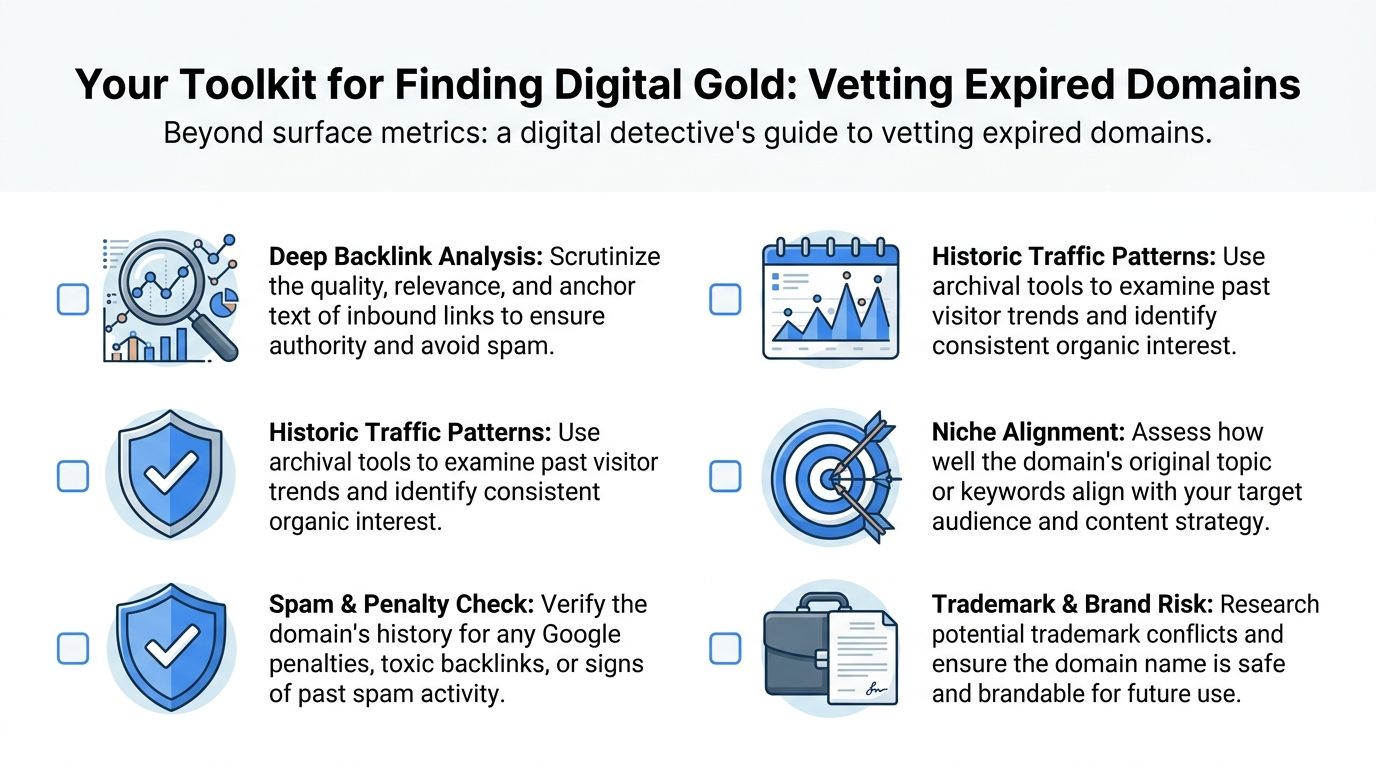
When I review a domain, I want answers to five questions fast:
Does the backlink profile look earned? Real links usually come from relevant articles, resource pages, local sites, industry blogs, or legitimate mentions. If the profile looks machine-made, I move on.
Do the anchors match the old topic? Anchors should feel natural. Branded phrases, URL anchors, and descriptive niche terms are fine. Gambling, pharma, foreign-language mismatches, and obvious money-keyword stuffing are danger signs.
Did the site used to be real? The Wayback Machine is still one of the fastest sanity checks in the business. If the domain was a real company, publication, project, or community site, that is a good start. If it changed topics repeatedly, caution goes up.
Does the topic align with my intended use? Relevance is not optional. If the old site was about landscaping and you want to use it for software, the leftover value gets much harder to preserve.
Is the name safe to use? Trademark risk can turn a “great find” into a legal headache. If the domain is obviously tied to a living brand, skip it.
The ten-minute vetting stack
A practical review does not need to be complicated. It needs to be disciplined.
- Backlink tools first: Check trust, referring domains, and anchor text.
- Archive second: Inspect what used to live on the domain.
- Search visibility history: Look for stable past performance, then ask whether the decline looks natural or suspicious.
- Brand risk check: Eliminate obvious infringement issues.
- Intent match: Decide whether this is a redirect candidate, a rebuild candidate, or not worth touching.
If you want a focused walkthrough on sourcing candidates before this vetting step, this expired domain finder guide is a useful companion read.
What often disqualifies a domain
I reject a lot of domains for reasons that never show up in a “top metrics” export.
Here are common deal-breakers:
- Topic drift: The domain was a business site, then a coupon site, then a crypto blog.
- Anchor pollution: The domain’s strongest anchors are irrelevant or spammy.
- Weak trust balance: Citation Flow outpaces Trust Flow by too much.
- Unclear history: Archive snapshots are sparse, broken, or look manipulated.
- Brand baggage: The name depends on someone else’s trademark or identity.
Tip: A domain with fewer but cleaner links usually beats a louder domain with a dirty profile.
The best buyers are not better at finding volume. They are better at saying no.
The Two Paths Rebuilding vs Redirecting
Once you land a clean domain, the next decision shapes the return. Most of the value comes from execution, not acquisition.
Redirect for amplifying sites
A 301 redirect is the fast path.
According to the verified data, a 301 redirect can transfer approximately 90 to 100 percent of link equity when niche relevance is maintained. The same source includes a case where a site’s Domain Authority rose from 15 to 30 and organic traffic increased by 45 percent within six months after a properly matched redirect (301 redirect use of expired domains).
That is the upside. The catch is relevance.
If the expired domain’s old topic and your target page are tightly aligned, a redirect can work beautifully. If the fit is loose, search engines may ignore much of the value or treat the move as manipulative.
Rebuild when the domain deserves its own life
Rebuilding is slower, but often cleaner.
This path makes sense when the domain name is strong, the old topic still has room to grow, and you want a standalone asset instead of a support play for another site. A rebuild also gives you more control over how old backlinks reconnect to useful pages.
How the trade-off looks in practice
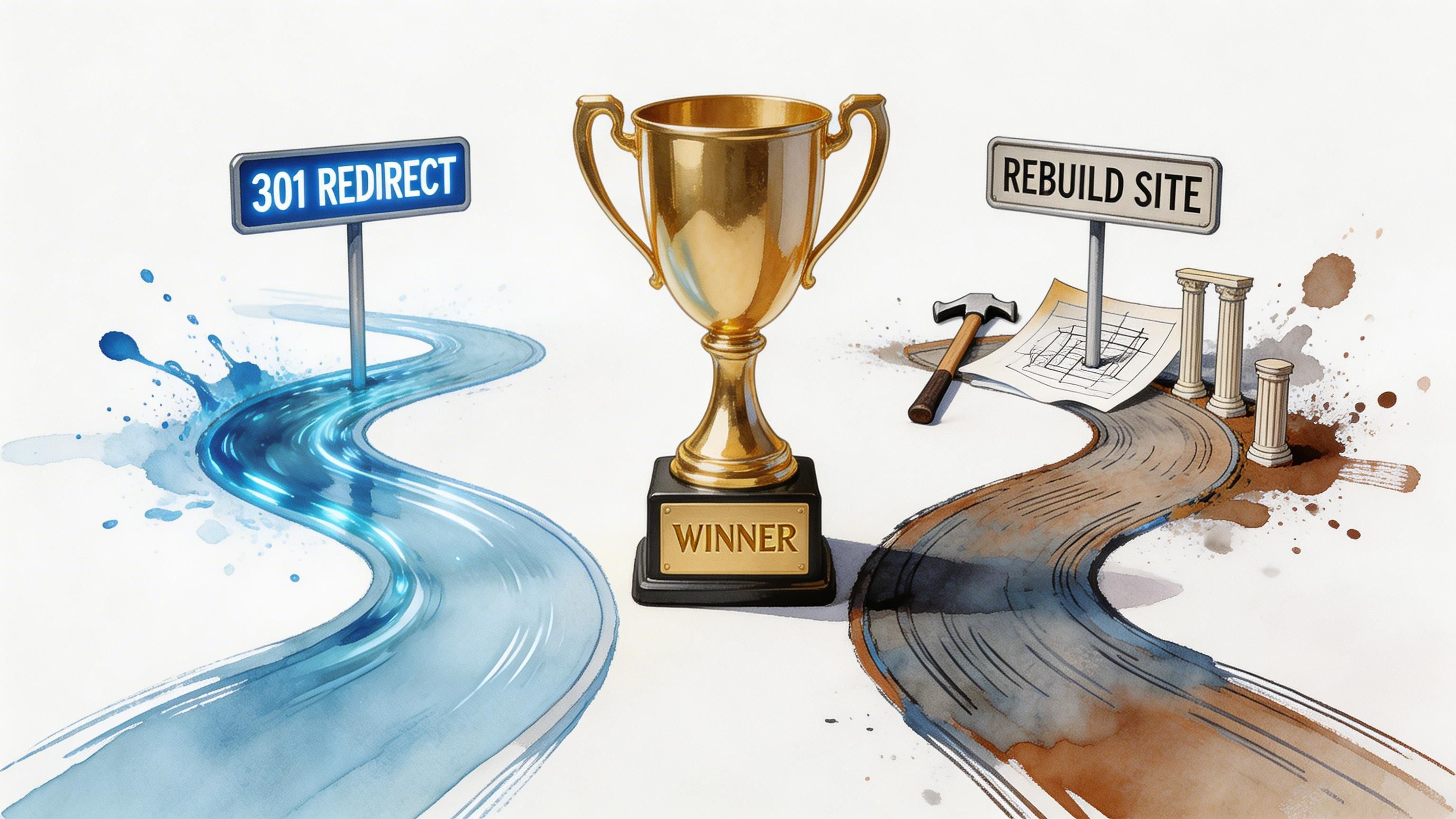
| Path | Best for | Main upside | Main risk | |---|---|---| | 301 redirect | Supporting an existing site | Faster authority transfer | Relevance mistakes waste value | | Rebuild | Creating a standalone asset | More long-term control | Requires more content and maintenance |
The decision rule that keeps things simple
Choose redirect when all three are true:
- The old niche strongly matches your current site
- The strongest legacy links point to pages you can sensibly map
- The domain name itself is not worth building into a brand
Choose rebuild when one of these is true:
- The domain name is brandable
- The old topic has independent monetization potential
- The backlink profile is good, but the fit with your current site is not close enough for a clean redirect
Key takeaway: Redirects are efficient. Rebuilds are flexible. The wrong choice in either direction burns the value you paid for.
From Niche Sites to PBNs Whats Your Goal
How you use an expired domain should follow the business model, not the other way around.
A verified case study of over 7,000 sold expired domains found that 64% were repurposed into PBNs, 24% for 301 redirects to money sites, and 12% were rebuilt directly as money websites (expired domain use case study). That split tells you something useful. Buyers are not all chasing the same outcome. They are optimizing for very different payoffs.
Rebuild for direct monetization
Affiliate marketers often do best with a rebuild.
A clean domain in a narrow niche can become a review site, resource hub, local content property, or lead-gen asset. This route works best when the old topic is commercially useful and the name still makes sense to a human visitor.
The advantage is control. You are not just trying to pass authority somewhere else. You are building an asset that can rank, convert, and eventually sell.
Redirect for added strength
Agencies and in-house teams often prefer redirects because the path is simpler.
A domain with relevant history can strengthen an existing site, category, or service page when the thematic match is strong. This is often the most practical route for businesses that already have a working domain and just want to amplify it.
If you are pairing redirects with a broader outreach campaign, it helps to understand how the tactic sits beside editorial links, digital PR, and resource-page placements. Austin Heaton’s roundup of best link building strategies is worth reading because it puts expired domains in context instead of treating them like the only lever that matters.
PBNs are common, but not neutral
The data shows PBN usage is common. It does not mean it is wise for every operator.
A PBN can give a buyer complete control over the links, anchor text, and timing. That is the attraction. The downside is footprint risk, maintenance burden, and the fact that low-effort PBN builds usually age badly.
Here is the blunt version:
- For affiliate churn projects: Some operators accept the risk.
- For agencies with client brands: The risk tolerance should be much lower.
- For long-term businesses: Rebuilds and relevant redirects are usually easier to defend.
Match the domain to the mission
A good expired domain can do several jobs. The smart move is choosing only one.
- Standalone site: Best when the name and topic can support a real business.
- Support redirect: Best when you have a near-perfect destination already.
- Network asset: Only for buyers who understand the operational and risk side, not just the upside.
The mistake is trying to force every decent domain into the same playbook. That is how buyers turn promising assets into mediocre ones.
A Practical Workflow with NameSnag
Theory is nice. Lists are not where money gets made. The work starts when you turn criteria into a repeatable hunt.
A clean workflow begins with source selection. Some domains are already dropped and can be registered immediately. Others are still in the expiration pipeline and may become available soon. That distinction matters because it changes both urgency and competition.

Start with the right pool
If you want domains you can act on immediately, use the Available filter at https://namesnag.com/domains?filter=available.
If you want domains that are expired but still moving through the grace period, use the Expiring filter at https://namesnag.com/domains?filter=expiring.
Then narrow by freshness. The time filters let you focus on Today, 3 Days, 7 Days, 14 Days, 30 Days, or All, which is useful when you want either the newest inventory or a larger pool for pattern hunting.
Build a shortlist before you overthink it
A practical screen looks like this:
- First pass: Filter out obvious junk by score, topic mismatch, or spam indicators.
- Second pass: Open only the domains that meet your baseline for trust, age, and relevance.
- Third pass: Manually inspect the few candidates that survive.
That sequence matters because manual research is expensive. Good tools should reduce the number of tabs you need to open, not give you more tabs to juggle.
Check the domain like an operator
Once a candidate looks promising, inspect the signals that decide whether it is useful:
- Trust metrics
- Referring domains
- Age
- Spam checks
- Brandability
- Fit for redirect or rebuild
This is the point where many buyers either waste hours or make snap judgments. The better approach is to use the platform to compress the obvious checks, then spend your time on the few calls that still require human judgment.
A quick product walkthrough can help if you want to see the interface in action:
Make the final call with purpose
The hardest part is not finding domains. It is resisting domains that are merely “interesting.”
I would only move forward when I can answer these questions without hand-waving:
| Question | Good answer |
|---|---|
| Why this domain? | The old topic, links, and name all support a clear use case |
| What is the play? | Rebuild or redirect, chosen before purchase |
| What could go wrong? | Spam history, mismatch, or brand risk has been checked |
| What is success? | A measurable outcome tied to traffic, rankings, or asset value |
If you want the full platform rather than the filtered domain views, start at NameSnag.
A workflow like this does not guarantee a winner every time. It does something more useful. It keeps you from buying the wrong domains for the wrong reasons.
Avoiding Hidden Traps and Tracking Your ROI
The expired domain crowd spends a lot of time talking about upside. The expensive lessons usually come from the downside.
The obvious risk is inheriting a domain with a bad history. The less discussed risk is security. Verified data points to a 2020 security analysis where an expired domain remained tied to active scripts on a major enterprise site, and one of those domains could be purchased for $89, creating an opening for malware injection or phishing (security risk of expired domains).
That is not an SEO annoyance. That is an operational problem.
The traps most buyers notice too late
Some issues announce themselves quickly. Others stay hidden until after launch.
- Penalty patterns: Historical traffic that collapses sharply can signal trouble.
- Poisoned backlinks: Links may exist, but come from bad neighborhoods.
- Dependency risk: Old scripts, assets, or references may create security exposure.
- Brand confusion: A domain can be clean technically and still unusable legally or reputationally.
A good pre-purchase process should include spam review and historical checks. If you want an extra filter for toxic history, a dedicated domain spam score checker is a useful checkpoint before you commit.
Tip: “Strong metrics” do not cancel out a bad past. They just make the mistake more expensive.
What to track after purchase
ROI depends on the strategy.
For a redirect, watch:
- Referral traffic arriving at the target site
- Ranking movement on the mapped destination pages
- Indexation behavior after the redirect goes live
For a rebuild, watch:
- How quickly pages get indexed
- Whether legacy links reconnect to useful content paths
- Early ranking traction on the rebuilt topic set
If you need a broader stack for alerts, visibility checks, and ongoing change detection, this guide to best SEO monitoring tools is a practical place to compare options.
The key is simple. Do not judge the purchase by how impressive the old metrics looked. Judge it by what the asset does after you own it.
Start Your Domain Treasure Hunt
The best traffic from expired domains does not come from luck. It comes from filtering out fantasy.
Buyers who win in this market know the difference between old search estimates and recoverable value. They inspect links instead of admiring dashboards. They choose rebuilds and redirects based on fit, not hype. They also walk away often, which is a big part of why their good buys work.
This is a learnable skill.
You do not need perfect instincts on day one. You need a clean process, decent judgment, and the discipline to reject domains that fail the boring checks. Do that long enough and you stop buying nostalgia. You start buying assets with real upside.
The lists are full of junk. They are also full of opportunities for anyone willing to vet hard and act fast.
If you want a faster way to sort the gems from the landfill, NameSnag is built for exactly that. It helps you scan expired and expiring domains, review trust and spam signals, and focus on candidates that are worth your time.
Find Your Perfect Domain
Get access to thousands of high-value expired domains with our AI-powered search.
Start Free Trial