When you buy a premium domain, you're not just registering a web address. You're snagging a foundational business asset. Forget thinking of it as an expense; it's an investment, the digital equivalent of planting your flag on a prime piece of real estate. A great name gives you instant credibility and a marketing head start that your competitors can only dream of.
What Makes a Premium Domain a Game Changer
Ever wonder why some domains fetch millions while others cost less than a cup of coffee? It’s not just the price tag. A premium domain is a strategic tool that accelerates everything you do from day one. It's the difference between being instantly memorable and instantly forgotten.

Think about it. A name like Mint.com immediately sounds authoritative. It’s trustworthy. They didn't have to spend a decade and millions in marketing to explain their value proposition; the name did most of the heavy lifting for them. That’s the real power here—you get to bypass a huge chunk of the brand-building grind.
The DNA of a Premium Domain
So, what separates a "premium" domain from the rest of the pack? It's a blend of specific traits that, when combined, create a powerful and valuable brand identity.
Here are the non-negotiables I look for:
- Short and Memorable: Names like
Zoom.comorJet.comare impossible to forget. They're easy to say, spell, and share—that’s pure gold for word-of-mouth marketing. - Highly Brandable: The best names just feel like a real brand. They have a professional ring to them that commands trust right out of the gate.
- Keyword Relevance: A domain like
Cars.comleaves zero doubt about what it offers. This kind of clarity sets user expectations perfectly and can give you a nice head start with search engines. - The .com Extension: Yes, there are hundreds of other extensions now. No, they don't matter as much. The .com TLD is still king. It's the default in people's minds, the most trusted extension on the planet, and the only real choice for a serious global business.
To quickly see the difference, it helps to put them side-by-side.
Premium vs. Standard Domains at a Glance
| Characteristic | Standard Domain | Premium Domain |
|---|---|---|
| Origin | Hand-registered, available now | Previously registered, sold on the aftermarket |
| Cost | $10-20 / year | $1,500+ one-time purchase |
| Length | Often longer, multi-word | Short, typically one or two words |
| Brandability | Lower, often includes hyphens/numbers | High, feels like an established brand |
| Memorability | Harder to remember and type | Easy to recall and share |
| Credibility | Lower, can look amateurish | Instant authority and trust |
This table boils it down, but the real-world impact is what matters. A standard domain keeps you in the starting blocks, while a premium domain puts you halfway to the finish line before the race even begins.
The Tangible Benefits of a Premium Name
This isn't just about vanity. Investing in a premium domain delivers real, measurable returns. The aftermarket is proof, with domain sales generating over $2.4 billion in 2024 and on track to blow past $3 billion by 2033. And while the seven-figure sales grab headlines, the median price for a quality name is often between $1,500 and $3,000, making it a surprisingly accessible strategy.
But the real value isn't just in the asset's price. It's about the immediate credibility you get. You instantly look more established than a competitor with a clunky, hyphenated name. That authority can save you a small fortune in marketing over the years because your name is doing half the work for you. Think of your domain as a core piece of your brand's digital identity and intellectual property protection—it’s that fundamental.
Finding the perfect premium domain isn’t about some magical stroke of luck. It's a hunt, and like any good hunt, it’s all about knowing the right territory and having the right gear. The obvious places to start—the big, shiny marketplaces—are fine, but that's rarely where you'll find the real trophies.
Think of it this way: the domains listed on the major marketplaces are like what you see in a high-end retail shop. They're polished, easy to find, and carry a price tag to match. If you have a fat budget and just want to buy a premium domain with zero fuss, those platforms work great.
But if you’re looking for a steal, for real value, you have to get off the beaten path. This means shifting your mindset from being a passive browser to an active hunter.
The Real Action Isn't on the Main Street Marketplaces
Sure, the big marketplaces and domain brokers have their place, especially if you're trying to discreetly acquire a specific, high-value name that someone else already owns. Brokers are ninjas for those kinds of high-stakes, private acquisitions. But they aren't where you go to unearth a diamond in the rough.
The real gold is buried in the world of expiring and dropped domains. These are names that someone once registered but, for whatever reason, let go. They often come with years of history, a bit of SEO juice from old backlinks, and established authority—assets you can pick up for a tiny fraction of what a comparable name would cost on a marketplace.
This is where the game gets interesting.
Key Takeaway: The best opportunities are almost never sitting on a crowded marketplace shelf. The secret is catching a great domain during its expiration cycle or grabbing it the second it drops, long before other investors find it and mark it up.
The Secret Weapon: Dropped and Expiring Domains
You have to understand the difference between expiring and dropped domains. It's crucial if you're serious about this.
- Expiring Domains: These names are in a sort of limbo. The owner missed their renewal date, but they still have a window—usually 30-40 days—to get it back. You can’t register them just yet, but you can get a massive head start by watching them.
- Available (Dropped) Domains: These are the ones that have gone through all the grace periods and auctions and have been released back into the wild. They're fair game. Anyone can register them instantly for the standard registration fee.
Snagging a great domain at either of these stages is the ultimate win. Imagine finding a short, memorable .com with a clean past and a few decent backlinks, all for the price of a regular registration. It happens every single day.
The problem is the sheer volume. Hundreds of thousands of domains expire daily, and frankly, most of them are complete junk. Trying to sift through that mountain of noise by hand is a fool's errand. This is why specialized tools aren't just a nice-to-have; they're absolutely essential if you want to hunt effectively.
Don't Bring a Knife to a Gunfight—Use Technology
Instead of burning hours staring at endless lists, you use a platform like NameSnag to do the grunt work. The whole point is to be in the right place at the right time, and technology is what gets you there first.
You can instantly filter for Available domains that you can register right now. Feel like finding a one-word .com that just dropped Today? A simple filter shows you exactly that. This is how you grab incredible names before the rest of the market even knows they exist.
For a more forward-thinking strategy, you can track Expiring domains. By setting alerts on names that are a few weeks from dropping, you're coiled and ready to strike the moment they become available. It gives you a serious leg up. While the auction process itself has its own complexities, knowing the lay of the land is half the battle. We've got a whole guide on the top domain auction sites if you want to go deeper.
Even with all the new TLDs popping up, .com is still king. As of March 2025, there were 157.2 million .com registrations, and the total number of domains worldwide hit 378.5 million by the third quarter of 2025. This crowded field makes short, brandable .coms more valuable than ever, turning them into appreciating digital assets. You can dig into more stats and trends on the ever-growing domain name market on Wix.com.
How to Value a Domain Without Getting Burned
So, you’ve found it. The one. A domain name that feels just right, sparking a hundred ideas for your next big project. But before you get too swept up in the romance, we need to talk price. Is it a fair deal, or are you about to overpay for a name with a toxic past?
Let's ditch the gut feelings and get into a data-driven playbook. Valuing a domain isn't some mystical art; it's a science of checking the right boxes and spotting the hidden red flags. Getting this right is the difference between securing a prime digital asset and inheriting a lemon.
This is a decision tree that helps visualize the domain acquisition process.
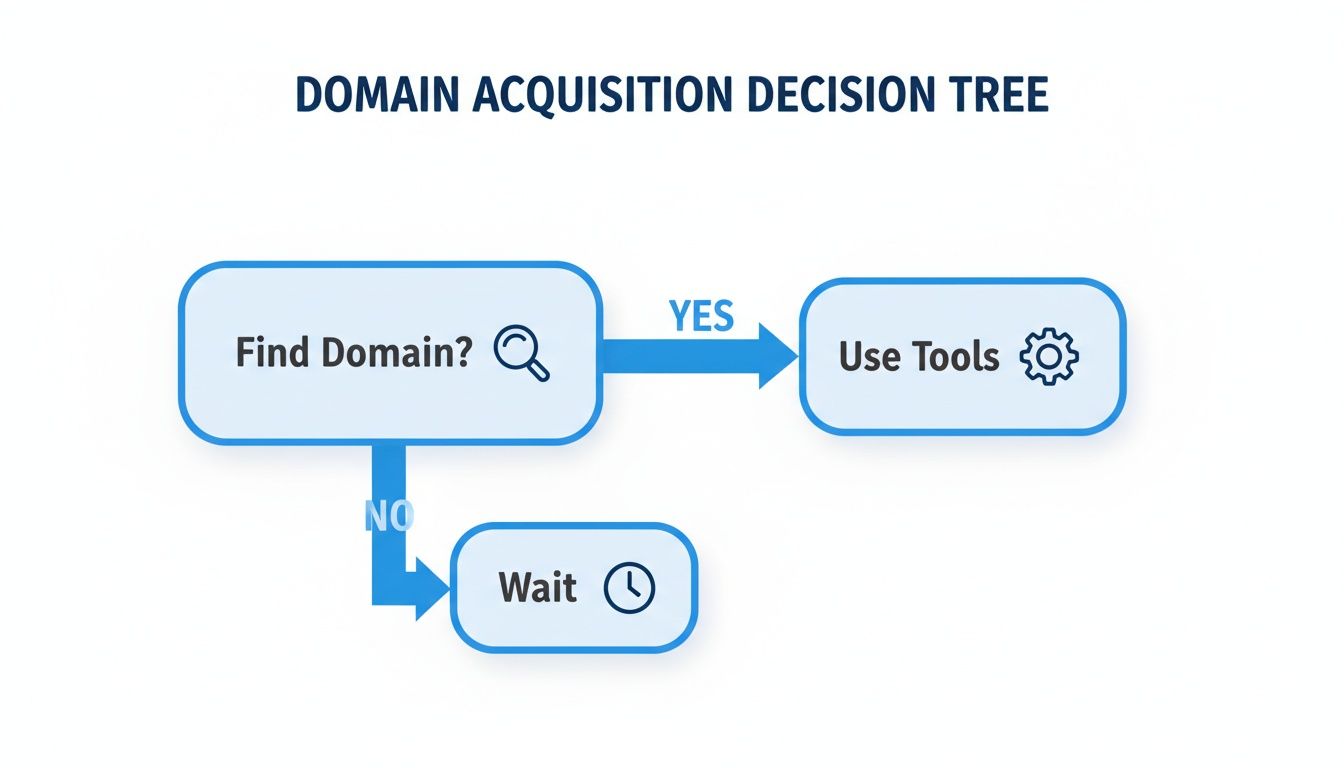
The flowchart simplifies the core choice: find a domain and use tools to evaluate it, or wait for the right one to appear.
Brandability Is Your North Star
Before you even glance at a single metric, run the domain through the "real world" test. Is it easy to say, spell, and remember? Imagine shouting the domain name to someone over a bad cell connection. If they can't get it right on the first try, that's a problem.
Here are the gut checks I run on every potential domain:
- The Radio Test: Is it crystal clear when spoken aloud?
Rise.compasses with flying colors;RizeNow.comis a guaranteed fail. - Typo-Prone: Are there common misspellings or clunky letter combinations? Words with double letters or unusual spellings are asking for trouble.
- Brand Vibe: Does the name feel like a legitimate brand? This is subjective, sure, but it’s absolutely crucial.
Apex.comfeels authoritative;BestApexOnline.comjust feels cheap.
A highly brandable name is a marketing asset in itself. It cuts down on friction for your customers and starts building trust before they even land on your site.
Perform an SEO Health Checkup
A domain can look pristine on the surface but hide a toxic past. A previous owner might have used spammy link-building tactics that got the domain penalized by search engines, and you definitely don't want to inherit those headaches. This is where you need to put on your detective hat.
To really dig in and avoid a costly mistake, using robust domain overview tools is a must. These give you a handle on its history, authority metrics, and any hidden issues. You’re looking for things like Domain Authority (from Moz) and Trust Flow (from Majestic) to get a high-level view of its "link equity."
My Pro Tip: Pay special attention to the quality of the backlinks, not just the sheer number. A handful of links from authoritative sources like .edu or .gov sites are worth a thousand times more than an army of spammy links from junk directories.
This is where you can lose countless hours, bouncing between a dozen different tools to piece together the full picture. Platforms like NameSnag streamline this by pulling data from Moz and Majestic into a single "SnagScore," giving you a clear verdict on whether a domain is a clean asset or a spam-filled liability.
Spotting Red Flags Before You Buy
Here’s a quick checklist of things that should make you pause and dig deeper. Finding one of these isn't always a deal-breaker, but it means you need to proceed with extreme caution.
- A Checkered Past: Use the Wayback Machine to see what the site looked like in previous years. Was it a spam site, a parked page full of ads, or something else that could tarnish your brand's reputation?
- Suspicious Backlinks: Does the backlink profile look unnatural? A sudden, massive spike in links from low-quality foreign sites is a major red flag for a past penalty.
- Trademark Troubles: This is a big one. Do a quick search to ensure the name doesn't step on an existing trademark. A cease-and-desist letter is not how you want to kick off your new venture.
Getting a handle on these valuation techniques is a skill that pays dividends. For an even deeper dive, check out our guide on how to value domain names like a seasoned pro.
The Art of Negotiation and Closing the Deal
Negotiating for a premium domain can feel like a high-stakes poker game. It’s not. It’s a strategic conversation, and the person who keeps a cool head and has a plan usually comes out on top. You’ve already done the hard part—finding and evaluating the name. Now it’s time to bring it home without lighting your wallet on fire.
The first, and most important, rule is to take emotion out of it. Your excitement for the domain is your secret, not your opening move. The goal here is simple: land on a price that feels like a win for both you and the seller.
Crafting Your Opening Offer
Your first offer sets the entire tone. Go in too low, and you look like an amateur who isn’t serious. Start too high, and you've just negotiated against yourself. This is where all that valuation work you did becomes your anchor.
Base your opening bid on the data—the comps, the metrics, the brandability. I find a good rule of thumb is to open around 60-70% of what you've decided is a fair market value. It shows you've done your homework but leaves you room for the inevitable dance that follows.
Let's say you've valued a domain at $5,000. A $3,000 opening offer is a perfectly reasonable place to start. Your email should be polite, professional, and direct. Something like this almost always works:
"Hi [Seller Name], I'm interested in acquiring [DomainName.com]. Based on my research of recent market sales for similar domains, I can offer $3,000. I'm prepared to pay immediately through a trusted escrow service. Let me know if that's of interest."
This script works. It’s confident, it references market data (you don't need to show your hand), and it mentions a secure payment method, which tells the seller you’re a pro.
Handling Counter-Offers and Seller Psychology
They will almost always counter your offer. Don't let it throw you; this is just part of the game. The key is to respond calmly and methodically. Your job is to understand who you're talking to.
- Individual Investors: These sellers can be emotionally attached and often have an inflated sense of what their domain is worth. Patience is your best friend here. Use polite, data-backed reasoning.
- Domain Brokers: These are pros. They do this all day, every day. They respect a firm, no-nonsense approach and are moved by numbers, not stories.
When a counter comes back, don't rush to reply. Take your time. If it’s still in a reasonable ballpark, you can inch your price up. If it's laughably high, you can either hold firm or politely explain why your valuation is more grounded in reality. There's an art to this, and if you want to go deeper, we've laid out more tactics in our guide on how to buy a domain name that is already taken.
The Non-Negotiable Step: Secure Payment and Transfer
Once you agree on a price, the deal is far from over. The final steps—the payment and the transfer—are where you're most vulnerable. This is precisely why using a third-party escrow service is absolutely non-negotiable. I can't stress this enough.
Here’s how an escrow service protects you and the seller:
- Agreement: You both agree on the terms (the domain and the price).
- Buyer Pays: You send the funds to the secure escrow account. The seller gets a notification that the money is locked in.
- Seller Transfers: The seller starts the domain transfer process to your registrar account.
- Buyer Confirms: You confirm you've received the domain and have full control.
- Funds Released: Only after you give the green light does the escrow service release the payment to the seller.
This simple process eliminates risk. You can't lose your money, and the seller can't lose their domain. For domain sales, services like Escrow.com, Dan.com, and Sedo are the industry standard. The whole transfer usually takes a few days to a week.
Never, ever agree to a direct payment through PayPal or a wire transfer for any significant purchase. The small fee for an escrow service is the best insurance policy you'll ever buy.
Alright, you did it. The money’s been spent, the transfer’s done, and that beautiful premium domain is finally sitting in your registrar account. Go ahead, take a victory lap. You just secured a prime piece of digital real estate.
But don't get too comfortable. The journey doesn't stop here. In fact, this is where the real fun begins.

Now it’s time to turn that asset into something that actually works for you—building a brand, driving traffic, or maybe just making you a tidy profit. Let’s map out the game plan.
Immediate Housekeeping and First Moves
Before you dream about your big launch, there are a few non-negotiable housekeeping tasks. These are the small, boring things that secure your asset and put a professional face on it, even if a full website is months away.
First, lock it down.
- Turn on Registrar Lock: This is a simple toggle that prevents someone from transferring your domain out from under you. It’s a must. Don't skip it.
- Enable Auto-Renew: The thought of losing a premium domain because you missed a renewal email should give you nightmares. Protect your investment and set this to auto-renew on day one.
- Set Up Email Forwarding: Create an email like
hello@[yournewdomain].comand forward it to your main inbox. It looks infinitely more credible than a Gmail address and takes five minutes.
With that out of the way, throw up a "Coming Soon" page. It tells the world—and more importantly, search engines—that the domain is active and something's brewing. Most registrars have a dead-simple tool for this.
The Strategic Playbook: What to Do Next
With the basics covered, your next move depends entirely on why you decided to buy a premium domain in the first place. Your goal dictates the strategy.
For the SEO and Affiliate Marketer
If you snagged the domain for its existing link profile and authority, you've got two solid plays.
The first is the 301 redirect. This is your quickest path to victory. You permanently redirect the premium domain to your main money site, effectively passing along its "link juice." This can give your site a serious, almost immediate boost in authority and search rankings.
Your other option is to build out a niche site or a Private Blog Network (PBN) property. This is a more surgical approach. You develop a small, high-quality site, letting you control the content and outbound links with precision. It becomes a powerful asset to prop up your main projects.
For the Startup Founder
Your premium domain is the cornerstone of your brand. It’s time to start laying the foundation.
Your domain name is the centerpiece of your online identity. A great domain name can go a long way. It’s easier for people to remember, share, and trust, making it a valuable asset for any business.
Start building a presence immediately. Grab the social media handles that match your new domain. Start creating content, even if it's just a single blog post outlining your mission. This kicks off the process of attracting early interest and getting indexed by Google.
The Investment Angle: Flipping for Profit
Maybe you're not a builder. Maybe you're an investor who spotted an undervalued asset and plans to sell it for more. The domain flipping market is alive and well, so your job is to get your new property in front of the right buyers.
Platforms like NameSnag aren’t just for discovery; they let you list your domains for sale, too. You can add your new acquisition to your portfolio and make it visible to end-users who are actively trying to buy a premium domain. Just be sure to set a realistic price based on market data and the name’s quality.
Your smart purchase today could become someone else’s perfect brand tomorrow—and a nice bit of profit in your pocket.
A Few Hard Questions About Buying Premium Domains
So you're wading into the world of premium domains. Good. It’s where the real brand-building assets are found. But it’s also a space filled with murky pricing, confusing jargon, and a lot of noise.
Let's clear the air. I’m going to tackle some of the most common questions I hear from people trying to land a killer domain without getting taken for a ride.
What's a Realistic Budget for a Premium Domain?
There's no single price tag here. I’ve seen deals close from a few hundred bucks to amounts that would make a venture capitalist blush. The truth is, it's all over the map.
But for a solid, truly brandable name that you won't be embarrassed by in two years, the sweet spot often lands in the $1,500 - $3,000 range. This gets you a genuinely high-quality asset without needing to liquidate your 401k.
Of course, things can get crazy. A short, single-word .com or a name in a white-hot niche like AI can easily jump into five or even six figures. The key isn't to fixate on the price, but on the value. Does the data back it up? Can you make a straight-faced argument for how this name will boost your brand, cut your marketing spend, and pay for itself over the long haul? If you can, the price is what it is.
What's the Real Difference Between Expiring and Dropped Domains?
This is a great question, and understanding the answer is what separates the amateurs from the pros who snag incredible deals. Getting this right is your secret weapon.
Expiring Domains: Think of these as being in purgatory. The owner forgot to renew, but they're still in a grace period (usually 30-40 days) where they can get it back. You can't register it, but you can see it coming. This is your chance to get a head start, track the name, and be ready to pounce the second it's free.
Available (Dropped) Domains: This is where the instant gratification is. A dropped domain has gone through all the grace periods and post-expiry auctions and nobody claimed it. It’s been released back to the public. You can register it right now at any registrar for a standard registration fee. It's the equivalent of finding treasure just lying on the beach.
This distinction is precisely why a tool like NameSnag is so powerful. You can stop guessing and just toggle filters to hunt for Expiring domains to plan your future acquisitions, or scan the list of currently Available domains to find something you can own today.
Pro Tip: Don't just browse. Set up alerts for high-potential expiring domains. Getting that notification the instant a name drops gives you a massive timing advantage over everyone else who's still hitting refresh on their browser.
Should I Buy from a Marketplace or Hunt for Expired Domains?
This really comes down to what you value more: your time or your money. Neither is inherently "better"; they're just different tools for different jobs.
Buying from a marketplace like Sedo or Dan.com is like shopping at a high-end retail store. It’s clean, straightforward, and you’re looking at a curated selection of great names. The catch? You’re paying retail prices set by the seller. It's the path of least resistance, but it's almost always the most expensive.
Hunting for expired or dropped domains, on the other hand, is the treasure hunt. This is where you find the absolute bargains—domains with years of history, real authority, and valuable backlinks—for nothing more than a standard registration fee. The payoff can be monumental, but it requires patience.
Let's be honest, you can't do this manually. Hundreds of thousands of domains drop every single day. Trying to sift through that firehose is a fool's errand. You need a platform that does the heavy lifting, using smart algorithms to score domains and filter out the 99.9% of junk. It's all about working smarter, not harder, to surface the few names that are actually worth your attention.
Ready to stop searching and start finding? NameSnag uses powerful AI to sift through over 170,000 domains daily, surfacing the hidden gems with real SEO and brand value. Stop wasting time on manual checks and let us help you snag your perfect domain faster. Discover your next premium domain with NameSnag today.
Find Your Perfect Domain
Get access to thousands of high-value expired domains with our AI-powered search.
Start Free Trial