So, you’ve probably seen searches for a "Brandy Melville domain" and wondered, "What's that all about?" Let me tell you, it’s not just fans looking for the latest drop. It’s a telltale sign of digital prospectors hunting for a specific kind of gold. The official site, brandymelvilleusa.com, is their locked-down flagship store, but a whole ecosystem of digital real estate pops up around a brand that big.
The Allure of the Brandy Melville Domain

This fascination isn't just a weird search trend. It’s a direct look into the minds of savvy SEOs, domain investors, and affiliate marketers. They’re not naive enough to think they can just buy the official site. They’re looking at the digital properties around it.
Think of it this way: a major brand’s main domain is a landmark on Fifth Avenue. It’s owned, it’s powerful, and it’s not for sale. But what about the other properties on the block? The one with a similar address that just became available? Or that spot that’s about to go on the market? That’s where the real money is made for investors who know where to look.
What Are They Really Searching For?
When someone types "Brandy Melville domain" into a search bar, they're really asking one of three questions:
- Who owns it? They might just be curious about the company’s digital footprint, or they're doing basic reconnaissance to see if the site they landed on is the real deal.
- Is a related domain available? This is the hunt for dropped domains—think valuable misspellings or names with a similar vibe—that can be registered on the spot.
- Is a valuable domain expiring soon? This is the high-stakes game. They're watching domains in their final countdown, hoping to snatch a high-authority asset the second it becomes available.
This whole hunt is powered by the massive authority a brand like this builds. A domain even loosely tied to a big name can inherit a bit of that trust and SEO juice. It’s a shortcut. It’s like finding a vintage jacket with the designer label still attached; the name itself gives it an immediate lift in value.
The real strategy here isn’t about impersonating the brand—that’s a legal disaster waiting to happen. It's about legitimately capturing the traffic, authority, and aesthetic associated with the brand’s world.
This guide is your playbook for understanding that strategy. We'll break down why these searches happen and, more importantly, how you can find powerful digital assets without stepping on any legal landmines. Forget chasing trademarked names. We're going to dig into finding powerful, recently dropped Available domains you can grab instantly or how to track high-value Expiring domains before anyone else. It's time to turn a risky search into a smart investment.
Brandy Melville's Digital Empire and Domain Value

Brandy Melville’s rise to cult status wasn’t some fluke built on Super Bowl ads or flashy billboards. It’s a masterclass in digital-first branding, and it all revolves around one core asset: its primary domain, brandymelvilleusa.com. This isn't just a website; it's the digital heart of an empire that somehow thrives on organic hype and an almost ruthlessly consistent aesthetic.
The brand managed to cultivate a massive, loyal following with what looks like zero effort. They completely sidestepped traditional ad spending. Instead, they leaned into the raw power of social proof, letting their target audience—teenagers and young women—do all the marketing through a relentless stream of Instagram posts and word-of-mouth buzz.
This quiet, almost stealthy growth is exactly what makes the Brandy Melville domain so ridiculously valuable from an SEO and investment perspective. It’s the digital equivalent of a business with rock-solid fundamentals and a customer base that would follow it off a cliff.
From Westwood Store to Global Phenomenon
That main domain, brandymelvilleusa.com, anchors a fast-fashion machine that exploded from a single Los Angeles store in 2009 into a global force. Projections show its annual sales are on track to blow past $212.5 million by 2026. That’s a huge 25% jump from 2019, and they pulled it off while navigating a pandemic and plenty of public scrutiny.
Think about that. They achieved this with a surprisingly small footprint of around 100 stores and a near-total refusal to offer sales or free shipping. It was all powered by influencer marketing and genuine teen enthusiasm. You can dig into Brandy Melville's impressive revenue growth on Zippia if you want to see the numbers.
This kind of real-world business success translates directly into domain value. A domain name that’s been the center of a resilient and recognizable brand like this automatically inherits years of trust, authority, and powerful backlink equity.
Why Domain Investors Drool Over Metrics Like These
For a domain investor, a brand's real-world success is a blinking neon sign pointing to digital gold. Consistent revenue, global recognition, and major retail partnerships all forge a powerful digital footprint. We measure that footprint with a few key SEO metrics that signal a domain's raw strength.
- Domain Authority (DA): This is a score predicting how well a website will rank. Brandy Melville's organic popularity gives its domain a naturally high DA. It just is an authority.
- Trust Flow (TF): This metric looks at the quality of a domain's backlinks. Every link from a reputable fashion blog, news outlet, or major influencer is a vote of confidence that pumps up its TF.
- Backlink Equity: Think of this as inherited reputation. Every time a major publication or popular blogger links to the site, they're passing along a bit of their own authority.
A domain like brandymelvilleusa.com has spent more than a decade just soaking up these high-value signals. It's been linked to in countless articles, featured in thousands of social media posts, and bookmarked by millions of shoppers. That history is baked right into the domain itself.
That’s why a domain tied to a powerful brand is so coveted. It’s not just about the name; it’s about inheriting a decade of organic SEO work, brand trust, and market authority without having to build it from scratch.
This is the anatomy of a "gem" domain. It represents a shortcut to the kind of authority that takes years and a small fortune to build. When SEOs or investors hunt for dropped domains, they aren't just looking for clever names. They're searching for domains that have this kind of built-in power, ready to be pointed at a new project.
Navigating the Legal Minefield of Brand-Related Domains
Before you get excited and register a domain like BrandyMelville-deals.com or Brandy-Melville-style.net, we need to have a serious talk. There’s a giant, flashing red light in the room, and it's called a trademark.
Getting this wrong isn't just a slap on the wrist. It can be an expensive, reputation-shattering mistake. Consider this your no-nonsense guide to the legal tightrope you'd be walking.
Think of it this way: grabbing a domain that hijacks a brand's name is like printing an official-looking badge and slapping it on a generic t-shirt. You’re borrowing someone else's hard-earned reputation to make your project seem legitimate. In legal terms, this is trademark infringement, and companies like Brandy Melville spend a fortune protecting their name.
Understanding Cybersquatting and the UDRP
When you register a domain name with a trademark in it, intending to profit from that association, you’re wading into the murky waters of cybersquatting. This isn't just frowned upon; it's a legal liability.
Brands have a powerful, streamlined weapon to fight back called the UDRP (Uniform Domain-Name Dispute-Resolution Policy). It’s a legal process designed specifically to resolve these kinds of disputes without a full-blown court battle.
If a brand files a UDRP complaint against you, they only need to prove three things:
- Your domain is identical or confusingly similar to their trademark.
- You have no legitimate rights or interests in the name.
- You registered and are using the domain in "bad faith"—for instance, to sell it back to them, divert their customers, or trash their reputation.
If they win—and in clear-cut cases, they almost always do—you will lose the domain. That’s the best-case scenario. In worse situations, you could be on the hook for their legal fees or even face a lawsuit for damages. To see how brands formally escalate these issues, it's worth understanding what a Cease and Desist Letter entails.
The Brandy Melville Precedent
Don't just take my word for it. Brandy Melville has a track record of aggressively defending its brand online. The company has filed multiple lawsuits against platforms like Redbubble for both trademark and copyright infringement.
While the details of those cases are complex, they prove one thing loud and clear: this brand is not afraid to take legal action to protect its intellectual property.
The core takeaway is simple: directly using a trademarked name in your domain is a high-risk, low-reward strategy. The potential upside is dwarfed by the legal and financial trouble waiting for you.
So, what does this mean for you? It means you need to pivot from lazy, risky moves toward smarter, more creative strategies. Instead of trying to ride on a brand's coattails, you build your own path in the same neighborhood.
This is where the real opportunity lies for savvy investors and SEOs. A bad choice here can ruin more than just one project; it can seriously damage your entire domain name reputation.
The Smart Investor's Pivot: Finding Killer Alternatives
So, you've realized that chasing a trademarked name like a "Brandy Melville domain" is a fast track to legal and financial pain. Good. That's a dead end. What’s the smart play?
It’s time to pivot. The real money isn't in grabbing some risky, brand-infringing domain that'll get you a cease-and-desist letter before you even get your site live. The opportunity is in finding powerful, brand-adjacent alternatives that give you a competitive edge without the legal drama.
This whole strategy is about targeting thematic domains that tap into the vibe of the Brandy Melville aesthetic. You need to think bigger. Instead of the brand name itself, you hunt for keywords that capture its world and its audience.
Target the Aesthetic, Not the Name
The appeal of Brandy Melville isn't just the name on the tag—it’s the culture built around it. That’s where your keyword brainstorming has to start. What words and phrases actually describe that world?
- Geographic & Lifestyle Keywords:
malibu,cali,socal,coastalliving - Aesthetic & Style Keywords:
minimalist,vintage,aesthetic,90sstyle - Audience Keywords:
teengirl,casuallook,effortlessfashion
These keywords are your treasure map. They lead to domains that pull in the exact same audience, but they do it safely and creatively. The goal is to own a piece of the niche, not a piece of the trademark. For brands looking to consolidate their online presence without committing to a full custom domain, exploring the functionality of the best link in bio tools can offer a flexible alternative.
Uncover Gems with Smart Filters
This is where you put theory into practice with a tool like NameSnag. Instead of just blindly guessing, you can use filters to zero in on high-potential domains based on those aesthetic keywords. You've got two main pools to fish in: expiring and available domains.
1. Hunting for Expiring Domains
These are domains that have expired but aren't available to the general public just yet. They're sitting in a grace period, which is your golden window to research them before they drop. This is where you find aged domains that might already have some SEO juice.
For instance, you could run a search for Expiring domains that contain the word "aesthetic" or "vintage." Then you can start layering on filters, like only seeing domains dropping in the next 7 Days, to narrow your focus. This way, you’re not wasting time on junk.
Here’s what that expiring domain search might look like inside NameSnag.
The screenshot shows a list of expiring domains, each with key metrics like SnagScore and age. It lets you spot the valuable assets before they're released to the wolves. This is how you get a head start.
2. Snagging Immediately Available Domains
Sometimes you just need a domain right now. For that, you'd search for Available domains. These have already gone through the expiration process and can be registered immediately at any registrar. While they might not have the deep history of an expiring domain, you can still find some incredible, brandable names if you're quick.
Using the same thematic keywords, you could instantly find and register a domain like malibuaesthetic.com or calivintagestyle.net if they're available. The game here is speed and creativity. The moment a good, brandable domain drops, it can be snapped up in minutes. For a deeper dive into securing domains that are already taken, our guide on how to buy a taken domain name offers some advanced strategies.
By shifting your focus from the brand name to the brand's world, you open up a universe of valuable, safe, and powerful domain opportunities. The smart investor doesn’t chase the name on the building; they buy the valuable property next door.
Due Diligence 101: How to Not Buy a Lemon Domain
So, you’ve found a domain name that looks like a winner. Maybe it’s a killer brandable that just dropped, or a keyword-rich gem you can't believe is available. It looks great on paper, but now comes the hard part: the due diligence.
Trust me, a fantastic-sounding name can hide a truly toxic past. Inheriting someone else's digital baggage is a fast way to kill your project before it even gets off the ground. Think of it like a home inspection for a digital property. You have to check the foundation (backlink quality), look for hidden mold (spam signals), and see who the previous tenants were (content history). Buying a domain blind is a rookie mistake, and it can be an expensive one.
The Vetting Checklist: Don't Get Stuck With A Lemon
Before you hit that "register" button, you need to put on your detective hat. A clean, penalty-free history is non-negotiable, whether you’re starting a new brand or just planning a 301 redirect to give an existing site a boost.
Here’s what you absolutely have to dig into:
- Backlink Quality: Are the links from real, relevant sites? Or are they from sketchy link farms in a language you don't even recognize? A handful of quality links beats thousands of toxic ones every time.
- Content History: What was this domain used for before? The Wayback Machine is your best friend here. A history of legitimate content is a green light. A past life selling shady pills, gambling, or adult content? That's a massive red flag.
- Spam Signals: Look for obvious signs of abuse. A mountain of backlinks that appeared overnight or a history of black-hat SEO tricks can leave a permanent stain that's almost impossible to wash out.
This is the basic flow from idea to ownership. It’s not just about finding a name; it’s about finding the right name.
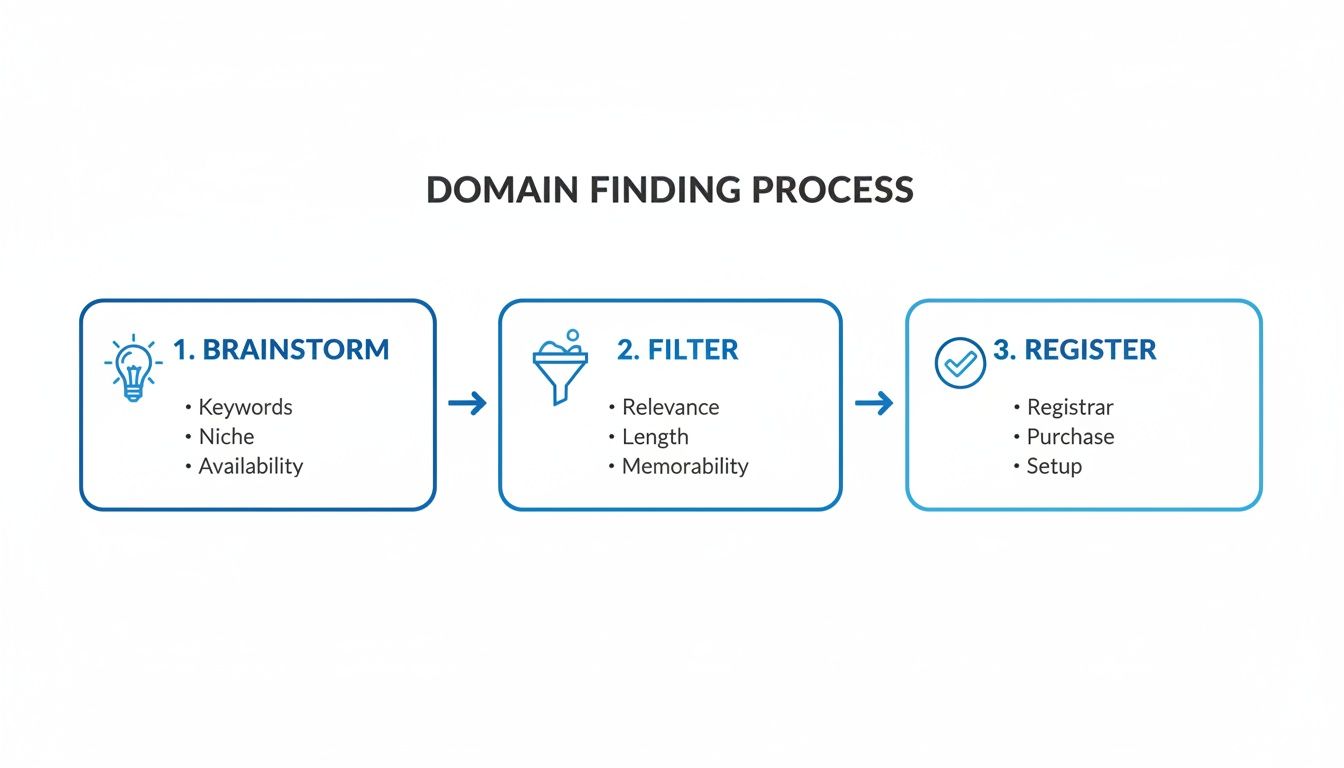
The journey looks simple, but that middle step—filtering for quality—is where most people go wrong.
Why Integrated Tools Are Your Secret Weapon
Doing this research manually is a soul-crushing time sink. You’ll have a dozen tabs open, trying to stitch together data from Moz, Majestic, Ahrefs, and who knows what else. It's clumsy, inefficient, and you're bound to miss something critical.
This is where having all your data in one place becomes a game-changer.
Instead of wrestling with multiple subscriptions and a browser that's about to crash, a tool that pulls all these key metrics into a single view is indispensable. It lets you size up a domain's authority, trust, backlink profile, and spam score from one dashboard.
Trying to piece this together yourself is a headache and a half. It's the difference between being an efficient pro and an amateur wasting hours on manual grunt work.
Manual vs. NameSnag Domain Vetting
| Vetting Step | Manual Process (The Old Way) | NameSnag Process (The Smart Way) |
|---|---|---|
| Authority Check | Open Moz, paste domain, check DA. | SnagScore provides an instant authority rating. |
| Backlink Analysis | Open Ahrefs, check DR and backlink sources. | Link profile and spam signals are in the same view. |
| Trust Metrics | Open Majestic, check Trust Flow and Topical Trust. | Trust Flow is integrated into the domain details. |
| Content History | Open Wayback Machine, manually browse archives. | Live previews show you the last known version instantly. |
| Spam Verification | Cross-reference multiple tools for spam flags. | The Spam Checker gives a simple pass/fail verdict. |
The old way requires you to be a data janitor. The smart way lets you be an analyst, focusing on what the numbers actually mean for your investment.
Think about a domain like Brandy Melville’s brandymelvilleusa.com. Its value isn't just the name; it's the years of organic authority it has built from organic links, fueling a business projected to hit $212.5 million by 2026. This authority is measured by the exact metrics we're talking about—Trust Flow, referring domains, and link quality.
By using an integrated platform, you can vet domains with that same professional rigor. You can instantly see if a name has a clean history and strong SEO foundations, or if it’s a money pit in disguise. For a full breakdown of the process, check out our guide on how to check domain history.
Making this vetting process a non-negotiable part of your workflow is what separates the pros who consistently find valuable digital assets from the amateurs who just get lucky once in a while.
Your Smart Investor Playbook for Niche Domains
Okay, let's talk strategy. That initial search for a "Brandy Melville domain"? It's not just some random whim. It's the first step down a rabbit hole that leads to incredibly valuable digital real estate.
We’ve already established that trying to snatch up a trademarked name is a fool's errand. It’s a fast track to wasting time, money, and maybe torching your reputation. But the instinct behind that search—the desire for a name with built-in authority? That’s pure gold.
The real money isn't in cybersquatting. It's in finding domains that bottle the essence of a successful brand's niche. The playbook is straightforward, but you need precision and the right tools to execute it.
Building a Portfolio of Powerhouse Domains
Your mission, should you choose to accept it, is to build a portfolio of brand-adjacent domains with real, measurable potential. This isn't about throwing darts at a board. It’s a data-driven hunt for a few key traits. You’re looking for domains that are clean, authoritative, and have that magic spark of brandability.
- Clean Histories: The domain absolutely must be free of spam or past penalties. A toxic history will poison any project you build on it, no matter how brilliant.
- Strong SEO Metrics: You're looking for assets with some heft. Think existing authority, decent backlinks, and a solid domain age.
- Brandable Appeal: Can you say it out loud without fumbling? Is it memorable? Does it feel right for the niche you're targeting?
The dream is to find a domain that has the kind of authority the official brandymelvilleusa.com has spent years building. That site’s resilience, on track to hit $212.5 million in sales by 2026, comes from over a decade of organic growth. It has accumulated incredible backlink equity from major retailers and even universities. You can get a sense of the brand's powerful market position to understand just why its digital footprint is so valuable.
Your playbook is to find domains that mirror this quality, even on a much smaller scale. A domain with a clean history and strong metrics is like finding a plot of land that’s already been graded and prepped for construction. You can start building value on day one.
Your Tactical Advantage with NameSnag
This is where a specialized tool stops being a nice-to-have and becomes your secret weapon. Instead of spending days sifting through mountains of junk domains by hand, you filter for exactly what you need.
Want to find a keyword-rich domain that just dropped and is ready to register this second? Pop over to the Available domains filter and start digging. You can snag these right now.
More interested in playing the long game? The Expiring domains section is your hunting ground for high-value assets about to hit the market. You can even filter by timeframes, like the next 7 or 14 days, to line up your acquisitions.
Stop chasing trademarked phantoms. Start using a data-driven strategy to find and secure powerful, brand-adjacent domains that you can actually own and build. This is how you create a real portfolio of digital assets with lasting value.
Quick Hits: Your Brand-Adjacent Domain FAQ
Got a few questions still rattling around about finding and evaluating domains in a niche like Brandy Melville? Let's clear up some of the common ones.
Can I Just Buy a Domain with a Brand Name in It?
It's a tempting thought, but it's an incredibly risky move. If a name is trademarked—and "Brandy Melville" certainly is—snatching up a domain that includes it is almost textbook cybersquatting. That path usually ends with a legal nastygram, losing the domain, and maybe even a hefty fine for your troubles.
The smarter play, the one that won't get you into a legal mess, is to get creative. Think thematically, not literally. You're aiming to capture the audience, not to borrow a brand's legal headaches.
What's the Difference Between "Available" and "Expiring" Domains?
This is a critical distinction, and knowing the difference tells you which pond to fish in.
- Available Domains: Think of these as off-the-rack. They've gone through the entire expiration process, been "dropped," and are now fair game for anyone to register immediately at a standard price. You can find these newly Available domains and own them in minutes.
- Expiring Domains: These are the ones you have to watch. They've passed their expiration date but are stuck in a grace or redemption period. You can't register them just yet, but they'll be dropping soon. By tracking Expiring domains, you get a head start to do your homework and be ready to pounce the second they become available.
Besides Keywords, What Really Makes a Domain Valuable for SEO?
Keywords are part of the equation, but the real gold is often in a domain's history. A clean, aged domain can give you a ridiculous head start, almost like starting a race halfway to the finish line.
A domain's past performance is a powerful signal of its future potential. Its age, the quality of its backlinks, historical authority metrics like Domain Authority and Trust Flow, and a clean slate free of spam or search engine penalties—that's the stuff that really matters.
How Do I Find Niche Domains Without Getting Sued?
Simple: you have to start thinking like a marketer, not just a domain flipper. Step back and brainstorm what the brand actually sells. What's the aesthetic, who's the audience, what's the lifestyle?
For a niche like the one swirling around the Brandy Melville domain, your keyword list should look something like this:
California casual styleteen minimalist fashion90s aesthetic clothingMalibu girl look
Plug these thematic keywords into your domain searches. You'll start to uncover domains that attract the exact right crowd, all without ever stepping on a trademark. It’s about capturing the vibe, not copying the name.
Ready to stop guessing and start finding high-value domains with a clean history and powerful SEO metrics? Let NameSnag do the heavy lifting. Our platform analyzes over 170,000 domains daily to help you discover hidden gems before anyone else. Find your next winning domain at NameSnag today!
Find Your Perfect Domain
Get access to thousands of high-value expired domains with our AI-powered search.
Start Free Trial