When a domain name expires, it doesn't just poof out of existence. It actually kicks off a surprisingly predictable journey. Depending on the domain type and the registrar, this whole process—from the official expiration date until it's deleted and tossed back into the public pool—can take anywhere from 30 to 90 days. If you want to either save your own domain or snag a great one someone else let slip, you need to understand how this all works.
The Secret Lifecycle of a Domain Name
Ever wondered what happens when someone forgets to hit "renew" on their website? It’s not an instant digital apocalypse for that site. Instead, thousands of valuable domains quietly begin a structured, predictable journey every single day.
Think of it like a piece of digital real estate entering foreclosure. There's a formal process, clear stages, and unique opportunities for anyone paying attention.
This journey, from the first missed payment to its eventual public release, is the secret lifecycle of a domain name. It’s a fascinating process that turns a simple mistake into a potential goldmine. A lot of people assume a domain is gone forever the day after it expires, but that couldn’t be further from the truth. There are built-in safety nets and recovery periods that create a window of opportunity.
From Active to Available: A Predictable Path
This lifecycle isn't random. It follows a well-defined path governed by rules from ICANN (the organization that manages domain names) and the specific policies of the registrar. Each phase offers different possibilities:
- For the Original Owner: There are multiple chances to get their digital asset back, though sometimes it comes with a higher price tag.
- For a New Buyer: This is a chance to acquire a domain with an existing history, authority, and maybe even some brand recognition.
Understanding these stages is the first step. It lets you anticipate when a domain might shake loose and plan your move. The word "expiration" itself can be a bit confusing, since a domain can be in several different states after it expires before it's truly up for grabs. If you want to get into the nitty-gritty, you can learn more about the difference between expiry and expiration.
The key takeaway is simple: a domain’s expiration date isn’t an endpoint. It’s the starting line for a new chapter—a countdown that gives the owner a second chance and everyone else a first chance.
By pulling back the curtain on this process, you can go from being a bystander to an active player. Whether you're trying to keep your own domain from slipping through your fingers or hunting for that perfect name for your next project, knowing the rules of the game is your biggest advantage. We'll walk through each phase, showing you exactly how to turn someone else's forgotten digital property into your next big win.
The Complete Domain Expiration Countdown
When a domain name hits its expiration date, it doesn't just fall off the face of the internet. Far from it. Instead, it kicks off a surprisingly structured countdown with several distinct phases. Each stage offers a different window of opportunity—either for the original owner to get it back or for a savvy buyer to snap it up.
Understanding this timeline is everything. It's the key to either rescuing your own forgotten domain or strategically acquiring a valuable one that someone else let slip.
The domain market is always in motion. On any given day, you can find well over 150,000 domains listed as expired, a testament to the constant churn happening online. These names don't just vanish; they typically enter a grace period that lasts 30 to 45 days before being deleted from the registry. If you want to dig deeper into these numbers, Cybernews offers a great breakdown of the market's dynamics.
To really get a feel for this journey, let’s look at the lifecycle from a bird's-eye view.
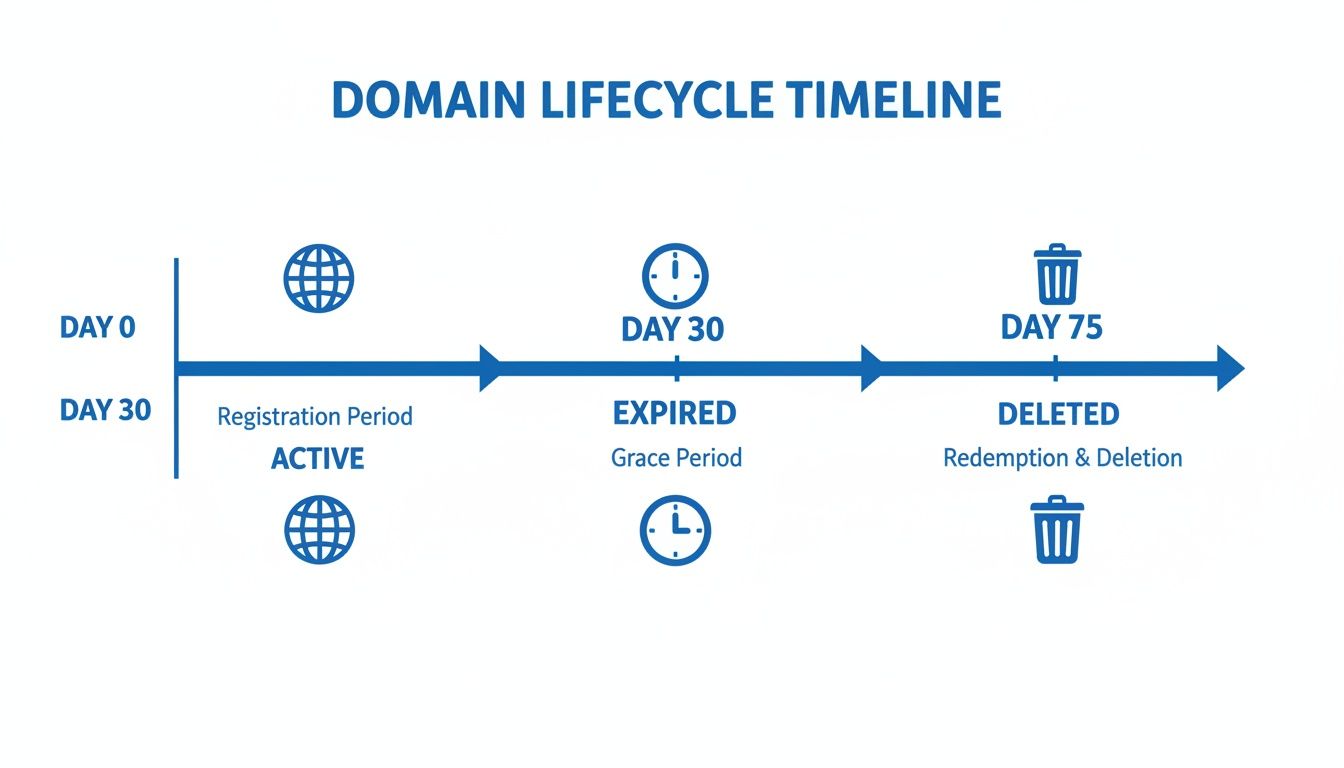
This visual makes it clear: expiration isn’t a single event. It's a process with distinct stages, each with its own rules and chances to act. So, let’s break down exactly what happens at each step.
Here’s a quick overview of the entire process from start to finish, showing you what’s happening behind the scenes and what you can (or can't) do at each point.
Stages of the Domain Expiration Lifecycle
| Phase | Typical Duration | Domain Status | What Can You Do? |
|---|---|---|---|
| Registrar Grace Period | 0-45 days | Expired, but recoverable at a normal price. | Original owner can renew. Buyers can only watch and wait. |
| Redemption Period | 30 days | Inactive, recoverable at a high cost. | Original owner can pay a steep fee to redeem it. Buyers are still on the sidelines. |
| Pending Deletion | 5 days | Locked, awaiting deletion from the registry. | Absolutely nothing. The domain is in limbo for everyone. |
| Dropped & Available | - | Publicly available for registration. | Anyone can register it on a first-come, first-served basis. Game on. |
Each of these phases is a critical part of the journey. Let's dig into the details.
Stage 1: The Registrar Grace Period
This is the first safety net. The moment a domain’s expiration date passes, it slips into the Registrar Grace Period. Think of it as a friendly reminder phase where the registrar gives the owner a chance to renew, usually at the standard price.
During this time, the website and any associated email accounts will almost certainly stop working. Registrars often "park" the domain, replacing the original site with a page announcing that it has expired. The exact length of this period varies by registrar, but it's a critical window.
- Typical Duration: 0-45 days (most commonly around 30 days).
- Key Action: The original owner can renew the domain, no questions asked and no penalty fees.
- For Buyers: You can't do anything yet except watch and wait.
This is the stage where you'll find domains listed under the Expiring domains filter on NameSnag. It’s the perfect time to spot valuable names that might become available soon, giving you a head start to plan your move.
Stage 2: The Redemption Period
If the owner fails to renew during the grace period, the situation gets more serious. The domain now moves into the Redemption Period. This is the absolute last chance for the owner to reclaim their domain, but it comes with a painful price tag.
To get a domain back at this stage, the owner has to pay a hefty redemption fee on top of the normal renewal cost. This fee can be anywhere from $75 to over $250, depending on the registrar.
The Redemption Period is a final, costly warning shot. It signals that the domain is dangling by a thread, just one step away from being permanently lost to the original owner. For anyone watching, it means the domain is getting tantalizingly close to dropping.
This phase, also known as the Redemption Grace Period (RGP), is an ICANN mandate for most common TLDs like .com, .net, and .org. The domain is officially removed from the registry at the start of this period but is held in a "pending delete" status.
Stage 3: The Pending Deletion Phase
This is the final, irreversible countdown. After the Redemption Period ends without any action, the domain enters the Pending Deletion phase. For the original owner, there’s no turning back from here.
This is a very short window—typically just five days—where the domain is queued up for complete removal from the registry. Once this phase is over, the domain is "dropped" and becomes available for anyone in the public to register on a first-come, first-served basis.
- Typical Duration: Approximately 5 days.
- Key Action: No one can do anything. The domain is completely locked.
- For Buyers: This is when you get ready. The domain will soon appear as an Available domain on NameSnag, and you can try to register it the second it drops.
The exact millisecond a domain drops can be unpredictable, which is why backordering services and tools like NameSnag are so invaluable for boosting your chances of grabbing it.
How to Check When Any Domain Expires
Alright, you've got the lifecycle down, you know the stages, and a few promising domain names are probably bouncing around in your head. Now for the fun part: putting on your detective hat.
Finding out when a domain expires is the first real step to building a strategic watchlist. Luckily, it’s not some hidden secret.
The main tool for this mission is the WHOIS lookup. Think of it as a public phonebook for the internet. Whenever someone registers a domain, they're required to provide some basic info, which gets stored in a massive public database called WHOIS. It’s the go-to source for finding out who owns a domain and, most importantly for us, when it’s set to expire.
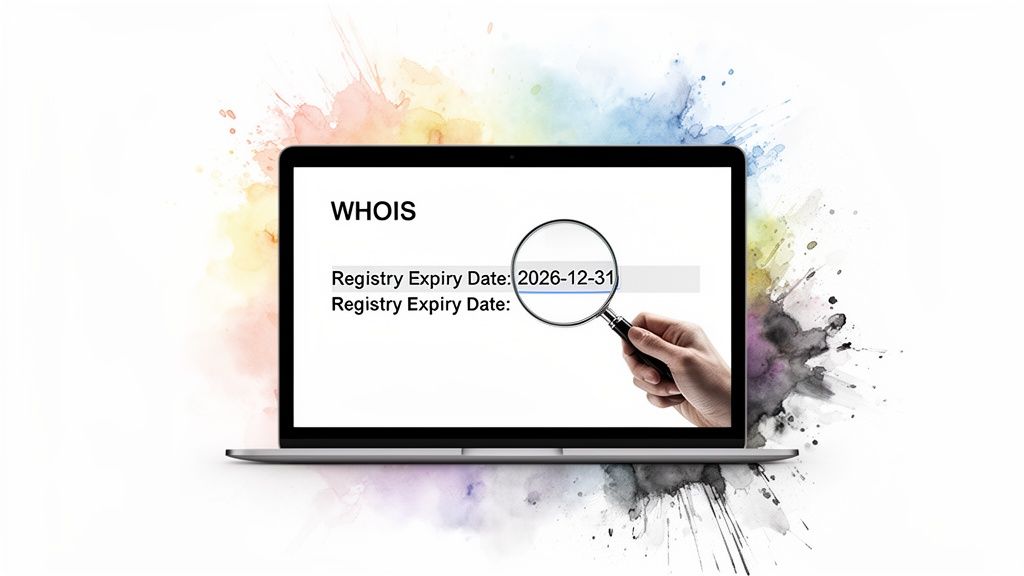
There are countless free WHOIS lookup tools all over the web. Just type "WHOIS lookup" into your favorite search engine, pick one, and pop in the domain name you're curious about. The tool will spit back a record filled with technical details.
Don't let the wall of text intimidate you. You're only looking for one specific line item.
Decoding the WHOIS Record
Most of what you see in a WHOIS record can feel like jargon, but you can ignore almost all of it. Just scan for a few key dates. The exact wording might vary a bit from registrar to registrar, but you’ll want to find these fields:
- Registry Expiry Date: This is the golden ticket. It's the official date the domain's registration term ends.
- Created Date: This tells you when the domain was first registered, giving you a clue about its age and history.
- Updated Date: This shows the last time any information in the record was changed.
The Registry Expiry Date is your north star. It’s the date that kicks off that whole expiration countdown we just walked through.
A common question is, "What if the owner's information is private?" Many domain owners use a privacy service to hide their personal details. The good news? These services almost never hide the expiration date. So even if you see "REDACTED FOR PRIVACY," you can almost always still find out when the domain expires.
This manual process is fine for checking one or two domains. But if you're serious about finding high-value names, checking them one by one becomes a massive time sink. This is where building an automated system or using a dedicated platform makes a world of difference. If you're looking to track multiple domains, check out our detailed guide on how to set up an effective domain name monitor.
Building Your Watchlist
Once you find a domain with a promising expiration date, add it to a watchlist. A simple spreadsheet can work wonders here. Just track the domain name, its expiration date, and any other important metrics you've found, like SEO data.
This proactive approach puts you in the driver’s seat. Instead of reacting when a great domain drops, you're anticipating it. You can plan your budget, prepare your acquisition strategy—whether it's a backorder or a manual registration—and be ready to act the moment opportunity knocks.
Remember, every great domain acquisition starts with a single piece of data: its expiration date. Now you know exactly how to find it.
Finding SEO Gold in Expiring Domains
Knowing when a domain expires is one thing. Knowing which ones are actually worth chasing? That’s the real game-changer.
Thousands of domains drop every single day, and trying to sift through them manually is like panning for gold—an absolute mountain of silt for a few incredible nuggets. It's a surefire path to burnout.
The smart move is to let automated tools do the heavy lifting and uncover these hidden gems. This takes you beyond just seeing what's available and into a deep analysis of what's valuable. The goal isn’t to find any domain; it’s to find a great one.
What Makes an Expiring Domain Valuable
Not all expired domains are created equal. Far from it. Some are digital junk, saddled with spammy links and penalties. Others are turnkey SEO assets just waiting for a new owner. The difference comes down to a few key metrics that signal genuine authority.
Think of it like buying a classic car. You're not just buying a metal frame; you're buying its history, its engine (the backlinks), and its reputation (domain authority). Here’s what to look for:
- Domain Authority (DA): This is a score that predicts how well a site is likely to rank. A domain with an existing DA of 20+ already has a massive head start over something brand new.
- Backlink Profile: This is the big one. A domain with high-quality, relevant backlinks from trusted sites is an SEO powerhouse. It’s like having hundreds of solid recommendations already built-in before you even write a single word.
- Domain Age: All things being equal, search engines tend to trust older domains more. A ten-year-old domain with a clean history carries a lot more weight than one registered yesterday.
- Brand Potential: Is the name short, memorable, and easy to spell? A catchy, brandable name adds a ton of value, especially if it’s in a popular niche.
Nailing a domain that ticks these boxes gives your next project an incredible, almost unfair, advantage. You get to skip the dreaded "sandbox" period and start day one with established authority.
Streamlining the Hunt with the Right Tools
This is where platforms like NameSnag become your secret weapon. Instead of burning hours manually digging through WHOIS records, SEO tools, and backlink checkers, you can let technology handle the grunt work.
NameSnag was built specifically for this. It chews through data on over 170,000 domains every day, pulling in the crucial metrics and laying them out in a way that’s actually easy to understand. You can see a domain's age, authority, and backlink strength at a glance.
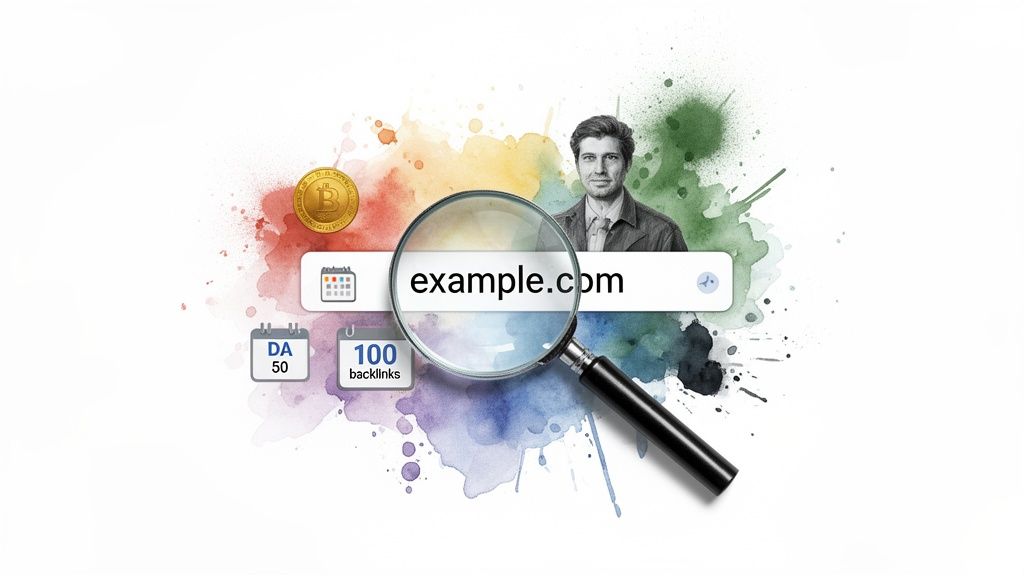
A dashboard like this lets you immediately spot the metrics that matter, so you can quickly decide which domains are worth a closer look and which ones are just noise.
This approach saves an unbelievable amount of time. But more importantly, it helps you make smarter decisions by focusing only on domains with real, measurable potential. While expired domains offer a unique shortcut, understanding the bigger picture of general search engine optimisation strategies in New Zealand will provide a solid foundation for whatever you build.
From Expiring to Available: The NameSnag Workflow
The beauty of a dedicated tool is how it supports your hunt across the entire domain lifecycle. Your strategy will change depending on where a domain is in its expiration journey.
You have two primary hunting grounds, both easily accessible with simple filters on NameSnag:
- Expiring Domains: These are domains sitting in their grace period. They haven't dropped yet, but they might. This filter lets you build a watchlist of high-potential names and get ready to pounce if they become available. It's all about strategic foresight.
- Available Domains: These are domains that have made it all the way through the expiration process and are now back on the open market. You can register them right now. This is where the race begins, and having a pre-vetted list means you can move fast.
By using time filters—like "Today" or "Last 3 Days"—you can zero in on the freshest opportunities before everyone else.
The real edge is efficiency. Integrated tools like a proprietary SnagScore and built-in spam checks condense hours of research into a single click. You can filter out domains with toxic backlinks or a history of penalties, making sure you only invest in clean, high-value assets.
This level of analysis transforms the hunt from a guessing game into a data-driven strategy. It lets you find domains with real SEO power, giving you a massive head start on building authority, driving traffic, or launching a new brand on a rock-solid foundation.
Strategies for Acquiring Expired Domains
Okay, you've done the homework. You've built a watchlist and zeroed in on the perfect domain. Now for the exciting part—how do you actually make it yours? Like buying a house, snagging an expired domain isn't just one-size-fits-all; there are specific strategies involved, and picking the right one makes all the difference.
Let's walk through the three main playbooks for capturing that digital gold. Each has its own rhythm, its own cost, and its own level of intensity.
Playbook 1: The Backorder
Think of a backorder as calling dibs. You're telling a specialized service, "Hey, if this domain ever drops, I want you to be there to catch it for me the microsecond it becomes available."
It’s a hands-off approach that saves you from the madness of staring at a countdown clock, waiting for the exact moment of deletion. The service uses its own high-speed, automated systems to attempt the registration for you.
- When to Use It: This is perfect for domains you really want but can't be online 24/7 to catch yourself. It’s your best shot at a moderately competitive name.
- The Catch: There's no guarantee. If multiple people backorder the same domain at the same service, it typically goes to a private auction between them. If they use different services, it's a high-tech drag race to see whose system is the fastest.
Playbook 2: The Auction Battle
Some domains are just too valuable to be unceremoniously dropped back into the wild. Registrars know this. So when a domain with killer metrics, great branding potential, or a history of traffic expires, it often gets sent to a public auction.
This is where things get real. You’ll find yourself bidding against other investors, SEO pros, and entrepreneurs who see the same potential you do. Prices can start under a hundred bucks and climb into the tens of thousands for truly premium names.
An auction is a test of nerves and budget. The key is to set a maximum price before you start bidding and stick to it. It’s dangerously easy to get caught up in the heat of the moment and overpay.
At last count, global domain registrations have hit around 378.5 million, a staggering number that hides a fascinating shift. While the total keeps climbing, registrations for legacy extensions like .com and .net recently saw a 2.6 million drop year-over-year. This means more classic, seasoned domains are expiring and hitting the market, creating fresh opportunities in auctions.
Playbook 3: Hand-Registration (The Drop Catch)
This is the most hands-on, adrenaline-pumping method of them all. "Hand-registering," or drop catching, is the raw art of manually registering a domain yourself the very instant it becomes available.
You're literally racing against sophisticated bots and automated backordering services, so your chances of winning a competitive name this way are slim to none. But for less-contested domains? It can be a dirt-cheap way to snag a hidden gem. You just need impeccable timing and a healthy dose of luck. For a deeper dive into the whole process, check out our complete walkthrough on how to buy expired domains.
Ultimately, choosing the right approach boils down to three things: the domain's value, your budget, and how much of a fight you're willing to put up. For those looking to acquire domains efficiently, especially in bulk, exploring a service like the Synergy Wholesale platform can be a smart move.
No matter which path you take, having a plan is what separates the winners from the watchers. Whether you’re setting a backorder, prepping for an auction, or getting your trigger finger ready for a drop catch, a clear strategy is what turns you from a hopeful observer into a serious contender.
Answering Your Burning Questions About Domain Expiration
We’ve walked through the whole lifecycle, from that first missed renewal email to the domain dropping back into the wild. But let's be real, some of this stuff can still feel a little murky. To clear the air, I've pulled together answers to the questions I hear all the time.
Think of this as your quick-reference cheat sheet. Let's nail down these details so you can start hunting for domains with confidence.
Expiring vs. Available: What's the Real Difference?
Getting this one right is probably the single most important part of the whole game. They sound alike, but "expiring" and "available" domains are in two totally different worlds, and your strategy for each needs to be just as different.
An expiring domain is one where the owner has missed the renewal date, but it's still in that cushy Registrar Grace Period. The original owner still has a shot—usually somewhere between 0 and 45 days—to get it back. You can’t register these yourself just yet, but you can absolutely keep a close eye on them.
This is where the pros play chess while others play checkers. By browsing the Expiring domains on NameSnag, you can build a killer watchlist of high-potential names before they're ever up for grabs.
An available domain, on the other hand, has run the entire gauntlet. It went through the grace period, the redemption period, and the pending deletion phase, and nobody came to its rescue. It has been officially "dropped" by the registry. Now, it's fair game for anyone, first-come, first-served. These are the gems you find using the Available domains filter and can register on the spot.
Is a Backorder a Guaranteed Win?
So you've found a domain you love, and you've placed a backorder. Feels like you've got it in the bag, right? Well, it's a smart move, but it's crucial to understand that a backorder is not a guarantee. Think of it as hiring a professional sniper to try and grab that domain the split-second it becomes available. It gives you a massive advantage, but it isn't foolproof.
Here’s the reality of the situation:
- The competition is insane. If you backorder a domain at one service, and someone else backorders it at another, it turns into a digital drag race to see whose system is milliseconds faster.
- You might end up in an auction. If a few people place a backorder on the same domain at the same service, they don't just hand it to the first person who clicked. More often than not, this triggers a private auction just between those bidders.
A backorder is like buying a ticket for the front-row seat, but when you get there, you might find a few other people holding the exact same ticket. It puts you in a fantastic position, but for a truly hot domain, the fight isn't over yet.
Is It Legal to Register Someone Else's Expired Domain?
In almost all cases, yes, it's 100% legal. Once a domain goes through the full expiration lifecycle and gets released back to the public, it's essentially abandoned property. The previous owner's rights are gone, and it’s up for grabs.
But there’s one massive, flashing red light you have to watch out for: trademarks.
If the domain name is a registered trademark (think "StarbucksCoffee.net" or something similar), you're walking into a minefield. Even if you register it fair and square, the trademark holder can file a legal dispute to take it from you. This process is called a UDRP (Uniform Domain-Name Dispute-Resolution Policy), and spoiler alert: the big brand with the trademark almost always wins. Before you spend a dime, do a quick trademark search, especially if the domain contains a known brand name.
Why Do Good Domains Expire in the First Place?
It seems totally bonkers that someone would just let a valuable piece of digital real estate disappear, doesn't it? Yet it happens thousands of times, every single day, for some surprisingly human reasons.
Often, it's the simple stuff. A business closes its doors, and the domain is no longer needed. The owner just plain forgot or their renewal emails went to spam. A very common culprit is an expired credit card on file for auto-renewal that was never updated.
Other times, the project tied to the domain just fizzled out, and the owner lost interest. They might be completely oblivious to the SEO authority or brand equity they're letting go of. And that's exactly where their oversight becomes your opportunity.
Ready to put all this knowledge to work? NameSnag is the tool you need to find those high-value domains others have let slip through their fingers. Stop guessing and start discovering domains with real power. Explore thousands of expiring and available domains on NameSnag now.
Find Your Perfect Domain
Get access to thousands of high-value expired domains with our AI-powered search.
Start Free Trial