
Heard that every good 3-letter domain was snatched up back when we were all using dial-up? That was mostly true... for a little while. But guess what? You absolutely can find 3 letter domains available to register right now.
The secret isn’t some complicated hack. It’s just knowing where—and how—to look. Hundreds of these premium domains drop back onto the open market every single month, and we're going to show you how to snag them.
The Undiscovered World of 3 Letter Domains

Let's kill a popular myth right now: the game for short, powerful domain names isn't over. Not by a long shot.
Yes, it’s true that the three-letter .com market was a feeding frenzy in the early days. It officially hit total saturation way back in 1997, a wild time when all 17,576 possible combinations were claimed. That early gold rush created an artificial scarcity that still fuels demand today. If you're curious, you can dive into the early days of domain history to see just how fast things moved.
But here’s the part most people miss. Businesses rebrand. Startups pivot. Projects get shelved, and every year, renewal fees get forgotten. Every single day, a fresh batch of these valuable domains expires and drops back into the public pool, creating a constant stream of opportunities for savvy investors and brand builders.
Why They're Still the Gold Standard
The obsession with three-letter domains isn't just about nostalgia; it’s about pure, unfiltered branding power. In a world of long, clunky, and forgettable URLs, a three-letter domain is the digital equivalent of a corner office with a view.
A short, memorable domain is more than just an address—it’s an immediate signal of credibility and authority. It tells your audience you were either smart enough to get in early or successful enough to acquire a premium asset.
These domains are the ultimate branding shortcut. They carry a psychological weight that longer names just can’t replicate. Think about it—they are:
- Effortlessly Memorable: Easy to type, easy to say, and almost impossible to forget.
- Instantly Credible: A short domain has an unspoken authority that builds immediate trust.
- Highly Brandable: They work as powerful acronyms (like IBM.com) or punchy, pronounceable words (like Joy.com).
This is why finding 3 letter domains available is more of a treasure hunt than a lost cause. The real challenge isn't a lack of supply—it's the overwhelming noise and competition. Manually refreshing registrars is a terrible use of your time. You need a better map.
Turning the Hunt into a Strategy
Instead of blindly searching and hoping, what if you could see exactly which three-letter domains dropped today? Or even better, get a heads-up on which ones are set to expire in the next few weeks?
This is where you shift from relying on dumb luck to employing a real strategy.
This is precisely what platforms like NameSnag were built for. You can filter to find Available domains that just dropped and are ready for standard registration at any registrar. Or, you can get ahead of the game by tracking Expiring domains that are in their grace period and will be up for grabs soon.
It transforms an impossible-feeling task into a strategic—and honestly, pretty fun—activity. We're moving beyond hoping to stumble upon a gem and into a world where you can strategically snag them.
Why Your Hunt for Short Domains Keeps Failing
If you’ve ever lost a Saturday morning to the registrar search bar, you know the ritual. You methodically type in three-letter combinations, only to be met with a demoralizing drumbeat of “already taken,” “unavailable,” or my personal favorite, “available for a cool $250,000.” You finally slam the browser tab shut, convinced the game is rigged and every good name was snatched up a decade ago.
Sound familiar? This manual approach is, to put it bluntly, a colossal waste of your time. It’s like trying to find a specific grain of sand on a mile-long beach by inspecting each one individually. You might get lucky, but the odds are stacked against you. By the time you manually type and check a domain, a bot has probably already registered it, sold it, and moved on.
This isn’t a knock on your hustle; it’s a critique of the strategy. Trying to win a modern-day land rush with tactics from 1999 is a recipe for frustration.
The Pitfall of Unfiltered Domain Lists
So, you get a little smarter. You hunt down a massive, intimidating list of "expiring" domains and decide to pan for gold. You download a spreadsheet with tens of thousands of names, pour a fresh cup of coffee, and start scrolling.
An hour later, your eyes have glazed over. You’re adrift in a sea of nonsensical strings like "XQZ.com" and "JVK.net," peppered with domains that have a backlink profile so toxic it would make a HazMat team nervous. It’s overwhelming, wildly inefficient, and—worst of all—it just kills your motivation. This method burns through your most valuable asset, your time, with almost nothing to show for it.
The problem isn't a lack of available 3 letter domains; it's a lack of an efficient system to find them. Hunting without the right tools is like fishing with your bare hands. You might catch something, but you’ll miss the big ones swimming right past you.
The domains you're actually looking for are hidden in plain sight, buried under an avalanche of digital noise. The real opportunity isn't in sifting through the noise, but in cutting straight through it with surgical precision.
Shifting from Luck to a Smarter Strategy
This is where a change in mindset becomes a real game-changer. The pros aren't manually hammering GoDaddy at 3 AM. They're not scrolling through endless lists, hoping for a miracle. They're using a tool-driven approach to do the heavy lifting for them.
Imagine, instead of that frantic manual search, you could just pull up a clean, pre-vetted list of every three-letter domain that became available today. That’s what a targeted approach looks like.
With the right platform, you can apply filters that do the sorting for you, instantly. For example, instead of guessing, you could:
- Instantly see newly dropped domains: Use a dedicated filter to find Available domains that have just been released and are ready for hand-registration at any standard registrar.
- Focus on the freshest opportunities: Narrow your search to domains that dropped within the last 3 Days or even just Today, putting you way ahead of the manual searchers.
This simple shift transforms the hunt from a frustrating chore into a strategic advantage. You’re no longer hoping to get lucky; you’re using data to make your own luck. The goal is to spend less time searching and more time evaluating high-potential assets.
Your Playbook for Snagging Available Domains Today
Alright, let's get down to business. We’ve talked about the frustration of the hunt, but now it’s time to shift from theory to an actionable strategy. This is your playbook for finding high-value three-letter domains you can register immediately. No auctions, no backorders—just pure, first-come, first-served wins.
The secret is to stop chasing ghosts. Focus exclusively on domains that just finished their expiration cycle and have been released back into the wild. These are what we call Available domains, and if you know how to find them quickly, they're the lowest-hanging fruit in the entire domaining world.
The ‘Available’ Filter Is Your Secret Weapon
The old way of hunting for domains is a soul-crushing guessing game. You manually type in combinations, sift through endless expiring lists, and end up with nothing but frustration. This cycle is a dead end.
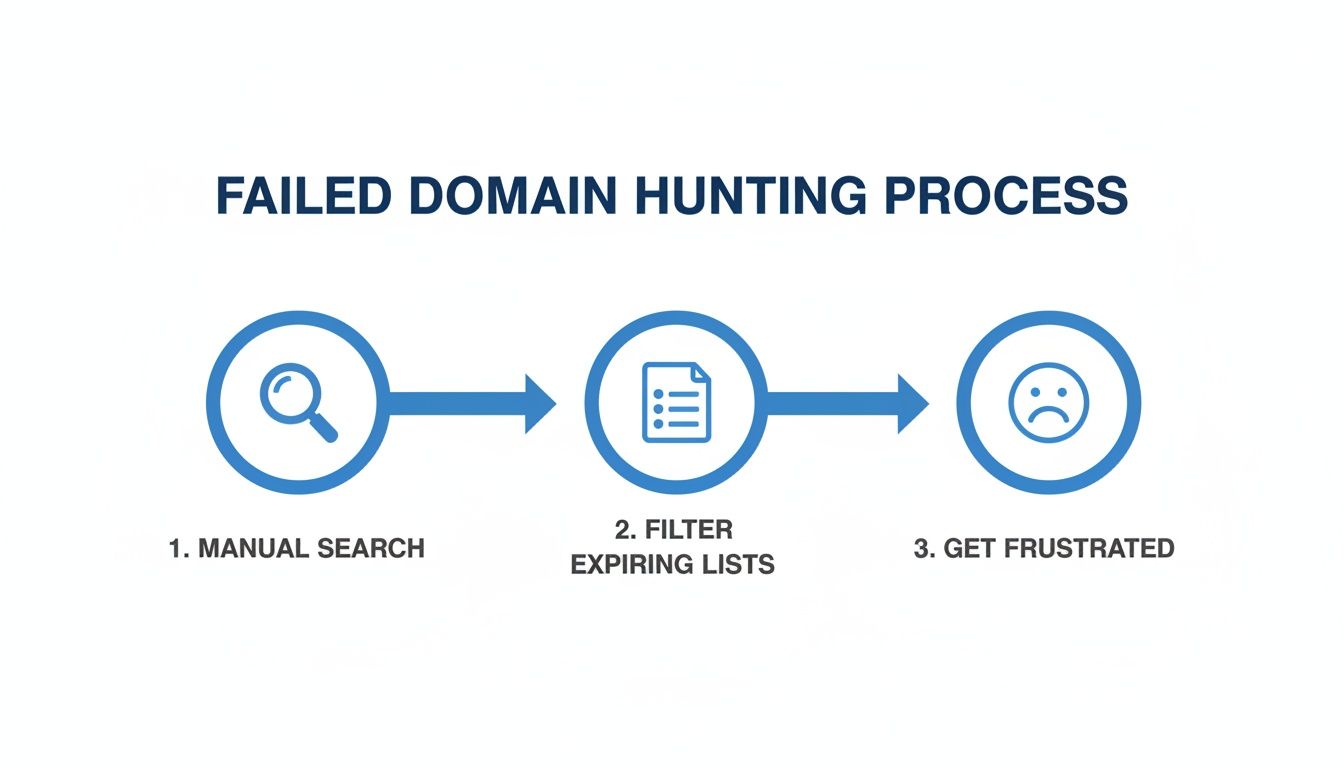
The takeaway here is simple: manual effort without the right tools is a recipe for failure. The solution is to skip the guesswork and go straight to a curated list of what’s actually available right now.
This isn't just a minor tweak; it's a complete shift in approach. Instead of hoping something is free, you're going to use NameSnag’s filters to see a real-time list of what is free. Here’s how you can do this right now:
- Head to the ‘Available’ Domains: Go to the NameSnag platform and click the Available domains tab. This immediately filters out every unavailable or expiring name, leaving only domains you can hand-register at any registrar.
- Set Character Length to ‘3’: This one’s obvious, but it's the critical step. Filter the results so you're only seeing 3-letter domains.
- Use the Time Filter: This is the pro move that puts you ahead of the crowd. Change the time filter to Today or 3 Days. This lets you see the absolute freshest drops before they get scooped up by everyone else still digging through old lists.
By focusing on the "Today" filter, you're essentially front-running the rest of the market. While others are still figuring out that a domain has dropped, you’re already evaluating it.
Hunting for Patterns and Acronyms
With a fresh, targeted list in hand, the hunt becomes more strategic. Not all three-letter domains are created equal, after all. You're looking for gems, not just random strings of characters.
Here are a few patterns I always prioritize:
- CVC (Consonant-Vowel-Consonant): These domains, like "NEX.com" or "VIM.com," are often pronounceable, memorable, and highly brandable. They just feel right.
- Meaningful Acronyms: Keep an eye out for combinations that could represent an industry or a concept. Imagine a founder of a new AI venture stumbling upon 'AIV.com' just hours after it dropped. That’s a massive win.
- Three-Letter Words: On rare occasions, actual three-letter words drop. These are the ultimate prizes and are absolutely worth checking for every single day.
Think of this as a daily ritual. Spend just 10-15 minutes each morning running this filter. Consistency is what pays off, giving you a shot at spotting a premium asset the moment it becomes available.
This repeatable process is your new discipline. It replaces hours of frustrating manual work with a few minutes of high-impact review. If you're new to this, our guide on how a domain name availability checker works can give you more background.
And once you've successfully snagged a great 3-letter domain, knowing how to transfer domain ownership is the next crucial step. It ensures you can move your new asset to your preferred registrar smoothly and securely—a key part of managing your new digital real estate.
This targeted view eliminates all the noise, letting you focus your attention only on the opportunities that matter right now.
Anticipate the Drop: The Art of Tracking Expiring Gems
Catching a great domain the second it drops is a good feeling. But the pros? They're playing a different game entirely. They don't just react to what hits the market—they see it coming. This is how you go from being a scavenger, picking through the leftovers, to a strategist who spots valuable three-letter domains before anyone else even knows they're in play.
It all comes down to the domain expiration cycle. When a domain isn't renewed, it doesn't just disappear. It first enters a "grace period," a window where the original owner can still get it back. If they don't, it eventually gets deleted and released. That grace period is your intelligence-gathering phase.
Scouting What’s on the Horizon
Instead of just hammering the "Available" list, you need to start looking at what's coming down the pipeline. This is where NameSnag’s Expiring domains feature becomes your crystal ball. It shows you which names are in their grace period and might soon be up for grabs, letting you see what's on the horizon.
Setting up this forward-looking hunt is simple but incredibly powerful.
- First, head over to the Expiring view in NameSnag. This single click shifts your entire perspective from what is available to what could be.
- Just like before, you’ll want to set the character count to 3 to keep your focus tight.
- Then, the key is to use the time filters. Toggling the 7 Days, 14 Days, or even 30 Days filters lets you scout what’s set to drop in the near future, giving you precious time to prepare your move.
Here's what that looks like in action. You're no longer looking at an empty pool; you're looking at a list of prime candidates.
This isn't just a list; it's a strategic advantage. You’re seeing domains that are locked up in their grace period, invisible to the rest of the market. By keeping an eye on this feed, you can pinpoint high-potential targets long before the mad rush begins.
From Passive Observer to Prepared Hunter
Spotting a promising expiring domain is one thing. Being ready to pounce is another. This is where your strategy gets serious.
Let's say you see a gem like "ZAP.com" on the 30-day expiring list. That's a massive head start. Instead of scrambling on drop day, you can use that month to do your homework without the pressure of a ticking clock. Research its history, check for trademarks, and really think through its branding potential.
The goal is to be fully prepared to backorder or hand-register a premium domain the moment it becomes available. This proactive approach completely flips the script on domain hunting.
This is the art of anticipating the drop. You're no longer one of the crowd fighting over scraps. You're a prepared investor, waiting patiently for a carefully chosen asset to fall right into your lap. As you get into tracking these future opportunities, it really helps to understand the full lifecycle of domains that are about to expire to nail your timing.
Setting Up Your Early-Warning System
Manually checking the expiring list every day is better than nothing, but it's not efficient. The next level is to put your vigilance on autopilot. Once you’ve picked out a few high-potential expiring gems, you need an early-warning system.
This is exactly what features like Watchers and Early Access Alerts on NameSnag were built for. When you "watch" an expiring domain, you’re telling the system to keep an eye on it for you. You’ll get a notification the second its status changes or it's about to be deleted.
This automated monitoring ensures you don't miss that critical window. While others are sleeping or distracted, you’ll get an alert that puts you at the front of the line, fully prepared to execute your plan. This simple action transforms your hunt for 3 letter domains available from a game of chance into a calculated, strategic operation.
How to Vet Your Shortlist Like a Pro Domain Investor
Finding an available three-letter domain feels like striking gold. But that initial thrill is just the starting gun. The real work—the part that saves you from throwing money into a digital money pit—is about to begin. You have to figure out if you've found a diamond or just a dud with a toxic past.
This is the process that separates the casual hobbyist from a serious investor. It's about looking past the shiny, three-letter facade and digging into the data to see what it's really worth. A great name with a terrible history is an expensive mistake waiting to happen.
Thankfully, you don't need a dozen different tools just to get a first impression. We built NameSnag to bake the most critical metrics right into the listings. This is your first line of defense, saving you hours of manual work.
Your First Pass: The Quality Check
Before you even start daydreaming about logos and brand colors, you need to check for red flags that can kill a domain's value instantly. NameSnag boils this down to two essential checks you should never, ever skip.
First up is the SnagScore. This isn't just some random number; it's a proprietary score that distills dozens of data points into one simple rating. It looks at things like domain authority, backlink quality, and domain age to give you a quick read on the domain's historical strength. A high SnagScore suggests it had a respectable past, which could give you a serious head start with SEO.
Second, and arguably more important, is the spam-free verification. A domain previously used for spam, phishing, or other sketchy business is radioactive. It might be blacklisted by search engines or email providers, making it nearly impossible to build a legitimate brand on. This simple check is non-negotiable.
Beyond the Score: Your Manual Due Diligence
While our built-in tools give you a fantastic starting point, the final call requires your own detective work. A great score doesn't automatically mean a domain is a perfect fit. You need to do your own manual due diligence to make sure you're not buying a future headache.
This is where you put on your brand strategist hat. Is the name actually marketable, or is it just a random jumble of letters? A huge part of this is the need to check the domain's history to see exactly how it was used before.
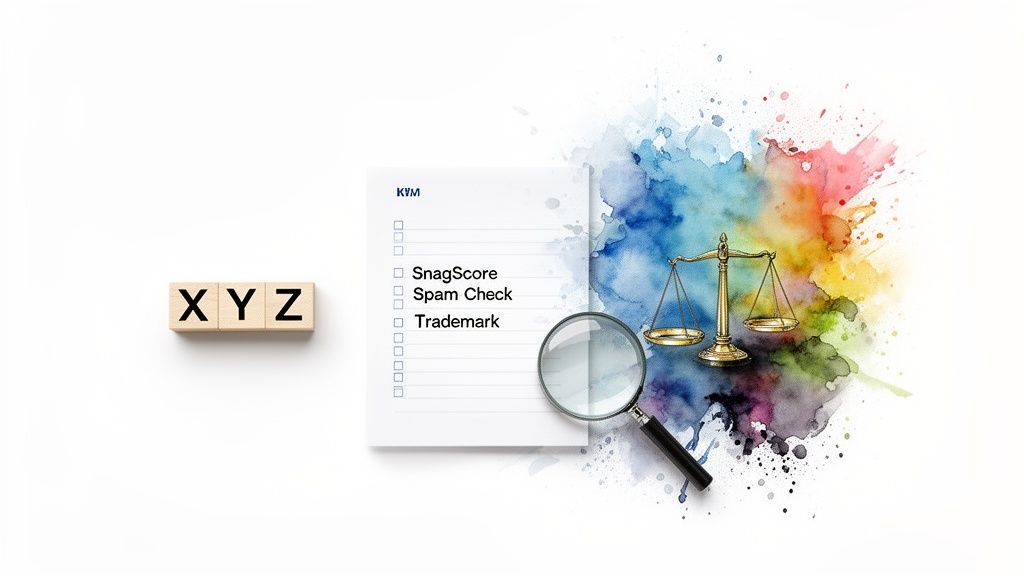
Here’s a quick checklist to guide your manual review. I’ve put it into a table to make the key valuation factors easier to scan.
Quick Valuation Checklist for 3-Letter Domains
| Evaluation Factor | What to Look For | Tool/Method |
|---|---|---|
| Trademark Search | Live or dead trademarks for the exact 3-letter combination. This is a potential legal nightmare. | USPTO TESS Database |
| Brand Conflict | Is another company, even in a different industry, heavily associated with this name? | Google, social media searches |
| Pronounceability | Is it easy to say and spell? CVC (consonant-vowel-consonant) patterns like "BOD.com" are gold. | The "say it out loud" test |
| Marketability | Who would buy this? Is it a good acronym for a hot industry (e.g., "AIV" for AI)? Does it sound like a cool startup? | Common sense, industry knowledge |
This process isn't just about avoiding bad domains; it's about understanding the true potential of the good ones. Each factor adds to or subtracts from the name's real-world value.
A domain's value is a combination of its clean history, technical strength, and brand potential. Skipping any part of the evaluation process is a gamble you can't afford to take when hunting for 3 letter domains available.
By combining automated scores with your own manual research, you build a complete picture of the asset. This robust evaluation empowers you to move forward with confidence, knowing you’re investing in a valuable piece of digital real estate, not just inheriting someone else's problems.
Your Burning Questions About 3-Letter Domains, Answered
When you start digging into the world of three-letter domains, you’ll find it’s a weird, fast-moving corner of the internet with its own rules. It’s a market that feels more like trading rare art than buying a simple web address.
To cut through the noise, I've put together answers to the questions I see pop up constantly. These aren't just textbook definitions; they're the practical realities I've learned from years of hunting these digital unicorns.
So, Are 3-Letter .Coms Still a Good Investment?
Short answer: Yes, without a doubt.
Even with hundreds of new extensions popping up, the three-letter .com remains a blue-chip digital asset. Think of it like oceanfront property in a world of endless suburbs. The reason is simple scarcity—all 17,576 possible combinations were snatched up by 1997. That’s it. There are no more.
You see the flashy, headline-grabbing sales like Ice.com going for $3.5 million or Fly.com for $2.89 million, and it's easy to think it's a market only for billionaires. But those sales just prove the top-end potential. The reality is that even mid-tier three-letter .coms are incredibly liquid assets for investors and a massive brand accelerator for businesses.
While new TLDs offer fresh options, the .com extension still dominates over 44% of the entire global domain market. This solidifies its status as the most trusted and recognized choice, making a three-letter .com a premier investment.
When you pair a super-short, memorable name with the world's default extension, you get something special. It’s a combination that screams authority and requires zero explanation, maximizing its value and long-term potential.
What's the Difference Between an "Available" and "Expiring" Domain?
Getting this straight is crucial. It’s the difference between a mad dash and a calculated strike.
An Available domain (often called a "dropped" domain) is one that has gone through the entire death cycle. The previous owner didn't renew it, it passed through all the grace periods, and the registry finally deleted it. Now, it's back in the public pool, ready for anyone to register at the standard price. It's a pure first-come, first-served sprint.
An Expiring domain is a different beast. It's technically still owned, but the renewal date has passed. It's sitting in a "grace period" where the original owner can still wake up and reclaim it. If they don't, it will eventually get deleted and become "Available."
This is where a bit of strategy comes in. Using a tool like NameSnag to watch Expiring domains is like getting insider information. You can see what valuable names might hit the market soon, giving you a head start to do your research and prepare to pounce before the rest of the world even knows it exists.
Why Is .Com So Important for These Short Names Anyway?
You can find three-letter domains in all sorts of extensions— .net, .org, or the trendy .ai. But the .com version is the undisputed king. This isn't just domain snobbery; it’s baked into decades of user behavior and internet history.
The .com TLD accounts for around 44% of all registered domains on the planet. For most people, it's the mental shortcut they automatically apply. Think about it: when a friend mentions a website, you instinctively type ".com" at the end without even thinking. That's a powerful habit.
This ingrained behavior means a .com domain is instantly more intuitive and professional. You don't have to spend your marketing budget educating your audience on your web address. They just get it.
How Can I Actually Find a 3-Letter Domain That's Available Today?
This is the million-dollar question, isn't it? The most effective way is to stop doing it manually. Poking around different registrars hoping to find a dropped gem is a slow, soul-crushing, and almost always fruitless exercise.
You need a specialized tool that does the heavy lifting for you. Here’s a simple, effective strategy you can turn into a daily habit:
- Go straight to a platform that lists recently Available domains. This ensures you're not wasting time on names that are already gone.
- Set the character length filter to exactly 3. No more, no less.
- Here’s the pro move: Filter the time to "Today". This shows you only the domains that dropped in the last 24 hours. You're getting first look, a huge advantage over people sifting through old, stale lists.
Make this a quick, 10-minute part of your morning routine. It turns the frustrating hunt into a strategic daily treasure hunt. You'll be amazed at what you can find when you're one of the first to the scene.
Does a Domain's Past Really Affect Its Future Value?
Yes, one hundred percent. A domain’s history is one of the most overlooked but critical factors in its real value. That three-letter gem might look perfect, but if it was previously a home for spam, phishing, or other sketchy activities, it could be a toxic asset.
Search engines like Google have long memories. They can penalize or completely de-index sites with a spammy history, making it nearly impossible to ever rank for anything. A domain can also be blacklisted by email services, which means any message you send from it goes straight to the spam folder.
Even if the domain was used for a legitimate business that just failed, you have to dig into its backlink profile. Are the incoming links from respected sources, or are they from a bunch of low-quality link farms in a foreign country? A clean history with a few strong, relevant backlinks can give you an SEO head start from day one. Vetting a domain's past isn't just a good idea; it's a non-negotiable step before you even think about buying.
Ready to stop guessing and start finding? NameSnag uses AI to analyze over 170,000 domains daily, surfacing the hidden gems with real branding and SEO potential. Find your next winning domain today.
Find Your Perfect Domain
Get access to thousands of high-value expired domains with our AI-powered search.
Start Free Trial