Expiry or expiration? It’s one of those little debates that feels like it shouldn't matter, but in the wild world of domain investing, the subtle differences are a really big deal. Getting it right can be the difference between finding a hidden gem and missing out completely.
So, what's the short version? Expiration is the formal, industry-standard term you'll see in the U.S. and in most techy contexts. Expiry is its slightly more casual cousin, common in British English. When it comes to domains, expiration is the word that pays the bills.
Untangling Expiry Vs. Expiration
Think of it like "color" versus "colour." Same idea, different spelling depending on where you're standing. But in the technical and legal arena of digital assets, expiration is the heavyweight champion. It’s what you’ll find baked into registrar agreements, official ICANN documentation, and the protocols that keep the internet humming.
So, why should you care? Because getting the lingo right is the first step toward seeing a simple date not as an ending, but as a massive opportunity. A domain’s expiration date kicks off a totally predictable lifecycle, opening up windows where valuable digital real estate suddenly becomes available.
A domain's expiration date isn’t just a deadline. It's a flashing neon sign that a digital asset—one with history, authority, and maybe even existing traffic—might soon be up for grabs.
For a quick breakdown, here’s how the two terms generally stack up.
Expiry Vs. Expiration At A Glance
| Aspect | Expiry | Expiration |
|---|---|---|
| Primary Region | Predominantly British English (UK, AU, CA) | Predominantly American English (US) |
| Formality | More informal, common in everyday speech | More formal, used in official contexts |
| Technical/Legal | Rarely used in contracts or technical docs | The industry standard for legal and technical use |
| Domain Industry | Sometimes seen, but non-standard | The correct and universally accepted term |
Ultimately, while you might hear "expiry" used casually, "expiration" is the term that carries weight and precision in the domain world.
Why The Right Word Matters
Using "expiration" correctly signals you know your stuff and ensures you're on the same page as everyone else. When you’re hunting for domains, you're looking for specific, time-sensitive statuses that follow a strict process.
For instance, at NameSnag, we label domains that have just passed their renewal date as Expiring domains. This is a deliberate choice. They are actively in the process of expiration but haven't been deleted yet. This is a totally different status from domains that are already deleted and instantly registerable.
Mastering this distinction is your secret handshake. It helps you separate the domains you need to watch from the ones you can grab right now. This knowledge transforms you from a passive observer into a strategic investor, ready to turn a simple date on a calendar into a powerful asset for your next big project.
Turning Domain Expiration Into Your Secret Weapon
A domain's expiration date isn't some boring administrative detail to pencil into a calendar. Far from it! For savvy investors and SEO pros, it’s a massive opportunity masquerading as an ending. They know that when a domain's registration lapses, it kicks off a totally predictable lifecycle—and inside that cycle is a goldmine of potential.
This is where you can flip a simple date into a real strategic advantage.
Instead of starting from absolute zero with a brand-new domain, picking up one with some history gives you an incredible head start. An expiring domain often comes pre-packaged with valuable assets that can take years and a small fortune to build from scratch.
- Established SEO Authority: It might already have a solid backlink profile and existing domain authority that you can inherit. Boom, instant credibility.
- Direct Traffic: The domain could still be pulling in traffic from old links or from people who remember the name and type it in directly. Free visitors!
- Brand Recognition: You might get lucky and find a memorable name that already has some recognition in its niche.
The Grace Period Advantage
The most critical moment in this entire process is the grace period. This is the window of time right after the official expiration date, but before the domain is deleted and thrown back into the public pool for anyone to grab.
During this period, the original owner can still technically renew it, but the fact that they haven't is a flashing neon sign that the domain might drop. This is your chance to scout for hidden gems and line up your shot. Instead of getting into a frantic bidding war when the domain finally drops, you can spot your high-potential targets in advance. For a much deeper dive on this, check out our complete guide on how to find expiring domains.
You can use specialized tools to keep an eye on domains just as they enter this critical phase. For instance, here’s a peek at how the NameSnag platform filters specifically for these opportunities.
This view gives you a curated list of domains that have blown past their expiration date and are now sitting in that grace period. It’s a watchlist of potential assets, giving you the time to properly evaluate a domain's metrics and decide if it's worth pursuing before the public scramble begins.
By focusing on expiration, you're not just buying a name; you're acquiring a digital asset with a past.
Expiring vs. Available: A Tale of Two Domain Statuses
Alright, let’s clear up one of the most important distinctions in the domain hunting game: the difference between an expiring domain and an available one. Nailing this concept is fundamental. It's the difference between preparing for a fight and celebrating an instant win.
Think of an expiring domain like a house that’s just hit pre-foreclosure. The owner has missed their renewal payment, but they're still in a grace period where they can reclaim it. You can't just swoop in and buy it yet. But you can—and should—start watching it closely, knowing it might hit the open market soon.
An available domain, on the other hand, is that same house after the foreclosure is complete. The "For Sale" sign is officially planted in the yard. It has survived the entire deletion gauntlet and is now back on the market, ready for anyone to register immediately.
This simple timeline breaks down the journey from a registered domain to one that's been fully dropped and is up for grabs again.
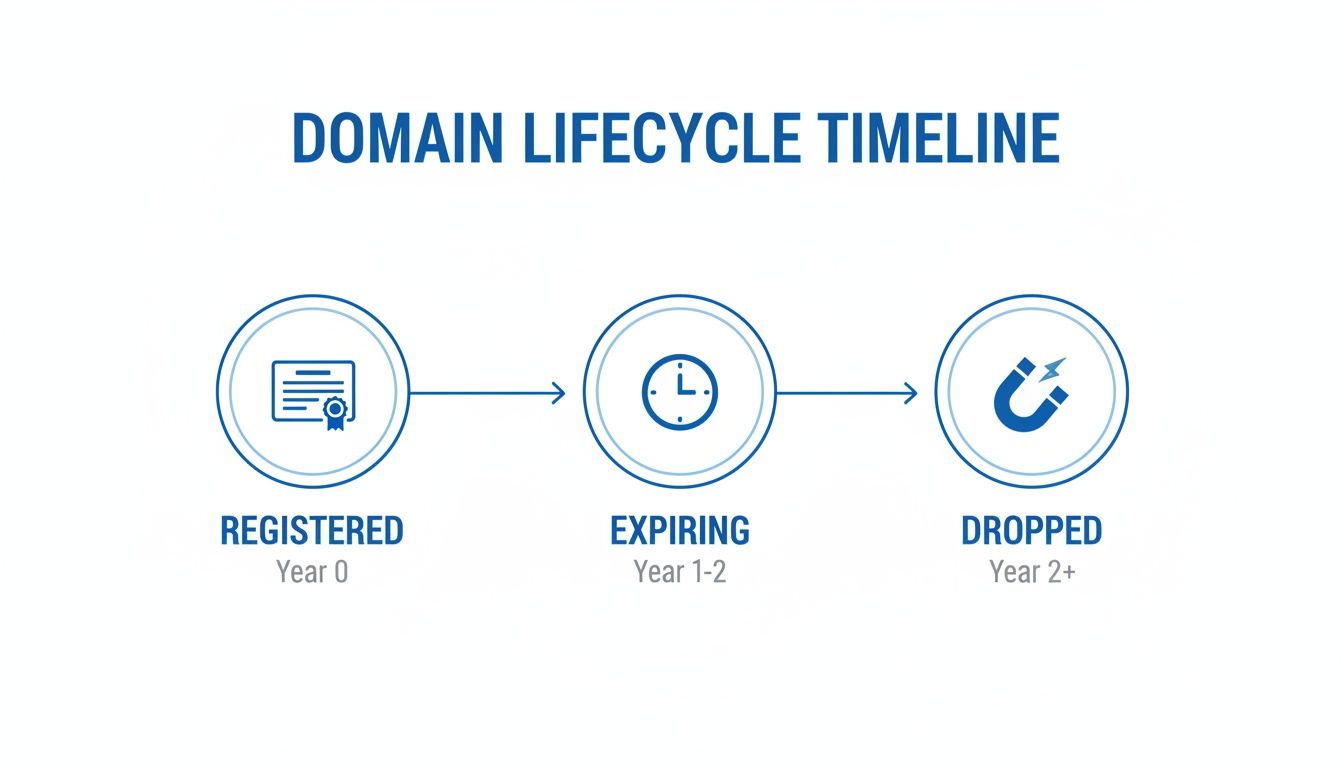
As you can see, the "expiring" phase is just a temporary limbo. The "dropped" (or available) status is the final destination, where the domain becomes fair game for everyone.
Snagging Instantly Available Domains
Understanding this difference is key to using tools like NameSnag effectively. You can find some absolute gems in the Expiring domains section, but those require a bit of patience. For an immediate score, you want the domains that have just completed their journey and dropped today.
This is where filtering for Available domains becomes your best friend. This view cuts through the noise and shows you a curated list of domains that became registerable this very day.
By focusing on the available list, you can skip the waiting game and the uncertainty of the grace period. You're looking at a list of high-potential names you can head over and register at your preferred registrar this very minute, securing valuable assets before anyone else does.
The Global Cost Of Misunderstanding Expiration

The confusion between words like expiry or expiration isn't just a quirky language problem; it has staggering, real-world consequences. To see the true cost, you just need to look at the global food supply chain, where a simple date on a label leads to mind-boggling, preventable waste.
When people see a 'best before' or 'use by' date, they often assume the food is instantly spoiled the day after. It's an easy mistake to make, but it leads to mountains of perfectly good food getting tossed out. This isn't just a few bucks wasted at the grocery store—this collective misunderstanding puts a huge strain on the environment, racks up economic losses, and even contributes to global hunger.
The Staggering Scale of Waste
Globally, something like 2.5 billion tons of food are wasted every year. A huge chunk of that is thrown out simply because of confusion over those dates. In the US alone, it's estimated that 80% of Americans throw away perfectly good food because they misread an expiration label. That's a big reason why nearly 40% of the entire US food supply ends up in a landfill.
This problem highlights a critical lesson that applies directly to the world of domains.
Whether it’s a carton of milk or a high-value domain name, ignoring or misinterpreting an expiration date means losing a valuable asset. The opportunity cost is massive.
The same casual dismissal that leads to food waste can cause an investor to completely miss out on a domain with years of established SEO authority. If you're building a portfolio, you're not just buying a name; you're buying its history. Overlooking a domain's past can saddle you with an asset that has hidden issues, like a high spam score.
When it comes down to it, the stakes are high. Understanding the real meaning and timeline behind an expiration is key to preventing loss and maximizing value—in both the real world and the digital one.
The Psychology Behind Expiration Dates
Ever wonder why a simple date on a package has so much sway over us? Phrases like "expires on" tap into a primal sense of urgency. It’s a powerful nudge that makes us act, sometimes impulsively—whether that means tossing out perfectly good milk or jumping into a bidding war for a domain name. This whole reaction is wired into our brains through a nifty psychological trigger called loss aversion.
Simply put, loss aversion means that the sting of losing something feels way more intense than the joy of gaining something of equal value. The mere thought of missing an opportunity, or even just the risk of a bad outcome, is a huge motivator. In the world of domaining, the ticking clock on a great name creates this exact feeling, and it’s often the spark that ignites a competitive fire among investors.
The Fear of Missing Out in Action
This isn't just some abstract theory; it has very real, and very expensive, consequences. A recent national survey found that a whopping 43% of Americans always or usually throw away food that's near or past its package date. This gut reaction, driven by the fear of spoilage, leads to about 3 billion pounds of food being tossed every year, carrying a staggering $7 billion price tag. You can get the full scoop on these consumer trends and their impact right here.
The same fear of loss is what fuels the mad dash for expiring domains. The idea that a valuable digital asset might just vanish into thin air if you don't act right now makes people pounce, often without taking a second to think things through.
Once you get a handle on this psychological trigger, you can start shifting from emotional, knee-jerk decisions to cool, calculated ones. This awareness alone gives you a massive advantage, whether you're in the grocery aisle or a domain auction.
So, the next time you see a domain in the Expiring domains section on NameSnag, just take a beat. Recognize that panicky feeling for what it is—a little psychological poke. Use that time not to freak out, but to calmly check the domain's stats, its history, and what it's really worth before it drops and joins the ranks of the Available domains.
How Expiration Dates Can Create Fraud Risks
Wherever there's something of value, you can bet someone is trying to game the system. Expiration dates, whether on a carton of milk or a domain name, are no exception and can be twisted for fraudulent gains.
In the physical world, this gets downright dangerous. Shady operators will sometimes slap new expiry labels on food to sell spoiled goods. This isn't just a small-time problem; it results in massive financial losses and, more importantly, poses a serious threat to public health.
This kind of scam is especially common in high-value markets. For instance, fraud involving nuts and seeds was predicted to see a 358% surge in 2025, often driven by tampered expiration dates. Deception like this costs the global economy an eye-watering $40 billion every year.
Digital Deception and Domain Expiration
The same deceptive mindset applies directly to the domain industry. Scammers have a whole playbook of tactics that exploit the expiration process, with cybersquatting and domain sniping being two of their favorites.
Their goal is to fool unsuspecting buyers. A common move is to register a domain that’s a slight misspelling of a popular brand right after it expires. They're banking on typos to divert traffic their way, which they can then use to sell counterfeit products or run phishing scams.
Another nasty trick is holding a valuable expired domain hostage. They snatch it up and then demand an outrageous sum from the original owner for its return, turning a simple expiration date into a tool for extortion. They’re betting on desperation.
Understanding these risks is your first line of defense. A savvy domain investor knows how to spot red flags and protect themselves from schemes tied to a simple expiration date.
Knowing how to tell a genuinely valuable asset apart from a cleverly disguised trap is a crucial skill. This is exactly why you have to do your homework and verify a domain's history before you even think about buying. A great place to start is learning how an expired domain checker can help you spot a clean, high-potential name. This knowledge transforms you from a potential target into a prepared and discerning buyer.
Got Questions? We've Got Answers.
What happens the moment a domain expires?
The second a domain passes its expiration date, it doesn't just vanish. Instead, it enters a "grace period," which typically lasts about 30-45 days. During this window, the original owner can still renew it without much fuss. If they sleep on it, the domain might slip into a much pricier "redemption period" before it's finally deleted and thrown back into the wild for anyone to grab.
Is it better to get an expiring or an available domain?
That really comes down to your game plan. An Available domain is like a blank canvas—you can register it on the spot, which is perfect for brand new ideas and projects. On the other hand, an Expiring domain often comes with a history, like existing SEO value and maybe even some leftover traffic. The catch? You might find yourself in a bidding war to snag it once it officially drops. It's a classic tortoise vs. hare situation: patience vs. speed.
How can I find out when a domain is expiring?
For any single domain you're curious about, a quick WHOIS lookup will tell you its official expiration date. But if you're hunting for a whole list of valuable domains that are about to drop, that's a different game entirely. That's exactly what platforms like NameSnag were built for—we do the heavy lifting of finding the good ones so you don't have to. You can even filter by time, like domains expiring in the next 3, 7, or 30 days, to perfectly time your strategy.
Ready to turn domain expiration from a risk into an opportunity? At NameSnag, we sift through over 170,000 domains every single day, looking for the hidden gems with real SEO and branding power. Start your search for high-value domains today.
Find Your Perfect Domain
Get access to thousands of high-value expired domains with our AI-powered search.
Start Free Trial