Your domain usually feels like plumbing. It sits there, does its job, and you ignore it while you work on sales, product, SEO, client delivery, or whatever pays the bills.
Then one day it doesn't.
Many savvy individuals view domain expiration protection as a registrar add-on to skip during the checkout process. In some cases, that is a reasonable choice. In others, it represents the most affordable insurance available. Success involves identifying the specific type of domain you hold, identifying where actual risks exist, and determining which protection features are merely attractive branding for settings that should already be active.
That Heart-Stopping Moment Your Domain Disappears
You open your laptop, type in your site, and instead of your homepage you get a dead page, a parked page, or some generic error screen that makes your stomach drop.
It gets worse fast. Your email starts bouncing. Contact forms vanish into the void. Customers assume your business is broken, hacked, or gone. Internally, everyone starts blaming hosting, DNS, SSL, or “the website.” But the root cause is often painfully simple. The domain expired.
That's why domain expiration protection matters. Not because the name is fancy, and not because registrars are good at naming things. It matters because your domain is the front door, mailbox, and street sign for your entire online business. Lose it, and the rest of the house suddenly looks a lot less secure.
Why this catches people off guard
Most domain losses aren't dramatic. They're boring.
A renewal notice went to an old inbox. The card on file expired. The person who bought the domain left the company three years ago. Someone assumed auto-renew was turned on. Someone else assumed accounting would handle it. That's how you lose a domain people would've sworn was “definitely covered.”
Practical rule: If your domain is tied to your revenue, brand, or company email, treat it like a critical asset, not a line item.
If you want a plain-English walkthrough on securing your digital address after expiration, that guide is worth a read because it frames the problem the way operators experience it, not the way registrars market it.
What domain expiration protection actually is
Domain expiration protection serves as a buffer. It gives you extra room to recover from the small admin mistakes that cause expensive disasters.
This service acts as a spare key held by a reliable contact. It does not replace the standard practice of locking your door. Instead, it protects you when the primary system fails at a critical moment.
That's the right mental model for the rest of this conversation. Domain expiration protection is useful, but only if you understand what it does, what it doesn't do, and where the traps are.
The Domino Effect of an Expired Domain
An expired domain doesn't just knock your website offline. It can trigger a chain reaction across marketing, operations, and security.
The homepage is typically noticed first due to its visibility. The less visible damage is usually worse. Sales emails stop landing. Password resets go missing. Vendor communication breaks. Then the cleanup starts, and cleanup is always slower than prevention.
The security risk most teams underestimate
The nastiest part of an expired domain isn't downtime. It's what happens if someone else gets control of it.
When expired domains are acquired by bad actors, they can intercept inbound emails intended for the original owner, potentially exposing sensitive material such as financial statements, invoices, and privileged corporate information. The same research notes that the most common cause is simple administrative failure, especially renewal notices going to outdated email addresses, and that approximately 25% of expired domains are reportedly used for malicious purposes according to CSC's review of expired domain risks.
That's not an IT annoyance. That's a business risk with legal, financial, and reputational consequences.
What breaks besides the website
Here's what usually gets dragged down with the domain:
- Company email: If your business runs on addresses tied to the domain, expired ownership can disrupt communication immediately.
- Lead flow: Contact forms, booking links, and trust signals stop doing their job the second the domain falls apart.
- Brand credibility: Customers don't know whether you forgot a renewal, got hacked, or vanished. They just see a broken business.
- Partnerships and vendors: Invoices, approvals, and renewal notices may keep flowing to addresses you no longer control.
- SEO equity: The links you earned over time stop helping if the destination is gone or replaced.
A domain isn't just a website label. It's the root credential for a lot of business communication people forget they depend on.
Why smart teams still lose domains
Because the failure mode is administrative, not technical. That's why it slips through.
Nobody forgets to back up a server on purpose. People do forget that the renewal email goes to the founder's old Gmail account from five years ago. They do forget that a role inbox exists but nobody owns it. They do forget that “auto-renew enabled” still depends on billing details being usable.
This is why I'm skeptical when people dismiss domain expiration protection as pure upsell. Sometimes it is. But if the domain matters, your risk isn't theoretical. It's operational negligence mixed with a timer.
Your Domain's Journey from Active to Auction
Friday afternoon. The card on file fails, the renewal email goes to an inbox nobody checks, and the domain still appears to be sitting there. That quiet gap is what catches people. Registrars know the name does not disappear in one motion. Investors know it too, and they watch that gap like hawks.
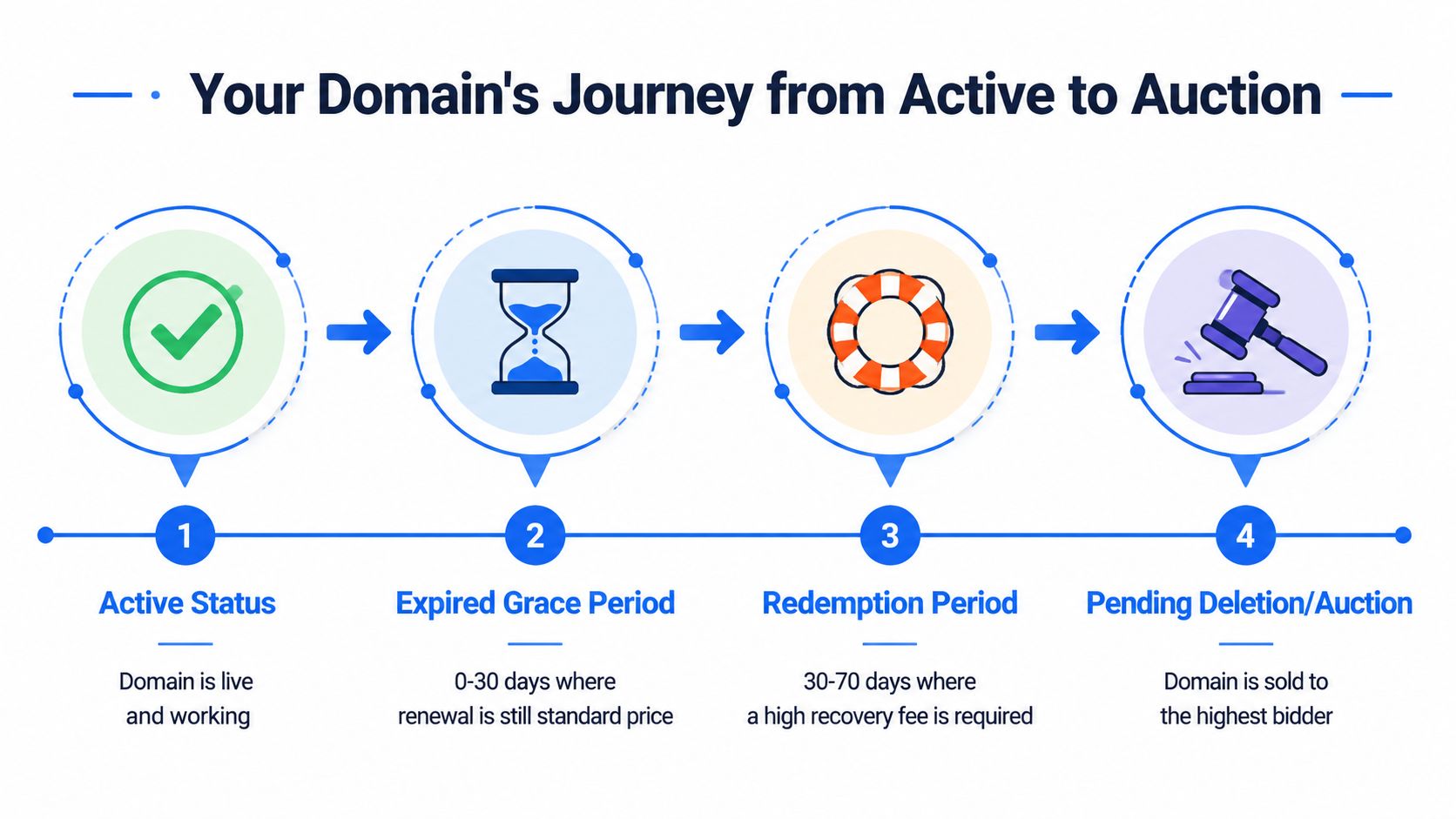
Stage one: expired, but not gone
After expiration, many domains enter a short recovery window where the original owner can still renew through the registrar. The exact timing depends on the extension and the registrar's policies, which is one reason blanket promises about "full protection" are usually marketing first and operations second.
That early window creates bad habits. Owners see the domain in an expired state, notice that renewal still works, and assume delay is harmless. It is not. The clock is already running, and each registrar handles the next step a little differently.
If you want the plain-English version of the ugly middle stage, this guide to the redemption period for domain names explains what happens after the easy fix disappears.
Stage two: redemption, also known as domain jail
Once the standard renewal window closes, recovery usually gets more expensive and more annoying. You are no longer paying for another year of registration. You are paying a penalty to reverse neglect.
This is the part registrars tend to describe in soft language. "Recovery." "Restore." "Reactivation." Fine. It is still domain jail. Your name is held, your options shrink, and the bill gets larger than it should have been.
I have seen people argue that expiration protection is always a useless upsell. That is too simplistic. For throwaway domains, maybe. For a primary brand domain tied to email, paid ads, and customer trust, a little extra buffer can be cheaper than learning how redemption works under pressure.
Stage three: pending deletion
After redemption, the domain can move into pending delete status. At that point, the owner's grip is basically gone and the release process is already in motion.
Incentives shift at this stage. Business owners search for a final escape hatch. Domain investors monitor dates, backorder systems, and registrar feeds to determine if the name will drop cleanly or move into an auction channel first.
If you want to see that pipeline in the wild, a live feed of expiring domains shows how many names are sitting in that vulnerable zone at any given time.
Stage four: back into the wild
Once the domain drops, speed matters. Sometimes it becomes available for fresh registration. Sometimes it gets intercepted through the registrar's auction partner before the public ever gets a fair shot.
That last part is the gotcha many owners never see coming. They assume an expired domain becomes available again without complication. Often, it enters a messy aftermarket path where bidders, drop catchers, and registrar partners all have a seat at the table before you do.
If you want to see what fully released inventory looks like, browsing available dropped domains makes the point fast. One person's administrative mistake becomes another person's acquisition list.
The investor lesson hidden inside the lifecycle
Owners treat expiration as a recovery timeline. Investors treat it as supply.
That gap matters more than registrars admit. The registrar sells peace of mind on the front end, but the primary market forms on the back end, once a neglected name starts sliding toward deletion. If the domain matters to your business, the smart play is boring prevention. If you hunt drops for profit, this same lifecycle is where the opportunity starts.
Your Defensive Toolkit Against Domain Loss
A registrar checkout page makes this look simpler than it is. Pay for the protection add-on, flip on auto-renew, and call it done.
That is how people lose good domains.
A safe setup uses different controls for different failure modes. Auto-renew covers forgetfulness. Registrar lock helps block transfer abuse. Expiration protection buys recovery time if billing breaks or someone on the admin side drops the ball. If a domain runs your site, your email, or both, treating one checkbox like a full security plan is rookie behavior.
What each protection layer actually does
Here's the plain-English version.
| Method | What It Prevents | Typical Cost | Best For |
|---|---|---|---|
| Auto-renew | Missed manual renewals when billing and account details are current | Usually included with registrar account settings | Every domain you care about |
| Registrar lock | Unauthorized transfers and some forms of account misuse | Usually included | Every active business domain |
| Domain expiration protection | Loss after missed renewals by extending the recovery window | Paid add-on, often cheaper than paying redemption fees or trying to buy the name back later | Mission-critical domains |
That table explains why registrar upsells confuse buyers. The two controls that do the most day-to-day work are often free. The paid layer still has a place, but only on names that would hurt to lose.
Where domain expiration protection actually earns its keep
Product protection is time.
Standard renewal grace periods can be short, and they vary by registrar and extension. Expiration protection extends your margin for error so a failed card, a missed notice, or a staffing change does not immediately turn into a public scramble for your own domain. That matters because once a valuable name starts slipping, other people are watching. Owners see a billing issue. Domain investors see incoming inventory.
That gap is the part registrars rarely explain clearly. They sell the add-on as peace of mind. The market sees it as a delay before a good name can drift toward redemption, auction, or a drop list.
If the domain is tied to customer email, your main site, paid traffic, or brand trust, extra recovery time is worth real money. If the domain is a half-baked side project you forgot you owned, paying to protect it every year is just organized waste.
What deserves your money, and what does not
Use this order of operations:
- Turn on auto-renew first. It fixes the most common problem for free.
- Apply registrar lock to every business domain. There is no good reason to leave it off.
- Buy expiration protection for names with real consequences attached. Revenue domains, branded email domains, and domains tied to trademarks belong here.
- Review the portfolio manually a few times a year. Dashboards miss things. People miss emails. Old cards fail at the worst time.
- Document ownership and renewal access. If the company lawyer, founder, or former employee is the only one with access, you have an operational problem, not just a domain problem.
That last point gets ignored until a dispute starts. If the domain matches a brand, basic ownership hygiene should sit next to your broader legal housekeeping, including intellectual property tips from Coto & Waddington.
What registrars love to sell, versus what helps
Registrars are happy to bundle protection with a pile of shiny extras. Privacy can be useful. Premium DNS can be useful. Random badge-and-certificate bundles usually are not part of expiration defense.
The ugly truth is boring. Good settings and clean account administration prevent more losses than fancy packaging. Expiration protection is the paid layer I respect most, but only after the free controls are set correctly. Otherwise you are buying a nicer spare tire for a car with loose lug nuts.
If you want the operational side buttoned up, this guide on how to renew a domain name correctly is a solid companion.
Protect the domains that would cause real pain if they vanished. For the rest, discipline beats add-ons.
The Hidden Gaps in Your Domain Protection Armor
This is the part registrars don't highlight on the checkout page.
Domain expiration protection sounds like a sealed bunker. In practice, it's more like a decent umbrella. Helpful, worth having in the rain, but not a force field.

The de-sync problem nobody explains well
A commonly overlooked issue is that domain expiration protection can de-sync from the domain's registration term. If you renew the domain for five years but only bought a one-year protection plan, you can create an unprotected four-year gap, as explained in HostGator's note on domain expiration protection.
That's a classic registrar gotcha. You think you bought long-term peace of mind because the domain itself now runs for years. Meanwhile the protection layer may have expired on its own schedule.
If your registrar doesn't make that obvious in the dashboard, you're not paranoid for being annoyed. You're paying attention.
Other ways people punch holes in their own safety net
Some failures are boring enough to be dangerous:
- Expired payment card: Auto-renew is on, but the transaction dies.
- Wrong contact inbox: Renewal warnings go to an address nobody checks.
- Former employee ownership: The domain is technically under the wrong person's account.
- Portfolio sprawl: Names are scattered across registrars, so nobody sees the whole picture.
These aren't edge cases. They're the routine messes that cause expensive surprises.
Don't confuse “I purchased protection once” with “my portfolio is protected now.” Those are not the same sentence.
Why investors think differently
For active flippers, affiliates, and SEO builders, a purely defensive mindset is too narrow. Protecting what you own matters, but so does watching what other people fail to protect.
That's one reason expired-domain tools are more useful than another checkbox inside a registrar panel. Serious buyers care about timing, history, and whether a name becomes available before auction chaos sets in. They're not waiting for a registrar to save them from themselves. They're scanning the market.
This is also where broader brand strategy matters. If a domain anchors your brand, the legal side of protection matters too. These intellectual property tips from Coto & Waddington are useful because domain hygiene and trademark hygiene tend to fail in the same companies for the same reason: nobody owns the process end to end.
A Simple Checklist for a Bulletproof Domain Portfolio
A strong domain setup doesn't come from one perfect registrar feature. It comes from repeatable review.
Use this as a quarterly audit, whether you own one domain or a pile of them.
The quarterly review
- Verify contact data: Make sure renewal notices go to a monitored address that is not dependent on the domain itself.
- Confirm auto-renew on critical domains: Don't assume. Open the account and check.
- Review the payment method: Replace old cards before they expire, not after a failed renewal.
- Check who controls the registrar account: If the company depends on the domain, the company should control the account.
- Look for term mismatches: If you use domain expiration protection, confirm it still lines up with the registration term.
- Consolidate where practical: Fewer registrars usually means fewer blind spots.
- Monitor key assets between audits: A proper domain name monitor helps catch changes and status issues before they become emergencies.
The habit that saves you
I'd borrow a lesson from any operations team that takes risk seriously. Use a checklist, assign ownership, and review it on a calendar. That's why a broader operational model like the Acorn Business Solutions compliance checklist is a useful mindset reference even outside domains. Critical assets stay safe when someone is clearly responsible for checking them.
This stuff isn't glamorous. Neither are backups, insurance, or accounting controls. That's exactly why it works.
The Final Verdict Should You Pay for Protection
Yes, sometimes. No, not always.

The clean way to decide is to tier your domains.
Mission-critical domains
These are your main business site, core brand, and any domain tied to active company email. For these, I'd use every sensible layer: auto-renew, registrar lock, current billing details, human review, and domain expiration protection. This is not the place to get clever and save a few bucks.
Valuable assets
These might be side projects, authority sites, client holdings you manage, or names with resale value. Here, the decision depends on replacement pain. If losing the domain would sting, use the paid protection. If the main risk is simple forgetfulness, strong settings and a quarterly audit may be enough.
Disposable domains
Short-lived campaigns, test projects, and names you're happy to let go don't need deluxe treatment. Keep admin hygiene tight, but don't pay for a velvet rope around something you'd willingly drop.
That is the definitive take on domain expiration protection. It is neither a scam nor a universal must-buy. It is a targeted safety layer. Use it where the downside is ugly. Skip it where the asset is replaceable. And remember the bigger lesson: passive protection defends what you already own. Smart operators also keep an eye on what is about to become available.
If you want a faster way to spot strong opportunities before everyone else does, NameSnag is built for that job. You can browse just-dropped domains, track expiring ones still in the grace window, and filter the noise out of daily domain flow without living inside five different tools.
Find Your Perfect Domain
Get access to thousands of high-value expired domains with our AI-powered search.
Start Free Trial