
Sticker shock is the wrong starting point for 3 letter domain value. Liquidity is.
Experienced buyers do not stare at an LLL.com and ask whether three characters should cost that much. They ask how often a clean one changes hands, how many serious buyers could show up if they needed to exit, and how fast price discovery happens when a strong acronym hits the market. That is what turns a short domain from a vanity asset into something investors, founders, and holding companies will pay real money for.
Scarcity matters, but tradability matters just as much. A random premium one-word domain can sit for years waiting for the right end user. A good 3-letter .com often has a much deeper buyer pool because it can fit multiple industries, multiple acronyms, and multiple geographies. That does not make every LLL a winner. It does mean the category has a built-in market that newer investors tend to underestimate.
I have seen that shift happen in real time. Someone starts at “that price is absurd,” then spends a week watching broker threads, expired auctions, and private sales, and realizes the better question is whether they can buy intelligently enough to participate at all.
That is the practical angle here. The opportunity is not limited to buyers writing seven-figure checks. It also lives in understanding letter quality, spotting expiring inventory early, and knowing why one three-letter domain gets ignored while another draws multiple serious offers within days.
The Million-Dollar Typo
A three-letter .com can look like a typo, a placeholder, or something a founder would register in five seconds. Then you see the price and realize you're not looking at a throwaway name. You're looking at a compressed asset class.
The part that catches newer buyers off guard is how high the floor got, even years ago. A 3Character.com price guide reported an observed minimum wholesale price of $17,800 for a 3-letter .com as of April 1, 2017, while retail pricing today is commonly described as $100,000 to several million dollars depending on letter quality and brand potential in this pricing reference.
That gap between “it's only three characters” and “it costs more than a luxury car” exists because these domains solve a lot of problems at once. They're short. They're memorable. They work as acronyms. They fit on a business card, in a logo, in an app icon, and in a pitch deck without effort. A startup can build a whole identity around one. A holding company can use one as a neutral corporate brand. An investor can treat one as a scarce digital asset.
A bad long domain can still function. A good 3-letter .com can define the entire business.
In practice, 3 letter domain value isn't about novelty. It's about optionality. The buyer isn't paying for three letters. They're paying for the ability to turn those letters into a brand, an acronym, a status signal, or a strategic hold.
That's why this market feels strange until you've watched it up close. Once you do, the prices stop looking random.
The Scarcity Engine Driving Value
The strongest argument for 3 letter domain value is also the simplest one. Supply is permanently capped.
There are only 17,576 possible three-letter .com combinations, because the alphabet gives you 26 x 26 x 26, and all of them are already registered according to Atom's analysis of 3-letter domain value. That same analysis notes that public sales commonly land in the $200,000 to $400,000 range, with top sales reaching $1,000,000.
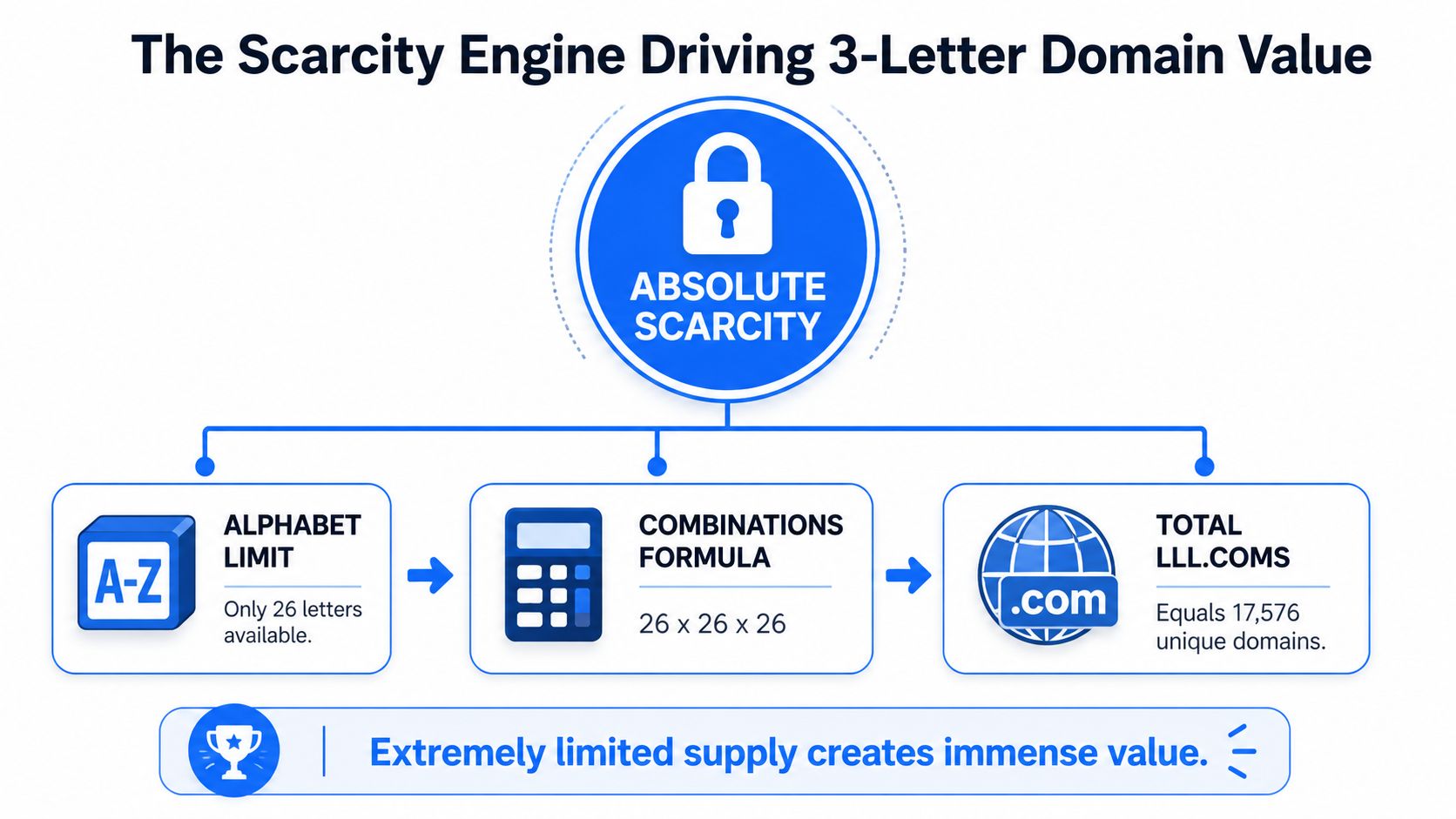
Why fixed supply matters
Most digital assets can be replicated. Another app can launch. Another brand can appear. Another social handle can be modified with an underscore or extra word.
A true three-letter .com doesn't work that way. There is no “new inventory” coming. If you want one, somebody else already owns it. That changes buyer behavior immediately. You're not comparing unlimited options. You're competing for a locked set of assets.
That's also why lower-quality names still hold weight in this category. In other corners of the domain market, mediocre inventory piles up and drifts lower. In LLL.com, even average combinations sit inside a closed universe.
Scarcity alone isn't enough, but it sets the floor
Scarcity doesn't make every three-letter name equally desirable. It does make the category distinct from hand-registered brandables and trend-driven extensions.
A practical way to consider this:
- Open-ended supply markets: buyers can wait, substitute, or compromise.
- Fixed-supply markets: buyers either acquire one from an owner or stay out.
- Acronym-heavy demand: companies in finance, tech, logistics, healthcare, media, and private equity all use initials.
- .com trust layer: buyers still pay a premium for the extension that feels default, global, and established.
If you want to study this niche more closely, this guide to available 3-letter domains is a useful companion because it shows how investors think about an apparently sold-out category.
Practical rule: Scarcity creates the baseline. Buyer utility creates the premium.
That's the engine. Everything else sits on top of it.
What Separates a Good LLL from a Great One
Every LLL.com is scarce. Not every LLL.com is elite.
That distinction matters because buyers often make the same mistake in reverse. Newcomers undervalue the entire category because some strings look random. Then, after learning that all LLL.coms are taken, they overvalue every letter combination equally. Both views miss how the market sorts quality.
Letter quality changes everything
The first filter is simple. Do the letters feel usable?
A name with broad acronym potential usually attracts more serious buyers than a name that feels awkward, obscure, or hard to say aloud. At this point, domain investing stops being purely mechanical. The market doesn't only reward shortness. It rewards utility.
OpenProvider's valuation guidance makes this point clearly. High-value domains need comparable sales and expert review because brandability and end-user demand can outweigh automated estimates, and in the 3-letter segment, acronym use cases materially increase value while alternate extensions often trade at much lower levels than .com in their domain valuation overview.
The rough tiers I look for
When evaluating a 3-letter domain, I generally sort it into a mental hierarchy:
- Top-tier patterns: pronounceable structures, clean acronym fit, or letters that can plausibly become a brand.
- Commercially useful initials: not especially elegant, but easy to map to industries, companies, products, or internal divisions.
- Low-friction letter sets: not beautiful, but not ugly either. These often still appeal to investors.
- Weak combinations: clunky, hard to read, hard to say, or burdened by letters that narrow buyer interest.
Pronounceability helps, but acronym depth matters just as much. A domain doesn't need to sound like a word if the initials work across many plausible buyers. Sometimes the strongest sale case isn't “this is catchy.” It's “a lot of businesses could justify owning this.”
TLD prestige still draws the line
People love to ask whether .ai, .co, or other extensions can deliver similar upside. They can have value, and some buyers do well in those markets. But they are not substitutes for LLL.com at the top end.
The reason is practical, not sentimental. A premium .com is easier to trust, easier to explain, and easier to defend in a negotiation. If a buyer wants a short, acronym-ready flagship domain, .com still carries a different kind of authority.
Here's what usually does not work:
- Overrating automation: appraisal bots miss context constantly in this category.
- Ignoring end-user fit: a string with no obvious business use is harder to sell, even if it's rare.
- Confusing novelty with demand: quirky letters can be memorable, but memorability alone doesn't create a buyer.
Hidden value can rescue an average string
Sometimes a middling letter combo becomes more interesting because of history. A clean prior use, quality backlinks, old age, or a strong archived footprint can make a buyer look twice. For SEOs, that can matter. For end users, a clean history matters more than a flashy story.
The letters get the meeting. The use case closes it.
That's the distinction between a good LLL and a great one. Great ones don't just exist. They fit.
The Real-World Price of a 3-Letter Domain
Three letters can cost more than a house. That only sounds irrational until you see how this market trades.
The mistake I see all the time is treating every LLL.com like a lottery ticket. Yes, top-tier sales can reach the upper end of the market. No, that does not make every three-letter name a seven-figure asset. Price is shaped by buyer depth, letter quality, and how quickly the owner needs liquidity.
Here are a few recent reported sales, as noted earlier in the article: OOV.com at $400,000, WWI.com at $350,000, FSL.com at $300,000, IPL.com at $265,000, HSM.com at $550,000, and UIG.com at $280,000.
Recent reported sales
| Domain Name | Sale Price | Year |
|---|---|---|
| OOV.com | $400,000 | 2024 |
| WWI.com | $350,000 | 2024 |
| FSL.com | $300,000 | 2024 |
| IPL.com | $265,000 | 2024 |
| HSM.com | $550,000 | 2025 |
| UIG.com | $280,000 | 2025 |
Those numbers matter for one reason. They reset expectations from fantasy to executable reality.
Wholesale, retail, and end-user money
A 3-letter domain does not have one price. It has at least three.
Wholesale is investor money. That is the fast market, where another buyer needs room to hold, relist, and still make the risk worth it. Retail is the asking-price market. Sellers can wait, test pricing, and see who bites. End-user pricing is where the big jumps happen, because the buyer is not comparing your domain to another investor deal. They are comparing it to the cost of operating on a weaker brand for years.
That gap is why liquidity matters so much. An investor-grade LLL.com can often sell faster than a longer brandable, but speed still depends on the letters. A clean, versatile string may get serious attention quickly. An awkward one can sit, even if the owner insists it is “rare.”
A practical way to look at it:
- Investor-to-investor deals are usually the most efficient path to cash, but the buyer prices in downside.
- Brokered retail listings can reach higher numbers, though the wait is often longer.
- End-user acquisitions produce the strongest outcomes when the initials fit a company, fund, product, or acronym already in use.
That is the shift newer buyers need to make. Stop asking only, “Why is this so expensive?” Ask, “Who can buy this quickly, and who can justify paying up?”
That question also helps on the acquisition side. If you are hunting dropped or expiring names, the primary opportunity is not finding a random cheap LLL. It is finding one with enough liquidity that you are not trapped if the perfect buyer never shows up. The framework in this domain valuation guide for comparable sales and buyer-fit analysis is useful for checking that before you commit capital.
Operations matter too. If you buy an expensive short domain and need to move it between registrars, this guide to streamlined GoDaddy domain moving is worth keeping handy because transfer mistakes get costly fast.
Sellers who price every LLL.com like a trophy usually wait a long time. Buyers who insist every seller should accept wholesale pricing usually miss the names that matter.
The market is expensive, but it is not random. Six figures is normal territory here. Bigger outcomes usually come from stronger letters, broader buyer demand, or a seller patient enough to wait for the right phone call.
How to Appraise a 3-Letter Domain Yourself
A bad LLL appraisal usually starts with a flattering story and ends with trapped capital.
Short domains punish lazy pricing because the spread between wholesale and end-user value can be massive. If you are buying at the wrong level, you can sit on a name for years and still be upside down after renewal costs and opportunity cost. The goal is not to guess the highest imaginable price. The goal is to set a range you can defend, then decide whether the hold time and liquidity fit your budget.
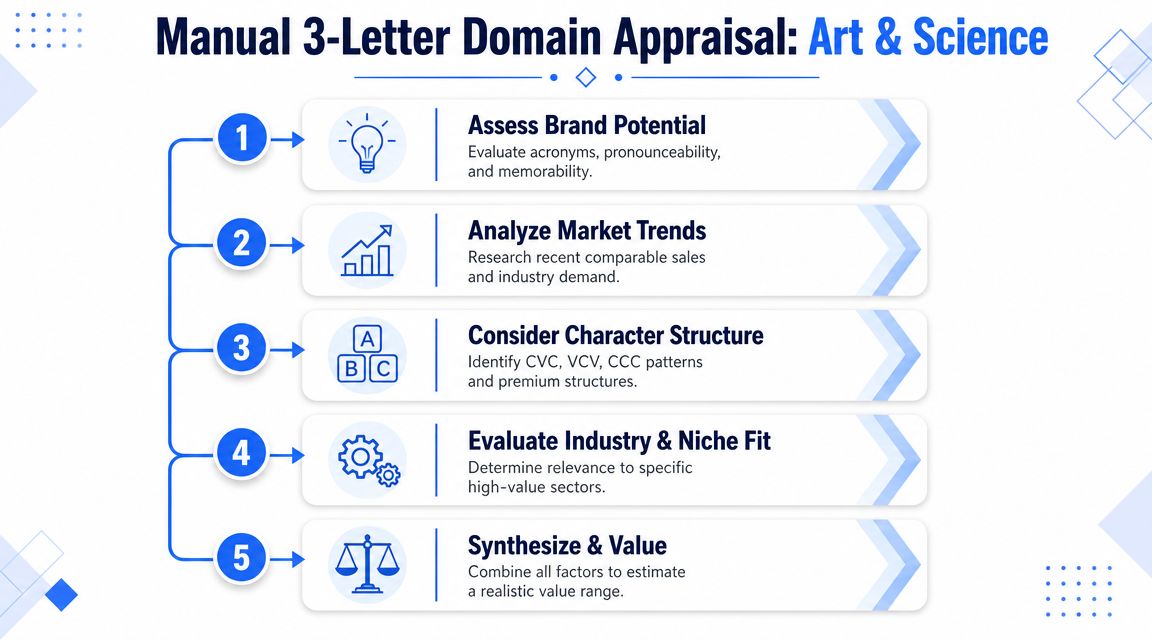
A simple manual framework
I appraise a 3-letter domain in this order:
Start with comps
Pull recent sales for the same extension and similar letter quality. A pronounceable, clean set of initials should not be comped against a clunky string with weaker buyer appeal just because both are three letters. If you want a broader process for comparing sales and buyer fit, this domain valuation guide for comparable sales and buyer analysis is a useful reference.Check buyer breadth
Count the plausible end users. Can the letters match multiple companies, products, funds, agencies, or acronyms across industries? A name with five believable buyer profiles is safer than one with a single perfect buyer who may never show up.Say it out loud
Good short domains are easy to hear, repeat, and type. If the letters blur together on a phone call or invite constant transposition, resale gets harder.Mark the floor before the ceiling
First ask what another investor would likely pay today. Then ask what a patient retail sale might bring. That order matters because liquidity is what keeps a mistake survivable.
What to inspect before you price it
Letter quality is only part of the job.
I also check for problems that can wreck a deal after the domain looks good on paper.
- Trademark risk: if the cleanest buyer path points straight at a brand dispute, the upside is weaker than it looks
- History: old spam use, toxic backlinks, or a messy archive record can reduce buyer confidence fast
- Practical buyer fit: some LLLs look premium but have very thin real demand once you stop forcing acronym stories
A clean but average LLL often outperforms a flashier one with baggage. That is not exciting. It is how investors avoid expensive mistakes.
Build a range, not a single number
Serious appraisals end with a range.
My notes usually break out three numbers:
- Wholesale range: what a domain investor might realistically pay now
- List price range: where I can test the market without looking detached from reality
- End-user range: what a business buyer might justify if the initials fit
That approach keeps emotion out of it. It also forces a harder question. If the wholesale floor is weak and the retail case depends on one dream buyer, do you really want to tie up cash here?
The best appraisal is the one you can explain to another investor in two minutes without hand-waving.
That is the standard. If the reasoning is thin, the price probably is too.
Unearthing Hidden Gems with NameSnag
“All the 3-letter .coms are taken” is true. “So there's nothing to do” is false.
Domains expire. Owners forget renewals. Some names go through grace periods, drop cycles, auctions, or backorder battles. Many individuals lose because they show up late, search manually, or spend their time scrolling junk.

Where the real opportunities show up
If you want to play in this market without paying retail for an already-established asset, the practical route is discovery. That means watching for names that have just dropped or are close to dropping.
One option is NameSnag, which is built around expired and expiring domain discovery. For this use case, the important part isn't hype. It's workflow. You can scan available domains that have already dropped and can be registered immediately, or watch expiring domains that are still in the grace period and may become available soon.
That matters because timing changes everything with short domains. If you wait until a good one is public and obvious, somebody else has usually already acted.
A workable hunt routine
For 3 letter domain value plays, I'd keep the process simple:
- Filter by length: set the search to three characters and remove the noise fast.
- Use time windows: start with Today, then widen to 3 Days or 7 Days if you want a broader view.
- Check history before excitement: a short name with a dirty past is still a dirty name.
- Track expiring names early: that gives you more time to decide whether the letters justify the effort.
Here's a quick walkthrough worth watching before you start digging through short names:
The biggest advantage of a structured workflow is emotional control. You stop reacting to random listings and start monitoring a narrow niche with intent. In a market this tight, that's a real edge.
Negotiation Tips and Common Pitfalls
A strong domain can still turn into a bad deal if the negotiation is sloppy.
Buyers usually fail in one of two ways. They either open with a number so low that the seller stops taking them seriously, or they signal too much enthusiasm and harm their bargaining position. Sellers have their own bad habit. They confuse rarity with guaranteed buyer urgency.
What works in live negotiations
A better approach is boring and professional.
- Lead with clarity: tell the owner you're interested, ask whether the domain is available, and avoid performative stories.
- Know your ceiling first: if you decide your max during the negotiation, you're already drifting.
- Use comps as discipline: not as a weapon. Serious sellers know the market too.
- Keep escrow mandatory: expensive domains deserve a secure process.
Pitfalls that can ruin the deal
Some mistakes are expensive even when the price looks good:
- Trademark blindness: a domain can look valuable and still be dangerous to own or market.
- Ignoring history: short names are not immune to spam, penalties, or ugly past use.
- Rushing transfer steps: admin mistakes are more painful when the asset is premium.
- Pricing from ego: the market doesn't care what you hoped the name would be worth.
One more practical note. If you're selling, don't turn every inquiry into a chest-thumping exercise. If you're buying, don't mistake politeness for weakness. The best 3-letter transactions usually happen when both sides act like professionals, not forum avatars.
If you want a practical way to monitor dropped and expiring short domains instead of waiting for obvious listings, NameSnag gives you a focused workflow for spotting available and soon-to-drop opportunities before they blend into the wider market.
Find Your Perfect Domain
Get access to thousands of high-value expired domains with our AI-powered search.
Start Free Trial