
You're probably here because you saw a 3-letter domain sell for the price of a luxury car, or a house deposit, and your first reaction was, “That can't be normal.”
It is normal in this corner of the market.
What is often overlooked, however, is this: 3 letter domain name value isn't driven by length alone. Three characters get you in the conversation. The actual price comes from a messier mix of letter quality, acronym demand, pronunciation, extension, buyer fit, and plain old timing. Two domains with the same length can live in completely different universes of value.
That's why beginners get burned. They hear “scarce asset,” buy a clunky three-letter name in the wrong extension, and assume they've bought digital gold. Sometimes they've bought a nice collectible. Sometimes they've bought an expensive fridge magnet.
So a 3-Letter Domain Sold for How Much?
A lot of people enter this market the same way. They stumble across a reported sale like HSM.com at $550,000 or OOV.com at $400,000, then start wondering whether every three-letter domain is secretly a jackpot. Those are real public examples listed in the 3Character price guide, and they're exactly why this niche feels so strange from the outside.
The confusion usually comes from comparing the wrong things. A newcomer sees “three letters” and assumes all LLL domains belong in one bucket. Investors don't think that way. They read the letters the way a watch collector reads a dial, or a real estate buyer reads an address. Tiny details change everything.
Why the sticker shock happens
If you browse domain sale history examples, the pattern becomes obvious fast. Short domains don't just sell because they're short. They sell because buyers can imagine a business, product, acronym, or global brand sitting on top of them.
A name like HSM.com has a clean corporate feel. OOV.com has symmetry and memorability. TII.com, which the same 3Character guide lists at $170,000 in 2026 as a cited public sale, feels like something a public company, fund, or enterprise software brand could use tomorrow.
Buyers aren't paying for three letters. They're paying for what those three letters let them shortcut.
That's the insider rule. A premium 3-letter domain works like a front-row storefront on the shortest street in town. It signals authority before the website even loads.
Why 3-Letter Domains Are Digital Unicorns
A buyer sees two 3-letter domains listed side by side and assumes they belong in the same price tier. That mistake gets expensive fast.
According to Atom's overview of 3-letter domain value, there are 26^3 = 17,576 possible letter combinations, and all three-letter .com combinations are already registered. Supply is capped. If the exact name you want is owned by someone else, you are negotiating with that owner, not ordering a fresh one from the registry.
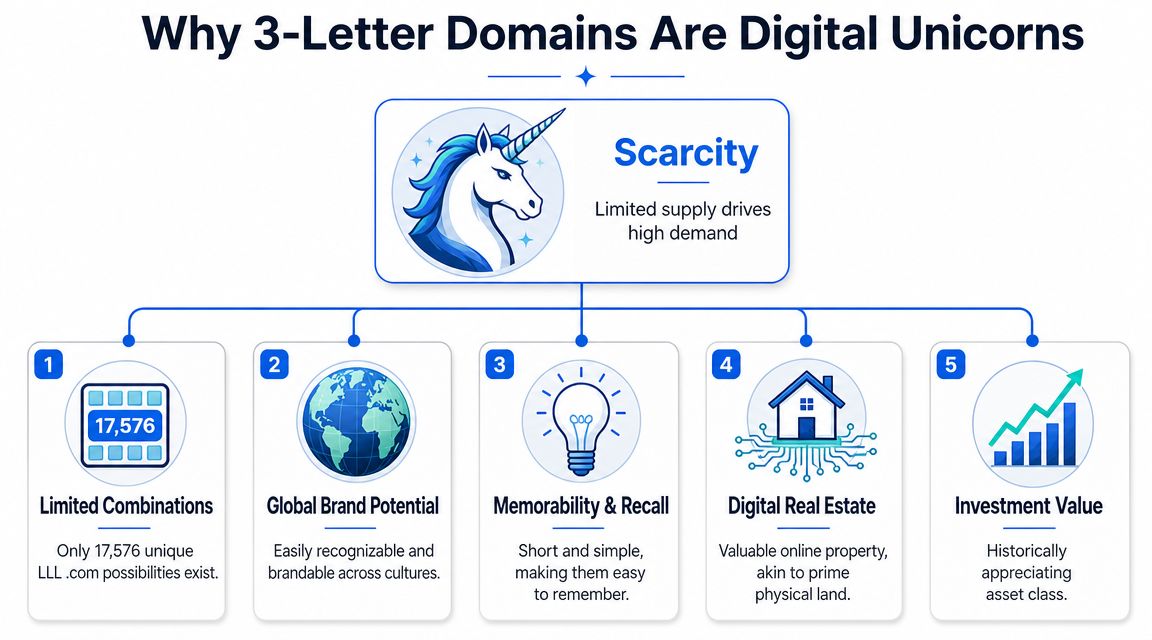
Scarcity creates the market
That fixed supply is why LLL.com names trade more like digital real estate than standard domains. The question is not what it costs to register a name. The question is how hard it is to replace.
For a company that wants a matching acronym, replacement can be impossible. If your brand is ABC, DEF.com is not a substitute. A different three-letter name might still be short, but it does not solve the same branding problem.
That is why these assets get compared to rare art, trophy properties, and vintage watches. The pool is finite, ownership is fragmented, and the best pieces rarely come to market on a clean schedule.
The real reason prices spread so wildly
Scarcity explains why the category exists. It does not explain why one 3-letter domain can be worth a modest five figures while another pushes deep into six or seven.
The spread comes from buyer fit.
A strong 3-letter domain usually does several jobs at once:
- Matches a common acronym used by real companies, products, or industries
- Sounds clean when spoken aloud
- Looks balanced in a logo or on a business card
- Works across borders without awkward pronunciation or baggage
- Carries status because short .com names still signal money, age, or credibility
I have seen newer investors miss this point and pay for length instead of quality. Three letters alone do not create liquidity. Three useful letters do.
Why buyers chase the best ones
The best LLL domains compress a lot of value into a tiny space. They are short enough to remember, broad enough to rebrand around, and prestigious enough to make a company look bigger than it is. That combination is rare.
A good one works like a storefront on the shortest, busiest street in town. Even before traffic, SEO, or brand spend enter the picture, the address itself carries weight.
Practical rule: Fixed supply gets attention. Letter quality and buyer relevance create the serious bids.
That is why 3-letter domains earn the unicorn label. The category is small, but the top end is driven by details that casual buyers do not notice at first glance.
Decoding the Price Tag Key Factors That Drive Value
Here, the simple “three letters = valuable” story falls apart.
A domain investor looks at an LLL name through a stack of filters. The first filter is the extension. The second is the letters themselves. The third is whether a real buyer can turn that string into a brand, acronym, or status asset without squinting.
TLD comes first
If you learn one rule, make it this one: .com is king.
Openprovider's domain valuation guidance notes that valuation is highly sensitive to TLD and letter composition, and that professional valuation starts with comparable sales before adjusting for brandability and acronym relevance. That same guidance explains why .com commands the strongest premium, while .co and .ai can still be valuable but at materially lower and more variable levels, with one market guide citing .co around $2,000 to $50,000 and .ai around $2,000 upward of $100,000 depending on startup relevance.
That's the first major split in 3 letter domain name value. The same letters in .com and .co aren't cousins. They're more like a townhouse on a prime block versus a modern condo in a fast-growing district. Both can be desirable. They do not trade the same way.
Letter quality changes everything
The next filter is letter quality. In this aspect, novices often overpay.
Some combinations are easier to say, easier to remember, and easier to assign meaning to. Others look like a bag of Scrabble tiles hit the floor. The market notices.
A useful way to consider it:
| Tier | What it looks like | Why buyers care |
|---|---|---|
| Best | Pronounceable, clean, acronym-rich strings | Strong branding, easier recall, broader end-user demand |
| Better | Solid corporate acronyms, decent visual balance | Useful for specific businesses and investor resale |
| Good enough | Random letter mixes with weaker phonetics | Scarcity value may exist, but buyer pool is thinner |
Pronounceability beats technical scarcity
A pronounceable LLL often attracts a different class of buyer than a harsh consonant stack. If a founder can say it in one breath, put it on a cap, and hear it on a podcast ad without spelling it out, that's powerful.
Repetition and symmetry also help. So does an obvious acronym connection. If a name could map to finance, health, logistics, media, software, or manufacturing, it becomes easier to pitch and easier to hold with confidence.
A 3-letter domain isn't just a code. It's a compressed branding device.
What usually doesn't work
What tends to disappoint?
- Weak extension choices: Even a decent string can lose momentum outside the right TLD.
- Awkward letter mixes: If people stumble when reading it, resale gets harder.
- No acronym market: A name with no obvious business fit can sit for a long time.
- Investor-only appeal: If only domainers care, you're relying on a smaller exit pool.
This is why two seemingly similar names can end up miles apart in price. The market doesn't reward character count evenly. It rewards usefulness.
What to Expect to Pay Valuation Bands and Real Examples
A buyer sees two 3-letter .coms and assumes they belong in the same price bucket. Then one trades like a nice house deposit and the other struggles to get serious offers. That gap is the part new buyers miss.
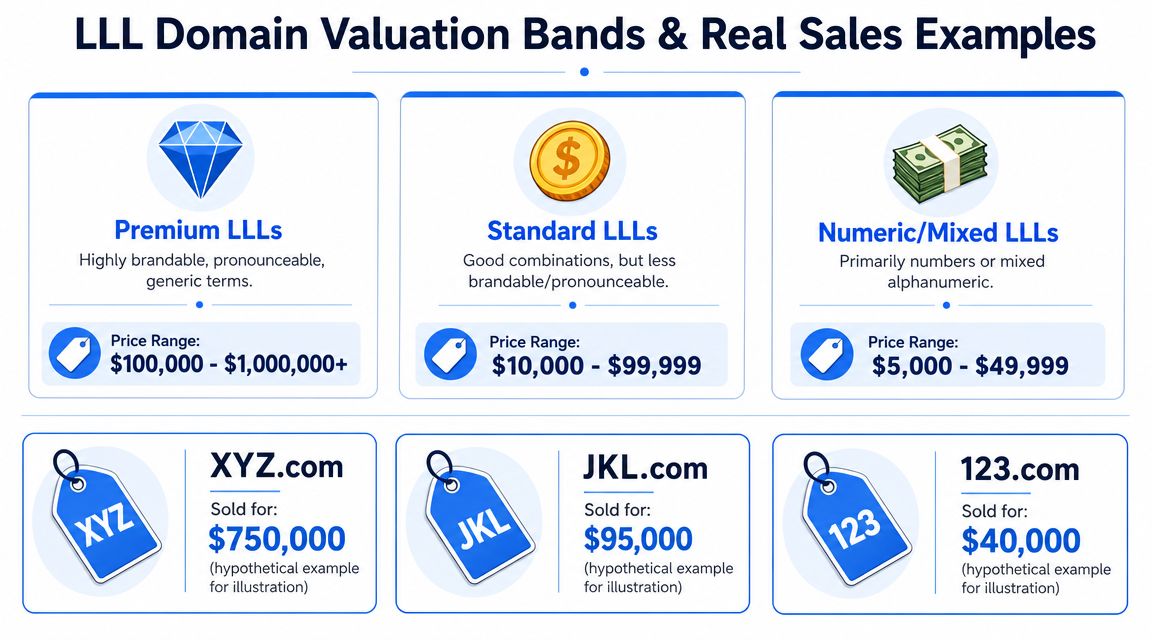
Public sales from the past few years show the broad shape of the market, but they do not hand you a price for any specific name. Three letters only gets you into the conversation. The actual number moves on letter quality, acronym demand, pronunciation, symmetry, and extension. That is why an awkward string can feel like dead inventory while a cleaner one gets treated like prime digital real estate.
Older wholesale references also help frame expectations. A long-running 3Character pricing guide has often been used by investors as a rough floor reference for weaker 3-letter assets across extensions, and the spread between .com, .net, .org, and lower-tier TLDs is wide. If you want a practical framework for sanity-checking a name before you bid, this domain name valuation tool article is a useful starting point.
Estimated 3-Letter Domain Valuation Bands 2026
| Domain Type | Example | Typical .com Range | Typical .io / .ai Range |
|---|---|---|---|
| Lower-quality random LLL | QXZ | Often far below premium LLL.com pricing and highly buyer-dependent | Often lower and more volatile than .com |
| Solid acronym LLL | HSM | Commonly trades in six figures in .com when buyer fit is strong | Can be valuable, but usually at lower and more variable levels |
| Premium brandable or highly desirable acronym LLL | OOV | Public examples show six-figure to seven-figure .com potential | Can be meaningful in startup-heavy sectors, but still generally trails .com |
A short explainer can help anchor the ranges:
Real sales worth studying
Public examples from the past few years include:
- HSM.com for $550,000 in 2025
- OOV.com for $400,000 in 2024
- TII.com for $170,000 in 2026, reported earlier in the year
- Other reported 3-letter .com sales in 2024 and 2025 that landed in the low to mid six figures
Those comps are useful for one reason. They show how much spread exists inside the same format.
HSM has strong acronym utility. OOV has a cleaner visual rhythm and more brand flavor than a clunky consonant pileup. TII fits multiple corporate acronym patterns. Put those next to something like QXZ and you start to see why "all LLLs are rare" is not a valuation method. It is only the opening bid in the argument.
Good pricing work also borrows from adjacent branding logic. Short domains behave a bit like rare art and a bit like commercial property. Scarcity matters, but buyer taste and use case decide the premium. DesignStack's domain name guide covers the branding side well, especially the practical tension between memorability and fit.
The practical takeaway is simple. Budget by tier, not by character count. A weak 3-letter name may still be expensive because the category is tight, but the best 3-letter .coms can be 10x or 100x apart from weaker ones that look similar at first glance.
The Hunt How to Find Buy and Sell 3-Letter Domains
A buyer spots an LLL.com, sees only three characters, and assumes the hard part is getting there first. In practice, the hard part is knowing whether the name is a hidden gem, an overhyped acronym, or a very expensive set of letters with no real exit.
That is why the hunt matters as much as the budget.
Serious buying happens in the secondary market. Owners know what they have, and the best names rarely sit around waiting for a random checkout cart. You are usually dealing with one of four channels: direct outreach, marketplaces, brokers, or expiration tracking. Each one has a different risk profile, and each one rewards preparation more than speed.
Where serious buyers actually look
Direct outreach gives you the cleanest shot at a name that is not actively listed. It also requires patience. Many owners ignore first contact, some quote fantasy prices, and a few will negotiate reasonably if the inquiry is professional and the buyer sounds credible.
Marketplaces and auctions are faster, but they can get noisy. A decent LLL domain with strong letters or clean brand potential attracts both end users and investors. That means the final price often reflects emotion as much as logic. I have seen bidders pay a premium for three letters they liked visually, then struggle to explain who would buy the name from them later.
Brokers are useful at the top end of the market. They can get a conversation started, filter unserious sellers, and help close around transfer terms. They also make weak names sound grand. A brokered listing does not make a domain premium any more than a fancy frame turns a sketch into museum art.
Why expiry monitoring still matters
Expired inventory is one of the few places where preparation can beat a bigger wallet. Good names do not drop often, but the buyers who catch them usually have systems, not luck.
That means building a watchlist, following deletion cycles, and reviewing names before everyone else piles in. A practical starting point is learning how expired 3-letter domains become available and how to monitor them. The goal is not to chase every short domain. The goal is to spot the rare one where the letters, extension, and buyer pool line up before the crowd turns it into a feeding frenzy.
A useful process looks like this:
- Screen the letters first. Check whether the combination is pronounceable, acronym-friendly, or visually clean.
- Match the extension to the likely buyer. An LLL.com can support global corporate demand. A weaker TLD usually needs a sharper branding case.
- Set your ceiling before the auction starts. Scarcity makes smart people bid like gamblers.
- Pass on names with no resale story. Three letters alone do not create liquidity.
Don't buy like a domainer only
Founders, brand teams, and operators pay the big checks. Their logic is different from forum chatter.
A short domain has to work on a homepage, in an email signature, and in a sales deck. It has to sound credible when spoken out loud. It has to avoid looking like a typo or a captcha. DesignStack's domain name guide is a useful reminder of the branding side, especially if you spend too much time looking at domains as ticker symbols instead of business assets.
That filter saves money. It also keeps you from buying names that impress other investors but leave real buyers cold.
Selling follows the same rule. Good sellers do not pitch an LLL domain as rare and stop there. They show why these specific letters matter, who might want them, and why replacing the name would be hard. The best listings feel less like hype and more like a clean real estate memo: here is the asset, here is the buyer fit, here is why the price makes sense.
Your Pre-Purchase Due Diligence Checklist
Buying an LLL domain without due diligence is how people turn a strong asset thesis into a painful invoice.
At this level, the problem usually isn't whether the domain is short. The problem is whether it's safe, usable, and strong enough to deserve the asking price.
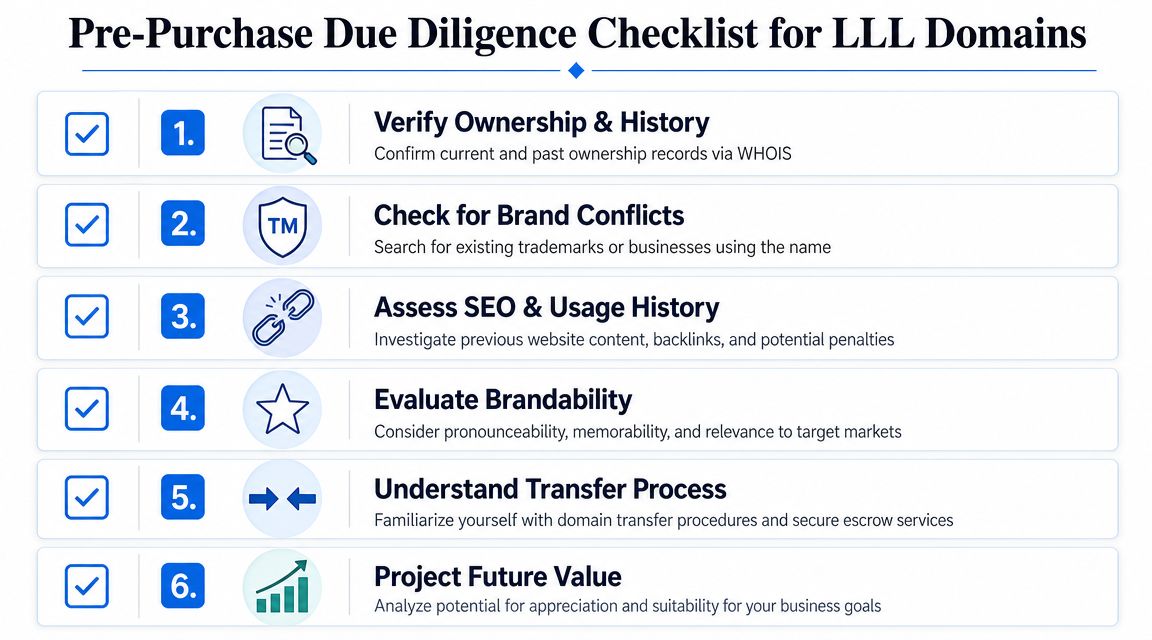
Legal comes first
Start with trademark risk. A three-letter acronym can look generic at first glance and still create headaches if it maps tightly to an existing company or protected brand in your target market.
That doesn't always make the domain unusable. Context matters. Industry matters. Geography matters. But if the whole value story relies on one obvious buyer category, and that category is crowded with trademark claims, you need to know that before money moves.
Then inspect the domain's past life
A domain can be premium and still come with baggage. Check historical use, backlink profile, indexing signals, and prior content. If the domain spent years tied to spam, low-grade redirects, or junk outbound links, that history can drag behind it.
Use a checklist, not vibes:
- Ownership history: Verify who owns it and whether the transfer path looks clean.
- Archive review: Look at prior site versions to see what lived on the domain before.
- Backlink sanity check: Favor natural references over chaotic link patterns and obvious abuse.
- Search reputation: Look for signs the domain was used in ways that could hurt trust.
- Transfer logistics: Use proper escrow and confirm registrar requirements before closing.
Evaluate quality, not just rarity
Many buyers overestimate what they're holding. A discussion on WebmasterWorld notes that premium-letter-only combinations can command a 500% to 600% premium over the baseline wholesale floor, which is why specific-name due diligence matters so much.
That premium spread tells you something important. The market is not paying evenly for all LLL strings. It is rewarding names with better letters, stronger phonetics, and clearer acronym demand.
Buyer check: Ask whether the domain is valuable because it is scarce, or because it is scarce and good. Those are not the same thing.
A practical pre-flight test
Before buying, answer these six questions plainly:
- Can a business say this name out loud without spelling it?
- Does the string fit multiple plausible industries?
- Is there any legal risk that would narrow the buyer pool?
- Does the domain have a clean enough history to build on?
- Would you still like the asset if you had to hold it longer than expected?
- Are you buying based on comparable quality, or just excitement?
If too many answers are shaky, pass. A bad three-letter domain is still easier to overpay for than a good longer name.
Is a 3-Letter Domain Right for You?
For some buyers, an LLL domain is a sharp strategic move. For others, it's an expensive distraction.
It makes sense when the domain will do real work. A startup building a broad brand, a company that lives on acronyms, or an investor building a premium portfolio can justify chasing one. In those cases, the shortness, status, and resale potential can all line up.
It makes less sense when the budget is tight and the business doesn't need the signal. A niche site, local service business, or early-stage project often gets more mileage from a strong, clear brandable name that costs far less and still does the job.
That's the part people don't always want to hear. 3 letter domain name value can be enormous, but that doesn't mean a 3-letter domain is automatically the best buy. Sometimes the smart move is paying for elite scarcity. Sometimes the smart move is letting someone else do that.
A useful rule is simple. Buy an LLL when you can explain the value in one sentence without using the word “rare.” If the whole thesis is scarcity, you probably don't have enough thesis.
If you want a faster way to spot clean opportunities without manually digging through junk, NameSnag is worth a look. It helps you track high-potential available and expiring domains, review branding and SEO signals, and focus your attention on names that might justify the chase.
Find Your Perfect Domain
Get access to thousands of high-value expired domains with our AI-powered search.
Start Free Trial