
Buying a UK domain often starts the same way. You type a few ideas into a registrar search box, watch every good option come back as taken, then start bargaining with yourself about names you didn't even like five minutes ago.
That's where many commonly err.
If you want to buy domain names UK buyers would trust, remember, and maybe one day pay good money for, you need to think like an acquirer, not a shopper. A domain isn't just a checkbox before launch. It's a brand asset, a credibility signal, and sometimes a piece of digital property with real aftermarket value.
Beyond the Search Bar Your UK Domain Strategy
The UK market is big enough that lazy decisions get expensive. Nominet reports over 10.4 million .uk domain names under management, which is a useful signal that the namespace is mature, competitive, and active for both registration and resale activity (Nominet domain statistics).
That scale changes how you should behave.
In a tiny namespace, you can sometimes get away with casual browsing and luck into a decent name. In the UK, good names are usually claimed early, held for years, or circulating in the aftermarket. That means the job isn't “find something available.” The job is find something worth owning.
What beginners waste time on
A lot of buyers spend too long on surface-level checks:
- Tiny wording tweaks: adding extra hyphens, awkward prefixes, or filler words rarely creates a stronger brand
- Registrar hopping: checking the same bad idea at five registrars doesn't improve the name
- Assuming cheap means good: low registration cost says nothing about trust, resale potential, or memorability
Practical rule: A strong UK domain should sound natural when spoken aloud, look clean in an email address, and avoid making the buyer explain it every time they share it.
What experienced buyers do instead
They build a short list and pressure-test it from several angles:
| Check | What you're asking |
|---|---|
| Brand fit | Does this sound like a real company, not a placeholder? |
| Extension fit | Does the suffix match the audience and intent? |
| Market reality | Is this likely hand-registerable, or do you need an expired or aftermarket route? |
| Risk | Could it create trademark issues or trust problems? |
The right mindset is simple. Don't buy the first domain you can tolerate. Buy the strongest asset you can justify.
The Great UK Domain Debate co.uk vs uk
The extension question matters more than people admit. In the UK, this isn't just a technical suffix decision. It's a branding signal.
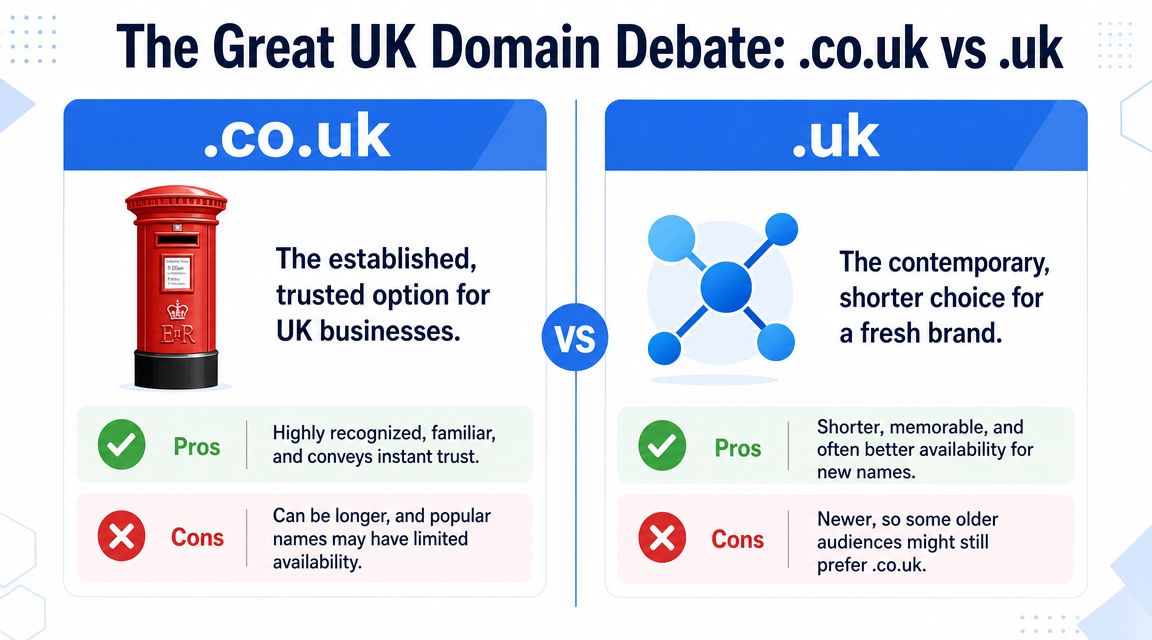
For a lot of businesses, a main choice is .co.uk vs .uk. Both can work. They just don't communicate the same thing.
Why .co.uk still carries weight
.co.uk has approximately 11 million registrations, which helps explain why it still feels familiar and commercially established to UK users (.co.uk registration scale).
That history matters in practice. If you're serving local customers, traditional industries, professional services, or older audiences, .co.uk often feels instantly legitimate. It has the boring virtue you want from infrastructure. People recognise it, trust it, and don't need it explained.
That doesn't mean every .co.uk name is good. Plenty are clunky. But when the underlying words are strong, the extension still does heavy lifting.
Where .uk makes more sense
The shorter .uk version feels cleaner and more modern. It suits brands that want a sharper look, fewer characters, and a simpler spoken identity. For startups, media brands, digital products, and newer companies, that can be a real edge.
The trade-off is perception. Some buyers still instinctively trust .co.uk more, especially in categories where reassurance matters.
Shorter isn't always better. Cleaner is better. If the .uk version feels premium and the .co.uk version feels dated, use the shorter one. If the .uk looks abrupt or ambiguous, the older commercial standard may win.
A simple decision filter
Use this when you're stuck:
- Pick .co.uk if your business depends on familiarity, local trust, or a conventional commercial feel
- Pick .uk if your brand is modern, concise, and benefits from a cleaner visual identity
- Buy both if the brand matters enough and you don't want confusion later
If you're comparing extensions more broadly, this country domain extension list is a handy reference point for seeing how country-code choices differ by market.
How to Find High-Value UK Domain Names
A common method involves approaching domains in reverse. Users brainstorm forever, search one idea at a time, and hope availability solves the problem for them.
Professionals run a filter process instead. Tim Ferriss describes a staged workflow that starts with brainstorming, then bulk-checking availability, then reviewing auctions and aggregators, and only then doing deeper diligence on the shortlist (domain buying workflow).

That process works because it cuts emotion out early. You don't want to fall in love with a name before you've checked whether it's realistic to buy.
Path one hand registration
Hand registration still makes sense when the name is fresh, brandable, and not obviously derivative of an existing business.
This route works best when:
- You're building a new brand: invented words, punchy combinations, and names without obvious resale baggage can be strong
- You want clean history: no old backlinks, no weird previous use, no inherited reputation issues
- You care more about branding than age: many startups don't need an old domain, they need a good one
The mistake here is settling for scraps. If the hand-reg option sounds like a compromise, it probably is.
Path two dropped and expiring domains
Experienced buyers spend more time here.
Dropped and expiring domains can be interesting because you're not just buying letters. You're sometimes buying history, links, age, and memorability that a brand-new registration doesn't have. That doesn't automatically make them valuable, but it does make them worth checking.
A practical way to work this angle is to monitor both freshly dropped names and soon-to-drop names. NameSnag surfaces Available domains that were just dropped and can be registered now, plus Expiring domains that are still in grace periods and may become available soon. The time filters matter because today's list and a 30-day view are very different hunting grounds.
The best opportunities often don't look flashy at first glance. They look clean, usable, commercially relevant, and oddly ignored.
What to check before you chase one
Don't assume every aged domain is a gem. Many are just old junk with a thin story attached.
Use a quick screen:
Read it aloud
If it sounds awkward in conversation, resale gets harder.Check whether a real business already uses the exact term
If yes, acquisition becomes harder and legal risk rises.Look at intent
A service keyword, local commercial phrase, or short brandable term usually has more practical demand than random word salad.Inspect history
You want signs of clean prior use, not spam residue or obvious abuse.
If you need help generating stronger candidates before screening them, this guide on how to find good domain names is worth skimming.
Selecting a Registrar and Nailing the Purchase
Finding the domain is half the battle. The purchase process is where people get nicked by bad interfaces, dodgy upsells, and registrars that make simple jobs feel like border control.

The cheapest registrar isn't always the lowest-cost decision. A bad control panel, poor support, or painful transfer process can waste more time than you saved on day one.
What to look for in a registrar
You want boring competence.
A good registrar gives you a clear dashboard, straightforward renewals, DNS controls that aren't buried under nonsense menus, and account security that doesn't feel optional. GoDaddy, 123 Reg, Namecheap, and others all get used in the market, but the point isn't brand loyalty. The point is whether you can manage the asset cleanly.
Use this checklist:
- Transparent renewal pricing: introductory pricing is common, renewal surprises are common too
- Clean transfer policy: if moving the domain later looks painful, that's a warning sign
- Usable DNS management: you'll need this soon after purchase
- Reasonable checkout flow: if every screen pushes extras, slow down and read everything
For a useful primer beyond the purchase itself, OneNine has a solid overview of essential domain and DNS tips that helps buyers avoid the operational mistakes that usually happen after checkout.
Upsells worth considering and ones to skip
Most registrar checkout pages behave like airport gift shops. Everything is urgent. Almost nothing is.
Here's the short version:
- Privacy protection: worth considering if the registrar offers it and it fits your setup
- Extra hosting bundles: only buy if you already know you need that exact package
- Add-on site builders: usually easy to skip if you have a separate web plan
- Email upsells: compare before accepting the default offer
A premium domain purchase has its own mechanics as well. If you're buying from the aftermarket rather than registering a fresh name, this explainer on how premium domain buying works gives a clearer picture of what changes once negotiation enters the mix.
A quick visual walkthrough helps if you're buying your first one.
The boring step that saves domains
Turn on auto-renewal if the name matters.
People lose good domains in stupid ways. Not because the market outplayed them. Because a card expired, an old email inbox wasn't monitored, or the renewal notice got buried. Domain ownership rewards discipline much more than drama.
After You Buy Your Domain The First Steps
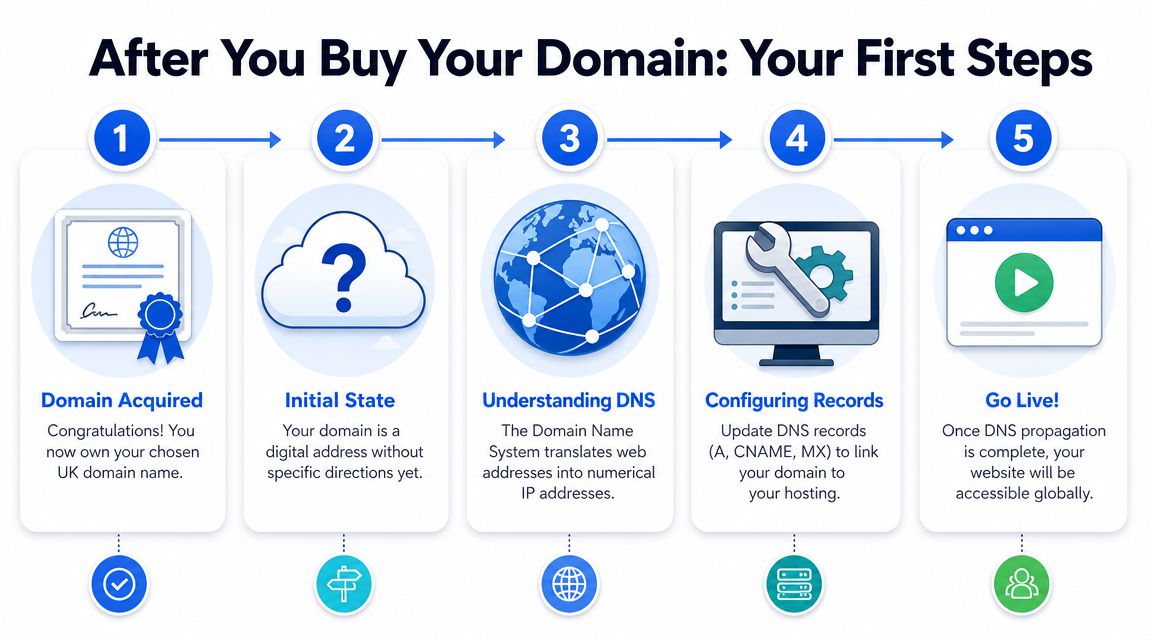
A newly purchased domain doesn't do anything on its own. It exists, you control it, but it isn't yet connected to your site, inbox, or anything the public can use.
DNS in plain English
DNS is just the system that tells the internet where your domain should go. Your registrar account will usually have a DNS or nameserver area. That's where you connect the domain to your hosting company and email provider.
You don't need extensive technical expertise to manage this well. You do need to know what you're changing, who is supposed to control it, and where to verify it if something breaks.
If the website isn't loading after launch, the problem is often not the domain itself. It's usually that the domain hasn't been pointed correctly, or the records aren't set the way the hosting provider expects.
Your practical first checklist
Once you've bought the domain, do these jobs in order:
- Connect the website: your host will tell you whether to change nameservers or manage records directly at the registrar
- Set up professional email: even a simple branded inbox looks more credible than a generic free address
- Check SSL status: make sure the site resolves securely once connected
- Enable auto-renew: don't leave valuable names exposed to administrative mistakes
- Store access details safely: registrar logins, renewal settings, and DNS access should not live in one person's memory
Keep ownership clean
This part gets overlooked in small businesses all the time.
Make sure the domain is registered under the right person or company account, with a monitored email address and a payment method someone will reliably update when cards change. If an agency built the site, confirm whether they control the domain or only the hosting. Those are different things, and confusion there causes ugly disputes later.
A well-bought domain becomes valuable when ownership, renewal, and technical control are all clear.
Advanced Plays for SEO and Domain Investing
Once you stop treating domains as disposable setup tasks, the game gets more interesting. Some names are just addresses. Others can support SEO work, brand positioning, or resale strategy.
That's where discipline matters most, because domain investing attracts more wishful thinking than almost any other corner of digital assets.
Why triage matters more than excitement
NamePros notes that typically only about 1% of names in a portfolio sell within a full year, which tells you something important about liquidity. Most domains do not sell quickly, and many never sell at all (domain liquidity and triage).
That's why experienced investors reject far more names than they buy.
A domain can look clever and still be commercially dead. A keyword can sound useful and still have no obvious buyer pool. A short name can feel premium and still be weak in the wrong extension.
What tends to hold value
When I review UK names for SEO or investment potential, I care less about novelty and more about fit.
Look for combinations like these:
| Type | Why it can work |
|---|---|
| Short brandables | Easier to remember, easier to pitch, broader end-user pool |
| Clear service terms | Obvious buyer intent if the phrase maps to a real business category |
| Strong extension match | A term that fits .co.uk or .uk naturally is easier to position |
| Clean expired domains | Useful when the prior history is relevant and not contaminated |
The opposite also holds. Random dictionary pairings, awkward misspellings, and names that only make sense after explanation are hard to move.
Buy names that solve a buyer's problem. Don't buy names that ask a buyer to share your imagination.
SEO use versus flip value
These are related, but not identical.
An expired domain with a useful backlink profile may be attractive for a site build or a strategic redirect, assuming the history is clean and the topical use makes sense. But a domain that helps an SEO campaign isn't automatically easy to resell. Investors need both technical cleanliness and end-user appeal.
Good operators rank names on four things:
- Marketability
- Extension fit
- Legal cleanliness
- Resale realism
That last one is where many portfolios go to die. If you can't picture the likely buyer, the likely use case, and the likely reason they'd want the name, you're probably buying hope.
UK Domain FAQs
How do I buy a UK domain that's actually worth investing in
Start by separating cheap from valuable.
An investment-grade UK domain usually has one of two profiles. It's either a clean, memorable brandable that a real business could use, or it's an expired domain with history that still looks commercially and technically sound. If it has awkward wording, doubtful prior use, or no clear buyer type, skip it.
A lot of bad purchases happen because the buyer asks, “Can I register it?” instead of “Why would anyone want this later?”
Are there rules for names that sound official or government-related
Yes, and you should take them seriously.
GOV.UK says organisations that defensively register a non-government domain must notify the Cabinet Office domain management team, and it warns against names similar to existing .gov.uk domains or names containing restricted terms such as "ltd" or "plc" (non-government domain guidance). Even if you're nowhere near the public sector, the practical lesson is simple. Don't register names that could confuse users into thinking you're an official body.
That kind of naming mistake creates trust problems fast.
Should I buy the .uk, .co.uk, and .com versions
If the brand matters and the budget allows it, defensive registration is usually sensible.
For a UK-first business, locking down the most relevant variations can reduce confusion and stop someone else from benefiting from your brand recognition. Whether you buy all three depends on your audience, your budget, and whether international use is realistic. But if you know you'll care later, buying earlier is often less painful than trying to recover the name afterward.
If you're hunting for UK domains with more upside than a standard registrar search can show you, NameSnag is built for that part of the job. You can scan available and expiring domains, filter the list by time window, and focus your attention on names that deserve a proper review instead of wading through junk manually.
Find Your Perfect Domain
Get access to thousands of high-value expired domains with our AI-powered search.
Start Free Trial