
You’re probably doing one of two things right now.
You’re either staring at a spreadsheet full of junk domains, trying to decide whether any of them are worth a registration fee, or you’re watching a clean, relevant name slip away because someone else moved faster.
That’s the game with recently expired domain names. The opportunity is true, but the noise is brutal. A good domain can give you age, backlinks, brandability, and a running start. A bad one gives you a spam graveyard wearing a decent name.
The difference is not access to more lists. It’s having a system.
The Digital Gold Rush for Expired Domains
Most domain hunting looks glamorous from a distance and feels like digital dumpster diving up close.
You open a list. You see hundreds of names that look promising for half a second. Then the cracks show. Weird anchor text. Off-topic link profiles. Obvious churn bait. Trademark baggage. A domain that was once a dentist, then a casino, then a fake coupon site. Back to the pile.
That grind is why a lot of people quit too early. They assume the well is dry when the true problem is that they’re digging without a process.

The scale alone explains why manual browsing breaks down fast. Every day, a vast number of domain names expire worldwide. Platforms like NameSnag analyze over 170,000 domains daily, and ExpiredDomains.net tracks over 4.7 million currently expired domains according to ExpiredDomains.net. There is no shortage of inventory. There is a shortage of disciplined filtering.
Why recently expired names matter
A clean recently expired domain can save months of dead-end work.
Instead of launching on a fresh registration with zero history, you may get a domain that already has archived pages, existing backlinks, brand familiarity in a niche, and signals that search tools still recognize. That does not mean every expired name is valuable. It means the upside is asymmetrical when you find one that stayed clean.
Here’s where people usually go wrong:
- They chase volume: More lists, more tabs, more saved searches. None of that fixes weak judgment.
- They overvalue one metric: A decent authority number can hide a terrible history.
- They ignore use case: A domain that works for a redirect can be wrong for a rebuild.
- They move too slowly: Good drops do not wait around while you “circle back later.”
Good expired domain hunting feels less like browsing and more like triage. Reject fast, investigate selectively, and act quickly when a name survives scrutiny.
There’s also a mindset shift that helps. Don’t think of expired domains as leftovers. Think of them as recycled digital assets. Some were abandoned for boring reasons. A founder shut down a side project. A local business folded. A niche site owner stopped renewing. Those situations create openings.
If domain investing is part of your stack, this mindset matters even more. A lot of the edge comes from spotting utility before the wider market notices it. If you want a broader primer on that angle, this piece on domain name investment is worth a look.
The Bottleneck
The bottleneck is not finding names. It’s separating a future asset from polished trash.
That’s the part most guides skip. They hand you a few tools, mention backlinks, and call it a strategy. In practice, the people who consistently win with recently expired domain names use a repeatable workflow. They know what to ignore, what to verify, and when to pay up.
Understanding The Two Paths to Buried Treasure
Not every expired domain is in the same state, and treating them all the same is how buyers waste time.
There are two practical lanes when hunting recently expired domain names. One lane is slower and more competitive. The other is faster and more tactical. If you mix them up, your timing will be off from the start.
Expiring domains
An expiring domain has passed its renewal date but has not fully dropped yet.
That means the previous owner may still have recovery rights, and the name often heads toward registrar auctions or backorder systems instead of open public registration. These are the names people watch closely because many of the stronger assets get intercepted before they ever become freely available.
If you want to browse this stage directly, the cleanest entry point is the expiring domains view.
What makes expiring names attractive is simple. Better domains often attract attention before deletion. Investors, SEOs, agencies, and operators all know the strongest assets rarely sit untouched.
But this path has trade-offs:
- More competition: If the domain is obviously useful, others already noticed it.
- More patience required: You’re often waiting through lifecycle stages instead of registering immediately.
- More acquisition friction: You may need auctions, backorders, or multiple platforms in play.
Available domains
An available domain already completed the expiration cycle and dropped.
At that point, anyone can register it at a standard registrar if they get there first. Speed matters in this scenario. These are not “auction maybe” names. These are “buy it now before someone else sees it” names.
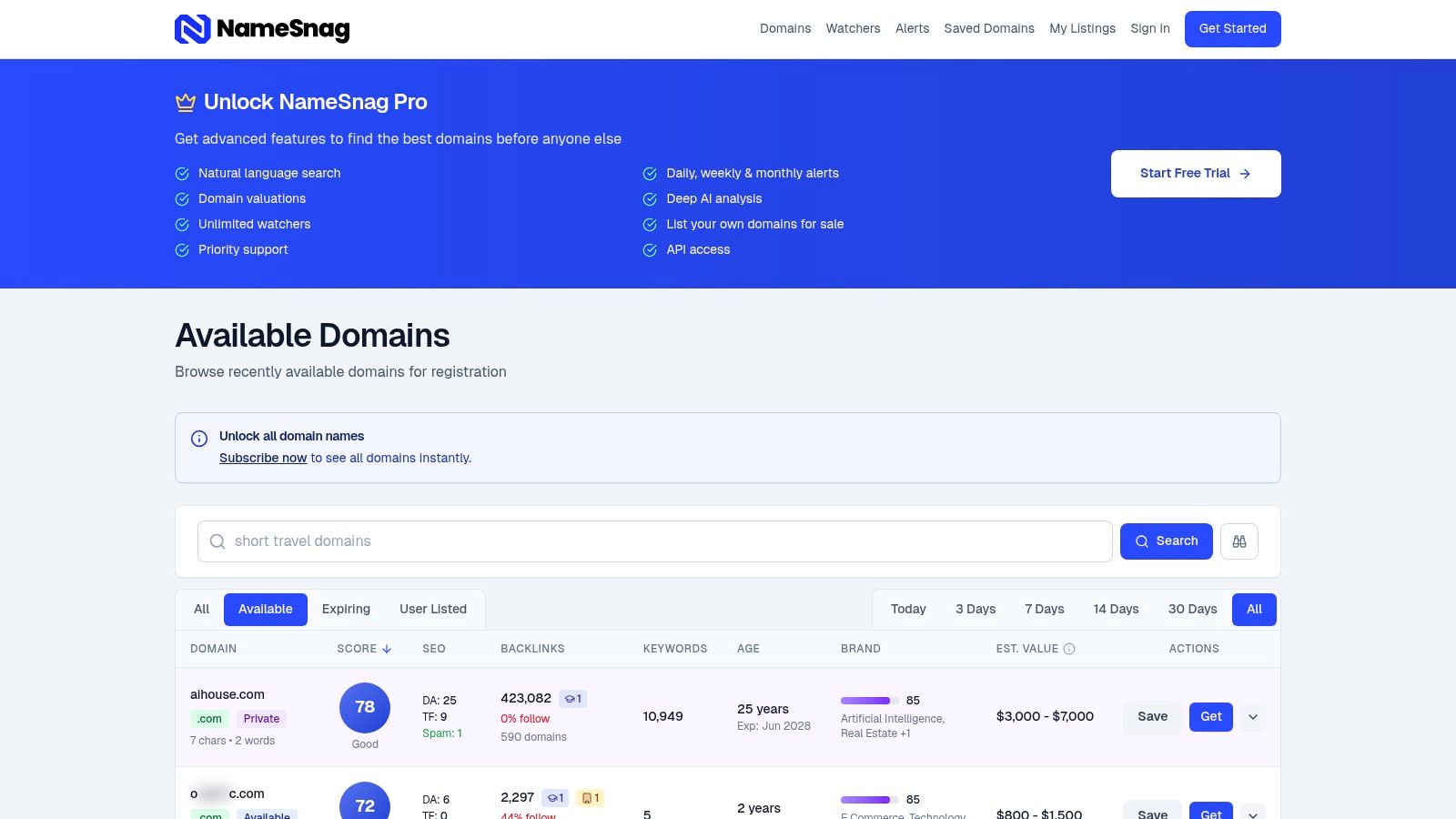
You can scan that category directly in the available domains view.
In this lane, experienced hunters pull value from names that survived the auction gauntlet, went unnoticed, or looked unimpressive until someone checked the history and backlinks properly.
Which path fits which goal
The easiest way to choose is by matching the domain state to your objective.
| Goal | Better path | Why |
|---|---|---|
| Acquire a strong category name with known demand | Expiring | High-value names often attract bidders before drop |
| Grab under-the-radar SEO assets at registration cost | Available | You can move fast on names others missed |
| Build a watchlist of future targets | Expiring | You get time to evaluate and prepare |
| Fill a pipeline of quick tests and side projects | Available | Immediate registration supports faster execution |
A simple rule for beginners
If you’re new, split your attention unevenly.
Spend more time learning how to evaluate available domains first. They let you make cleaner yes-or-no decisions without auction pressure. Then graduate into expiring names once you’re comfortable reading history, links, and niche fit.
That matters because timing errors are expensive. A lot of people see “recently expired” and assume “ready to register.” That is often wrong. If you need a plain-English breakdown of the lifecycle confusion, this explainer on when a domain will expire helps.
“Recently expired” is a status, not a guarantee of access. Some names are still recoverable by the old owner. Others are already effectively spoken for.
The working difference
Here’s the practical version.
Expiring domains reward planning. Available domains reward decisiveness.
Both can work. Both can burn you. The mistake is using auction tactics on a dropped name or treating a competitive expiring asset like it will politely wait for you.
Your Repeatable System for Filtering Out Junk
You open a fresh list of recently expired domains and twenty names look promising in the first minute. By the end of the hour, maybe two deserve serious attention.
That gap is where money gets made or burned.
The bad buys usually do not happen at checkout. They happen earlier, when someone mistakes a decent-looking metric stack for a usable asset. A domain can look old, show backlinks, and still be unusable because the history is messy, the links are hollow, or the name never fit a market in the first place.
A repeatable system fixes that. The point is not to find more domains. The point is to kill weak candidates fast so your time goes to names that can be rebuilt, flipped, or held with conviction.
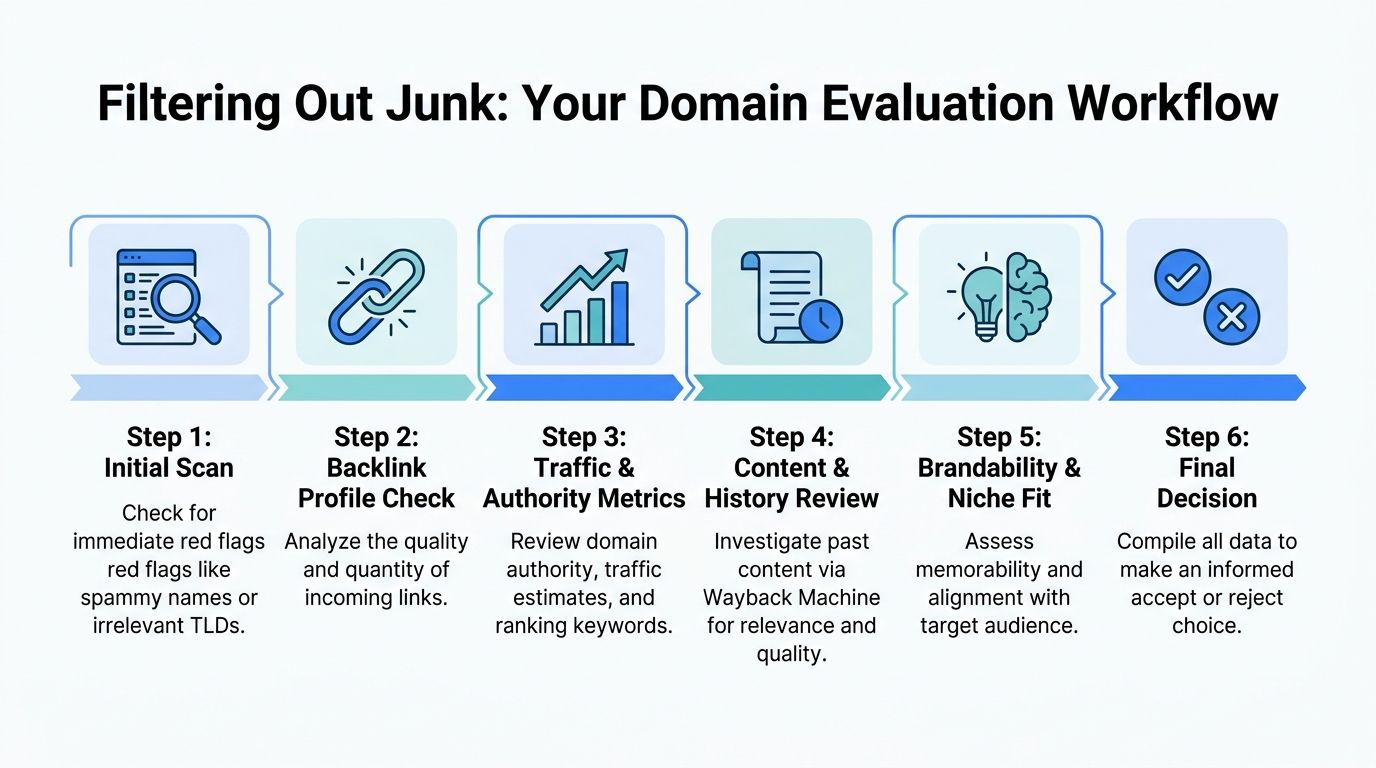
Start with a brutal first pass
The first pass should feel unfair. Good. That is the job.
If a domain cannot survive ten seconds of scrutiny, it does not earn ten minutes. I throw out most candidates for obvious reasons:
- Ugly naming patterns: awkward strings, random numbers, hyphen clutter, or names that read like they were assembled by a script
- Wrong extension for the plan: a local ccTLD for a broad affiliate project, or a novelty TLD for something you expect to resell
- Immediate topic mismatch: the name suggests one niche, but the likely history points somewhere unrelated
- Trademark risk: anything too close to a known brand goes in the trash
This filter is supposed to be harsh. You are clearing debris, not talking yourself into edge cases.
Use metrics to sort the pile
Metrics are triage. They are not proof.
What works in practice is a system that combines hard filters with a quick way to rank the survivors. NameSnag helps here because you can screen recently expired and expiring names by age, keyword patterns, backlink indicators, and other filters, then use SnagScore to decide what deserves manual review first.
That matters when you are looking at a large batch. A composite score does not guarantee quality, but it does save time. Instead of opening fifty tabs at random, you inspect the strongest candidates first, then work down the board until the quality drops off.
I treat that as the cheat code. Not because the score is magic, but because a repeatable workflow needs a queue. NameSnag gives you one.
What Matters in the Filter Stack
I care about signals that hold up after inspection, not just numbers that look good in a spreadsheet.
Niche relevance Clean, topic-aligned history is easier to monetize and easier to trust.
Age with continuity Older can help. Stable use matters more. A domain that changed identity every year usually brings baggage.
Backlink quality Ten real links from relevant sites beat a bloated profile full of junk.
Brandability If it sounds clunky out loud, resale gets harder and rebuilding gets harder.
Link source type Strong sources help when they are relevant and natural. Random leftovers from old redirects do not count for much.
For a separate check on link risk, use this guide to a domain spam score checker.
The three checks I never skip
Filters shrink the pile. Manual review decides the buy.
Check the archive history
Open the Wayback Machine and scan for pattern changes.
The questions are simple:
- Did the domain host a real site?
- Did the topic stay roughly consistent?
- Did it turn into spam at some point?
- Did someone already try to revive it with thin content or junk pages?
A boring old local business site can be fine. A domain that bounced from dentist to casino to AI blog is usually a pass.
Check the backlink profile
Use Ahrefs, Majestic, Semrush, or whatever tool you trust. Then ignore the vanity metrics for a minute and look at the shape of the profile.
I want links from real pages on real sites. I want anchors that look natural. I want to know whether the referring pages still exist and whether the authority depends on one suspicious cluster that could vanish tomorrow.
The best expired domains often look less exciting than the sales pitch. That is usually a good sign.
Check for baggage in search and branding
Run a branded search. Look for old complaints, low-quality indexed pages, legal noise, or a reputation that makes the domain awkward to use.
This part gets skipped too often. A domain can pass archive and backlink review and still be a poor buy because the name carries baggage you do not want attached to a project.
A practical accept or reject grid
If I'm unsure, I use a simple decision grid.
| Signal | Accept | Reject |
|---|---|---|
| Archive history | Stable and relevant | Spam, abrupt topic shifts, or junk rebuilds |
| Links | Natural and believable | Toxic anchors or suspicious clusters |
| Name quality | Memorable and usable | Clunky, confusing, or legally risky |
| Project fit | Clear next use | “Maybe someday” logic |
If two boxes land in the reject column, I pass.
No exceptions.
The part that takes discipline
Finding a decent domain is not the hard part. Rejecting a tempting mediocre one is harder.
A lot of names look close enough. The archive is slightly messy, but maybe usable. The links are uneven, but not terrible. The name is serviceable, but forgettable. That is where buyers get trapped, especially after spending an hour researching.
I have learned to treat hesitation as a signal. If a domain needs a long internal debate, it usually is not strong enough.
What the system looks like in practice
The workflow is simple on purpose:
- Scan fast
- Filter hard
- Use SnagScore to sort
- Manually inspect the shortlist
- Reject anything with real doubt
- Act fast on the names that clear every check
That is the repeatable system. It removes junk early, keeps your review time focused, and gives you a cleaner path from discovery to acquisition.
That is how you find gems without drowning in noise.
The Art of the Snag Bidding and Backordering Tactics
A clean shortlist means nothing if your acquisition process is sloppy.
This is the point where good buyers separate themselves from hobbyists. The hobbyist finds a promising name, gets excited, then improvises. The disciplined buyer already knows the venue, the ceiling, the fallback option, and how fast they can check out. That is the difference between building a repeatable system and donating money to the market.

Why acquisition deserves its own strategy
Competition on worthwhile expired domains is real, especially on decent .com names. As noted earlier, strong drops attract heavy automated competition, and catch rates on desirable names can be brutally low.
That changes how you should act.
Expired domain buying is not about spotting one good domain and hoping nobody else noticed. It is about running a process that gets you from discovery to action without hesitation. That is where a tool like NameSnag earns its keep. SnagScore helps cut the list down to names worth your time, but its primary advantage is what happens after that. Saved filters, watchlists, and fast sorting give you a workflow you can repeat every day instead of a pile of tabs and half-made decisions.
Tactics for expiring domains
Expiring names reward planning.
If a domain is headed to auction or backorder, I set the acquisition plan before the bidding starts. Once the timer is running, discipline gets expensive fast. Buyers talk themselves into “just one more bid” because they already spent time researching the name. Time spent researching is not equity. The domain is still worth only what it can realistically return.
A workable process looks like this:
- Define the use case first: Redirect, rebuild, hold, or resale. Your use case sets the ceiling.
- Choose the venue early: GoDaddy Auctions, NameJet, and SnapNames each have their own rhythm, bidder pool, and pricing behavior.
- Place the backorder early: Late timing rarely creates an edge.
- Set a hard max bid in writing: If bidding passes that number, the domain belongs to someone else.
- Keep one backup target: Good buyers lose auctions all the time. The backup keeps you rational.
Proxy bidding is fine if your ceiling is clear. Manual bidding is fine if you want tighter control. Neither method fixes bad valuation.
One more point. Some names look cheap until renewal fees, transfer friction, and rebuild costs get added to the full total. Price the whole move, not just the winning bid.
Tactics for available dropped domains
Dropped domains are different. Speed matters more than auction strategy.
Once a domain is fully available to hand-register, there is no prize for waiting. If it passes your checks and fits an active plan, register it. I have seen buyers spend two hours second-guessing a domain they already approved, then lose it for ten bucks.
That usually happens because the system broke before checkout. The review was too slow, the registrar account was not funded, or the buyer was still trying to decide whether the name was for SEO, resale, or a future project.
The fix is operational:
- Keep your registrar account ready
- Store payment details in advance
- Use NameSnag filters and SnagScore to surface only names that fit your criteria
- Review the shortlist in batches, not one-off
- Register immediately when a name clears the bar
The cheat code is not some secret bid trick. It is reducing decision time without lowering standards.
Video walkthrough
If you want a visual walkthrough on the hunting side, this is a useful companion while you build your process.
What Wins
Auction drama gets attention. Process wins more domains.
The habits that matter are boring, which is why many buyers skip them:
- Track names before they become urgent
- Use alerts so good drops do not sit unseen
- Know your registrar checkout flow cold
- Accept missed names quickly instead of revenge bidding on the next one
- Review enough candidates that no single domain feels irreplaceable
That last point matters more than people admit. A thin pipeline makes buyers emotional. A healthy pipeline keeps pricing sane.
The strongest expired-domain workflow is simple. Find candidates, sort aggressively, use SnagScore to prioritize, assign an acquisition path, and act without delay once a name clears your limit. That is the system. The buyer who repeats it every week beats the buyer looking for clever tricks.
You Snagged a Domain Now What?
Owning the domain is the easy part. Extracting value is where skill shows up.
A good expired domain can support several strategies, but the right move depends on what you bought. Some names are ideal for redirects. Some deserve a rebuild. Some are better held for resale. A few fit advanced SEO plays that come with risk.
The usage patterns are clearer than many think. A case study covering over 7,000 expired domains sold through SEO.Domains from January 1 to October 1, 2020 found that 64% were used for Private Blog Networks, 24% for 301 redirects, and 12% for other uses. It also found that 96.3% remained indexed in Google according to the SEO.Domains expired domain use case study.
301 redirects
This is the most straightforward use when the fit is obvious.
If the expired domain is tightly aligned with your existing site, a redirect can consolidate relevance and inherited signals into a property you already control. This works best when the old domain’s topic, audience, and backlink context make sense next to the destination site.
Best for: Existing sites with strong topical overlap.
What does not work is forcing a redirect just because a domain has links. If the old topic and the destination are miles apart, the move looks awkward and usually performs like it.
Rebuilding on the domain
Sometimes the domain itself deserves the project.
If the name is brandable, the archive history is clean, and the old niche is still commercially interesting, rebuilding gives you a head start compared with starting on a fresh registration. You’re not inheriting a blank slate. You’re inheriting context.
This route works well for:
- Affiliate sites
- Local or niche authority projects
- Content brands
- Lead generation properties
The mistake here is rebuilding without respecting the domain’s past identity. If a domain built its history in one subject area, keep the new version close enough that the transition feels coherent.
PBN use
Expired domains have always had a strong following for PBN use, and the case study numbers reflect that.
A lot of buyers use them for Private Blog Networks because clean, indexed domains with existing signals can be repurposed into supporting sites. That appeal is obvious. So are the risks.
PBNs require stricter operational discipline than many admit. One sloppy footprint, one bad hosting pattern, one weak content layer, and the setup starts looking mechanical. For many operators, rebuilding a legitimate niche property is the safer long game.
Best for: Experienced SEOs who understand footprint risk and can maintain quality.
Not best for: Beginners who mainly want a reliable, durable asset.
Domain flipping
Some domains are worth more as inventory than as websites.
If the name is short, memorable, commercially useful, and clean, you may be better off holding it for resale. This is especially true when the domain has brand value that matters more than old links.
What works in flipping is restraint. Buy names that a true founder, agency, or operator could plausibly want. Avoid the trap of buying clever names that only make sense because you’ve stared at them for an hour.
Launching a brand
This is the underrated use case.
A strong recently expired domain can give a startup or small business a more credible foundation than a forced hand registration. If the name is clean and natural, age and existing history can be a bonus. The brand still has to earn trust, but it doesn’t have to start from zero identity.
Choosing the right use case
A quick matching framework helps:
| If the domain has this quality | Consider this move |
|---|---|
| Strong topical relevance to an existing site | 301 redirect |
| Clean archive and memorable brand | Rebuild |
| Link equity with careful operator control | PBN use |
| Broad commercial name | Flip or hold |
| Brand-friendly identity for a real business | Launch on it |
Don’t ask “What can I do with this domain?” first. Ask “What is this domain naturally suited for?” The second question produces fewer bad builds.
A lot of disappointment with recently expired domain names comes from forcing the wrong model onto the right asset. The domain wasn’t bad. The plan was.
Your Action-Ready Templates to Start Today
A system only matters if it survives contact with your calendar.
The easiest way to stay consistent is to turn your hunting process into a few reusable templates. That removes daily decision fatigue and keeps you from drifting into random browsing.
Perfect domain alert template
Use this as a starting point for your alerts, then adapt it to your niche.
Template
- Target niche: [insert niche or keyword theme]
- Domain state: Available or Expiring
- Time window: Today, 3 Days, 7 Days, 14 Days, 30 Days, or All
- TLDs: [.com, relevant ccTLD, or niche extensions]
- Minimum age: [your threshold]
- Keyword includes: [insert words]
- Keyword excludes: [insert words to avoid]
- Minimum quality score: [your threshold]
- Link preference: edu/gov or niche-relevant backlinks when applicable
- Brandability rule: pronounceable, clean, no hyphens, no random numbers
- Action rule: review within the same session the alert arrives
This kind of template helps because your brain is unreliable when a shiny name appears. A pre-written rule set is more reliable.
Strategic watchlist checklist
Use a watchlist for names that are interesting but not buy-now obvious.
Watchlist checklist
- Reason it made the list: One sentence only
- Primary use case: Redirect, rebuild, flip, or hold
- History status: Clean, mixed, or reject pending review
- Link profile status: Natural, suspicious, or unknown
- Brand risk status: Clear, unclear, or problematic
- Decision deadline: Date you must revisit it
- Maximum bid or registration rule: Written before competition starts
That last line matters. If you add names to a watchlist without a decision rule, the list becomes digital clutter.
Daily workflow you can maintain
A workable routine is better than an ambitious one you abandon.
Try this:
Scan new candidates quickly Reject obvious junk on naming and fit.
Shortlist only clear maybes If the use case is fuzzy, skip it.
Run manual checks on the shortlist Archive, links, brand baggage.
Decide immediately Buy, watch, or reject. No fourth category.
The anti-hoarding rule
Most domain hunters accumulate too many maybes.
Use this filter before adding anything to your portfolio:
- Would I still want this domain if I had to explain the purchase in one sentence?
- Do I already know what I would do with it?
- Would I buy it again tomorrow at the same price?
If those answers get weak, pass.
The goal is not owning more recently expired domain names. The goal is owning better ones.
If you want a faster way to apply this workflow, NameSnag helps surface available and expiring domains, sort them with filters, and review them before you waste time on obvious junk.
Find Your Perfect Domain
Get access to thousands of high-value expired domains with our AI-powered search.
Start Free Trial