Stop Drowning in Junk Domains. Start Finding Gems.
Hunting for a great domain feels like a part-time job that keeps trying to become a full-time one. You open one tab for expired lists, another for backlink checks, another for Wayback screenshots, another for valuation comps, and then two more because you still do not trust the first results. A couple of hours later, you have a shortlist full of names that look decent until you inspect them and realize they were used for casino spam, auto-generated junk, or a forgettable side project from a decade ago.
That is the core problem with any domain name research tool. Most of them help you find more domains. Fewer help you avoid bad ones. Even fewer help you move fast enough to grab the good ones before someone else does.
The pain is familiar. You sift through giant lists, manually compare metrics, bounce between Ahrefs, Majestic, Moz, auction feeds, and sales databases, and by the time you are confident, the domain is gone. The workflow is slow, fragmented, and mentally expensive.
This guide fixes that. Not with theory. With a practical stack.
You will see which tools are best for discovery, which ones are best for SEO validation, which ones are best for pricing and comps, and which ones are best for brandability checks. Some tools are broad. Some are surgical. A few are still worth using even if their interface feels stuck in another decade.
If you also care about usernames and naming consistency beyond domains, handles.karesocial.com is worth a look.
1. NameSnag
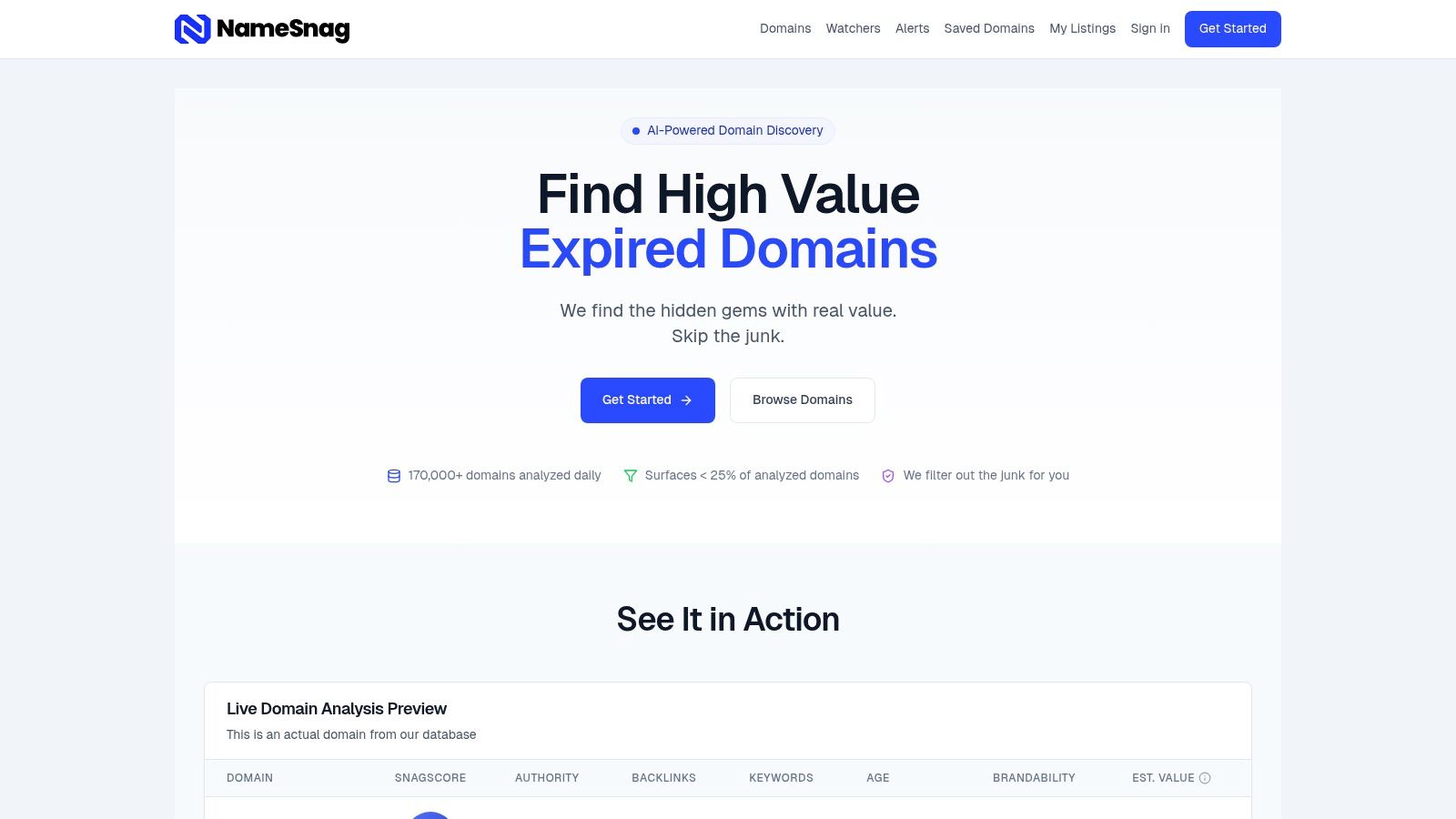
You spot a promising domain in a raw list, open four more tabs to vet it, and 20 minutes later you still do not know whether it is a bargain, a rebuild candidate, or a cleanup job. NameSnag earns its place at the front of the workflow because it shortens that first pass.
It is built to solve the messy middle of domain research by narrowing the field first, rather than forcing you to stitch together a process from five different tools. That is the job here. Find candidates quickly, sort obvious junk from plausible buys, and send only the best names to heavier tools later.
Where it fits in the workflow
Use NameSnag at the discovery and triage stage.
This is the point where speed matters most. A good domain name research tool should help you filter by what affects the decision, such as age, backlink signals, keywords, TLD, and whether a name still has some brand potential. NameSnag does that well because it puts those filters in one place and gives you a composite view through SnagScore.
That score is useful for ranking, not deciding. I would still review any serious candidate manually, especially if the domain will support an SEO project or a resale purchase with real money attached. Composite scores save time. They do not replace judgment.
A practical workflow looks like this: start with TLD and age filters, add minimum backlink thresholds, then narrow by keyword or naming pattern. After that, set watchers and let the tool surface new candidates instead of refreshing lists by hand all day.
Two entry points matter here. Available dropped domains are about quick action at registration-level pricing. Expiring domains in grace period are a different game. Those require monitoring, patience, and a plan before the drop window opens.
What it does well
- Cuts research time early: You can screen candidates without jumping straight into Ahrefs, Majestic, and archive checks.
- Flags obvious risk: Spam checks and penalty-risk indicators help remove weak names before you waste time on them.
- Supports active buying: Watchers, alerts, exports, and API access make it workable for both solo buyers and teams.
Trade-offs to keep in mind
- Valuation is directional: AI price estimates can help you sort names, but they are not a reliable final number for bidding or negotiation.
- Better workflows sit on higher plans: If you want more alerts, more watchers, or heavier API use, costs rise fast.
- Strong filtering can hide edge cases: If you set the thresholds too aggressively, you can miss names that look weak on paper but still have resale or rebuild value.
That last point matters. Some of the best buys are imperfect domains with one strong angle, such as a clean link profile, a sharp brand feel, or a niche keyword match. If you filter only for the highest scores, you will save time, but you may also filter out opportunities.
NameSnag also works well for early brandability checks before you spend money validating SEO strength elsewhere. If you want a lighter companion read for that first screening step, their guide to a domain name availability checker workflow is a useful starting point.
2. Ahrefs

Ahrefs is where I go when a candidate has survived the first cut and now needs a proper backlink interrogation.
This is not the tool I’d use for broad discovery. It is too expensive and too detailed for that role. But when you have a shortlist and need to know whether a domain’s authority is real, inflated, or toxic, Ahrefs earns its keep.
Best use case
Ahrefs is strongest at answering questions like these:
- Are the links still live or mostly dead?
- Do the referring domains look relevant or random?
- Is anchor text natural or full of manipulative patterns?
- Was the domain propped up by a few links that disappeared long ago?
Its Site Explorer is the main attraction. Plug in the domain, then inspect referring domains, best-by-links pages, anchors, and broken backlinks. Expired domains often look good at first glance because a headline metric is still hanging around. Ahrefs helps you see whether there is still any substantive equity left.
The trade-off
The upside is depth. The downside is cost and workflow friction.
Ahrefs has moved toward a credit-based model with optional add-ons, and that changes how casually you use it. This is not a “poke around all day” tool unless you are comfortable paying for that style of work. I use it more like a final reviewer than a daily browser.
Ahrefs is a scalpel, not a net. Use it after discovery, not instead of discovery.
If you vet domains in batches, the Batch Analysis feature is useful. It lets you compare several names before you decide which ones deserve a closer manual look. That can save you from wasting deeper review on names that collapse under even a basic backlink screen.
For anyone doing SEO-driven acquisitions, Ahrefs remains one of the strongest validation layers in a domain name research tool stack. Just do not expect it to replace a purpose-built domain finder.
3. Semrush
Semrush is what I reach for when the domain decision is tied to business strategy, not just backlink strength.
That distinction matters. Some domains are bought for redirects, authority plays, or rebuilding. Others are bought because a founder wants a brandable asset in a market with real search demand. Semrush helps on that second type of decision.
Where Semrush shines
Its value comes from context.
With Domain Overview, Backlink Analytics, keyword research, competitor comparisons, and broader marketing data in one place, Semrush helps answer a different set of questions:
- Does this domain sit in a niche with search demand?
- What is the competitive environment like?
- Are there obvious keyword angles for rebuilding?
- Does this fit a broader content or brand strategy?
If I am evaluating a name for a niche site, a startup, or a category build, Semrush often tells me more about practical upside than a pure link tool does. It is especially useful when a domain looks clean but you are not sure the naming angle is worth pursuing.
The catch
Semrush can feel like a Swiss Army knife that keeps adding new blades. That is good if you want one platform for SEO, ads, and market research. It is less good if you just want lean domain due diligence.
Its pricing can get murky once add-ons enter the picture, and some of the more appealing historical or competitive data sits higher up the ladder. That makes it easy to overbuy if your only goal is domain screening.
Still, if you work with clients or need to justify a purchase based on more than “the metrics look okay,” Semrush does a better job than most tools at connecting domain quality to business opportunity.
I would not call it the best pure domain name research tool. I would call it one of the best domain decision tools.
4. Majestic
Majestic is still one of the quickest ways to separate “looks strong” from “relevant.”
A lot of people reduce Majestic to Trust Flow and Citation Flow, but a primary advantage is topical relevance. For expired domains, that is huge. A domain with links from the wrong neighborhood can look decent in aggregate while being a terrible fit for your use case.
Why experienced buyers still keep it open
Majestic helps answer a simple but expensive question: Is this domain strong in the topic I care about, or just noisy?
Topical Trust Flow is the part I care about most. If a domain’s history lines up with the niche you want to build in, that is a strong sign. If the topical profile is all over the place, I slow down fast.
Useful features include:
- Trust Flow and Citation Flow: Quick quality screen.
- Topical Trust Flow: Strong niche relevance signal.
- Fresh and Historic indexes: Helpful for seeing whether link strength is current or mostly legacy.
- Bulk tools: Good for screening lists before manual review.
Where it falls short
Majestic is not winning any awards for ease of use. The interface is functional, but new users often need time to understand what they are looking at.
It also does not try to be an all-in-one platform. You are not coming here for content strategy, keyword planning, or polished reports. You are coming for link intelligence.
That narrow focus is exactly why it still deserves a place in a serious workflow. If NameSnag is your finder and Ahrefs is your deep inspector, Majestic is often the fastest second opinion on whether a candidate belongs in your niche at all.
5. Moz Pro Link Explorer

Moz Pro is not the deepest link platform in this list, but it is one of the easiest to use without a lot of training. That matters more than some power users admit.
For many teams, especially agencies or buyers working with non-technical stakeholders, Moz’s familiar metrics still have practical value. Domain Authority is widely recognized, even when everyone knows it should never be treated as gospel.
Where Moz earns a spot
I use Moz as a quick sanity-check layer.
If a domain looks promising in another tool, Moz can help confirm whether the overall authority profile is at least directionally strong. Link Explorer surfaces DA, PA, linking domains, and Spam Score in a straightforward interface. That makes it useful for fast review sessions or for sharing a candidate with clients who want metrics they already understand.
If you want background on how that metric works in practice, this explainer on Moz Domain Authority score gives a solid overview. For a broader external perspective, this guide to Domain Authority is also useful reading.
The honest trade-off
Moz is approachable. It is also lighter.
Its link index is not the one I trust most for final judgment when real money is on the line. I would rather use Moz to support a decision than make the entire decision. Free and lower-tier access can be handy, but if you need broader historical depth or heavier query volume, you will feel the limits quickly.
That said, not every domain workflow needs maximum complexity. If you are screening manageable lists and want a clean interface with recognizable metrics, Moz still works well as a supporting domain name research tool.
6. DomCop
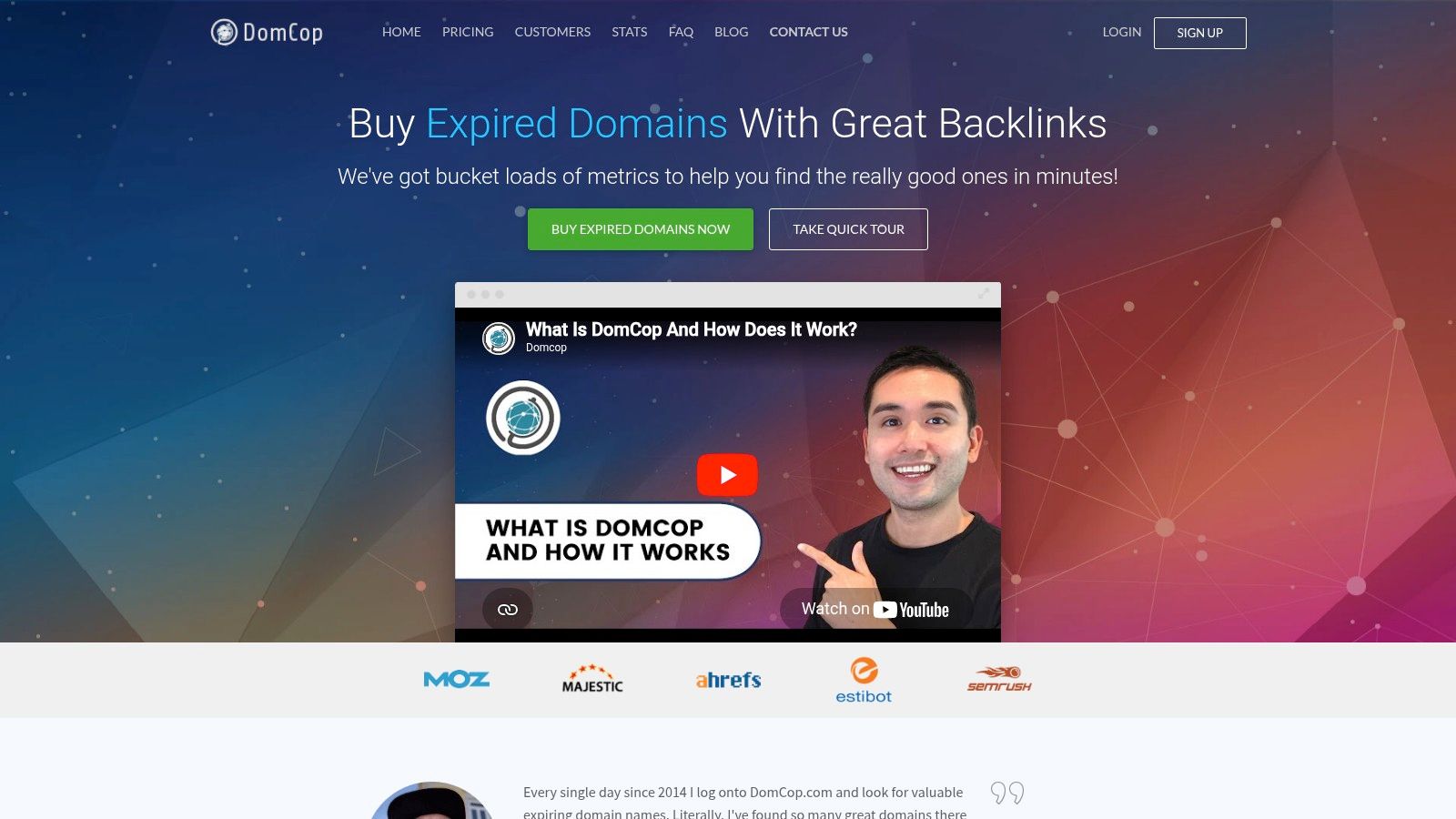
DomCop is built for people who are tired of visiting every marketplace one by one.
That alone makes it useful. Discovery gets messy fast when auction venues, expired feeds, and deleted lists all live in different places. DomCop’s main job is aggregation, and it does that well.
What it does well
It pulls together expiring, expired, and auction domains from multiple sources, then overlays familiar metrics from tools like Majestic, Moz, Ahrefs, and Estibot. That means you can filter more aggressively before clicking out.
DomCop is especially handy if you already know your buying criteria. Age, referring domains, TF, CF, domain pop, extension, and price-related filters can carve giant inventories down to something workable.
A few practical uses:
- Marketplace consolidation: Faster than checking auction venues manually.
- Metric overlays: Helpful for sorting before deeper verification.
- Watchlists and exports: Useful if you monitor recurring niches or TLDs.
Where users get burned
The biggest risk with DomCop is false confidence.
Because it displays a lot of metrics in one place, buyers sometimes assume they have already done due diligence. They have not. DomCop is best used as a sorting layer. Final checks still belong in the source tools, especially if the domain has meaningful competition or a suspicious history.
The other limitation is access. The more useful data sits behind paid tiers, so the experience can feel constrained until you commit.
DomCop works best for experienced hunters who want one dashboard for opportunity scanning, then have the discipline to verify winners elsewhere.
7. SpamZilla
SpamZilla exists for one reason. Most expired-domain lists contain a lot of landmines.
That focus makes it valuable. General SEO suites are good at showing strength. They are often less good at screaming, “Do not touch this one.”
Why it deserves a place in the stack
SpamZilla is purpose-built to detect abuse patterns in expired and auction domains. It leans heavily into historical and forensic review. Wayback snapshots, anchor patterns, language changes, and marketplace feeds combine to help you spot domains that were repurposed, burned, or heavily manipulated.
This is the tool I like when a name looks attractive on the surface but something feels off. Maybe the anchors are strange. Maybe the history does not match the current backlink profile. Maybe the niche changed too many times.
SpamZilla is good at flushing out those doubts quickly.
A domain with impressive metrics and ugly history is still an ugly buy.
The limitation
SpamZilla is specialized. That is both the point and the constraint.
It is not trying to be your all-in-one SEO platform. It does not replace Ahrefs, Semrush, or NameBio. It narrows risk in the expired-domain lane. If that is your main game, it becomes much more useful. If you mostly care about fresh brandable names or broad market research, it is less central.
I also would not use it as the only validator. If SpamZilla clears a domain, I still like checking winners in a primary link tool before buying.
As a junk filter, though, it is one of the more practical tools on this list.
8. ExpiredDomains.net
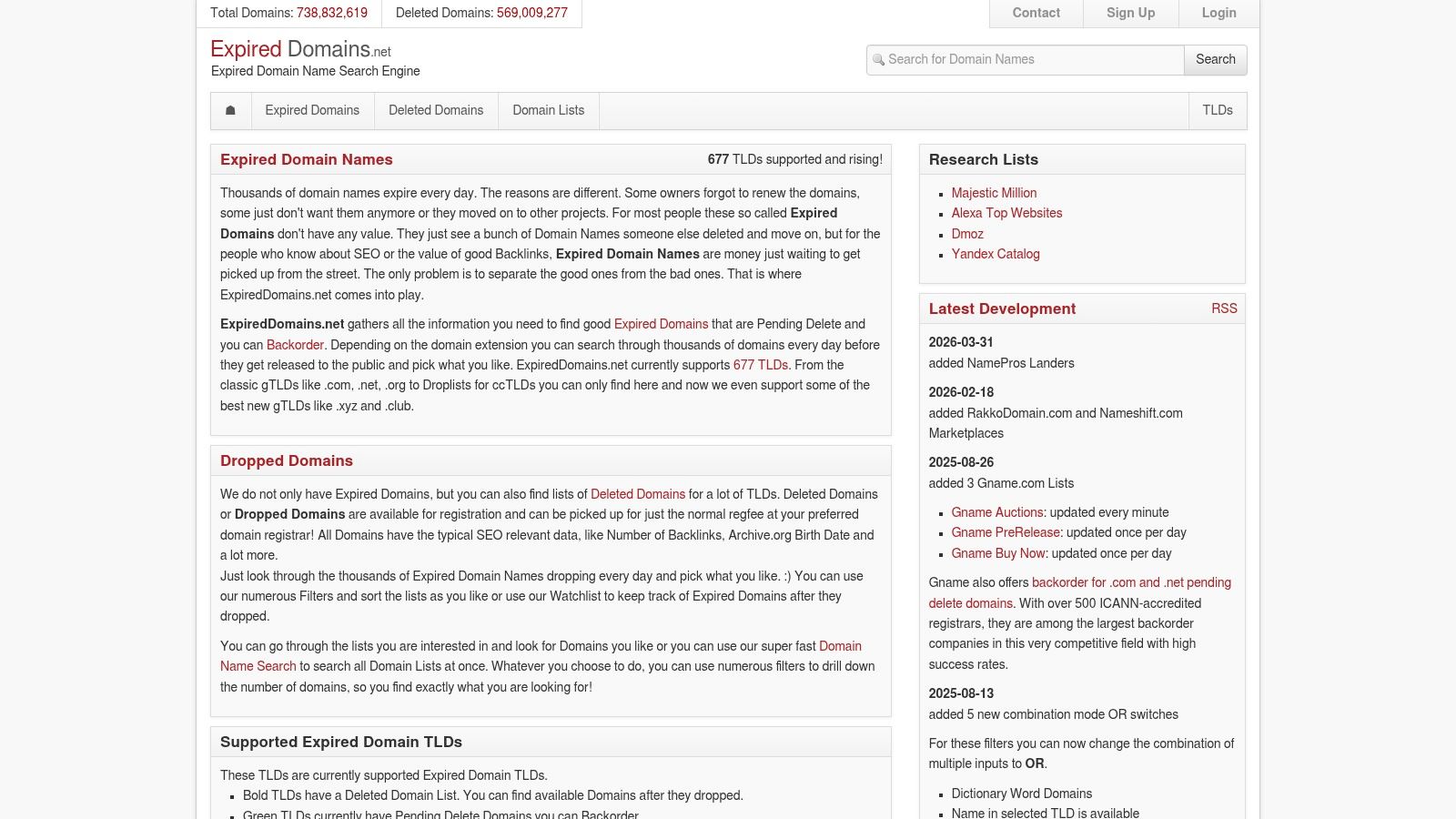
ExpiredDomains.net is the old workhorse of this category. The interface feels dated, but its value as a discovery engine is still high.
Here is the practical use case. You need a large pool of candidates before you spend money or time validating anything. ExpiredDomains.net handles that first stage well because it lets you cast a wide net across deleted, expiring, and auction inventory without paying for an enterprise SEO suite just to build a shortlist.
Why it still matters
According to Bishopi’s domain research tools review, ExpiredDomains.net filters millions of deleted, auctioned, and expiring domains daily. That matters less as a bragging point and more as a workflow advantage. A bigger feed gives you more shots at finding names other buyers missed, especially if you search across less crowded TLDs or smaller auction sources.
The filtering is the reason experienced buyers keep coming back. You can sort by age, keyword, extension, dictionary status, backlink indicators, auction venue, and a long list of secondary criteria. Used well, those filters cut down the junk fast and leave you with a manageable list for review.
It also works well as the front end of a broader expired-domain workflow. Start here for discovery, then run finalists through a proper expired domain checker workflow before you commit money.
Where it falls short
ExpiredDomains.net does not answer the hard questions by itself. It helps you find candidates. It does not tell you whether the backlink profile is clean, whether the domain was abused, or whether the asking price makes sense.
That trade-off is fine if you use it for what it does best. I would not rely on it as the final word on SEO quality or value, and beginners often get buried by the sheer number of filters and lists. There is also no official API, which limits automation if your process depends on custom pipelines.
As a first-pass discovery tool, though, it earns its place. Use it at the top of the funnel, then validate elsewhere.
9. NameBio
NameBio is where pricing stops being fantasy.
A lot of domain buyers talk themselves into numbers that have no relationship to the market. That gets expensive fast. NameBio helps align expectations with market data. Without comps, buyers drift into wishful thinking. That is how mediocre names become expensive mistakes.
Why comps matter more than opinions
The NameBio sales database records over 6.6 million domain sales totaling $3.2 billion. That scale is why it has become a foundational reference point for valuation work.
When I evaluate a domain for resale or acquisition, I do not want generic optimism. I want comps by keyword, TLD, venue, price range, and date. NameBio gives you that. It is especially useful for:
- Comparable sales: Search by keyword or extension to find realistic pricing anchors.
- Trend spotting: See how certain naming patterns and TLDs move over time.
- Negotiation support: Helpful when buying from a seller with inflated expectations.
If you are working through expired opportunities, this guide to an expired domain checker pairs well with NameBio because it connects valuation thinking to screening.
What NameBio does not solve
NameBio is not exhaustive. Not every sale is public, and private deals can distort your expectations if you assume the database captures everything. It also does not tell you whether the domain is clean, useful, or SEO-safe.
That is why NameBio belongs later in the workflow. First discover. Then validate history and links. Then price it with comps.
Used that way, it is one of the most important tools in this entire stack.
10. dotDB
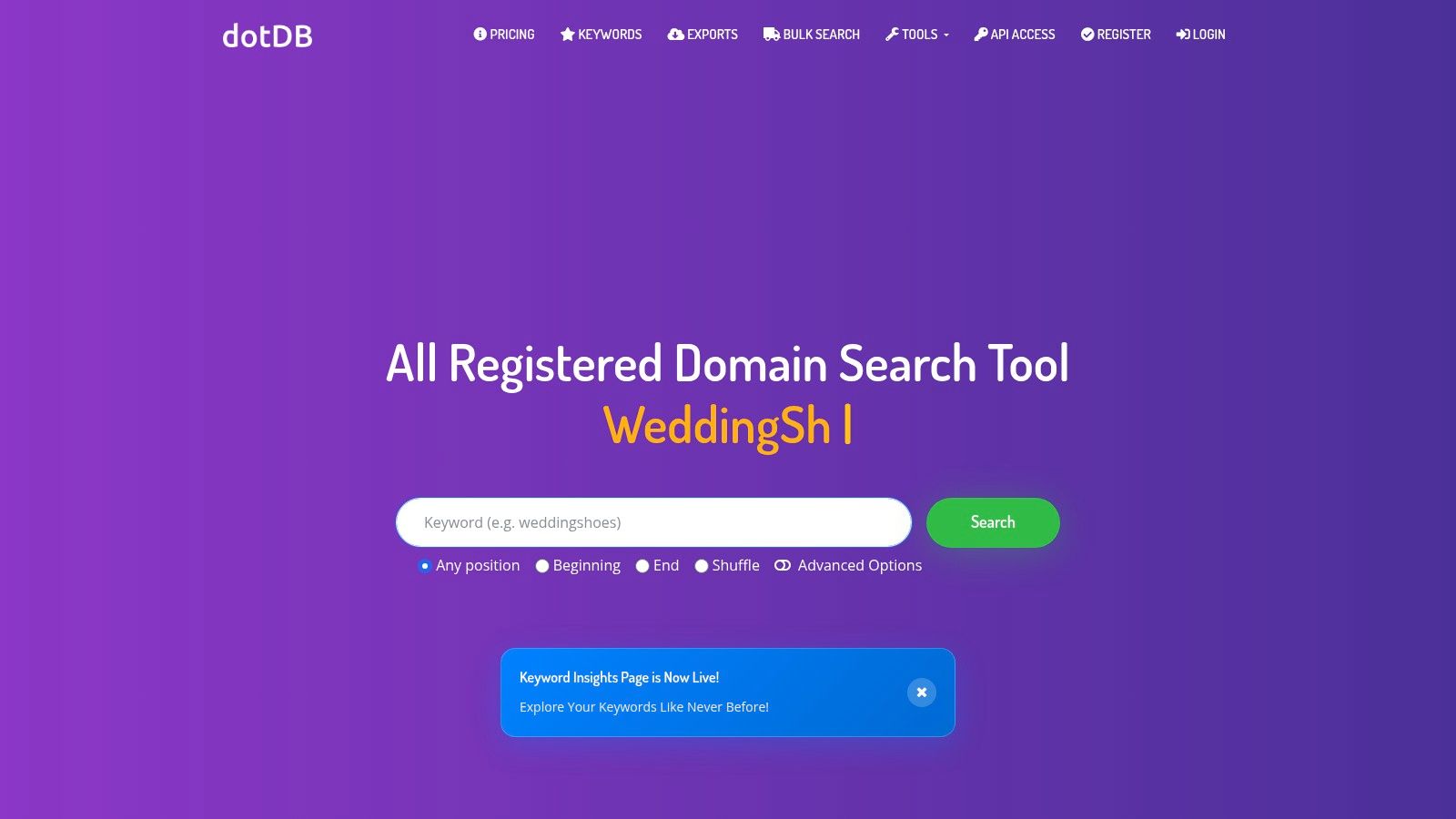
You shortlist a name, the .com is gone, and then the key question starts: Is the underlying term strong, or are you forcing a brand around a string nobody else cares about?
dotDB helps answer that part of the workflow. It is the naming-focused tool in this list, built for checking how a word or phrase shows up across registered domains and related strings.
That matters early, before you spend time on SEO metrics, backlink history, or pricing comps. If a term appears across many extensions and variations, you may be looking at commercial interest, a crowded naming field, or both. If the string is barely used, that can be good or bad. Good if you want something distinctive. Bad if the term feels awkward, obscure, or hard to adopt.
When dotDB earns a tab in your browser
Open dotDB during name discovery and brandability checks.
It is useful for:
- Testing a core string: See whether a keyword or coined term is broadly registered.
- Finding adjacent naming patterns: Related registrations often reveal prefixes, suffixes, and phrasing angles you would have missed.
- Checking naming crowding: Helpful when you need to know whether a space is wide open or already saturated with lookalike brands.
- Defensive brand research: A practical way to spot how exposed a brand concept might be before legal review or launch planning.
The trade-off is straightforward. dotDB does not tell you whether a domain is clean, authoritative, or worth buying for SEO. It does not inspect links, traffic, spam risk, or historical abuse.
That is why I use it near the front of the process, not the end. dotDB helps narrow the naming field. After that, the stronger workflow is to move the surviving candidates into availability checks, expired domain screening, SEO validation, and only then valuation.
Used that way, dotDB saves time and prevents a common mistake. Getting attached to a name before you know how crowded the string really is.
Top 10 Domain Name Research Tools Comparison
| Platform | Core features | Quality (★) | Value & pricing (💰) | Target audience & unique edge (👥 ✨) |
|---|---|---|---|---|
| NameSnag 🏆 | SnagScore (composite SEO metric), spam-free verification, Early Access Alerts, Watchers, API & bulk export | ★★★★★ Consolidated daily analysis + penalty flags | 💰 Free 7‑day trial; Scout $19/mo · Pro $49/mo · Elite $199/mo: high ROI for finds | 👥 SEO pros, domain investors, agencies · ✨ Proprietary SnagScore + spam-free discovery & early alerts |
| Ahrefs | Site Explorer, massive backlink index, broken-links & batch analysis | ★★★★★ Industry-leading backlink coverage | 💰 Premium; credit/add-ons can increase cost | 👥 Enterprise SEOs, agencies · ✨ Largest, freshest backlink index |
| Semrush | Domain/keyword research, backlink analytics, site audit, competitor tools | ★★★★ Wide toolset for marketing & SEO | 💰 Mid–high; modular add-ons can stack | 👥 Marketers, agencies, brand teams · ✨ All‑in‑one SEO + market intelligence |
| Majestic | Trust Flow / Topical TF, Link Graph, Fresh/Historic indexes | ★★★★ Strong link‑quality signals | 💰 Lower-cost entry vs some competitors | 👥 Link analysts, domain buyers · ✨ Topical Trust Flow for niche relevance |
| Moz Pro (Link Explorer) | Domain Authority, Spam Score, Link Explorer, keyword tools | ★★★★ Client-friendly, approachable metrics | 💰 Mid-tier; some free queries, limits on low plans | 👥 Consultants, agencies, clients · ✨ Recognized DA metric & clean UI |
| DomCop | Aggregated expiring/expired/auction lists, Majestic/Moz/Ahrefs overlays, filters | ★★★ Saves marketplace-checking time | 💰 Paid tiers for full data & exports | 👥 Domain investors · ✨ Centralized multi-marketplace aggregation |
| SpamZilla | Automated spam/penalty detection, Wayback & anchor timelines, Z‑Score | ★★★★ Focused on risk elimination | 💰 Mid; focused pricing for expired-domain hunts | 👥 Flippers, cautious buyers · ✨ Strong PBN/penalty detection |
| ExpiredDomains.net | Massive free deleted/expired lists, filters, marketplace feeds | ★★★ Huge inventory for discovery | 💰 Free with registration (no official API) | 👥 Prospectors, bargain hunters · ✨ Extensive free coverage across 600+ TLDs |
| NameBio | Searchable sales comps, daily feeds, business API | ★★★★ Trusted comps for valuation | 💰 Free search; API for business use (paid) | 👥 Valuers, brokers, negotiators · ✨ Reliable historical sales comparables |
| dotDB | Exact/related string counts across domains, keyword insights, alerts | ★★★ Fast brandability & registration visibility | 💰 Freemium with daily limits | 👥 Brand strategists, namers · ✨ Cross‑TLD string intelligence for naming decisions |
A Great Tool Doesn't Find a Domain, It Buys You Time
A weak domain workflow usually fails in one of two places. The shortlist is too loose, so junk survives too long. Or the review is too slow, so the good names are gone by the time someone is ready to act.
The fix is a staged process. Use one tool to find candidates fast, a second set of tools to pressure-test them, and a pricing tool only after a name clears the quality checks. That order matters. It keeps you from wasting half an hour on a domain that should have been rejected in the first two minutes.
The stack changes with the job. An expired-domain buyer should work very differently from a founder naming a startup. But the sequence stays consistent. Discovery first. Validation second. Pricing third. Decision last.
Specialized tools exist because manual checking breaks down once volume goes up. Analysts at Precedence Research found the domain name system tools market is growing steadily through 2035. The reason is practical, not theoretical. Teams want less tab-hopping, fewer blind spots, and faster decisions.
Use the tools by stage.
Start with discovery. ExpiredDomains.net is still hard to beat for broad free coverage if you can tolerate a clunky workflow. DomCop saves time for buyers who want aggregated lists and already know what they are filtering for. If you want a tighter operating console with filtering, monitoring, and built-in triage, use the platform discussed earlier as the first screen.
Then move into validation. Ahrefs is the backlink audit I trust when money is about to change hands. Majestic is useful for topic alignment and trust signals. Moz gives you a fast client-friendly read on authority and spam risk. SpamZilla is good at killing false positives before they turn into expensive mistakes.
Only then should you price the name. NameBio keeps negotiations tied to comps instead of optimism. For brand-first searches, dotDB belongs near the front of the process because string saturation matters before you get attached to a name.
A few rules keep the workflow honest:
- No single score should decide the purchase.
- Historical comps matter more than your hunch.
- Available, expiring, and auction domains require different timing and tactics.
- Archive checks and anchor review are part of the job, not optional cleanup.
The best domain tool is the one that removes wasted steps from your process and helps you reject bad options earlier.
If you want a simple starting point, build your workflow around one discovery hub, then pull in Ahrefs, Majestic, Moz, SpamZilla, NameBio, or dotDB only when a domain earns that extra scrutiny. That is how experienced buyers stay fast without getting careless.
Find Your Perfect Domain
Get access to thousands of high-value expired domains with our AI-powered search.
Start Free Trial