Ever glanced at a simple web address and wondered, "Could that be a goldmine?" If so, welcome to the wild, fascinating world of domain name investment! The best way to think about it is like digital real estate—you're essentially buying up prime online property, holding onto it, and then selling for a profit. And no, this isn't just for tech gurus; it's a market that's surprisingly accessible to anyone with a bit of a strategic eye.
Welcome to Digital Real Estate Investing
So, what exactly is this "domain name investment" thing? At its core, it's just the practice of buying domain names with the expectation that their value is going to go up over time. It's not all that different from a real estate investor scooping up a plot of land in a neighborhood they think is about to take off. A domain investor is just buying a digital "address" that could become highly sought-after down the road.
This isn't about hoarding thousands of random, nonsensical names and hoping for the best. It's a calculated game focused on finding domains that have some kind of inherent value. This value usually comes from a few key places:
- Brandability: Short, memorable, and catchy names are the digital equivalent of a prime storefront on Main Street. Think
cars.comorvoice.com. - Keyword Relevance: Domains that nail popular search terms, like
bamboosheets.com, can be incredibly valuable to businesses trying to own that niche. - Existing Authority: Some domains aren't new at all. They come with a history of traffic and backlinks, giving them a serious head start in Google's eyes.
Why Is This a Booming Industry?
The internet just keeps growing. With every new business, brand, or big idea that pops up, the demand for a high-quality domain name grows right along with it. A great domain is so much more than just an address—it's the very foundation of an online identity, a powerful marketing tool, and a legitimate business asset all rolled into one. The market's growth is simply a reflection of that reality.
The global domain market was valued at $2.4 billion in 2024 and is projected to hit $3.57 billion by 2033. This isn't just random growth; it's fueled by the increasing recognition of domains as real digital assets, not just simple web addresses. You can dive deeper into the domain marketing statistics to see the full picture.
This steady climb tells you something important: domain investing is shifting from a niche hobby to a recognized asset class. For anyone savvy enough to see it, this presents a massive opportunity to get in on the ground floor of the internet's ever-expanding real estate market.
Your Path to Becoming a Domain Investor
In this guide, we’re going to ditch the confusing jargon and give you a practical, no-fluff roadmap to get started. We'll cover everything from how to spot those undervalued gems hiding in plain sight to cashing in on your portfolio. It doesn't matter if you're a complete beginner or just looking to sharpen your skills—you'll learn how to navigate this industry with confidence.
We'll teach you what actually makes a domain valuable and how to start building your own collection of digital assets. Get ready to turn web addresses into wealth. It's time to claim your piece of the internet.
Decoding a Domain's True Worth
So, what separates a digital diamond from a complete dud? When it comes to domain name investing, it all boils down to valuation.
Think of yourself as a digital real estate appraiser, learning to spot the subtle clues that scream "valuable" while everyone else just sees a web address. This isn't about luck; it's about knowing exactly what to look for.
A domain with a clean, authoritative history is like inheriting a well-established business instead of starting from scratch. It already has a reputation, and in the online world, that's a massive head start. But how do you actually measure that reputation? It starts with looking at its digital footprint and the company it keeps.
SEO Power and Authority Metrics
Some of the most critical factors are completely invisible to the naked eye. These are the SEO metrics that tell you how Google and other search engines see a domain. A strong history here means you're not just buying a name—you're buying an asset with built-in momentum.
Here are the heavy hitters you need to get familiar with:
- Trust Flow (TF): A metric from Majestic that measures the quality of the backlinks pointing to a domain. A high Trust Flow score suggests the domain is linked to by trustworthy, authoritative sites, making it a more credible asset in the eyes of search engines.
- Referring Domains: This is simply the total number of unique websites linking back to the domain. More important than the raw number is the quality—a single link from a major news outlet is worth more than a hundred from spammy directories.
- Domain Age: An older domain that has been continuously active and well-maintained is often seen as more trustworthy. It’s like a business that’s been on the same street corner for 20 years—it has staying power and a proven track record.
These metrics are closely related to concepts like Domain Authority (DA), a score from Moz that predicts a website's ranking potential. Understanding these interconnected scores is crucial for any serious investor, and you can get a better handle on them by exploring our guide on the Moz Domain Rating.
To help you keep these factors straight, here's a quick reference table.
Key Domain Valuation Factors at a Glance
| Valuation Factor | Why It Matters | What to Look For |
|---|---|---|
| Trust Flow (TF) | Measures backlink quality. High TF means links come from reputable sources. | A score of 15+ is a good starting point for a quality domain. |
| Referring Domains | Shows the breadth of a domain's link profile. | Look for a diverse set of quality, relevant domains. |
| Domain Age | Older, active domains are often seen as more trustworthy by search engines. | A history of clean, consistent use without long periods of inactivity. |
| Brandability | A catchy, memorable name is a massive marketing advantage. | Short, easy to spell, passes the "radio test." |
| Backlink Quality | Not all links are equal. A few powerful links beat thousands of spammy ones. | Links from industry authorities, news sites, and educational institutions. |
Think of this table as your initial checklist. When you find a domain, run it through these criteria to get a quick sense of its potential.
The Art of Brandability
While the SEO stats are critical, never, ever underestimate the power of a great name. Brandability is the X-factor that can make a domain priceless. It's the difference between a name that's instantly forgotten and one that sticks in a customer's mind.
So, what makes a name brandable? It’s a mix of art and science.
A great domain name is like a great brand slogan—it's short, memorable, and communicates value instantly. It should pass the "radio test," meaning someone could hear it once and easily type it into their browser without confusion.
A name like mint.com is a perfect example. It's short, implies finance and freshness, and is incredibly easy to remember. That's the gold standard.
This next graphic drives home the point that domain names are fundamental digital assets, sitting right alongside full-fledged websites as core components of any online presence.
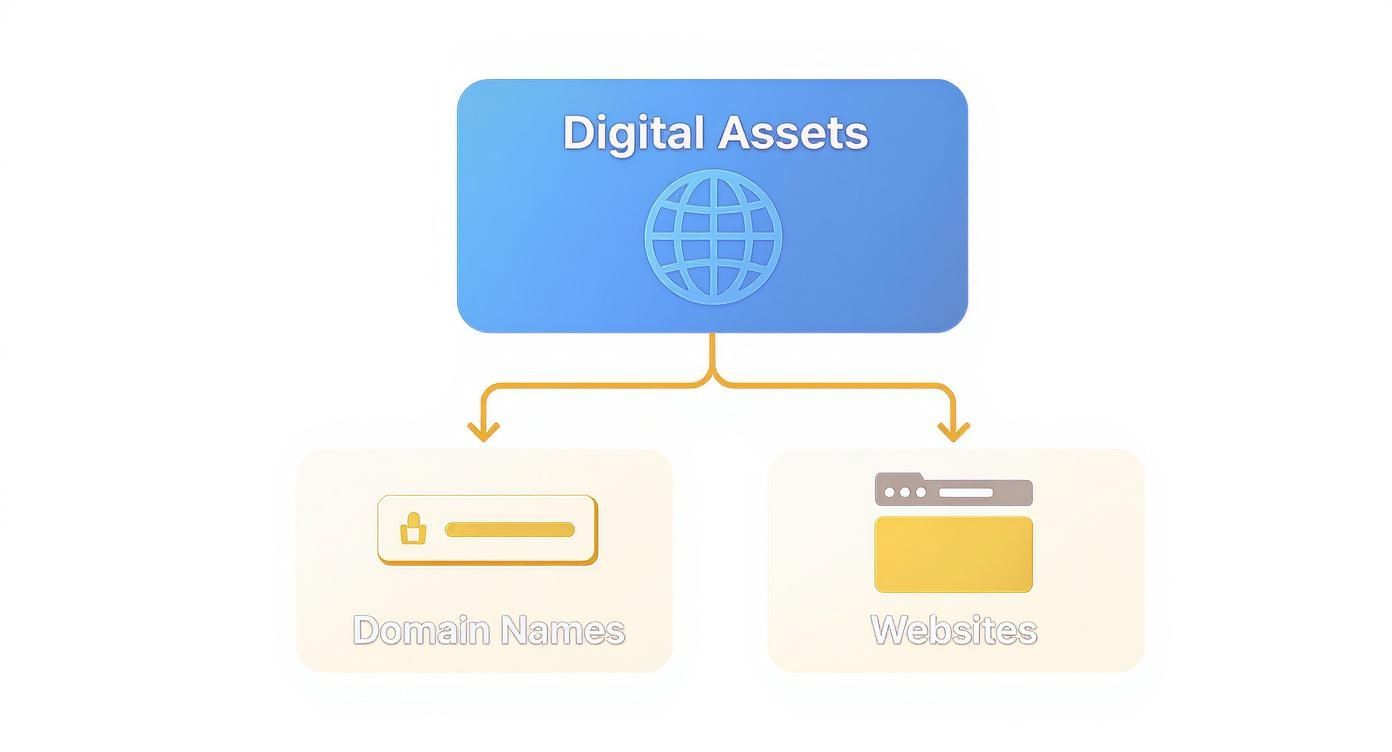
This visual highlights a key concept: a domain isn't just a pointer to a website; it is a distinct, valuable asset in its own right, forming the foundation of any digital enterprise.
Putting It All Together for Valuation
No single metric tells the whole story. A domain with fantastic SEO stats but a clumsy, unbrandable name might be a tough sell. On the flip side, a killer brand name with zero backlink history is a blank slate—valuable, but for very different reasons.
The real sweet spot is finding domains that balance both.
By the end of this guide, you’ll have a practical checklist. You'll be able to look at any domain and confidently break down its SEO power, assess its brand appeal, and make a smart call on its true market value.
Hunting for Undervalued Digital Assets
Alright, now for the really fun part—the treasure hunt. This is where you put your newfound valuation skills to the test and start finding those undervalued domains with massive potential. Think of yourself as a digital prospector, sifting through the noise to find nuggets of gold.
Your best opportunities won't be advertised on billboards. They’re often found in places where domains are overlooked, forgotten, or just changing hands. This is where a sharp eye and the right tools give you a serious edge.
This image perfectly captures the feeling of discovering a hidden gem: an expired domain that still holds immense value, just waiting for a savvy investor to scoop it up.
The Goldmine of Expired Domains
One of the most lucrative hunting grounds for domain investors is the world of expired domains. These are domains that someone, for whatever reason, forgot or chose not to renew. Their loss is your gain.
An expired domain isn't just a name; it’s a piece of digital history. It might come with a pre-existing backlink profile, established authority, and years of age—all powerful assets that you get for the cost of a simple registration.
This is where a platform like NameSnag becomes your secret weapon. Instead of manually checking endless lists, you can filter through the noise with laser precision.
- Expiring domains are those that have passed their renewal date but are still in a grace period. They will be dropping soon, giving you time to research and prepare. With NameSnag's Expiring domains filter, you can see what’s coming down the pipeline in the next 3, 7, or even 30 days.
- Available domains have completed the expiration cycle and are available for anyone to register right now. Using the Available domains on NameSnag, you can snatch up these fresh opportunities before anyone else does.
This proactive approach is key. To get a better handle on the process, check out our detailed guide on how to find expiring domains, which breaks down the entire lifecycle.
Domain Auctions and Marketplaces
Beyond expired domains, auctions and marketplaces are where the big fish swim. These are platforms where premium domains are bought and sold, often through competitive bidding.
- GoDaddy Auctions: The largest marketplace for expired and user-listed domains.
- Sedo: A huge global marketplace known for its vast inventory and brokerage services.
- Flippa: A platform where you can buy not just domains, but also established websites and online businesses.
When you're starting out, just watch these auctions. See what types of names are getting bids, what sells, and for how much. This is real-time market research that costs you nothing but time.
Don’t just look at the final sale price; ask why. Why did one four-letter .com sell for $500 while another sold for $50,000? Observing these patterns is how you develop an instinct for value.
This observation phase is critical. You're building the market sense you need to succeed.
Building Your Investment Pipeline
Success in this game is about consistency. You need a steady pipeline of potential investments to analyze, which means setting up alerts and using tools to automate your search. The sheer size of the domain market is your advantage here—there’s always new inventory.
The global domain registration landscape is constantly expanding, hitting 378.5 million registrations in Q3 2025—a 4.5% increase from the previous year. New generic TLDs (ngTLDs) exploded by 21% year-over-year, adding millions of new names to the market. You can break down the latest domain industry data to see how these trends create fresh opportunities.
With so many options, your job is to build a system that brings the best ones directly to you. Start by setting alerts for specific keywords, metrics (like a minimum Trust Flow), or domain extensions. This way, you’re not just hunting; you’re setting strategic traps to catch the best assets as they become available.
Your Domain Due Diligence Checklist
Alright, before you get swept up in the excitement and smash that ‘buy’ button, it's time to put on your detective hat. A domain that looks pristine on the surface can be hiding a toxic past. This is where you protect your investment, and a little digging now will save you from a world of hurt later.
Think of it this way: you wouldn't buy a house without a proper inspection, would you? Of course not. You'd want to know about any hidden mold, foundation cracks, or sketchy wiring. Due diligence for a domain is the exact same principle—it’s your inspection report for that piece of digital real estate.
Checking for Past Penalties and Spam
First things first, you absolutely have to investigate the domain's history. A name that was previously used for some spammy, low-quality, or penalized website is a ticking time bomb. If you buy it, you inherit all that baggage, making it nearly impossible to ever rank on Google.
So, how do you peek into its past life? Your go-to tool here is the Wayback Machine over at Archive.org.
- Enter the Domain: Just pop the domain name into their search bar.
- Scan the Timeline: Look at the calendar view. Do you see huge, unexplained gaps where the site was offline? That could be a red flag.
- Review Past Content: Click on a few snapshots from different years. What was this site actually about? Did it look like a legitimate business, a personal blog, or a spam-filled link farm designed to trick search engines? If you see anything shady—like pages stuffed with keywords or selling questionable products—it’s an easy pass. Walk away.
This historical check gives you a clear picture of what you're dealing with. You’re looking for a clean, consistent history, not a digital ghost town or a former den of spam.
Uncovering Backlink Quality and Toxicity
A domain's backlink profile is like its professional network. A link from a reputable source, like a major news site, is a glowing letter of recommendation. But links from spammy, irrelevant sites? That's like finding out its main hobby is hanging out with a bad crowd—they drag the domain's reputation right down into the mud.
A domain's value isn't just in its name; it's in its history and reputation. A toxic backlink profile can render even the most brandable name worthless from an SEO perspective.
Manually checking every single backlink is a monumental task, but you need to at least spot-check for the obvious red flags. Look for links from foreign-language sites that have nothing to do with the domain's topic, or links from ancient-looking web directories that feel like they were built in 1999. These are dead giveaways of a profile that's been manipulated.
If you really want to get into the weeds on this, you can also learn how to check backlink quality with more advanced tools and techniques.
The Trademark Minefield
This one is a big deal, so pay attention. Buying a domain that infringes on an existing trademark is basically buying a lawsuit that's just waiting to happen. It doesn’t matter if you registered the domain legally; if a company has a registered trademark on that name, they have a very strong claim to it, and they will come for it.
Before you even think about investing, you have to do a trademark search.
- Google It: This is the simplest first step. Just search for the domain name and see what comes up. Is there an established brand already using that name or something very similar?
- Check Trademark Databases: Use the U.S. Patent and Trademark Office's (USPTO) database, or your country's equivalent. Search for the exact phrase and any close variations.
If you find a direct conflict, especially with a well-known brand, just steer clear. The risk is simply not worth the potential reward. Getting this risk-management phase right is what separates the amateur speculators from the professional investors. Follow these steps, and you'll be investing with confidence, not just hope.
Turning Your Domains Into Profit
Alright, so you’ve done the hard part. You've hunted, vetted, and snagged a fantastic domain. Now what? A killer domain name investment isn’t just about buying and holding on for dear life; it’s about making that asset actually work for you.
It's time to talk about turning that piece of digital real estate into cold, hard cash.
Whether you’re after some passive income while you wait for the perfect buyer or you’re ready to cash out entirely, you’ve got several powerful plays at your disposal. This is where your smart acquisition starts looking like a real return on investment.
Parking Your Domain for Passive Income
The simplest way to get some cash flowing from your domains is through domain parking. Think of it like renting out a vacant lot for advertising billboards. You're not building anything on it, but you're still making a little money from the traffic that wanders by.
Here's how it works: you point your domain to a parking service, and they automatically splash the page with ads related to the domain's keywords. If you own BestCoffeeGrinders.com, that page will almost certainly show ads for coffee grinders, espresso machines, and artisanal beans. Every time a visitor clicks an ad, you earn a small commission.
It's a low-effort way to generate some cash, especially for domains that already get a bit of "type-in" traffic from people guessing the URL. While it won’t make you rich overnight, it can easily cover your annual renewal fees and then some, making those long-term holds much easier to stomach.
Leasing Your Domain for Steady Cash Flow
If you want to get more active—and potentially earn a lot more—domain leasing is a fantastic strategy. This is a perfect fit for premium, brandable domains that a new business or startup would love to use but just can't afford to buy outright.
Instead of a one-time sale, you rent the domain to them for a fixed monthly or annual fee. This gives you a steady, predictable income stream, and the business gets to build its brand on a top-tier domain name. It’s a beautiful thing.
By leasing a domain, you keep ownership of the asset—letting it appreciate in value—all while collecting regular payments. It’s a win-win that turns your domain into a reliable, income-producing machine.
Many lease agreements even include an option to buy, allowing the lessee to purchase the domain for a set price down the road. This model is getting more popular because it lowers the barrier to entry for businesses that need a killer online identity from day one.
Your Ultimate Exit Strategy: Selling the Domain
Of course, for most of us, the end game is the exit—selling the domain for a significant profit. This is where all that research and patience finally pays off. Make no mistake, the domain aftermarket is a serious business.
The global domain aftermarket was valued at roughly USD 0.64 billion in 2024 and is expected to hit USD 1.17 billion by 2033. This explosion is fueled by the relentless demand for good, memorable names in an incredibly crowded digital world. If you want to see just how big this market is, you can explore more domain name statistics.
Pricing your domain is both an art and a science. It's a mix of looking at comparable sales, weighing its brandability and SEO metrics, and getting inside the head of a potential end-user to figure out what it's worth to them.
When you're ready to find buyers, you've got a few routes to take:
- List on Marketplaces: Sites like Sedo, Afternic, and Dan.com put your domain in front of millions of eyeballs.
- Direct Outreach: Find businesses that would be a perfect fit for your domain and reach out with a professional, well-crafted inquiry.
- Use a Broker: For high-value domains (think $10,000+), a good domain broker can tap into their network and use their negotiation chops to land you the best possible price.
Selling is the final, most rewarding step. With the right strategy, you can maximize your return and start funding your next big domain name investment.
So, Where Do You Go From Here?
You’ve made it through the crash course. We’ve covered everything from what actually gives a domain name its value to the thrill of the hunt and the playbook for turning these digital assets into real profit. The map is in your hands.
But remember, this is a marathon, not a sprint. Real, lasting success in domaining is built on consistent research, a bit of detective work (due diligence!), and a healthy dose of patience. The absolute worst thing you can do is get excited and register a hundred domains tomorrow. Trust me, that’s a fast track to burnout and a portfolio full of expensive mistakes.
Taking Those First Steps
The only way to start is small. Your first goal isn’t to flip a domain for a six-figure payday. It’s much simpler: just learn something from every single transaction, no matter how small the numbers are. Think of your first few domains as tuition. They're hands-on lessons in valuation, negotiation, and market timing that no guide can fully teach you.
Success in this game isn't about getting lucky; it's a skill you build, brick by brick. Every domain you analyze, every auction you watch, and every sale you make (or miss out on) sharpens that skill. Treat it like a business, not a lottery ticket.
Focus on adding one quality domain at a time to your portfolio. As you get more reps in, your ability to spot an undervalued gem will start to feel like second nature.
Stay Ahead of the Curve
To keep your edge, you have to stay plugged into the constant stream of newly available domains. This is where having the right tools is a game-changer, helping you cut through the noise of hundreds of thousands of options to find the handful that are actually worth your time.
For example, you can build a whole discovery workflow around this:
- Find domains that just dropped and are available for hand-registration right now by checking out the list of Available domains on NameSnag.
- Get a jump on the competition by scouting names that are about to become available using the Expiring domains filter. This lets you do your research and plan your move before the starting gun even fires.
The internet isn't getting any smaller, and the demand for premium, brandable, and authoritative domains is only going one way: up. You have the playbook—now it's time to go out there and claim your piece of digital real estate.
Common Questions from New Domain Investors
Diving into domain investing can feel a bit like learning a new language. You've probably got the big picture down, but I'm willing to bet a few nagging questions are still bouncing around in your head. Let's tackle some of the most common ones I hear to clear the air and get you started on the right foot.
How Much Money Do I Actually Need to Start?
You can get in the game with a surprisingly small bankroll. While you see headlines about premium domains fetching thousands, the real action for new investors is in recently expired or 'dropped' domains. You can often snag these for nothing more than the standard registration fee—usually just $10-$15. These are the hidden gems, the undervalued assets that savvy folks look for.
Realistically, a great starting budget to build a small, curated portfolio of five to ten solid names would be around $100-$200. The key isn't how much you spend, but how smart you are with it. Focus on acquiring quality over quantity and make sure you reinvest your early profits to grow your portfolio.
What Are the Biggest Mistakes I Should Avoid?
It's almost a rite of passage for new investors to stumble into the same few traps. The good news? You can sidestep them with a little foresight. The single most common mistake is buying domains based on a gut feeling or personal preference instead of cold, hard market data.
Here are a few pitfalls to watch out for:
- Ignoring the Data: Don't buy a name just because you think it sounds cool. That's a recipe for a portfolio of duds. Always research comparable sales and keyword demand first.
- Skipping Due Diligence: A domain with a spammy, penalized history is worse than worthless; it's a liability. You have to check its past, no exceptions.
- Getting Emotionally Attached: This is a business, not a pet shelter. Treat your domains like the investments they are. When a good offer comes along, be ready to sell.
- Forgetting Trademarks: This one's a biggie. Always check for trademark conflicts before you buy. It's a simple step that can save you a world of legal headaches down the road.
How Long Does It Take to Sell a Domain?
Ah, the million-dollar question. The honest answer is... it depends. It varies wildly. I've seen some domains sell within a few weeks of being listed, while others have sat comfortably in a portfolio for years before the right buyer came along. There's just no set timeline in this game.
Patience is more than a virtue in this business; it's a core strategy. A high-quality domain is a valuable digital asset. Eventually, the right buyer who understands its true worth will find it. Don't get spooked into selling for a lowball offer just to make a quick buck.
How fast a name sells boils down to its quality, your pricing strategy, and how actively you're marketing it. For domains you plan to hold for the long term, consider parking them to generate some passive ad revenue. It's a fantastic way to cover your annual renewal costs and make the wait profitable.
Ready to find those undervalued gems without all the guesswork? NameSnag uses AI to sift through over 170,000 domains every single day, handing you a curated list of high-potential assets. Start your search for Available domains or get a jump on the competition by scouting Expiring domains today.
Find Your Perfect Domain
Get access to thousands of high-value expired domains with our AI-powered search.
Start Free Trial