
So you've got a domain name—or a whole portfolio of them—just sitting there. Maybe it’s a killer brandable name you snagged for a future project, or maybe you’re a domain investor holding onto digital real estate. Leaving it to collect digital dust is like owning a vacant lot; it’s not costing you much, but it’s certainly not making you anything.
What if you could put that asset to work? Parking that domain with GoDaddy is one of the easiest ways to do just that. You can turn it from a line item on your expense report into a small, passive revenue stream. Let's dive into how you can make that happen.
What Is Domain Parking and Why Use GoDaddy
Let's be real, "domain parking" sounds a bit like leaving your car in a digital lot. And in a way, it is. But what if that lot paid you? That’s the core idea. Instead of showing an error page or a blank screen, a parked domain displays a simple landing page filled with relevant ads. When a visitor clicks on one of those ads, you earn a cut. Cha-ching!
It’s a super straightforward strategy for monetizing domain names you own but aren't quite ready to build out into a full-blown website.
The Benefits of Parking Your Domains
Parking a domain isn't just about making a few bucks from ad clicks, although that's a sweet perk. It offers a few strategic advantages that I’ve found genuinely useful.
- Effortless Monetization: This is the fun part! You can generate passive income from domains that would otherwise just be a recurring expense. GoDaddy handles all the nitty-gritty of ad placements and optimization, and you collect a share of the revenue. It’s about as hands-off as it gets.
- Secure Future Assets: Got a perfect domain for a project you’ll start someday? Parking lets you hold onto it without the pressure to build a full site right away. It's reserved for you and only you, patiently waiting for its big debut.
- Gauge Traffic Potential: A parked page is a fantastic barometer for a domain's natural, or "type-in," traffic. This data is pure gold when you're deciding whether to develop the domain into a full site or sell it to the highest bidder.
You might wonder if GoDaddy is the right place for this. Well, they're the undisputed heavy-hitter in this space. A comprehensive 2023 APNIC study found that GoDaddy's parking services command over 50% of the market share, managing more than 31 million parked domains. That kind of scale means they have the tech and advertiser relationships to optimize revenue in a way most of us couldn't on our own.
CashParking vs. 'For Sale' Pages
When you're dealing with GoDaddy, you essentially have two paths for your unused domains, and they serve very different goals. A basic 'For Sale' page is exactly what it sounds like—a simple lander that tells visitors the domain is available for purchase. It’s the right move if your only goal is to flip the domain quickly.
On the other hand, CashParking is GoDaddy’s dedicated monetization service. Enrolling a domain in CashParking turns it into a revenue-generating asset through targeted advertising. It’s the better choice for domains you plan to hold for a while, as the ad revenue can help cover renewal costs and sometimes even turn a profit.
To really make this work with a portfolio, you need to know what your names are worth. Check out our guide on using the GoDaddy bulk appraisal tool to get a better sense of their value before deciding which ones to park versus sell.
Finding Valuable Domains to Park Using NameSnag
Let's be honest. Parking a brand-new, hand-registered domain is almost always a waste of time. You’re essentially opening a storefront in the middle of nowhere and hoping someone stumbles upon it. It's a losing game. The real money in domain parking, especially with a service like GoDaddy, comes from domains that already have a pulse.
This isn't about guessing what might be popular one day. It’s about acquiring digital real estate that already has value baked in. Think of a tool like NameSnag as your radar for these properties. You’re looking for names with a history—lingering traffic, a decent backlink profile, and some age. That's where the potential lies.
Target Freshly Available Domains
One of the quickest ways to find a worthwhile domain is to look at what just became Available. These are domains that were registered, expired, and then got dropped by the previous owner. The beauty of this is there’s no auction and no waiting period. You see it, you like it, you can register it on the spot at any registrar.
I usually start my hunt on NameSnag by filtering for domains dropped Today or within the last 3 Days. This shows you the freshest inventory before it gets picked over. You’re on the lookout for names that clearly had a past life—maybe an old blog, a defunct local business, or a project that never quite took off. These often have some residual type-in traffic or a few backlinks still pointing to them, which is pure gold for parking.
A huge mistake I see people make is grabbing any available domain just because it sounds cool. A domain's history is everything. If it was used for spam or shady business, it’s toxic. It will be a money pit that never monetizes properly, no matter what you do.
Strategically Hunt for Expiring Domains
Another, more powerful tactic is to go after Expiring domains. These are the heavy hitters. They’ve passed their expiration date but are stuck in a grace period before they officially drop, usually heading to an auction.
This route requires more patience, but the payoff can be massive. You can use NameSnag to spot expiring names that have real SEO muscle—think high authority scores or quality links from legitimate websites. When you find one of these gems, you can place a backorder to get yourself at the front of the line when it finally becomes available. We've got a whole playbook on this, which you can read in our guide to find expiring domain names with high traffic.
By going after expiring names, you're not just buying a string of characters; you're buying its entire history, authority, and traffic potential. Parking a domain like that with GoDaddy gives your monetization a running start, turning a blank page into an asset that can generate income from day one.
How to Park a Domain on GoDaddy
So you’ve landed a great domain—maybe a forgotten gem from the Available list or a high-value Expiring name you won at auction using a tool like NameSnag. Congratulations! Now, what are you going to do with it? Letting a quality domain sit idle in your account is like buying a piece of prime real estate and leaving the lot empty. It’s time to put that asset to work.
The first step for any domainer is finding these assets in the first place. The whole game revolves around a cycle of spotting expiring names, backordering the best ones, and scooping up valuable domains the moment they become available again.
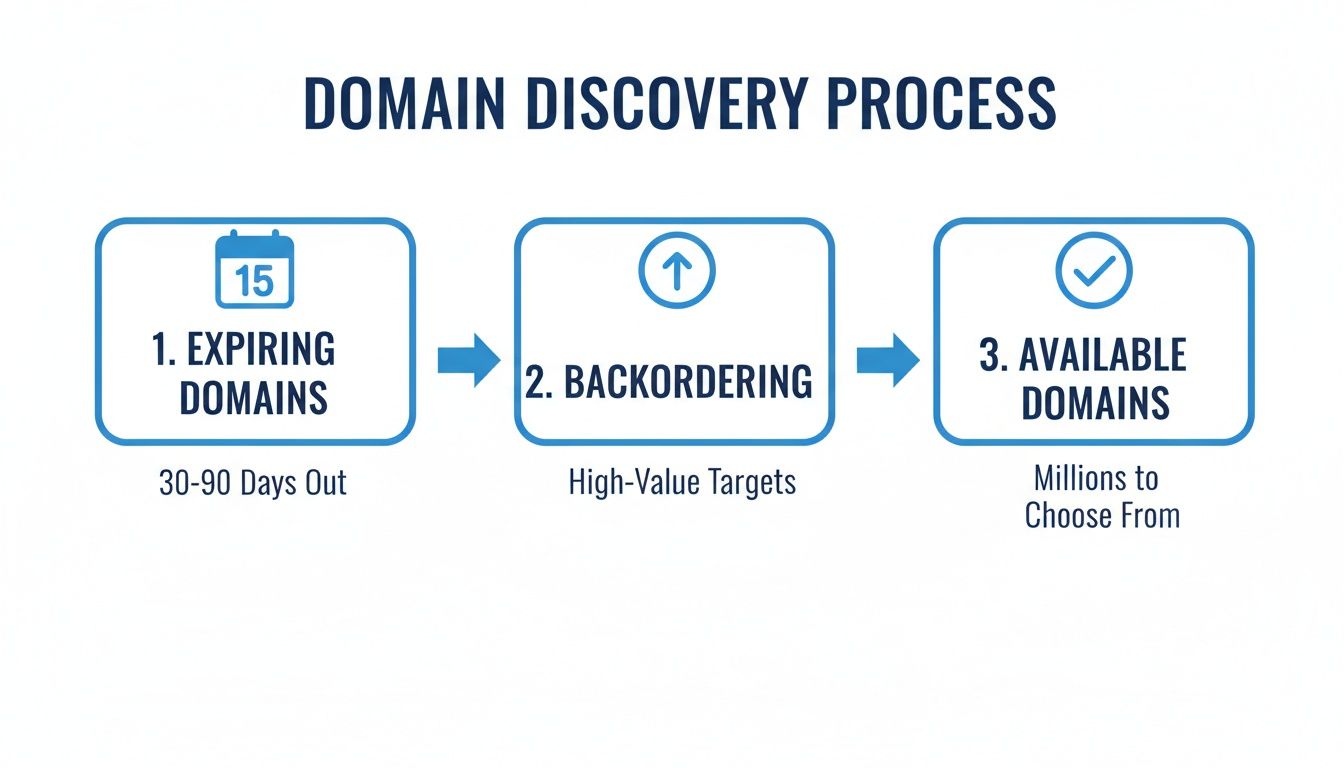
Once you’ve acquired a domain, parking it with a registrar like GoDaddy is your next move. You have a couple of solid options, each serving a different purpose.
The 'For Sale' Lander: A Simple First Step
The most straightforward approach is to flip up a basic 'For Sale' landing page. Think of this as the digital equivalent of putting a sign on that empty lot. The goal isn't immediate income; it’s about signaling to potential buyers that your asset is on the market.
Getting this done is dead simple. Just head into your Domain Portfolio in your GoDaddy account, find the domain, and look for an option to add a 'For Sale' page. You'll set your price and contact details, and you’re done. Anyone who types in the URL will know it's available and how to reach you.
Leveling Up with GoDaddy's CashParking
If you want to do more than just wait for a buyer—if you want to generate some passive income while you hold the domain—then you’ll want to look at GoDaddy’s CashParking service. This is where you can start making that portfolio pay for its own renewal fees, and hopefully a lot more.
CashParking is a paid program that swaps the basic 'For Sale' page for a landing page that displays relevant ads. Setting it up involves a few key steps:
- You'll need to buy a CashParking plan first.
- Then, you add your domains into the CashParking account dashboard.
- The final, crucial step is making sure your domain's nameservers are pointed to GoDaddy’s dedicated parking servers.
Once that's done, GoDaddy's system takes over. It analyzes your domain name's keywords and any traffic it gets, then automatically populates the page with targeted ads. You earn a cut of the revenue every time a visitor clicks on one.
GoDaddy is a giant in this space, supporting around 80 million domains and serving content with 65 million active TLS certificates. When Google killed its AdSense for Domains program, GoDaddy didn't miss a beat. They switched to other ad feeds and now use AI to route traffic to maximize revenue, showing just how committed they are to making parking profitable. You can read more about their secure parking infrastructure on the GoDaddy engineering blog.
This isn't some simple placeholder. It's a sophisticated monetization engine designed to squeeze value from dormant domains securely and effectively. By understanding both the simple 'For Sale' sign and the more robust CashParking service, you can make the right call for every domain you own.
The Art of Squeezing Juice from a Parked Domain
 Getting your domains parked on GoDaddy is just the start. If you stop there, you’re leaving money on the table. The real work—and the real profit—begins when you start treating your parked domains like the tiny, cash-generating assets they are.
This means you’ve got to get your hands dirty in the CashParking account and actually pay attention to the numbers. Don't let the charts and acronyms scare you off. They’re the only real feedback you have on whether your domain is a dud or a diamond in the rough.
Making Sense of Your CashParking Numbers
After your domain is live and collecting dust (or clicks), the GoDaddy CashParking dashboard starts to populate. But what do these numbers actually mean for your bank account? Let's cut through the noise.
- Impressions: This is simply how many times someone landed on your parked page. Think of it as your raw foot traffic.
- Click-Through Rate (CTR): Of all those people who showed up, what percentage actually clicked an ad? A high CTR is a great sign; it tells you the ads are hitting the mark with the visitors you're getting.
- Revenue Per Mille (RPM): This is your estimated earnings for every 1,000 impressions. It’s the best metric for comparing the earning power of different domains at a glance.
Watching these numbers is how you spot opportunities. Got a killer domain name that’s pulling zero impressions? The type-in traffic you were banking on just isn't there. Another domain getting tons of traffic but a pathetic CTR? The ads are probably irrelevant to the audience. This is the core of how you make money with a website without selling anything—by optimizing ad performance.
For a quick breakdown, here’s how GoDaddy’s main parking options compare.
GoDaddy Parking Options At a Glance
| Feature | Basic Parking ('For Sale' Page) | CashParking |
|---|---|---|
| Primary Goal | Selling the domain | Earning passive ad revenue |
| Monetization | None (links to your 'For Sale' page) | Ad revenue sharing |
| Cost | Free with domain registration | Paid service (Basic or Premium plan) |
| Customization | Minimal; standard 'For Sale' lander | Customizable ad categories and keywords |
| Analytics | None for ad performance | Detailed reports (Impressions, CTR, RPM) |
| Best For | Domain flippers focused purely on a sale | Domainers with a portfolio they want to monetize while holding |
The choice is pretty clear. If you just want to sell the domain, stick with the basic 'For Sale' page. If you're playing the long game and want to earn while you wait, CashParking is where you need to be.
The Big SEO Question for Parked Pages
One of the longest-running debates among domainers is what to do about SEO. Do you let Google see your parked page, or do you hide it? My rule of thumb is pretty simple, and it comes down to your ultimate goal for the domain.
If you have any intention of building a real website on that domain, you should probably block search engines from indexing the parked page. Why? Because a parked page is the very definition of thin content—it’s a wall of ads with zero unique value.
A bad first impression with Google can be hard to shake. Letting it get indexed as a low-quality ad farm can handicap your efforts later. To avoid this, you can add a "noindex" tag, which tells search engine crawlers to just ignore the page for now. This keeps your domain's reputation clean until you're ready to build.
On the other hand, if your only goal is to flip the domain for a profit, letting it get indexed might actually help. Demonstrating that the domain pulls in even a trickle of organic traffic can be a decent selling point. Just be warned: if it sits there as a parked page for too long, Google might devalue it, hurting your sales pitch.
GoDaddy has been in this game for a long time. When Google killed its AdSense for Domains program back in 2023, GoDaddy didn't miss a beat. They switched to other ad networks, ensuring domainers' revenue streams kept flowing.
This is where a tool like NameSnag really proves its worth. It helps you uncover expired domains that already have some SEO juice—strong backlinks, a good age, maybe even some existing domain authority. A domain with a head start is always going to perform better when parked. If you want to get deeper into that, our guide on how to improve domain authority is a good place to start.
Common Mistakes to Avoid With Domain Parking
Getting into domain parking is exciting. It's easy to get swept up in the potential, but a few rookie mistakes can quickly sour the whole experience, turning a decent side hustle into a money pit. When you're parking domains with GoDaddy, sidestepping these traps is every bit as crucial as picking good names to begin with.
Let’s talk about the biggest, most catastrophic mistake you can make: wandering into a trademark dispute.
It’s tempting. You see a name like "Goog1e-Search.com" or "MyFaceboook.com" and think you're being clever. You’re not. You’re being reckless. This is the fastest way to get a cease-and-desist letter, or worse, find yourself on the losing end of a lawsuit. Before you buy anything that even smells like a brand, do a quick search on the USPTO's trademark database. Seriously. It takes five minutes and can save you from a world of legal and financial pain.
Dodging Domains with a Sketchy Past
Another classic blunder is buying a domain without checking its history. A domain with a spammy background is like a house with a cracked foundation—the problems are built-in and hard to fix. The previous owner might have used it for shady link schemes or other black-hat SEO nonsense, getting it flagged or outright penalized by Google.
This is where a tool like NameSnag earns its keep. Before you spend a dime, you need to do a background check on your potential asset.
- Spam Score: NameSnag runs spam checks for you, flagging domains with toxic histories. This is your first line of defense against buying a blacklisted name.
- Backlink Quality: Don't just look at the number of backlinks; look at where they come from. A handful of links from reputable sites are worth infinitely more than thousands from junk sources.
- Past Usage: Take a quick spin on the Wayback Machine. Was the domain a respectable blog in a past life? Great. Was it a sketchy site selling pills? Run.
If you skip this step, you could end up parking a domain that ad networks and search engines already despise. Your earning potential will be zero before you even get started.
Setting Realistic Expectations and Managing Your Portfolio
It's easy to get mesmerized by stories of seven-figure domain sales, but the day-to-day reality of parking is much more modest. You are not going to get rich overnight from one parked domain. That’s just not how this works. For almost everyone, real returns come from patiently building a quality portfolio over time.
Domain parking is a marathon, not a sprint. The goal is to build a collection of domains where the combined passive income from ad clicks covers your renewal costs and, eventually, generates a consistent profit.
Finally, don't let poor portfolio management become a silent killer. It's shockingly easy to let a valuable domain expire, only to watch someone else snatch it up the moment it drops. Use a simple spreadsheet. Track your domains, their expiration dates, and how they're performing. This basic discipline helps you make smart calls on what to keep, what to let go, and which names are worth actively trying to sell. Don't let your best assets slip away because of a simple oversight.
Alright, let's cut through the noise. People ask a lot of the same questions about parking domains, usually because they've heard it's some kind of magic money printer. It's not. But it can be a smart play if you know the rules of the game.
Here are the straight answers to the questions you're probably thinking about.
Let's Talk About The Money
Can you make real money parking domains? Yes, but it's a numbers game, and it’s all about quality over quantity. One parked domain isn't going to pay your mortgage. Forget that idea right now.
The real strategy is in building a portfolio. Think of it like real estate. You’re not buying one lot; you're acquiring a collection of valuable properties that, together, kick off a decent passive income. The secret is finding domains that already get "type-in" traffic or have some backlink history. Those are the ones with built-in visitors, which means built-in ad clicks.
A good place to start hunting is for domains that just dropped. You can find lists of recently Available domains on platforms like NameSnag and grab them before anyone else does.
The SEO Question: Are You Shooting Yourself In The Foot?
Parking a domain can be bad for SEO. You have to be smart about it. A parked page is what search engines call "thin content"—basically, a page full of ads with zero real value. If you plan to build a legitimate website on that domain later, you need to protect its reputation.
The move here is to block search engines from indexing the parked page. Use a "noindex" tag. This tells Google and friends to ignore the page, so your domain's record stays clean for its future life as a real website. It’s like putting plastic wrap on the furniture before the painters arrive.
A quick thought on this: If your only goal is to flip the domain for a quick profit, letting it get indexed might actually help. A little traffic history can be a selling point. But don't leave it parked for too long—a domain associated with a spammy ad page will eventually get dinged by Google. It’s a fine line to walk.
How Long Until The Money Shows Up?
Once you fire up a parking service like GoDaddy's CashParking, it's usually live within a few hours. But seeing actual earnings? That takes a bit longer. Traffic has to find its way there, and the ad systems need time to figure out what to show.
And let's be blunt: a brand-new domain with zero history will probably earn you pennies. Maybe. The real money comes from domains with a past—Expiring domains that already have a history of traffic. These are the gems. With the right tools, you can spot them before they even go public, and they can start earning almost the minute you point them to a parking page.
Ready to find your next digital asset? NameSnag gives you the tools to discover high-value expired domains with real SEO potential, cutting through the junk so you can focus on what matters. Start building your portfolio today at https://namesnag.com.
Find Your Perfect Domain
Get access to thousands of high-value expired domains with our AI-powered search.
Start Free Trial