
Alright, let's dive headfirst into one of the OG popularity scores in the SEO world: MozRank. At its heart, MozRank is a beautifully simple idea: it tries to measure a webpage's authority by looking at the quality and quantity of other pages that link to it. It then spits out this "link equity" score on a logarithmic scale from 0 to 10.
That logarithmic part is super important. It means jumping from a MozRank of 2 to 3 is basically a walk in the park compared to the Herculean effort it takes to climb from a 7 to an 8.
What Exactly Is a MozRank Score?

Think of it like a high school popularity contest, but for websites. Getting a single nod of approval—a "vote"—from the star quarterback is worth way more than getting a hundred votes from kids nobody's ever heard of. In the online world, that quarterback is an authority site like The New York Times or a major university. A link from them is a massive vote of confidence.
This concept has a cool name: link equity, or as it's often called, "link juice." When a powerful page links to one of your pages, it passes some of that authority along. MozRank is simply the metric that tries to put a number on how much of that valuable link juice your page has managed to collect.
Page-Specific, Not Domain-Wide
Here’s the single most critical thing to get about MozRank: it’s a page-specific score. It doesn't give a hoot about your website as a whole. It focuses entirely on the authority of one, single URL.
This means your homepage could have a respectable MozRank of 6, while a random blog post you wrote two years ago might be a 4, and your "About Us" page is chilling at a 2. They're all judged independently.
For domain investors and SEOs, this distinction is everything. When you're digging through recently dropped domains, you aren't just looking for a site with a decent overall profile. You're hunting for domains where specific pages, especially the homepage, already have a strong backlink profile you can work with.
A high MozRank on a specific page of an expiring domain is like finding a hidden treasure map. It tells you that a particular piece of content on that domain once attracted powerful links—a clear signal of built-in authority you can capture.
Why It Matters for Domain Hunting
This page-level focus makes MozRank an excellent tool for spotting hidden gems. You might stumble upon a domain that looks completely average at first glance, but it has one forgotten page with an unusually high MozRank. Maybe it was an old resource page that went viral or a blog post that got picked up by a major news outlet years ago.
When you acquire a domain like that, you inherit that valuable page and all the link juice pointing to it. That's a massive head start! You can either rebuild content on that exact URL to keep the authority flowing, or you can 301 redirect its power to your new homepage.
This is why tools that let you filter and analyze domains based on these kinds of metrics are so invaluable for strategic hunting. Whether you’re looking for Available domains to register today or scouting for Expiring domains about to hit the market, understanding MozRank helps you separate the junk from the true authority.
MozRank vs. Domain Authority: Decoding the Differences
It’s one of the most common mix-ups in SEO, so let's finally set the record straight. While MozRank (MR) and Domain Authority (DA) are often mentioned in the same breath, they measure entirely different things. Getting this difference is crucial, especially when you're hunting for high-value domains.
Let's get fun with an analogy. Think of it like evaluating a prestigious university.
Domain Authority (DA) is the overall reputation of the entire university. It’s a holistic score from 1 to 100 that predicts how well the entire website will rank on search engines. A high DA means the whole institution is well-regarded and powerful.
MozRank (MR), on the other hand, is like the fame of a single, world-renowned professor on campus. It’s a page-level metric on a scale from 0 to 10 that measures the link authority of one specific URL, not the entire domain.
This distinction is everything. A website could have a relatively modest DA of 30, but one of its internal blog posts might have an impressive MozRank of 6 because that single page attracted a ton of powerful backlinks.
Why The Difference Matters For Domain Investors
Understanding this nuance is your secret weapon for spotting hidden opportunities. When you're browsing for expiring domains, you might skip over a site with a mediocre DA. But if you dig deeper, you might find an internal page with a killer MozRank. This signals that the domain holds a valuable asset—a page with a strong backlink profile you can leverage, even if the domain's overall authority seems average.
For domain investors and SEOs, this is pure gold. A high MR on a homepage or an internal page of an expiring domain means you can acquire that specific authority and either redirect it or build upon it.
Since its creation by Moz founders Rand Fishkin and Gillian Muessig in 2004, Moz's toolset has become an industry standard. Domain Authority in particular has become a key metric for evaluating domains. Given that DA scores update roughly every 1-2 months, knowing this helps you make timely decisions when a valuable domain drops.
To really nail these distinctions, it helps to see how Moz's metrics stack up against others in the field. A deeper dive into what Domain Authority entails provides excellent context for making smarter evaluation choices. For a complete breakdown, you can read our comprehensive guide on the Moz Domain Authority score to really sharpen your domain analysis skills.
How MozRank Is Calculated Under the Hood
Alright, let's pop the hood on MozRank without needing a math degree. At its core, MozRank is a direct nod to Google's original PageRank algorithm—the concept that first treated links like votes of confidence, and in doing so, changed search forever.
Think of the internet as a giant popularity contest, but for web pages.
A link from one page to another is basically a vote. But not all votes are equal. A link from a major university's research page or a New York Times article carries a ton of weight. A link from some brand-new, unknown blog? Barely a whisper.
MozRank is a score that measures the quality and quantity of the pages linking to your page. It’s not just about how many links you have, but where they come from. Getting one powerful link is often better than getting a hundred weak ones.
The Logarithmic Climb
Here’s a key detail: MozRank is scored on a logarithmic scale from 0 to 10. That’s a fancy way of saying the climb gets exponentially harder. Jumping from a MozRank of 2 to 3 is pretty straightforward. But climbing from a 6 to a 7? That requires a monumental boost in link authority. It’s the difference between jogging your first mile and training to break a four-minute mile.
This is where it gets confused with its more famous sibling, Domain Authority. This might help clear things up:
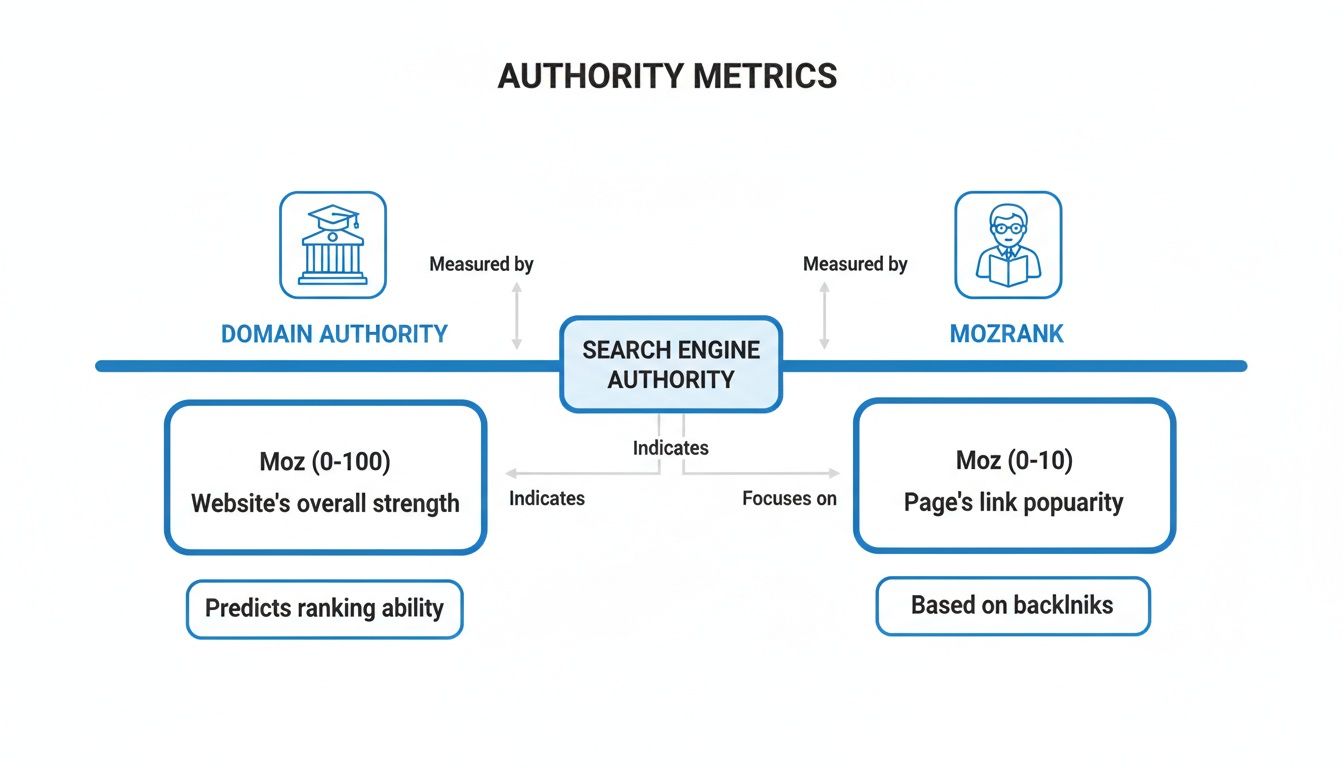 As the infographic shows, MozRank is all about the "professor" (the specific page), while DA looks at the reputation of the entire "university" (the whole domain).
The Original 'Vote of Confidence'
Back in 1998, when Larry Page and Sergey Brin unleashed PageRank, they turned the web on its head. Before them, search was a mess. They were the first to really codify the idea that an external link is a vote, a signal of trust. That single idea is the bedrock of modern SEO. If you're a domain investor, knowing this history matters. Aged domains with high-quality, long-standing backlink profiles are valuable precisely because they’ve been collecting these powerful "votes" for years.
Those votes come from what we now call referring domains. Having a firm handle on this concept is non-negotiable for anyone serious about SEO or domain investing. If you're a bit fuzzy on the details, our guide on what referring domains are will get you up to speed.
For anyone looking at an expired domain and dreaming of its potential, understanding this calculation is your reality check. It helps you see what you’re really buying.
How to Use MozRank to Find Domain Gold
Alright, theory is great, but let's talk about turning numbers into money. Knowing what a MozRank is becomes a real weapon when you use it to find domain gold. For domain investors, a high MozRank on an expired domain's homepage is a massive buy signal.
That single number tells a story—a history of valuable backlinks. Snagging a domain with that kind of inherited authority can give a new project an incredible head start. Or, you can juice another site's SEO with a simple 301 redirect. It’s about making a simple metric part of a profitable acquisition strategy.

Hunting for Available Domain Gems
The most exciting finds are the domains that have just dropped. They're ready for immediate registration—assets you can secure right now. The problem? You're sifting through tens of thousands of newly dropped domains every single day, looking for the handful that have any real link equity.
This is where a targeted approach saves you from going insane. Instead of manual digging, a tool like NameSnag lets you filter specifically for Available domains that actually meet your criteria. You can set time filters to see what dropped Today, in the last 3 Days, or even the last 30 Days. This lets you instantly see domains that just hit the market, complete with their key metrics like MozRank and Domain Authority. With some smart filtering, you can cut straight through the junk and zero in on domains that already have the link authority you're after.
Scouting Future Assets with Expiring Domains
Patience is a superpower in domain investing. Some of the best opportunities are domains that haven't even dropped yet—they're still in their grace period. These are Expiring domains, and keeping an eye on them is like getting a sneak peek at tomorrow's inventory.
By monitoring these domains, you can spot high-potential targets before they ever hit the open market. Here’s a simple playbook:
- Filter for Expiring Domains: On NameSnag, just switch your filter to see domains set to drop soon. You can look ahead 3, 7, or even 30 days.
- Sort by MozRank: Put the domains with the highest homepage MozRank right at the top. This is your first and best indicator of raw link power.
- Analyze the Backlink Profile: A high MozRank is a great start, but you always have to dig deeper. A quick look at the backlink profile confirms the quality of the links feeding that score. For more on this, check out our guide on how to check backlink quality so you don't get stuck with a dud.
- Set an Alert: Once you’ve picked a winner, set an alert. That way, you’re ready to grab it the second it becomes available.
This proactive approach allows you to build a watchlist of domains with built-in authority. Instead of scrambling when a domain drops, you’re making calculated decisions based on solid data, ready to pounce on proven assets. It’s the difference between gambling and investing.
Why a Single Metric Is Never Enough
Relying on just one number like MozRank to evaluate a domain is a classic rookie mistake. It’s like buying a used car based only on the mileage. Sure, low mileage is good, but what if the engine is shot or the frame is rusted through? You're missing the context that actually matters.
A high MozRank tells you a domain has some link authority. That's a great start. But it tells you nothing about the site’s traffic, whether its topic is relevant to your needs, or if the domain name itself is any good. It's just one data point.
Worse, single metrics are notoriously easy to game. A domain might have a puffed-up MozRank from a few spammy, high-authority links that carry zero real-world value. Buy a domain based on that number alone, and you’re just gambling. You could easily end up with a dud that looked good on paper but is practically worthless.
The Power of a Holistic View
To figure out what a domain is actually worth, you need to look at it from all angles. Think of it like a doctor running a full diagnostic. They don't just take your temperature and send you on your way. They check your blood pressure, listen to your heart, and ask about your history to get the complete picture. Evaluating a domain needs that same kind of check-up.
This means you have to look past a single score and pull together multiple data points to build a reliable profile. While MozRank gives you a piece of the puzzle, it's most useful when it’s one part of a much broader strategy, like implementing solid ecommerce SEO best practices to get real-world results.
A truly valuable domain isn't just one with a high MozRank. It’s one that balances authority with relevance, brandability, and a clean history. A single metric can't possibly tell you all of that.
From Single Scores to Composite Intelligence
This is exactly why modern domain analysis has shifted toward composite scores. Instead of trying to mentally juggle a dozen different numbers from a dozen different tools, a blended metric like NameSnag’s SnagScore does the heavy lifting for you. It gives you a far more trustworthy signal of a domain's real potential.
A composite score is designed to combine several critical data points into one simple, understandable number. It stops you from getting tunnel vision on one shiny stat.
Here’s a quick breakdown of why this approach is just plain better:
Single Metric vs Composite Score: A Quick Comparison
| Evaluation Factor | Single Metric (e.g., MozRank) | Composite Score (e.g., SnagScore) |
|---|---|---|
| Perspective | A narrow view of one specific attribute, like link authority. | A holistic overview combining multiple key health indicators. |
| Reliability | Susceptible to manipulation and can be misleading on its own. | More stable and trustworthy by balancing various data points. |
| Actionability | Provides one piece of data, requiring you to find and interpret others. | Gives a comprehensive thumbs-up or thumbs-down, saving you time. |
By blending metrics like MozRank, Trust Flow, referring domains, domain age, and brandability, a composite score acts as a safety net. It protects you from making a bad investment based on incomplete information. It helps you quickly spot the domains that aren't just strong in one area, but are healthy, well-rounded assets ready to perform.
How to Check and Interpret a MozRank Score
Alright, let's get down to brass tacks. Knowing the theory behind MozRank is one thing, but the real value comes when you can check it yourself and, more importantly, understand what that number is actually telling you. The score itself is just a number; the story behind it is what matters.
You can pull a page's MozRank easily enough. Just grab a tool like Moz’s own Link Explorer, plug in the URL, and it will spit out the score. But just seeing that number is pretty useless on its own. Interpretation is where the money is.
Think of it this way: a MozRank of 4 might be fantastic for a personal blog you just launched last month. But that same score on a key product page for a major e-commerce brand that's been around for a decade? That's a five-alarm fire. You have to measure the score against its direct competitors to get any real sense of where it stands.
Looking Beyond the Snapshot
The real magic happens when you stop looking at MozRank as a static number and start looking at its history. A single score is just a snapshot in time. The trend line tells the real story. Is the page’s authority climbing, holding steady, or in a death spiral? This is where modern SEO tools have become indispensable.
For example, Moz Pro’s rankings tracker used to cap historical data at 12 weeks. They've since uncapped it, giving you unlimited access to a page's history. This was a huge shift, allowing for much deeper analysis of performance over time. You can read about how Moz advanced its historical data capabilities to see the full picture.
This kind of historical deep-dive is absolutely non-negotiable when you’re vetting an expiring domain. It's how you tell if a domain's authority is real and stable, or if it was just propped up by a blast of spammy links that have since been disavowed, sending its score off a cliff.
For domain hunters using NameSnag to find valuable expiring domains, doing this diligence is what separates a smart buy from a total dud. It's how you ensure you're getting a domain with a genuinely healthy, consistent link profile, not just a score that looked good on paper for a fleeting moment.
FAQ: Your MozRank Questions Answered
Alright, let's clear up some of the common questions that always pop up about MozRank. Getting these straight will save you a lot of grief when you're out in the wild, hunting for domains.
Is MozRank Still Relevant?
Yes, but you have to know what you're looking at. Think of it less as a definitive judgment and more as a single, highly-specialized signal. It’s one of the purest, old-school metrics for raw link authority at the page level.
The big mistake is treating it like the whole story. It isn't. MozRank is one tool in the toolbox, perfect for a quick gut check on a page's link power. For a full diagnosis, you absolutely have to pair it with other metrics.
What Is a Good MozRank Score?
This is where context is king. A "good" score is meaningless in a vacuum; it only matters when you're stacking it up against the direct competition.
As a very rough guide:
- A MozRank of 3-4 is pretty solid for a page on a newer site or a personal blog that's just getting its legs.
- For an important page on an established business site, you'd want to see something in the 5-6 range, if not higher.
- Scores of 7 and up? That's territory reserved for the heavy hitters—truly authoritative pages on major websites.
But again, the only way to know for sure is to benchmark. A score is only "good" when you see how it compares to the other players in that specific niche.
Can I Improve My MozRank Quickly?
Not in any way that matters, and that's a feature, not a bug. MozRank was designed from the ground up to reflect genuine, earned authority over time.
Trying to game it with a blast of spammy, low-quality links is a fool's errand. It won't move the needle, and you’re far more likely to get your site penalized than to see any benefit. The only path forward is the slow and steady one: earning high-quality backlinks from other respected sites. There just aren't any shortcuts to building real trust.
Ready to put this knowledge to the test? With NameSnag, you can instantly filter thousands of domains by metrics like MozRank to find hidden gems. Start by exploring high-authority Available domains you can register today, or get ahead of the competition by scouting valuable Expiring domains before they drop.
Find Your Perfect Domain
Get access to thousands of high-value expired domains with our AI-powered search.
Start Free Trial