
So, you're sitting on a list of domains. Maybe a few dozen, maybe a few hundred. You think there might be some gold in there, but you have no earthly idea what any of them are actually worth. This is where you bump into the GoDaddy Bulk Appraisal tool. It’s a machine built for one thing: getting a quick-and-dirty valuation on a list of up to 100 domains at a time.
It spits out an 'Estimated Value' using GoDaddy's own GoValue algorithm, which has been fed millions of historical domain sales. Think of it as a fast market snapshot, not gospel truth. It's a fun first step, but it's just that—a first step.
What Is This Thing, Really?

If you're trying to make a living buying and selling domains, you know the grind. Sifting through endless lists of names feels like looking for a needle in a digital haystack. GoDaddy's bulk tool is supposed to be your magnet, helping you quickly sort a giant list by what it thinks might be valuable.
The reason it's become a fixture in so many investors' toolkits comes down to one word: speed. Appraising names one by one is a soul-crushing waste of time. Uploading a CSV and getting a list of numbers back in a few minutes? Now that's a workflow we can get behind!
To get a better sense of the tool at a high level, here's a quick breakdown of what you're getting into.
GoDaddy Bulk Appraisal At a Glance
| Feature | What It Means for You |
|---|---|
| Bulk Upload | Upload a CSV file with up to 100 domains at once. A huge timesaver for initial sorting. |
| GoValue Algorithm | An automated system that uses historical sales data to generate an "estimated value." |
| Comparable Sales Data | Shows examples of similar domains that have sold, which is the basis for its valuation. |
| Free to Use | There's no cost to use the tool, making it an accessible first step for anyone. |
| Minimum Value Floor | Often sets a surprisingly high minimum value (around $1,399) on almost any domain. |
| Maximum Value Cap | Historically capped public appraisals at $25,000, potentially undervaluing premium names. |
Ultimately, the tool is a starting point. It gives you a fast, data-driven opinion, but it’s just that—an opinion from an algorithm that has some well-known blind spots.
How the GoValue Algorithm Thinks
The brains behind the operation is GoDaddy’s proprietary GoValue algorithm. It’s not magic; it’s just chewing on data from millions of past domain sales. It’s looking at a few core things: the keywords in the name (is it something hot like "crypto" or "AI"?), the length (shorter is almost always better), and the TLD (a .com will trounce a .biz or .info nearly every time).
Most importantly, it tries to find comparable sales—what have similar domains sold for in the past? And remember, it's appraising the domain name itself, the raw asset, not a full URL with a website attached.
Key Takeaway: The GoDaddy Bulk Appraisal tool is for triage, not for final decisions. It's a quick, algorithmic filter. It knows nothing about a domain's SEO history, its brand potential, or what's trending in the market this week.
The Good, The Bad, and The Just Plain Weird
No algorithm is perfect, and GoValue has some legendary quirks. Ever since it became a go-to for investors around 2020, people have learned its oddities. For example, the tool has a habit of putting a floor of around $1,399 on almost any domain you feed it. This can make a pile of junk look like a treasure chest, which is both hilarious and dangerous.
On the flip side, it used to cap its public appraisals at $25,000. If you had a truly premium, six-figure domain, GoDaddy's tool would tell you it was worth a fraction of its real value. These are the kinds of algorithmic blind spots you have to account for.
This is exactly why you don't use it in a vacuum. A smart workflow involves layering tools. You might run a list of 100 expiring domains through GoDaddy's bulk appraiser for a first pass. Then, you take the top 10 or 20 promising names and plug them into a tool like NameSnag to dig into their actual SEO value—backlinks, authority, and traffic history.
GoDaddy might say a domain is worth a generic $1,500, but NameSnag could uncover that it has a powerful backlink profile that makes it a five-figure asset to an SEO agency. For domain flippers, it’s like understanding the difference between a car's sticker price and what it’s actually worth after a mechanic looks under the hood. It's the same logic you'd apply when trying to find gems in a GoDaddy closeout auction. The appraisal is just one piece of a much bigger puzzle.
How To Prepare And Upload Your Domain List
So, you’re ready to get some numbers. Before you sprint to the uploader, let’s talk about the single most common hurdle everyone trips over the first time: the list itself. Prepping your domain list correctly is the difference between a smooth appraisal and a cascade of frustrating error messages.
The good news? It’s almost laughably simple. GoDaddy’s bulk tool wants a CSV file. That’s just a "Comma-Separated Values" file. Don't let the name spook you. You can make one in Excel, Google Sheets, or even a basic text editor.
The only rule that matters is this: one domain per line. That’s it. No headers, no extra columns, no funny business. Just a clean, single-column list.
Building Your Perfect CSV List
Let's say you're curious about a few domains. Your file, saved as something like AppraisalBatch1.csv, needs to look exactly like this:
SuperCoolGadget.com
BestPizzaInMiami.net
MyFirstBlogEver.org
QuantumLeapAI.co
Notice there’s no http:// or www. in front. You're appraising the raw domain name, so keep it clean. This simple format is your ticket to avoiding hiccups with the uploader.
But here’s the thing most beginners miss: the quality of the appraisal you get out is directly proportional to the quality of the domains you put in. Running a list of random, low-value names will just get you a spreadsheet full of inflated, meaningless numbers. The real strategy is sourcing a high-potential list from the start.
This is where a smart discovery process is worth its weight in gold. Instead of just guessing, start with domains that already show some promise. A killer tactic is to find domains that just dropped and are now available to anyone.
A fantastic place to start is by finding Available domains on NameSnag that were just released. By filtering for names that dropped 'Today' or in the 'Last 3 Days,' you're getting the absolute freshest inventory before everyone else piles on. Exporting that list gives you a perfectly formatted, high-potential CSV ready for its GoDaddy bulk appraisal.
Uploading Your List And Handling Batches
Once you've got your CSV saved, the upload on GoDaddy is straightforward. You'll find a section to "Upload a file," where you can just drop your CSV in. The tool will chew on it for a few minutes and then spit out your report.
You'll quickly slam into the tool's main limitation, though: the 100-domain cap. If you have a list of 500 domains, you can't just upload the whole thing at once. You have to chop it up into five separate files, each with 100 domains. It's a bit of manual labor, but it's the only way to work with larger portfolios.
This is a key part of building an efficient workflow. Say you're digging through soon-to-expire domains and find a few thousand interesting names. You could grab a list of powerful Expiring domains from NameSnag, then split them into manageable batches for appraisal. Staying organized with your files (e.g., ExpiringBatch1.csv, ExpiringBatch2.csv) will save you a massive headache later. This methodical approach is a cornerstone of effective due diligence automation for any serious domain investor.
By starting with a well-sourced, cleanly formatted list, you're not just avoiding errors—you're making the entire GoDaddy bulk appraisal process smarter and more valuable from the very first click.
Alright, the CSV has been processed, the report is generated, and now you’re staring at a spreadsheet full of numbers. Congratulations, you just finished the easy part. The real work starts now: figuring out what these numbers actually mean and how to turn them into smart decisions.
Your eyes will probably jump straight to the "Estimated Value" column. This is the moment you need to put on your skeptic's hat. For all its speed, the GoDaddy bulk appraisal tool has some infamous quirks that can send you down the wrong path if you’re not paying attention.
The Infamous $1,399 Floor
One of the most well-known oddities is what investors call the $1,399 floor. You'll notice it pretty quickly. Even the most nonsensical, junk-drawer domains often get a valuation right around this mark.
You could feed it a truly terrible name like best-red-shoes-store-online123.info, and the tool might confidently tell you it’s worth almost $1,400. This is the algorithm's bias in action. It’s an automated system that gives a false sense of security, making a pile of digital junk look like a small treasure chest by overvaluing the absolute bottom of the barrel.
Investor's Tip: When you see a valuation hovering around the $1,400 mark on a questionable domain, an alarm bell should go off in your head. Just treat this number as the tool’s default "I don't know, but here's a number" response. It’s almost always a sign of a worthless asset.
The Historical $25,000 Cap
On the other end of the spectrum is the tool's historical high-end blindness. For years, the public-facing tool simply would not appraise a domain for more than $25,000, no matter its real market potential. While GoDaddy has since updated its systems, this long-standing bias reveals a critical blind spot for premium names.
If you happen to have a category-defining, single-word .com in your list, the tool might slap a five-figure valuation on it when its true worth is in the six or even seven-figure range. The system just isn't built to recognize elite-tier assets. It relies on publicly available sales data, which often excludes the massive private deals where the real money changes hands. This is precisely why a deeper understanding of how to value domain names is so important; the tool's number is just one data point.
GoDaddy's appraisal tool has definitely evolved, especially with paid API access now available. But its core logic still has baggage. A DomainGang analysis once showed how that old $25,000 cap could devalue a six-figure asset by 80-95%. Their example, Islanders.com, was pegged at $20.5k when a real-world comparable sale was $375k. The tool is better now, but this history is a cautionary tale about blindly trusting an algorithm with high-value assets. You can check out GoDaddy's own resources on domain appraisal to see how they explain it.
GoDaddy Value vs Reality A Quick Guide
To help you mentally adjust the numbers you're seeing, think of the GoDaddy appraisal as a starting point, not the final word. Here’s a quick guide to help you translate its algorithmic opinion into a more realistic assessment.
| Domain Type | GoDaddy's Likely Appraisal | What to Consider for a Realistic Value |
|---|---|---|
| Random, Long-Tail .net/.info | ~$1,399 | Probably worthless. This is the "floor value" kicking in. |
| Decent Two-Word .com | $1,500 - $5,000 | This is the tool's sweet spot. The value is likely in the right ballpark, but still needs manual review. |
| Short, Brandable, 1-Word .com | $25,000+ | Dangerously undervalued. The tool can't grasp true premium potential. Requires expert appraisal. |
| Domain with SEO History | Any Value | GoDaddy has no idea. It doesn't check backlinks or Domain Authority, so an SEO gem could be valued at $1,399. |
The key takeaway here is to treat the GoDaddy bulk appraisal not as a price tag, but as a conversation starter. It’s a machine, trained on past data, telling you what it thinks your list is worth. Your job is to bring the human intelligence—the understanding of brandability, market trends, and SEO potential that no algorithm can fully replicate.
Building A Smarter Domain Appraisal Workflow
Relying on just one tool for domain valuation is a rookie mistake. The pros—the ones who consistently find undervalued gems and flip them for a profit—use a layered, multi-tool process to validate every single find. Let’s walk through a powerful workflow that combines the raw speed of GoDaddy’s tool with the deep, analytical insights of a platform like NameSnag.
Think of it as having two different experts look at your potential investment. GoDaddy is the market historian, telling you what similar domains have sold for in the past. NameSnag is the private investigator, digging into the domain's background to see if it has a clean record and hidden strengths. Using them together is how you make truly informed decisions.
Start with Quality, Not Quantity
The process doesn't begin at GoDaddy. It starts with finding a list of promising domains before you even think about appraisal. Running a list of random names through the GoDaddy bulk appraisal tool will just get you a spreadsheet full of meaningless numbers. You need to start with pre-vetted candidates.
A killer strategy is to hunt for domains that are about to drop but haven't hit the public auctions yet. This is where you can find some incredible opportunities.
- Find promising leads: Head over to NameSnag and start searching for Expiring domains. These are names that have passed their renewal date but are still in a grace period.
- Filter for power: Use advanced filters to find domains with high Trust Flow, valuable backlinks (like from .edu or .gov sites), or a strong, all-in-one SnagScore. This immediately weeds out 99% of the junk.
- Export your targets: Once you have a curated list, export it. You now have a clean CSV file full of high-potential names, not a random grab bag.
This initial step is the most important part of the entire workflow. You’re ensuring that every domain you appraise has already passed a basic quality check.
Layering GoDaddy's Market Data
Now that you have your high-potential list from NameSnag, it's time to bring in GoDaddy for that quick market snapshot. Upload your curated CSV to the GoDaddy Bulk Appraisal tool. In a few minutes, you’ll have GoDaddy’s "Estimated Value" for each name.
You'll now have two completely different but equally crucial data points for every single domain:
- NameSnag's Data: SEO metrics, brandability signals, and backlink profile quality.
- GoDaddy's Data: A market-based valuation based on historical sales of similar names.
This is where the magic happens. By comparing these two datasets, you can spot opportunities that other investors, who only use one tool, will completely miss.
By running a quality-filtered list from NameSnag through the GoDaddy bulk appraisal, you're not just getting a valuation—you're cross-referencing SEO potential with market data. This hybrid approach is your best defense against overpaying for junk and your secret weapon for finding undervalued assets.
Interpreting the Hybrid Results
Now, let's analyze what you might see. If a domain has a high appraisal from GoDaddy and a great SnagScore, that’s a fantastic sign. It has both market appeal and SEO strength. But the real gold is found in the discrepancies.
Consider this scenario: you find a domain, TechFlow.io, that NameSnag shows has a clean history and a handful of powerful backlinks from tech blogs. However, you run it through the GoDaddy bulk appraisal, and it comes back with a low valuation, maybe around the infamous $1,399 floor.
This infographic shows the appraisal bias you'll often encounter, where junk domains get an inflated floor value and premium domains hit an artificial ceiling.
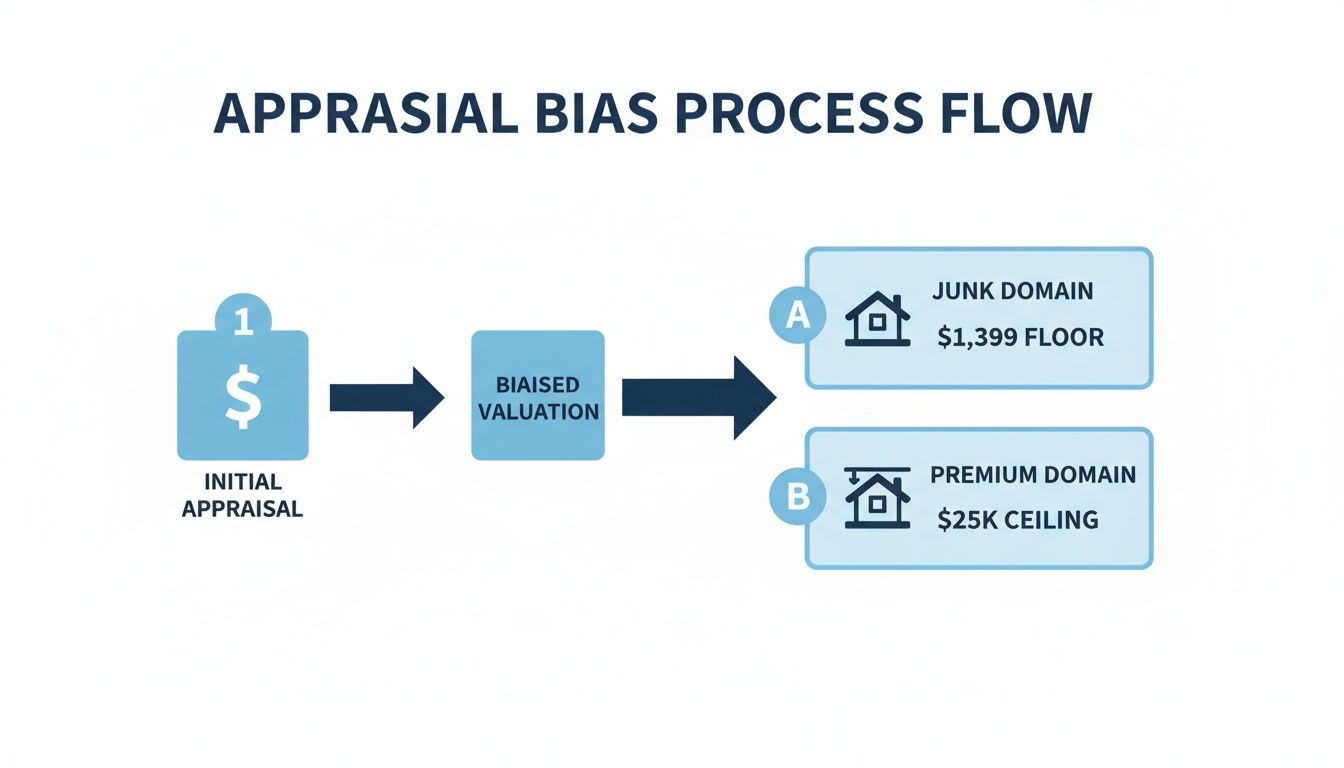
The visualization highlights how GoDaddy’s algorithm can pull both low-quality and high-quality domains toward a biased middle ground, creating opportunities at both ends. An investor who only used GoDaddy would dismiss it as worthless. But because you have the NameSnag data, you know it's an SEO powerhouse in disguise. This is a classic undervalued gem that you can acquire for a low price and either build on or flip to an SEO-savvy buyer for a significant profit.
For any domain investor, understanding the nuances of how to effectively manage your portfolio is key, and this includes knowing how to choose a domain registrar to safely house these valuable assets once you find them. This smarter workflow gives you the confidence to act on data, not just gut feelings.
Common Mistakes And Pro Tips For Bulk Appraisals
So you've run your first big list through GoDaddy's bulk appraiser. You've got a spreadsheet full of numbers. Now what?
Getting the numbers is the easy part. The hard part—the part that separates a hobbyist from a serious investor—is learning to see those numbers for what they are: a single, flawed data point. This is where you stop taking the machine's word for it and start thinking for yourself.
The biggest trap is something called appraisal anchoring. It’s where you see that first “Estimated Value” and treat it as gospel. You lock your expectations to that number, refusing to budge even when all other signs point to it being wildly off. Remember, an algorithm gave you that number, but it's a number with zero context about the real world.
Avoid These Common Pitfalls
Ignoring a domain's past is another classic mistake. The GoDaddy tool has no memory. It doesn't check if the name was used for a spammy affiliate site or got penalized by Google. A pretty domain with a toxic history isn't an asset; it's a liability.
- Ignoring Domain History: You absolutely have to do a manual check. A quick look at Archive.org's Wayback Machine can instantly tell you if a domain once hosted something questionable.
- Overvaluing Non-.com TLDs: The tool's algorithm is built on a mountain of .com sales data. That’s its comfort zone. Be extremely skeptical of high appraisals for other TLDs unless you’re deep in a hot niche like .ai or .io and know the market cold.
- Forgetting Brandability: GoDaddy’s algorithm has no taste. It can't tell the difference between a clunky, keyword-heavy name and one that's short, catchy, and memorable. You have to be the judge of whether a name can actually become a brand.
A savvy investor uses the GoDaddy bulk appraisal as leverage, not as a price tag. If a seller's asking price is astronomical and GoDaddy’s value is low, you can use that data point to bring them back down to earth during negotiations.
Pro Tips for a Smarter Appraisal Process
Once you understand the tool’s weaknesses, you can start using it to your advantage. It’s all about building your own process—a “second opinion” checklist—to validate what the algorithm spits out. This is how you move from guessing to investing.
Your first move should be to source better lists from the get-go. Don't waste your time appraising random junk. For example, you can find a list of freshly dropped Available domains on a platform like NameSnag and filter them by metrics GoDaddy completely ignores, like their backlink profile. This pre-screens your list for quality before you even ask for a valuation.
Building Your "Second Opinion" Checklist
After GoDaddy gives you a number, the real work begins. Don't skip this part. This is where you find the story behind the domain—the stuff an algorithm can't see.
Check Trademark Databases: Always run your top names through the USPTO's TESS database or your country's equivalent. A domain that steps on a registered trademark is worse than worthless; it's a legal time bomb.
Use Backlink Tools: GoDaddy won't tell you if a domain has powerful .edu or .gov backlinks. A tool like NameSnag can surface this hidden SEO value, which could make a domain worth far more than GoDaddy’s estimate.
Analyze Historical Traffic: Look for signs of past life. A domain that once had organic traffic in a valuable niche has already proven its potential. That’s a powerful signal.
This multi-step approach turns the GoDaddy bulk appraisal from a simple number-generator into just one piece of a much smarter investment strategy. You’re no longer just taking the algorithm's word for it. You’re building a complete profile of the asset—its market value, SEO potential, brandability, and legal standing. That’s how you find the real gems.
Some Questions You Probably Have About GoDaddy's Bulk Appraiser
Got questions about the GoDaddy bulk appraisal tool? Of course you do. When you first start feeding it lists of domains, a few things are bound to feel a bit... off.
Let's walk through the common questions that pop up for domainers and SEOs alike. These are the things everyone wonders but sometimes feels weird asking.
So, How Accurate Is This Thing, Really?
Think of it as a helpful, but deeply flawed, first guess. The algorithm has a definite sweet spot: generic, keyword-heavy .com domains that might fetch a price in the low four-figures. For those, it's not terrible.
But its reliability absolutely plummets at the extremes.
- On the low end: It’s infamous for slapping a floor value of around $1,399 on almost any domain. This means it will tell you a completely worthless name has value, which is just not true.
- On the high end: It has a long history of failing to recognize true premium domains. It might cap a name at a fraction of its real six or even seven-figure potential.
The tool also has a gigantic blind spot: it knows nothing about SEO. It doesn’t look at a domain's backlink profile or authority, so it will miss absolute gems that are valuable for other reasons. Use it for a quick first pass, but never, ever trust its number as the final word.
Can I Appraise More Than 100 Domains At A Time?
Not with the free tool you see on their website. That public-facing uploader has a hard limit of 100 domains per CSV. If your list is bigger, you’re stuck splitting it into smaller files by hand.
For the serious investors who need to churn through thousands of names, GoDaddy does offer paid API access. These plans can get expensive, but they let you automate thousands of appraisal requests a day. This is the power-user approach for evaluating entire portfolios or massive expiring lists without the tedious manual uploads.
If GoDaddy Gives Me A Value, Why Bother With Another Tool?
Because a domain's actual worth is about so much more than just what similar names have sold for in the past. GoDaddy is completely blind to some of the most critical value drivers, especially for anyone doing SEO or building niche sites.
A domain might get a throwaway $1,399 valuation from GoDaddy but have a powerful, clean backlink profile that makes it worth thousands to the right buyer. A tool like NameSnag was built specifically to find this hidden value. It digs into backlinks, checks for spammy history, and gives you a comprehensive SnagScore for a much more complete picture.
Key Insight: The smart move is to use both tools. GoDaddy gives you a general market vibe based on historical sales. NameSnag shows you the SEO and brandability angle that GoDaddy misses entirely. If you ignore the SEO side, you are almost guaranteed to leave the best deals on the table for someone else.
What's The Best Way To Source Domains For Appraisal?
Garbage in, garbage out. The quality of your results is directly tied to the quality of your list. Appraising a random jumble of nonsensical names is just a waste of your time.
A much better workflow is to build a pre-vetted list using a discovery platform first. For example, you can use NameSnag to find domains with high potential before they even hit the auction chaos.
Here's a great tactic: find domains that are newly available and ready to be registered right now. Head over to NameSnag and search for Available domains that meet your specific criteria, like having a minimum number of quality backlinks or containing certain keywords. By filtering for these signals first, you create a curated list of high-potential names that are actually worth the effort of appraising.
Ready to stop guessing and start finding high-value domains with real potential? NameSnag gives you the SEO insights and brandability metrics that appraisal tools miss. Filter through 170,000+ daily domains to find gems with powerful backlinks and clean histories, saving you hours of manual research. Start your journey with NameSnag today and discover the assets your competitors are overlooking.
Find Your Perfect Domain
Get access to thousands of high-value expired domains with our AI-powered search.
Start Free Trial