“Never use numbers in a domain.” That advice gets repeated so often that people treat it like a law of physics.
It isn't.
The true issue with numbers in domain names has never been the digits themselves. It's whether the number adds meaning, hurts clarity, or makes the domain look like it was generated by a bot at scale. Those are very different questions, and lumping them together is how people miss both strong brands and good buys.
I've seen numeric domains work brilliantly when the number carries obvious context. I've also seen domains die on contact because the digits feel random, disposable, or shady. That gap matters more than the old blanket rule ever did.
Why Everyone Is Wrong About Numbers in Domains
The standard warning sounds like this: “Numbers make domains look spammy, so avoid them.”
That's incomplete advice. Sometimes it's right. Often it's lazy.
A late-2024 zone-file analysis found 1,008,834 unique registered .com domains made up only of digits, which means numeric domains are already a huge, established submarket inside .com, not some fringe oddity on the edge of the web. The underlying analysis is discussed in Stobbs' review of the numeric domain universe.
If over a million numeric-only .com names exist, the useful question isn't “Are numbers allowed?” Of course they are. The useful question is whether a specific numeric pattern makes a domain easier to remember, easier to brand, and easier to trust.
Numbers aren't the problem. Meaning is.
A number can do real work in a domain:
- It can compress a phrase like 24/7, 365, or B2B.
- It can make a brand stick when the number already belongs to the identity.
- It can solve availability problems when the plain word version is long gone.
A number can also make a mess:
- It can create confusion if people don't know whether to type the numeral or the word.
- It can weaken trust when the string feels random.
- It can scream automation when the pattern looks like churned-out junk.
Practical rule: Don't judge a domain for “having numbers.” Judge it for what the numbers communicate.
That's where most mainstream advice falls apart. It treats all digits as equal. They aren't. A domain with a clean, meaningful number behaves very differently from a domain that looks like somebody smashed a keyboard or ran a bulk generator.
How Search Engines and People Read Numeric Domains
Search engines don't sit there judging your domain the way a human does. They parse text, entities, links, and user behavior. Think of Google like a robot trying to understand a crowded party. It doesn't care that one guest is wearing a blue jacket. It cares who people walk toward, who they trust, and who they ignore.
That's why the old “Google hates numbers in domains” claim doesn't hold up. Network Solutions notes that numbers in a domain don't directly hurt or help Google rankings. The effect is indirect, through brand reinforcement, user perception, and click behavior.
What people notice first
Humans read a numeric domain much faster than they analyze it. They react to pattern.
A few examples make this obvious:
| Pattern type | How users tend to read it | Likely result |
|---|---|---|
| Clear semantic number like B2B or 24 | “I get it immediately” | Stronger recall |
| Brand-native number like 365 | “That feels intentional” | Better trust |
| Random trailing digits | “Why is that there?” | Lower confidence |
| Long mixed string with multiple numbers | “That looks machine-made” | Spam signal |
The test I use is simple: could someone hear the domain once and type it correctly later? If the answer is no, you've got a branding problem, not an SEO problem.
The radio test still matters
Domains with numbers pass when the digit is obvious and familiar. “24” often works. “365” often works. “B2B” works because people already use it in speech and writing. Area codes can work in local businesses because they carry geography.
Domains fail when the number creates a translation problem. Is it “4” or “four”? Is it “2” or “to” or “too”? If the answer depends on context you don't control, expect leakage.
If users hesitate, rankings won't save you. The domain already made the interaction harder.
Where people overcomplicate it
You don't need SEO voodoo here. You need common sense.
Use this quick screen:
- Can someone say it out loud without explanation?
- Does the number mean something real in the brand or offer?
- Would it still look credible on a business card, ad, or search result?
If those answers are solid, the presence of numbers alone isn't your enemy.
The Good The Bad and The Spammy
Most numeric domains fall into one of three buckets. This is the framework I use before I buy, build, or skip.
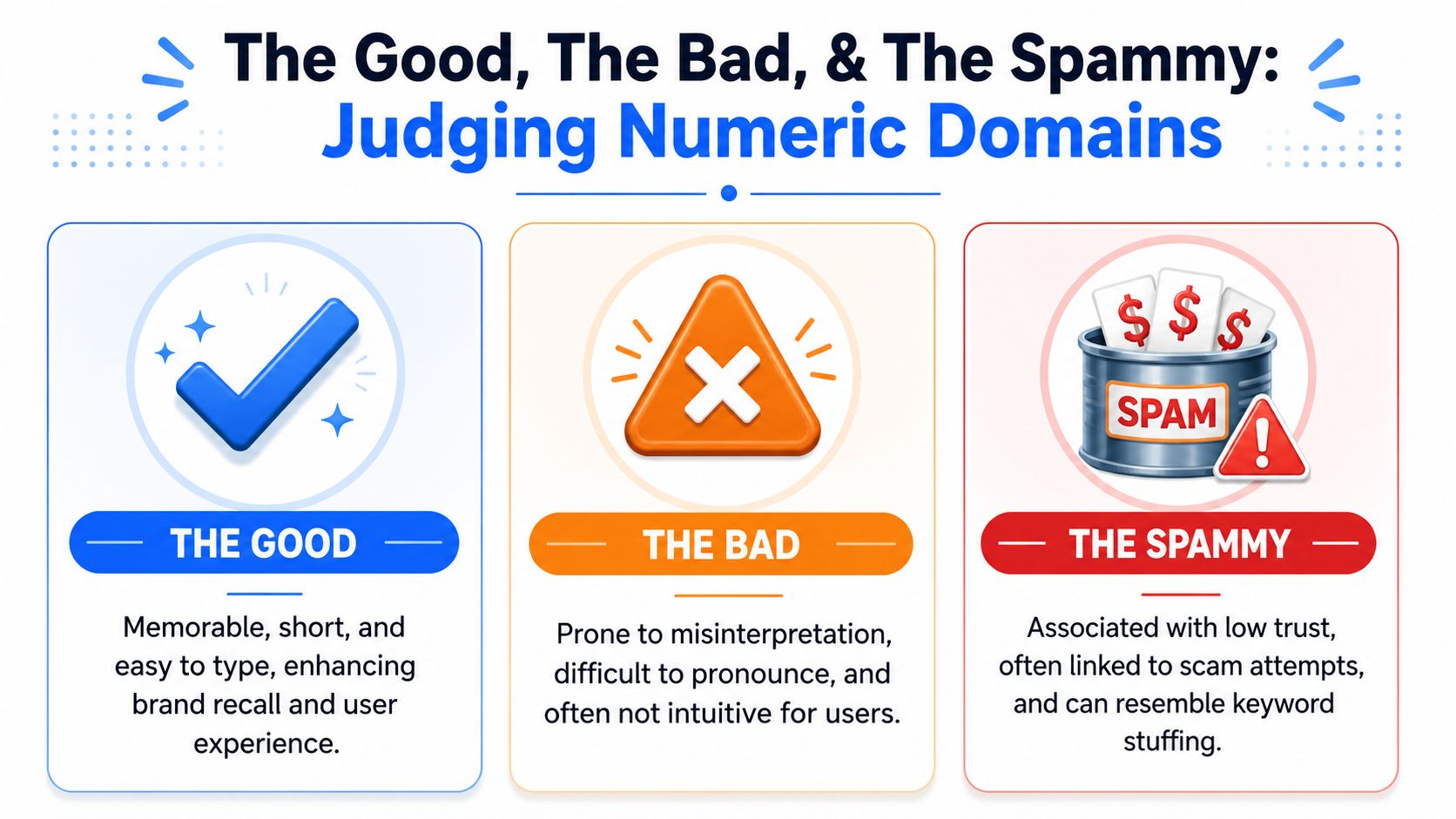
The good
Good numeric domains feel intentional.
They usually do one of four jobs well. They shorten a phrase, reinforce an existing brand, signal a category, or create a memorable pattern. Think of names where the number is part of how people already talk about the thing.
Good examples often have these traits:
- Built-in meaning such as 24 for around-the-clock service, 365 for always-on availability, or 101 for introductory education.
- Pattern clarity where the user instantly understands why the number exists.
- Short construction that keeps typing and recall easy.
- Brand fit so the number feels native instead of stapled on.
The bad
Bad numeric domains aren't scams. They're just awkward.
They usually create friction because the number is unclear, forgettable, or aesthetically off. The domain might still function, but it won't pull its weight as a brand asset.
Here's where they tend to go wrong:
- Pronunciation ambiguity. People hear the name but don't know how to type it.
- Visual clutter. The digit interrupts a clean word without adding meaning.
- Forced availability hack. The number exists only because the owner couldn't get the better version.
A domain like that can still rank if the site is strong, but it starts every branding interaction a step behind.
The spammy
This is the bucket that gave numbers a bad reputation.
Spammy numeric domains don't just “contain digits.” They carry patterns that look automated, manipulative, or disposable. Infoblox's analysis is useful here because it pushes the conversation beyond “digits yes or no” and toward reusable numeric templates and generator fingerprints. If you want another filter for this, a domain spam score checker can help separate suspicious structures from cleaner inventory.
A number isn't a red flag by itself. A repeatable junk pattern is.
Watch for signals like:
- Random numeric suffixes attached to weak keywords
- Multiple numbers in odd positions
- Strings that look generated instead of chosen
- Cheap urgency language combined with digits, especially when the whole domain reads like an ad headline**
That last category kills trust fast. Even before anyone visits the site, the domain tells a story. If that story sounds like mass-produced garbage, users act accordingly.
Numeric Domains in the Wild Case Studies
The easiest way to understand numeric domains is to look at brands that made the number feel inevitable.

When the number is the hook
1-800-Flowers works because the number was already the sales mechanism. The numeric element wasn't decoration. It was the memorable entry point. That kind of number has utility baked in.
C4 Energy works for a different reason. The number is part of the product identity. It feels branded, punchy, and deliberate. You may or may not love the style, but nobody reads it as accidental.
37signals is another classic lesson. The number gave the company a distinct identity instead of trapping it inside a generic descriptive phrase. That's a good reminder that numbers can create separation, not just availability.
Why these examples hold up
These names succeed because the number does real semantic work.
Here's the common thread:
| Brand style | Why the number works |
|---|---|
| Phone-based or service-based | It carries functional recall |
| Product-led branding | It sharpens identity |
| Distinctive company naming | It creates contrast and memorability |
None of those examples feel like “word plus random digits because the good domain was taken.” That's the dividing line.
Good numeric branding feels chosen. Bad numeric branding feels leftover.
A failing pattern worth spotting early
Now compare those to a domain that looks like a promotion, a churn site, or an affiliate throwaway. You know the type. Hyphens, stuffed keywords, odd digits, urgency language, maybe a cheap “247” tacked on the end whether it belongs there or not.
That kind of domain fails before the homepage loads because the naming telegraphs low effort. Even if the content is decent, the first impression is uphill.
That's why examples matter. Numbers in domain names aren't one tactic. They're a category with very different outcomes depending on whether the string reads like a brand, a utility, or a bot artifact.
The Money Angle Valuing and Flipping Numeric Domains
Numeric domains have a money angle because buyers don't evaluate them the same way they evaluate ordinary keyword names.
Some are branding assets. Some are pattern assets. Some are pure scarcity plays. Once you see that, the market makes more sense.
A large-scale study of nearly 1,000 new gTLDs found 20,933,637 unique domains, with 3,259,684 purely numeric names, meaning 15.57% of active new gTLD domains were numbers-only. That concentration was linked largely to demand in China, where digits work as a universal, language-agnostic naming format, as reported by Domain Incite's summary of the zone-file study.
What drives value
When I'm sizing up a numeric domain, I look at it more like real estate than like content SEO.
The biggest value drivers are usually:
- Extension quality. .com gets the broadest buyer recognition and usually the cleanest resale story.
- Length. Shorter is almost always easier to remember, easier to market, and easier to sell.
- Pattern quality. Repeats, symmetry, sequence, and meaningful combinations carry more appeal than random strings.
- Use-case flexibility. A domain that could fit multiple buyers has more optionality than one tied to a narrow phrase.
A short numeric .com is a different class of asset from a long random numeric name in a weaker extension. They shouldn't be priced with the same logic.
Liquidity isn't the same as quality
This trips up newer investors all the time.
A domain can sit inside an active numeric market and still be junk. Registration volume alone doesn't make your specific name good. It just tells you there is a real buyer pool for the category.
That's why pattern quality matters so much. If you want a stronger framework for assessing resale potential, this guide on how to value domain names is a useful companion.
A quick investor lens
I'd sort numeric opportunities like this:
| Type | Investor read |
|---|---|
| Short, clean, recognizable pattern | Strong candidate |
| Semantically meaningful mixed brand | Depends on branding quality |
| Long random numeric string | Usually pass |
| Spam-adjacent structure | Hard pass |
A lot of flips are won before the purchase. If the string needs a long explanation, it's already less liquid than it looks.
How to Snag a Winning Numeric Domain
Buying good numeric domains requires a detective mindset. Don't shop for “domains with numbers.” Hunt for patterns with meaning and discard the rest fast.
That distinction matters because, as Infoblox argues, the true edge comes from spotting the difference between meaningful numeric structures and the statistical fingerprints of machine-generated spam. Their analysis is covered in this numerology-focused domain study.
Start with pattern filters, not excitement
A lot of people get distracted by novelty. They see digits and assume rarity. That's backwards.
Start by filtering for pattern quality:
Meaningful numbers first
Look for strings tied to recognized concepts like 24, 365, 101, 360, B2B, or area-code relevance.Then check structure
Repeats, clean sequences, mirrored forms, and short combinations are easier to evaluate than random mixed strings.Finally check brand fit
Ask who would buy it, build on it, or remember it. If you can't answer quickly, keep moving.
Use live inventory instead of guessing
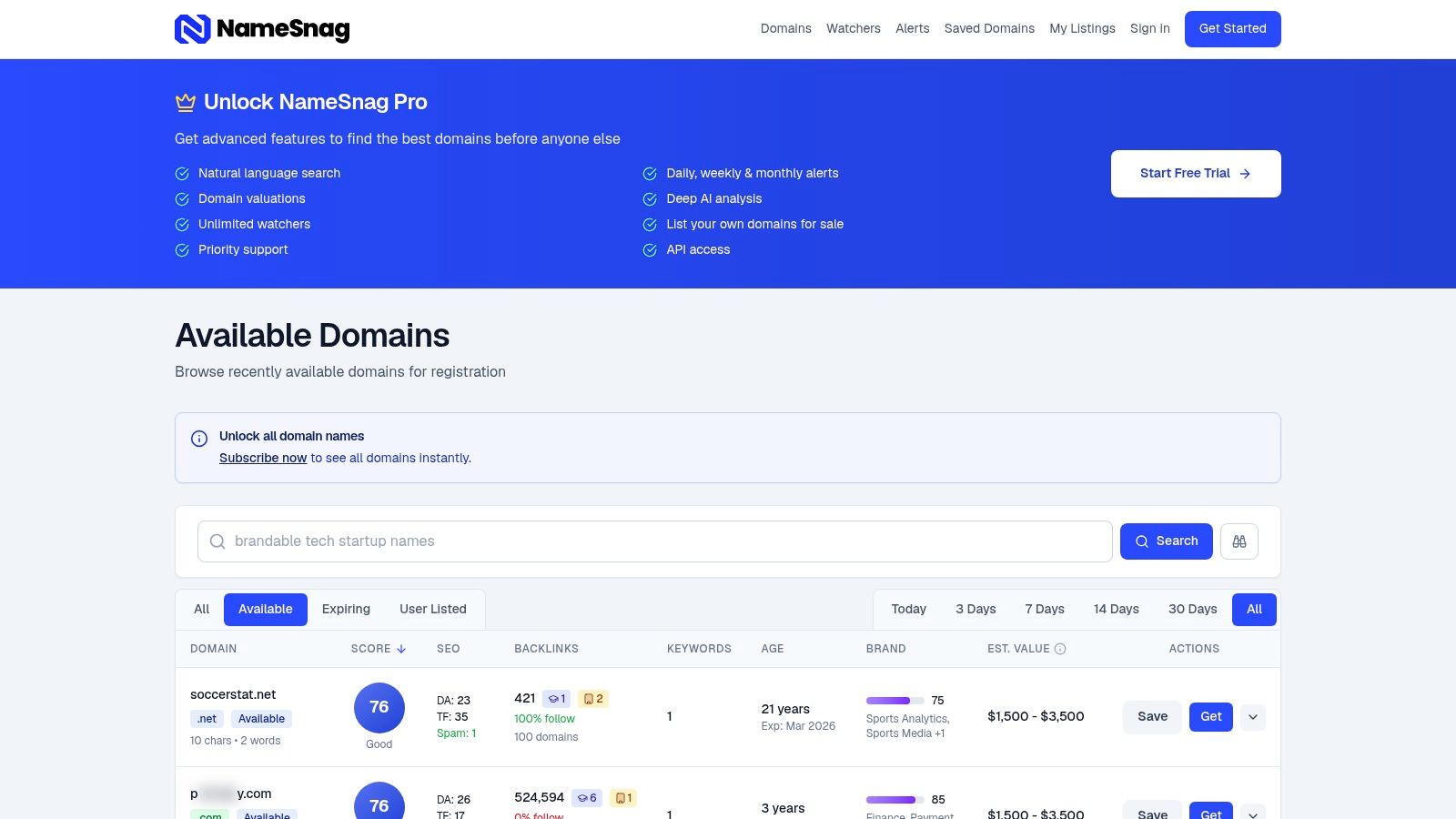
If you're prospecting actively, NameSnag is one practical option because it lets you review available dropped domains and expiring domains in grace periods, then narrow by time windows like Today, 3 Days, 7 Days, 14 Days, 30 Days, or All. For numeric hunting, that matters because good short patterns don't stay unnoticed for long.
I'd use a workflow like this:
- Scan available names first when you want immediate registration opportunities.
- Check expiring inventory next when you're willing to wait for stronger patterns to drop.
- Review quality signals before touching anything that looks automated or over-optimized.
- Shortlist only names with a clean why. If your rationale is “it has numbers and numbers are hot,” that's not a rationale.
A practical pass-fail checklist
Use this before registering anything:
- Pass if the number has obvious meaning.
- Pass if the structure is short and clean.
- Pass if the name sounds intentional when spoken aloud.
- Fail if the digits look appended to rescue a weak phrase.
- Fail if the name resembles churn-and-burn lead gen.
- Fail if you'd need to explain the spelling every time.
Buy numeric domains the same way you'd buy a storefront sign. If people misunderstand it at a glance, it's not helping.
For names you can't register outright, a domain backorder service is often the smarter path than waiting and hoping nobody else notices.
Your Next Move Are Numbers in Your Future
Numbers in domain names aren't automatically good, and they aren't automatically bad. They're a tool. Used well, they can compress meaning, improve recall, and create a distinct asset. Used badly, they make a domain look like disposable junk.
That's the essential frame to keep. Don't ask whether digits are allowed. Ask whether the pattern is brandable, understandable, and credible.
If you're building a business, the right number can make a name more usable. If you're investing, the right pattern can make a domain more liquid. If you're doing SEO, the number itself isn't the ranking story anyway. User trust is.
The lazy rule says avoid numbers. The better rule says learn to read them.
Once you can tell the difference between a meaningful numeric pattern and a machine-generated one, you stop rejecting opportunities blindly. You also stop buying garbage just because it looks unusual. That's where better decisions start.
If you want to put this into practice, try NameSnag to review fresh available and expiring domains, compare patterns quickly, and spot numeric names that look intentional instead of automated.
Find Your Perfect Domain
Get access to thousands of high-value expired domains with our AI-powered search.
Start Free Trial