You're probably staring at the same fork in the road most domain buyers hit sooner or later.
The clean .com is taken. The exact phrase you want is available only with a dash in domain name. It's cheap, readable, and sitting there like a guilty shortcut. Every old forum post says to avoid it. Every practical bone in your body says, “Maybe this is good enough.”
Sometimes it is. Sometimes it absolutely isn't.
The mistake is treating hyphenated domains like they're always bad or always underrated. They're neither. They're a trade-off. If you're building a flagship brand you want people to remember, repeat, and type without thinking, the dash usually hurts more than it helps. If you're buying for SEO history, local lead gen, niche sites, or resale arbitrage, the uglier domain can be the smarter buy.
The Great Dash Debate Friend or Foe
A dash in domain name creates an immediate split between technical reality and human reaction.
Technically, a hyphen is allowed. Search engines can read it. Domain buyers can register it. There's nothing broken about it. The problem starts when real people have to remember it, say it out loud, or trust it at a glance.
That's why the blanket advice around hyphens has always been too simplistic. “Never buy one” is lazy advice. “They're just as good” is lazy too. What matters is the job the domain needs to do.
When the dash is a problem
If the domain is your main company brand, you need to think beyond availability.
A branded root domain has to survive the radio test. It has to work in podcast mentions, sales calls, emails, and memory. If you have to keep saying “with a hyphen,” you've already added friction. That friction leaks traffic, weakens recall, and makes the business feel a little less established.
When the dash can be useful
There are cases where the domain isn't trying to become the next iconic brand. It just needs to be useful, relevant, and easy to acquire.
That usually includes:
- Niche SEO projects: Exact-match or phrase-match domains can still be attractive when readability matters.
- Local service sites: Geo plus service combinations often look clunky without separators.
- Aged acquisitions: A hyphenated domain with a real backlink profile can be worth more than a fresh, cleaner-looking name with no history.
- Budget-conscious buys: If the non-hyphenated version is priced like a trophy asset, the hyphenated alternative may open the door to a practical build.
Practical rule: Judge hyphenated domains by the business model, not by internet folklore.
That is where the debate lies. A dash in domain name isn't automatically a foe. It's a tool with obvious downsides and a few sharp strategic uses. Buyers who understand that difference usually make better decisions than buyers who follow slogans.
How Google Sees a Dash in Your Domain
The biggest fear around a dash in domain name is still SEO. That fear is mostly outdated.
Google has been consistent on this point for years. Hyphens are treated as word separators, not as an SEO penalty. Former Google engineer Matt Cutts said hyphens improve readability without algorithmic penalties, and John Mueller later reaffirmed it with: “I don't think anything in our algorithms looks specifically for hyphens in domain names,” as summarized by Studiohawk's review of hyphens and underscores in URLs.
That matters because many buyers still act like a hyphen itself tanks rankings. It doesn't. If a page struggles, the usual causes still apply. Weak content, weak links, poor intent match, poor architecture, or a messy history. The dash isn't the villain.
Hyphens help machines read words cleanly
A simple domain like best-seo-tool.com gives Google clear word boundaries. That's the core reason Google has long preferred hyphens over underscores in multi-word URLs.
From a crawling and parsing standpoint, the dash is readable. It separates terms in a way that's obvious to search systems and obvious to people scanning a SERP. If you work in optimizing digital presences for search engines, this is one of those foundational details that matters more in interpretation than in hype.
A lot of confusion comes from mixing up ranking factors with user response factors. Google can read a hyphenated domain just fine. Users may still like it less. Those are two different questions.
SEO neutrality does not mean equal performance in practice
People often overcorrect in this situation. They hear “no penalty” and assume “no downside.” That's not true.
A hyphenated domain can rank. It can inherit authority. It can support a content site or lead gen property. But rankings are only one part of the picture. If users trust the cleaner result more, click it more often, or remember it better later, the non-hyphenated brand still has a business advantage.
For a deeper take on that distinction between search treatment and practical trade-offs, NameSnag has a useful piece on hyphens in domain names.
Here's a short clip worth watching if you want Google's position in a more direct format:
Google's stance is the easy part. Search engines don't mind the dash. Humans often do.
That distinction is why some hyphenated domains perform better than you'd expect in SEO projects, while still being poor choices for serious brand building.
The User Experience Problem with Hyphenated Domains
If search engines don't punish the dash, why do hyphenated domains still carry baggage?
Because visitors aren't crawlers. They're busy, distracted, and imperfect typists.
The core issue with a dash in domain name is usability. People forget hyphens. They skip them when typing. They miss them when hearing the domain spoken aloud. They also make snap judgments about quality, and a hyphenated root domain often feels less premium than the cleaner version beside it.
The click and trust problem
According to the summary published by Gandi on dashes in domain names, Ahrefs studies from 2023 found hyphenated domains average 15 to 20% lower organic click-through rates, and they carry a 2x higher typo-squatting risk. That lines up with what many domain investors see in the wild. Even when a hyphenated domain ranks, users often prefer the cleaner-looking option.
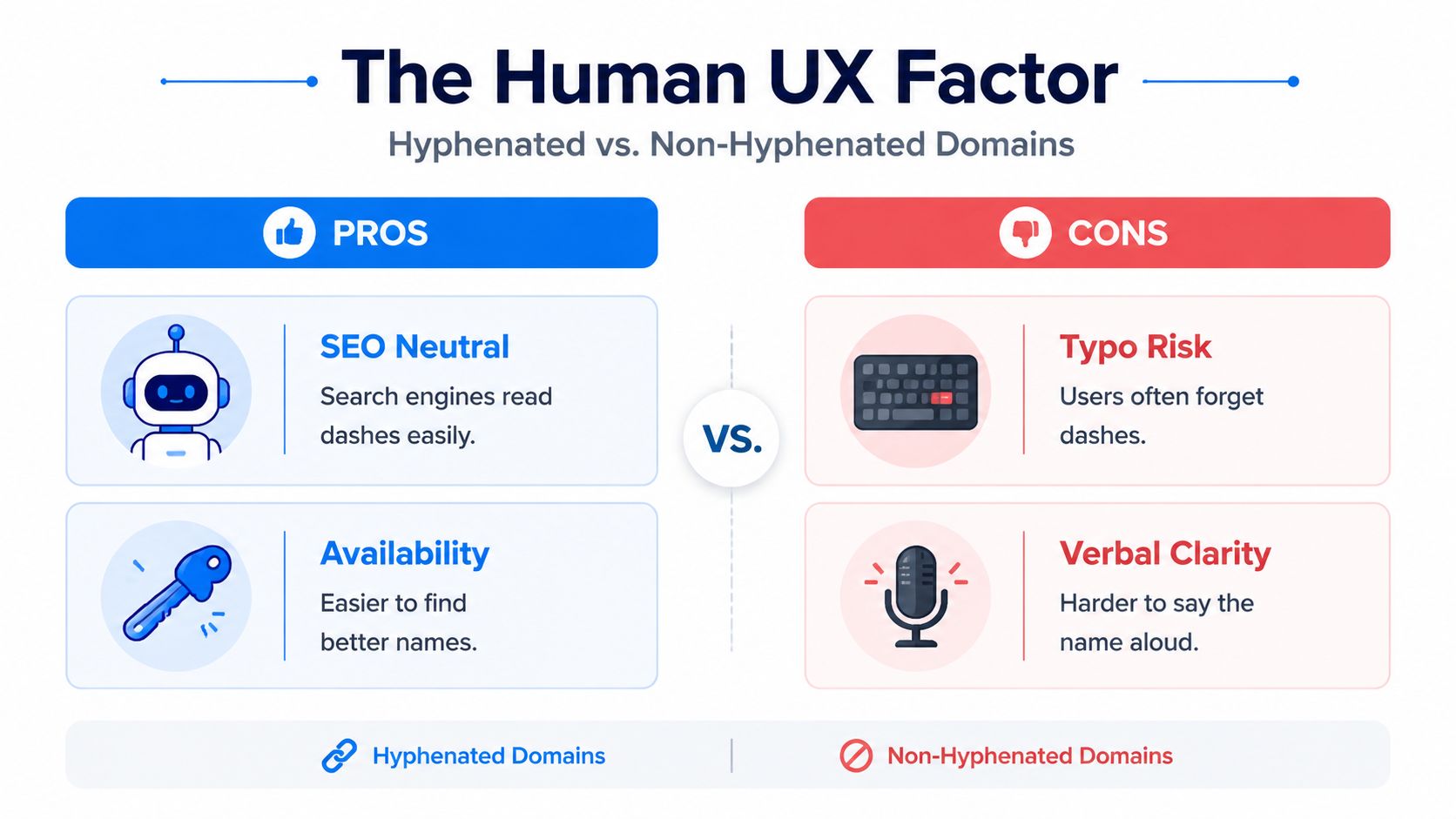
That typo risk is especially nasty when the non-hyphenated version belongs to someone else in the same market. You end up educating users about your competitor every time they forget the separator.
The radio test still matters
A domain passes the radio test when someone can hear it once and type it correctly. Hyphenated domains usually fail.
“Visit green-roof-advice dot com” is workable. “Visit greenroofadvice dot com” is smoother. The difference sounds small until you repeat the name on calls, in videos, in interviews, and in offline marketing.
That's why brand strategists spend so much time on verbal clarity. Good naming isn't just about availability. It's also about ease of repetition. If you want a broader primer on that side of the equation, this guide to what makes a good brand name is worth reading alongside your domain shortlist.
UX cost is cumulative
One missed character doesn't sound fatal. But friction stacks up.
- Memory friction: People remember the phrase but not the punctuation.
- Trust friction: Some visitors associate hyphen-heavy domains with lower-quality sites.
- Sharing friction: Spoken referrals get clumsy fast.
- Navigation friction: Direct type-in traffic leaks when users default to the undashed version.
If your project depends on making websites easy for visitors to use, the domain itself is part of that experience, not just the site design. This practical guide on making websites easy for visitors to navigate gets at the broader principle well.
The dash is often invisible to the buyer and very visible to the visitor.
That's why the human side of this decision matters more than the technical side for most primary brands.
Why So Many Dashes A Brief Domain History
A lot of investors dismiss hyphenated domains on sight. That misses where many of them came from.
During the dot-com rush, businesses were registering anything usable they could get. Clean .coms disappeared fast, especially exact-match service terms, geo terms, and two-word commercial phrases. The hyphen was not a style choice. It was often the remaining version a real business could still register without paying aftermarket prices.
That matters because it changes how you read an old dashed domain today. Some of these names were built by operators who cared more about ranking for a phrase or launching on time than winning a branding debate. In practice, that means a hyphenated domain can come with age, backlinks, and topical relevance that a cleaner hand-reg has never had.
Why hyphens showed up everywhere
The format was shaped by technical rules as much as buyer preference. ICANN's domain name syntax rules allow letters, numbers, and hyphens in hostnames, but not underscores in standard domain labels, as explained in ICANN's overview of domain name structure and valid label formats. So if a company wanted a readable multi-word domain and the plain version was taken, the hyphen was the obvious separator.
That created a huge class of domains that looked awkward but were commercially sensible at the time.
I have seen this pattern repeatedly in expired inventory. A dashed domain from 2003 or 2008 is often attached to a real local business, affiliate site, publisher, or lead-gen project. That history does not make it good by default. It does make it worth checking before you write it off.
What that old history means in the aftermarket
The aftermarket still reflects that early scarcity. NameBio tracks a long tail of hyphenated sales across commercial, geo, and keyword-driven names, which you can verify by reviewing historical hyphenated domain sales in NameBio's market database. The prices are usually lower than equivalent undashed names. For investors, that discount is the whole point.
Asset quality is the essential question. A clean domain with no history may be easier to brand, but a hyphenated domain with archived content, relevant links, and a prior business footprint can be the better buy. That is the part newer buyers miss, especially if they have only looked at domain aesthetics and not at the underlying record.
A few patterns show up often:
| Situation | What the history suggests |
|---|---|
| Aged hyphenated domain | It may trace back to a real operating site from the early registration boom |
| Cheap expiry or auction buy | The dash often keeps bidder interest down even when the name has usable history |
| Exact-match service or geo phrase | These were commonly registered for practical SEO and lead generation use |
That is why I treat old hyphenated domains as a separate category, not as automatic rejects. If you buy domains based on history, links, and resale spread, a dashed name can be a smarter bet than a prettier one with no past at all. For buyers building that kind of criteria, this guide to domain name investment strategies is a useful companion.
The Smart Investor's Guide to Hyphenated Domains
A domain investor shouldn't ask, “Are hyphens good?” The smarter question is, “When does the discount create an edge?”
Hyphenated domains present an interesting opportunity. They're often priced down by perception before anyone studies the underlying SEO value. If a clean, new domain has no history and a hyphenated alternative has age, links, and topical relevance, the ugly one may be the better asset.
The Age plus Hyphen angle
One of the more useful strategic questions in this space is whether a 10+ year-old hyphenated domain with strong Trust Flow can recover faster or hold more practical SEO value than a newer non-hyphenated alternative. The gap is less about the hyphen itself and more about whether buyers are undervaluing age and backlink history because they dislike the appearance.
The available research framing this issue points directly at that trade-off. As noted in this discussion of the dash versus underscore gap for domain buyers, the key question is whether a 10+ year-old hyphenated domain with strong authority metrics can outperform a newer clean domain, especially when the hyphenated option comes with 50+ referring domains and is discounted by buyer bias.
That's not proof that hyphenated domains always win. It is a strong argument for checking history before dismissing them.
What I'd actually buy
I'll pass on most hyphenated brandables. I get interested when the domain checks several boxes at once.
- A clear topic match: The words still describe a category, service, or local intent naturally.
- Aged footprint: Older domains deserve more scrutiny because they may have real use history.
- Link quality over raw volume: A small clean profile beats a noisy one.
- No obvious conflict with the undashed version: If the cleaner domain is an active direct competitor, the leak risk gets worse.
- An end use that relies more on search than on memorability: Niche content, lead gen, and testing properties fit this better than broad consumer brands.
Good fits and bad fits
Here's how I think about it in plain terms:
| Better fit for hyphenated domain | Worse fit for hyphenated domain |
|---|---|
| Local SEO site | Main venture-backed startup brand |
| Affiliate project | Word-of-mouth heavy business |
| Lead gen property | Podcast, radio, or offline promoted brand |
| Aged SEO asset acquisition | Consumer brand trying to feel premium |
| Geo plus service phrase | Broad category-defining company name |
A lot of buyers get trapped by visual bias. They see the dash and move on. That can create openings for people willing to inspect archive history, anchor patterns, and backlink quality carefully.
If domain investing is your lane, this primer on domain name investment is a helpful companion read because the same logic applies beyond hyphens. Price and appearance are only part of value.
Where discipline matters
A hyphenated domain is not a bargain just because it's cheap. It becomes interesting when the discount and the underlying asset quality are misaligned.
Use a short filter before you buy:
Check the archive trail
Confirm the old use makes sense. If the domain changed topics repeatedly or hosted junk, walk away.Review the backlink profile manually
Don't let a decent-looking score hide rotten links.Look at the words themselves
Some phrases improve with a hyphen. Others just look awkward with one.Ask how traffic will arrive
Search-first projects can tolerate more friction than direct navigation brands.
Buy the history, not the punctuation.
That's the investor mindset. The dash doesn't add value. The market's overreaction to the dash sometimes creates value.
Your Dash-in-Domain Decision Checklist
At this point, the call usually becomes clearer. You're not deciding whether hyphens are good. You're deciding whether this specific hyphenated domain is right for this specific job.
Five questions that settle the issue
Ask these in order.
1. Is this my core brand or a tactical asset?
If it's your forever brand, be strict. A clean root domain is usually worth waiting for, reworking, or paying up for. If it's a tactical SEO build, local site, affiliate property, or acquisition based on history, the dash gets a lot more acceptable.
2. Who owns the non-hyphenated version?
If a direct competitor owns it, expect leakage and confusion. If it's parked, unused, or in a different category, the risk is still there but easier to manage.
3. Will people hear this domain more than they type it from search?
This is the simplest practical test. If your growth depends on referrals, brand mentions, or offline promotion, the dash is a handicap. If most visits will come from search engines and links, that weakness matters less.
The quality screen
A hyphenated domain only deserves attention when the underlying asset is strong.
Use this quick screen:
- History clean enough to trust: No obvious spam era, bait-and-switch topic shifts, or sketchy use.
- Words still make sense together: The domain should read like a phrase, not like a compromise.
- Backlinks support the intended use: Relevance matters more than vanity.
- You can live with the brand perception: If the domain feels second-rate to you now, it'll probably feel second-rate later too.
For smaller businesses weighing branding and search together, this article on SEO domain name strategy for UK SMEs offers a grounded perspective on where keyword relevance helps and where brand clarity matters more.
Final verdict
I'd keep the rule simple.
For a primary brand, avoid the dash if you can. The problem usually isn't SEO. It's memory, trust, and direct navigation.
For SEO projects, local lead gen, affiliate builds, or aged-domain acquisitions, don't reject a dash in domain name on sight. If the history is clean and the asset is discounted because other buyers are chasing prettier names, that's not a compromise. That's a pricing inefficiency.
Bottom line: A hyphenated domain is weak branding and potentially strong arbitrage.
That's the lens that keeps you from overpaying for cosmetic purity and keeps you from buying junk just because it's cheap.
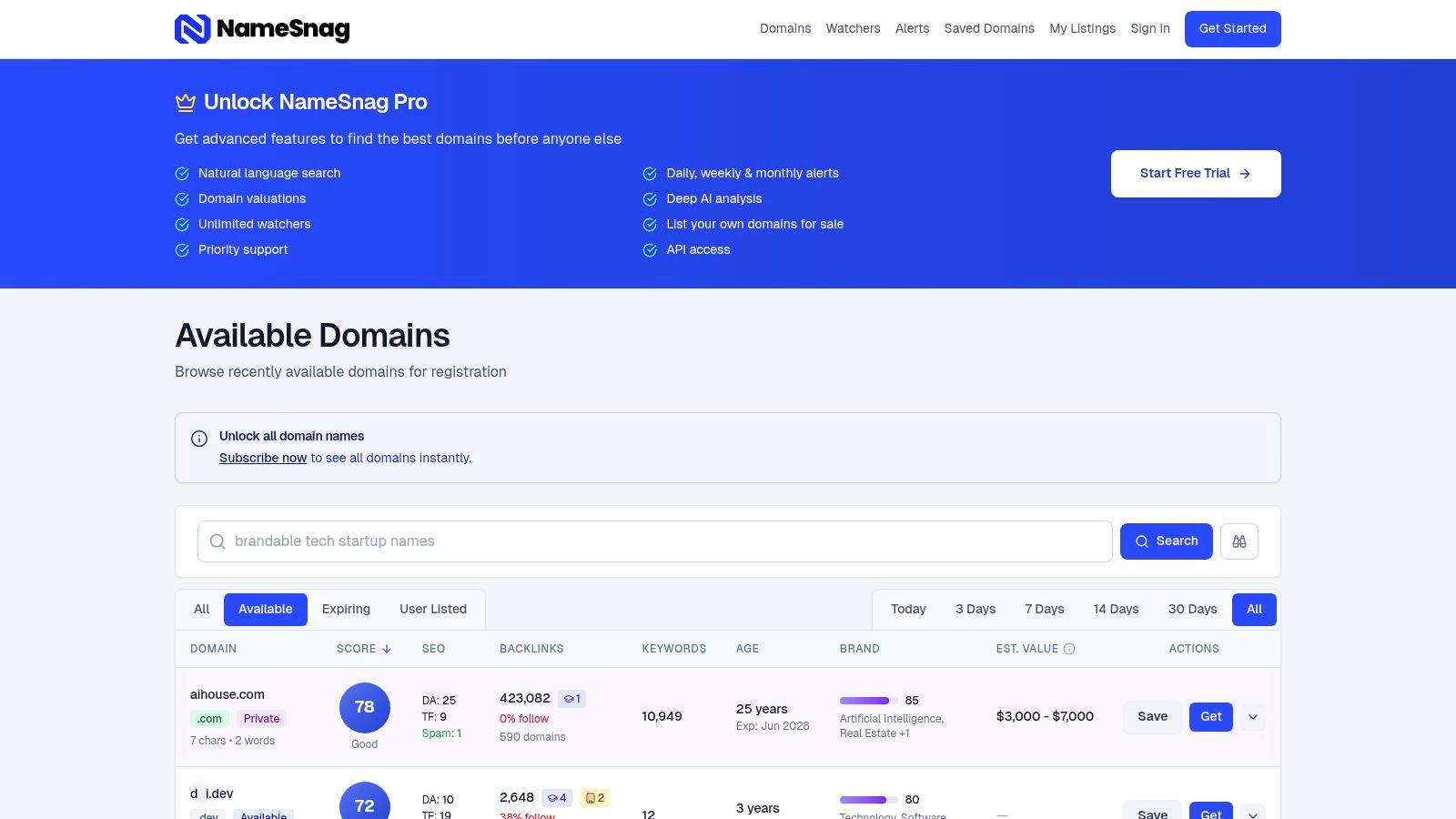
If you want to hunt for undervalued domain opportunities without digging through endless junk by hand, NameSnag is built for exactly that. You can browse available dropped domains for names you can register right away, or check expiring domains that are still in the grace period and likely to drop soon. The time filters make this even more useful. You can narrow by Today, 3 Days, 7 Days, 14 Days, 30 Days, or All, depending on how aggressively you want to prospect.
Find Your Perfect Domain
Get access to thousands of high-value expired domains with our AI-powered search.
Start Free Trial