Keywords in a domain name can feel a little like a dark art, but they're really just the words that tell both people and search engines what your site is all about. The sweet spot is a domain that blends a memorable brand with a relevant keyword, making it instantly obvious what you do while also giving your visibility a nice little bump.
Why Your Domain Name Is a Critical SEO Asset
Let's be honest: your domain name is way more than just a web address. It's your digital storefront, your first impression, and a massive signal to Google about what your business does. Nailing this choice isn't just about branding; it's one of the first foundational SEO moves you can make, and it pays off for years.
A domain name that includes a core keyword gives search engines a direct hint, helping them categorize your site correctly right from the start. Think about it. When someone searches for "miami pet grooming," a domain like MiamiPetGrooming.com screams relevance. This kind of clarity often leads to better click-through rates from search results because people see exactly what they were looking for.
The Great Debate: Brandable vs. Exact Match
The world of domain strategy really boils down to two main camps. In one corner, you have the purely brandable names—think Zillow or Kayak. They're unique and catchy, but they take a ton of marketing muscle to build meaning and recognition from scratch.
In the other corner are the exact-match domains (EMDs), which are just what they sound like: they precisely match a search query, like BuyUsedCarsOnline.com. While Google has dialed back the massive ranking boost EMDs used to get, they still carry weight in user perception and pure, simple clarity.
These days, the smartest approach is often a hybrid—a name that's both brandable and contains a high-value keyword.
Choosing a domain is all about balancing immediate keyword relevance with long-term brand equity. A name that is easy to recall, spell, and share creates a better user experience, which is a massive factor in modern SEO.
Ultimately, your domain is a key piece of your digital identity. While you're weighing your options, it doesn't hurt to get a handle on the technical side, like understanding DNS propagation, which is what makes sure your new domain actually points to your website for everyone around the world.
For a much deeper look into how all this fits together, check out our complete guide on finding the best domains for SEO.
How to Brainstorm Keywords Your Customers Actually Use
Alright, let’s get into the fun part: digging for keyword gold.
The biggest mistake I see people make is brainstorming keywords based on what they think their business is. The real magic happens when you stop thinking like an owner and start thinking like a customer.
What problems are they trying to solve? What desperate questions are they typing into Google at midnight?
Your goal isn't just to list your services; it's to uncover the exact language your audience uses every day. Ditch the industry jargon. Get into their heads. This shift in perspective is the difference between a domain that connects and one that falls flat.
Think Like Your Audience
A great place to start is Google itself. Type in one of your core services and just scroll down to the "People Also Ask" section. This is a literal goldmine of customer intent.
If you sell home security systems, you might find questions like "best diy home security" or "affordable security camera for apartment." These phrases are the building blocks for a powerful domain name.
Another fantastic source is online communities. Spend some time lurking on Reddit, niche forums, or even Facebook groups related to your industry. Pay close attention to the titles of threads and the specific phrasing people use when they describe their needs. You’ll find raw, unfiltered language that’s perfect for your keyword list.
The best keywords aren't dreamed up in a boardroom—they're discovered in the wild. Listen to how real people talk about their problems, and you'll find the words that resonate.
Categorizing Your Keyword Ideas
As you gather ideas, you'll start to notice they fall into a few different buckets. Organizing them helps you spot patterns and identify the strongest candidates for your domain name. It’s a simple but effective way to bring order to the creative chaos.
For a more comprehensive look at this process, check out this excellent guide on how to build a keyword list that can seriously level up your SEO game.
To get you started, here's a breakdown of different keyword types that will help you generate a comprehensive list for your domain search.
Keyword Categories for Domain Brainstorming
| Keyword Type | Description | Example |
|---|---|---|
| Primary Keywords | These are broad, foundational terms that describe your main service or product. | HomeSecurity, DogWalking, WebDesign |
| Secondary Keywords | These add a layer of detail, often describing a feature, benefit, or specific niche. | SmartCamera, PuppyWalker, ShopifyDev |
| Geo-Specific Keywords | Perfect for local businesses, these keywords include a city, state, or neighborhood. | MiamiSecurity, BrooklynDogs, DenverWeb |
This simple structure helps you see your options clearly and start playing with combinations.
Keeping an eye on current trends is also incredibly smart. In November 2025, the domain aftermarket platform Sedo revealed its top searched keywords, and 'AI' was absolutely dominating the charts. This reflects the massive global interest in artificial intelligence and shows just how quickly keyword popularity can shift.
Once you have a solid list, you can start combining these ideas. You might stumble upon a gem like SmartMiamiSecurity.com or BrooklynPuppyWalker.com. The process is all about creative mixing and matching, and having a well-organized list makes it far easier to spot those winning combinations.
If you're feeling stuck, we have even more tips for generating great domain name ideas for your business that can spark some fresh inspiration.
Turning Your Keyword List Into a Brandable Domain
Alright, you've got a killer list of keywords. Now what? The real goal isn't just to jam them into a URL; it’s to mold them into a name that actually sticks in someone's head. This is where the science of data meets the art of branding.
Think of yourself as a word chemist for a minute. You're mixing, matching, and experimenting with different elements to see what sticks. This is the creative part, so have some fun with it.
From Keywords to Catchy Concepts
Start by just playing with your primary keywords. Can you tack on a simple prefix or a trendy suffix? Sometimes a tiny tweak is all it takes to turn a generic term into something with energy.
I’ve seen these simple modifications work wonders:
- Prefixes: Slap words like
get,try,go, ortheon the front. A keyword likesolarpanelis functional, butGetSolarPanel.comimmediately sounds more proactive and service-oriented. - Suffixes: Thanks to the rise of tech startups, suffixes like
-ly,-ify,-io, and-aifeel modern and fresh.Designify.comhas a much stronger brand feel than the genericdesign.com. - Blending: Mash two concepts together. If your business is about "fast" and "delivery," you could try something like
Fastiver.com.
The key here is finding a balance. You want the name to hint at what you do without being painfully literal. The best brandable domains pass what I call the "radio test"—if you heard it on the radio, could you easily type it into a browser later? If it's a pain to spell or say out loud, it's probably not the one.
Checking for Brand Viability
Before you get too attached to a name, you need to do a little homework. Seriously, don't skip this. Falling in love with a domain only to discover you can't actually use it is a massive waste of time and emotional energy.
Run these two essential checks before you even think about buying:
- Trademark Search: Do a quick lookup on the USPTO's TESS database (or your country's equivalent). Building a brand on a domain that infringes on someone else's trademark is just asking for a legal headache down the road.
- Social Media Handles: See if the name is available on the big platforms—Instagram, X (formerly Twitter), Facebook, etc. Consistent branding across channels is crucial. You don't want to be
AwesomeBrand.combut have to settle forAwesome_Brand_123on social media. It just looks sloppy.
Your domain isn't an island. It’s the central hub of your brand's entire digital presence. Make sure you can claim the name consistently everywhere your audience spends their time.
This vetting process ensures your chosen name actually has room to grow into a real, defensible brand.
Once you have a few strong, vetted candidates, it's time for the fun part: seeing what’s actually available. This is where a tool like NameSnag becomes your best friend. Instead of guessing and checking manually, you can quickly filter for Available domains that have just been dropped and are ready to be registered immediately. This helps you snap up a clean, problem-free name before anyone else gets to it.
Unlocking SEO Value with Expiring Domains
Why build your digital empire on an empty plot of land when you can start with a solid foundation already in place?
This is the core idea behind one of the smartest strategies in the SEO playbook: acquiring expiring domains. Instead of starting from scratch with a brand-new domain, you can find one that already has history, authority, and—most importantly—valuable backlinks.
Think of it this way. A new domain is like a startup with no track record. An expired domain, on the other hand, is like taking over a well-regarded shop on a busy street. It already has trust built up with search engines and customers who’ve linked to it over the years. This gives you an incredible head start.
The Power of an Aged Domain
An expiring domain is simply a domain that someone previously owned and built a site on, but then failed to renew. After a grace period, it's released back into the wild. Many of these domains have spent years accumulating SEO value, which you can inherit the moment you register it.
The key is to find one with a clean history that aligns with your niche. These gems often come packed with some serious advantages:
- An Established Backlink Profile: This is the big one. It can take years and a massive budget to build high-quality links. An expired domain might come with dozens or even hundreds of them, instantly boosting your site's authority.
- Domain Authority (DA) and Trust Flow (TF): These are metrics that estimate a domain's trustworthiness and power. Starting with a domain that already has a decent score is like starting a race halfway to the finish line.
- Age: Older domains are generally viewed more favorably by Google. They've had time to prove they're not some fly-by-night operation.
Picking up a quality expired domain isn't just a shortcut; it's a strategic move. You're essentially buying a pre-built reputation that would otherwise take you years to earn on your own.
Starting fresh has its place, but acquiring an asset with built-in authority changes the game entirely. Let's break down the key differences.
New vs. Expired Domain Showdown
| Attribute | New Domain | High-Value Expired Domain |
|---|---|---|
| Backlinks | 0 - you start from scratch | Potentially hundreds of existing links |
| Authority | Low (e.g., DA 1) | Established (e.g., DA 20+) |
| SEO Impact | Slow, gradual build-up | Immediate authority boost |
| Age | Brand new | Several years old |
| Initial Cost | Low (standard registration fee) | Higher (auction or backorder fee) |
| Effort | High effort to build authority | High effort in research, lower in link-building |
Ultimately, a new domain is a blank slate, while a good expired domain gives you a running start by inheriting years of SEO equity.
Finding Your Diamond in the Rough
Sifting through thousands of dropping domains can feel like a fool's errand. This is where you need a smart approach and the right tools. Instead of manually checking every potential domain, you can use a platform built for this exact purpose.
For instance, on NameSnag, you can jump straight to the Expiring domains section. This filter is designed to help you pinpoint keyword-rich domains that are about to become available. You can even narrow your search to domains dropping today, in the next 3 days, or even 30 days out, giving you time to plan your move.
Historical data confirms the power of this strategy. Comprehensive WHOIS databases show that of the over 370 million registered domains worldwide, those over five years old with target keywords average 3x higher domain authority. You can explore more detailed insights on domain stats and trends to see just how valuable age and keywords are.
For a deeper dive, check out our guide on how to find expired domains for a step-by-step process.
By focusing on these pre-vetted, high-potential domains, you’re not just looking for keywords for domain names; you're hunting for a complete SEO package that can fast-track your growth from day one.
Vetting Your Domain to Avoid Hidden Penalties
You’ve found it—the perfect domain. It’s got a great keyword, it’s aged, and it feels like a winner. But hold on a second. Before you pop the champagne, it’s time to play detective.
I've seen it happen too many times: someone snags a great-looking aged domain only to discover it comes with serious baggage. We're talking hidden Google penalties or a history as a spam farm, which can absolutely poison your SEO efforts before you even write a single line of content.
Think of this as a pre-purchase inspection for a piece of digital real estate. A domain with a toxic past is a massive headache just waiting to happen, costing you time, money, and rankings. This step is what separates a smart investment from a future nightmare.
This decision tree gives you a simple way to think about your strategy, whether you're starting from scratch or hoping to leverage an existing domain's history.
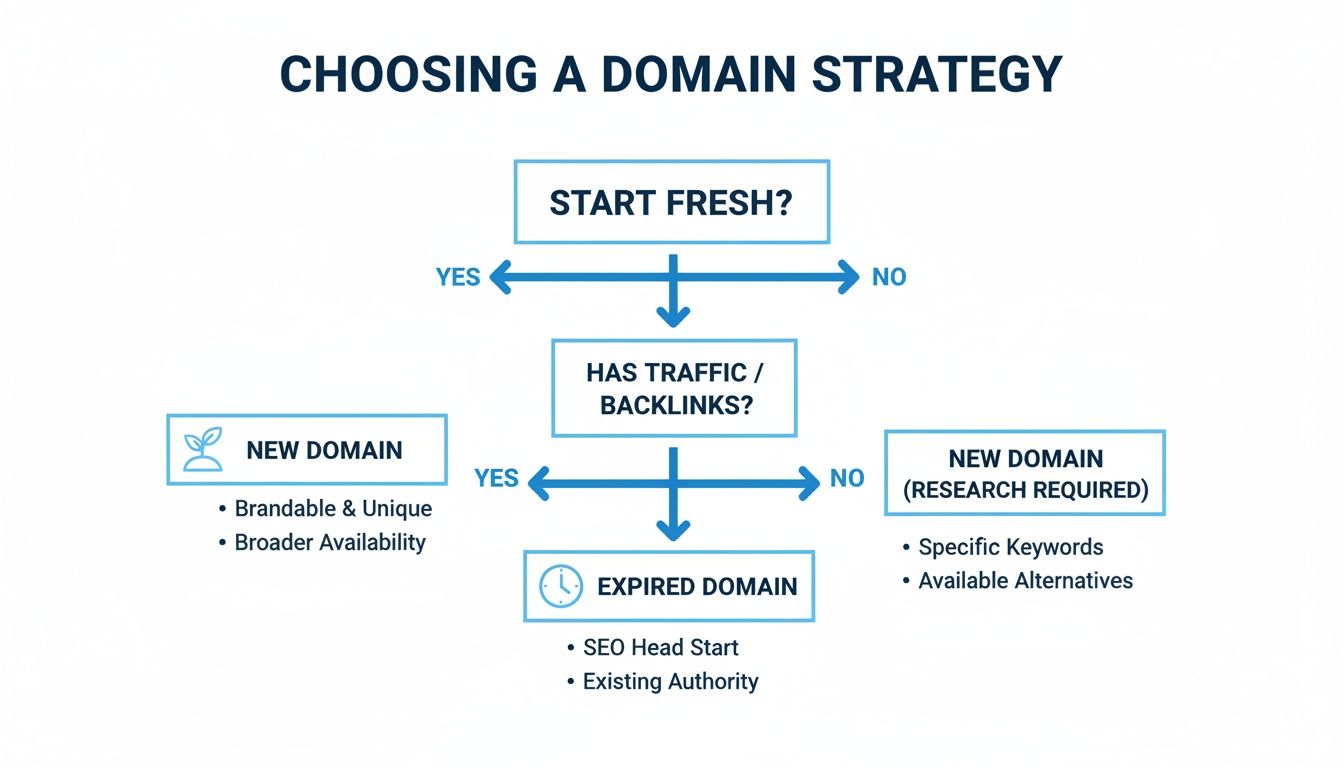
Ultimately, you're choosing between a clean slate and inherited authority. This visual should push you to really think about your goals for traffic and brand building right from the start.
Uncovering a Domain’s Past
Your first stop should always be the Wayback Machine (Archive.org). This incredible tool lets you see snapshots of what a website looked like over the years. Was it a legitimate business in your niche, or was it plastered with spammy, irrelevant garbage?
A clean, relevant history on the Wayback Machine is a huge green flag. If you see anything that looks suspicious or completely off-topic, it’s a sign to proceed with extreme caution—or just walk away.
Next up, you need to dig into its backlink profile. A quick check with a tool like Ahrefs or Moz will show you who's linking to the domain. You're looking for links from reputable, relevant sites in your industry.
A profile filled with links from low-quality directories, foreign-language sites, or spam blogs is a massive red flag. That kind of junk can signal an existing penalty you'll have to clean up.
Here’s what I look for:
- Anchor Text Diversity: Is the anchor text natural (like the brand name or "click here"), or is it stuffed with over-optimized, spammy keywords?
- Link Quality: Are the links coming from authoritative sites, or from domains with zero authority and trust?
- Relevance: Do the linking sites have anything to do with your industry, or are they completely random?
The Safer Alternative: A Clean Slate
All this detective work can be a real time-sink. If you want the keyword benefits without the historical risk, there’s a much simpler path. Instead of vetting a potentially problematic expired domain, you can zero in on domains that have just finished their lifecycle and are now totally fresh.
On NameSnag, you can filter specifically for Available domains. These are domains that were recently dropped and can be registered immediately at any standard registrar. They offer a true clean slate—no sketchy history, no hidden penalties, just a keyword-rich name ready for a fresh start. You can even filter for domains that became available Today or in the last 3 Days.
This approach really gives you the best of both worlds: a valuable keyword foundation without the gamble of inheriting someone else's mess.
And don't underestimate the value here. Data from millions of domain sales shows just how important this is. Keyword-rich domains consistently outperform generic ones by up to 400% in average sale prices, with a 67% higher resale velocity. You can learn more about domain market trends to see for yourself how powerful the right keywords can be.
Of course. Here is the rewritten section, adopting the expert, conversational style from the provided examples.
Some Lingering Questions About Domain Keywords
Alright, you've got the process down, but a few questions are probably still rattling around in your head. Let's tackle the most common ones I hear. Getting these right can be the difference between a domain that works for you and one you're constantly working against.
Exact-Match or Brandable Name? Which One Wins?
Honestly, this is a false choice. The real sweet spot is almost always a hybrid.
An exact-match domain like buyusedcarschicago.com screams its purpose, which can give you a nice little SEO bump right out of the gate. The problem? It's generic as heck and completely boxes you in. What happens when you want to sell new cars, or expand to Milwaukee? You're stuck.
On the other end of the spectrum is a purely brandable name like Zillow. It’s unique, memorable, and sounds great. But it takes an absolute mountain of marketing cash and effort to teach people what Zillow even means. Most of us don't have that luxury.
The winning move is to land somewhere in the middle. Think Cars.com. It includes the core keyword but still feels like a proper brand.
The best domains marry keyword relevance with brand personality. This blend makes you instantly understandable to search engines and memorable to customers.
What's the Ideal Length for a Domain?
Shorter is almost always better. If you can snag something in the 6-15 character range, you're golden.
These domains are just easier for humans to deal with. They're simpler to remember, harder to mistype, and don't look ridiculous on a business card. They also don't get butchered when shared on social media.
Sure, most single-word .com domains were claimed back when the internet was young. But you can still find short, punchy names by keeping an eye on domains that have recently dropped. It's a fantastic way to find a premium-sounding name without the eye-watering price tag. And please, avoid hyphens and numbers. They feel cheap and are a nightmare to explain out loud.
Is .Com Still King?
For most businesses, absolutely. The .com TLD is the default setting for the internet. It’s what people trust and what they’ll type into their browser out of sheer habit. Make securing the .com your first priority.
That said, other TLDs can work if you're in the right niche. A .io or .ai domain can look sharp for a tech startup. A local business might find a country-specific TLD like .co.uk serves them perfectly well. If you find a killer keyword domain with a different extension, just be dead sure it fits your brand and won't send your customers to the wrong place.
How Do I Know If an Expired Domain Has a Sketchy Past?
Time to put on your detective hat. Your first stop should always be the Wayback Machine at Archive.org. You need to see what that site used to be. Was it a real business in your industry, or was it a spam-filled cesspool?
Next, you need to run a backlink check. You're looking for a healthy, natural link profile from sites that make sense. If you see a ton of garbage links from spammy directories or sketchy foreign-language sites, run. That's a massive red flag. A clean history is the only way you'll inherit any of that sweet, sweet SEO value.
Finding the perfect domain is part strategy, part discovery. Whether you're hunting for a high-value aged name or starting with a clean slate, NameSnag has the tools to help. Cut through the noise and find a domain with real potential by exploring our lists of just-dropped Available domains or soon-to-be-released Expiring domains today.
Find Your Perfect Domain
Get access to thousands of high-value expired domains with our AI-powered search.
Start Free Trial