Investing in domains is the practice of buying domain names with the hope of selling them later for a much bigger number. It’s a lot like acquiring digital real estate; you're buying a valuable, finite asset—like a prime plot of land—that can appreciate significantly over time.
Welcome to the World of Digital Real Estate

Ever wondered why a simple string of text can sell for thousands, or even millions? Just like physical property, a great domain name is both scarce and highly desirable. It's digital beachfront property, my friend!
Every single day, thousands of new businesses are born, and every one of them needs an online address. This constant, unyielding demand fuels a thriving market where a memorable, brandable, or keyword-rich domain can become an incredibly valuable asset.
But investing in domains isn't just about grabbing a catchy name and hoping for the best. It's a strategic game that involves identifying undervalued assets, understanding market trends, and knowing precisely when to hold or when to sell. Before we get into the weeds, if you need a refresher on the basics, we've got a great guide on the difference between a site and a domain.
The Two Core Paths in Domain Investing
This isn't a one-size-fits-all venture. Your approach will depend heavily on your goals, how much capital you have, and your timeline. At a high level, most investors fall into one of two camps.
Here's a quick look at the two primary strategies for domain investors, which should help you decide which path fits your goals.
Two Core Paths in Domain Investing
| Strategy | Primary Goal | Typical Timeframe | Ideal Domain Type |
|---|---|---|---|
| Domain Flipping | Quick Profit | Weeks to Months | Undervalued, expired, or trending domains with immediate appeal. |
| Portfolio Building | Long-Term Growth | Years | Premium, brandable, or keyword-rich domains with lasting value. |
Let's unpack that a little more.
Flipping domains is the fast-paced, short-term play. You hunt for undervalued domains—often recently expired names or fresh finds—with the sole purpose of reselling them quickly for a tidy profit. Success here is all about speed, market knowledge, and having an eye for names with immediate commercial appeal.
On the other hand, building a portfolio is a long-term, buy-and-hold strategy. Here, you're carefully acquiring high-quality domains and sitting on them, letting their value appreciate over years. This approach is less about quick wins and more about patiently building a valuable collection of digital assets, much like a real estate mogul would accumulate properties.
Think of a domain flipper as a house flipper who renovates and sells in a flash. The portfolio builder is more like a property developer who buys up land in an up-and-coming area and waits for its value to skyrocket.
The market for these digital assets is robust and showing no signs of slowing down. In fact, the global domain name registrar market was valued at $2.45 billion in 2024 and is projected to hit $3.62 billion by 2033, according to Straits Research.
That steady growth signals a healthy future for anyone looking to start building their own digital property empire.
How to Spot a Diamond in the Digital Rough

Alright, you're ready to start treasure hunting. But when you’re staring at a list of thousands of domains, how do you actually tell the digital diamonds from the worthless rocks? A smart domain investor needs to look at a few core metrics to figure out a domain's true value, much like a gemologist inspects a stone for clarity, cut, and carat.
Diving in without this knowledge is basically like buying a mystery box—sure, you might get lucky, but you’re far more likely to end up with junk. Let’s pull out our digital loupe and examine the key traits that separate a dud from a high-value asset.
The Age and History of the Domain
Think of an older domain like a vintage wine; it has character and a story. A domain that’s been registered for many years often carries a bit more weight with search engines. Age alone isn't enough, though. Its history is what really matters.
You absolutely need to know how the domain was used in the past. Was it a reputable blog? An old e-commerce store? Or was it a spam-filled link farm? A clean history is a huge asset, but a spammy past can be a major liability that takes a ton of work to clean up, if it's even possible.
Backlinks and Referring Domains
This is where things get really interesting. Backlinks are incoming links to a domain from other websites. You can think of them as votes of confidence. The more high-quality "votes" a domain has, the more trustworthy and authoritative it appears to search engines.
But not all votes are created equal. A single link from a prestigious university (.edu) or a government agency (.gov) is worth more than a hundred links from sketchy, low-quality directories. This is why you must look at referring domains—the unique websites linking to your domain. A diverse profile of links from reputable sources is the sign of a very healthy asset.
When evaluating a domain's backlink profile, think quality over quantity. One powerful recommendation from an industry leader is far more valuable than a thousand whispers from irrelevant sources.
Tools that simplify this analysis are worth their weight in gold. For instance, the SnagScore feature in NameSnag consolidates these complex metrics into a single, easy-to-understand score. It saves you the headache of manually checking multiple SEO tools and gives you a quick snapshot of a domain's health.
Brandability and Memorability
Beyond the technical SEO stuff, a great domain just needs to have that special spark. A truly valuable domain is often short, easy to remember, and simple to spell. It should roll off the tongue and be instantly associated with a product, service, or idea.
Ask yourself these simple questions:
- Is it easy to say? If you told someone the domain name over the phone, would they get it right on the first try?
- Is it memorable? Does the name stick in your head, or is it instantly forgettable?
- Is it brandable? Could you build a real business around this name? Think about names like
Mint.comorSlack.com—they're short, catchy, and evocative.
A domain that scores high on brandability has massive potential for startups and new businesses, making it a prime target for investment. This is often the X-factor that separates a good domain from a great one, and getting it right is a crucial part of successfully investing in domains.
Your Toolkit for Finding Investment-Grade Domains
Alright, you know what a high-value domain looks like. You've got your digital loupe ready to inspect its age, backlinks, and brandability. Now for the million-dollar question: where do you actually find these hidden gems?
Think of the domain market like a vast ocean teeming with fish. You can't just cast a net randomly and hope for the best. You need the right boat, the right map, and the right sonar to find the schools of prize-winning tuna. This is where a powerful platform becomes your most essential piece of gear.
Navigating the Two Main Pools of Opportunity
As you start your hunt, you'll find that domains fall into two main categories. Knowing the difference is a killer tactic that helps you focus your energy and pounce at the right moment.
The two primary types of domains you'll encounter are:
- Available domains: These are the instant gratification finds. They just "dropped"—meaning their previous registration expired and wasn't renewed—and are now on the open market. Anyone can register them immediately through any standard registrar.
- Expiring domains: These are the "coming soon" opportunities. The owner has failed to renew them, but they're still in a grace period or redemption phase. You can't register them just yet, but they will be dropping soon.
This distinction is crucial. If your strategy is to move fast and scoop up undervalued assets as they become available, the Available domains list is your new best friend. You can see what dropped today, yesterday, or within the last week and register it on the spot.
On the other hand, if you're a planner who likes to identify high-potential assets ahead of time, browsing Expiring domains gives you a massive head start. You can do your research, set a budget, and be ready to act the moment they drop.
A Practical Look at Finding Available Domains
Let's make this real. A tool like NameSnag lets you filter specifically for domains you can acquire right now. This cuts out the guesswork and waiting games, serving you a curated list of freshly dropped assets.
This screenshot shows a list of just-dropped, Available domains on NameSnag, complete with key metrics like SnagScore and Trust Flow.
What you're seeing here is a goldmine of immediate opportunity. Instead of manually checking if a name is taken, you get a clean feed of domains ready for registration, pre-vetted with the data you need to make a quick, smart decision.
Setting Your Sights on Expiring Gems
While available domains are great for quick flips, some of the most valuable assets are found in the expiring pool. These domains often have incredible histories, powerful backlink profiles, and established traffic that you can inherit. For a deeper dive into this strategy, our guide on using an expired domain finder is a fantastic resource.
Think of hunting expiring domains like being a scout for a professional sports team. You're identifying top-tier talent before they hit the free agent market, giving you a competitive edge over everyone else.
Success here comes down to preparation and timing. You need a system that not only helps you discover these expiring domains but also alerts you the second they become available.
This is where setting up alerts and watchlists becomes a non-negotiable part of your workflow. By flagging domains that meet your specific criteria—say, a SnagScore over 60 with at least one .edu backlink—you ensure you never miss out when a prime investment finally drops. This proactive approach transforms investing in domains from a game of chance into a game of strategy.
Knowing how to spot a solid domain is one skill. Knowing which domains to hunt for is what separates the hobbyists from the pros. It’s the difference between collecting stamps and investing in rare art.
Trying to invest in domains without a feel for market trends is like opening a ski shop in Florida. You might have great gear, but you’re in the wrong place entirely. The real secret is to stop thinking about names that sound cool to you and start thinking like the person who’s going to write the check.
Who are the most likely buyers for premium domains? Startups in industries that are blowing up. Established companies launching a new product line. Entrepreneurs who need a killer brand name on day one. These are the people with a budget and a serious problem to solve—finding the perfect digital address.
Following the Money to Profitable Niches
Emerging industries are an absolute goldmine. When a new trend like artificial intelligence, green technology, or Web3 really takes off, it creates a flood of new companies, all scrambling for relevant and brandable domains. Your job is to get there before they do.
By anticipating these waves, you can register or acquire names that are about to be in seriously high demand. Think about names related to sustainable energy, AI-driven analytics, or decentralized finance. Snagging a strong, two-word .com in a niche that's just starting to bubble up is a classic play for long-term growth.
A savvy domain investor doesn't just follow the news; they use it to predict future demand. By identifying the next big thing, you position your portfolio to meet the market where it's heading, not where it's been.
To really get this right, you have to master effective keyword research strategies. This isn't just for SEO geeks; it’s a core skill that tells you what terms your potential buyers are searching for, which directly translates into a domain's real-world value.
Brandables vs. Industry Keywords: A Smart Mix
As you build out your portfolio, you’ll want a healthy balance of two main types of domains:
- Industry-Specific Domains: These are keyword-heavy names like
SolarPanelInstallers.comorAIFinanceTools.com. They’re fantastic because they immediately tell you what the business does and come with built-in SEO juice. - Brandable Domains: These are unique, catchy, and often made-up names like
ZilloworKajabi. They give a startup a blank canvas to build a memorable brand and are usually shorter and more versatile.
Tech startups, in particular, are huge buyers of short, memorable .com domains. They need a name that’s easy to market and can scale globally, which keeps the value of premium brandable names consistently high.
Playing the Long Game for Better Returns
While the idea of a quick flip is always tempting, the real money in domaining often comes from patience. The market is shifting, and recent data makes that crystal clear. A 2025 trends report shows that 48% of investors now hold domains for three years or more, while only a tiny 8% are focused on rapid flipping.
This lines up perfectly with how businesses operate. A full 50% of domain purchases are made by companies launching new ventures, and those things take time to get off the ground. And it should come as no surprise that the .com extension is still king, capturing 65% of all investment attention. You can dig into more of these valuable 2025 domain investing trends yourself.
The takeaway is simple: focusing on quality over quantity and holding assets with genuine long-term potential is a smarter, more profitable approach than chasing short-term speculative wins.
How to Value a Domain Without Guessing
Figuring out what a domain is actually worth can feel like you're just pulling numbers out of thin air. You see these eye-popping sales like Insure.com for $16 million or NFTS.com for $15 million, and it’s easy to get starstruck. But while those deals prove the insane potential in this game, they don't tell the whole story.
For most investors, chasing seven-figure domains isn't a winning strategy. The truth is, the smartest plays—and often the best returns—come from a totally different angle: hunting for undervalued names with massive upside. Think of it less like buying a mansion and more like finding a fixer-upper in a neighborhood that’s about to take off.
The data backs this up. The flashiest domains aren't always the most profitable. Analysis shows that lower-cost domains frequently crush the expensive ones when it comes to the price-to-acquisition ratio. A domain you pick up for a simple registration fee might sell for hundreds of times what you paid, while the big-ticket names often top out at a 5x return.
Blending Art with Science
So, how do you ditch the guesswork and start making data-driven valuations? You have to become part detective, part art critic. It’s all about blending hard data with the more subjective, creative qualities of a name to see the full picture.
To get a real sense of a domain's power, you have to look at its SEO metrics, like its backlink profile and understanding Domain Authority. A domain with existing authority is like a business with a built-in customer base—it has a head start that makes it instantly more valuable.
This decision tree gives you a good visual for how your goals should dictate your strategy right from the jump.
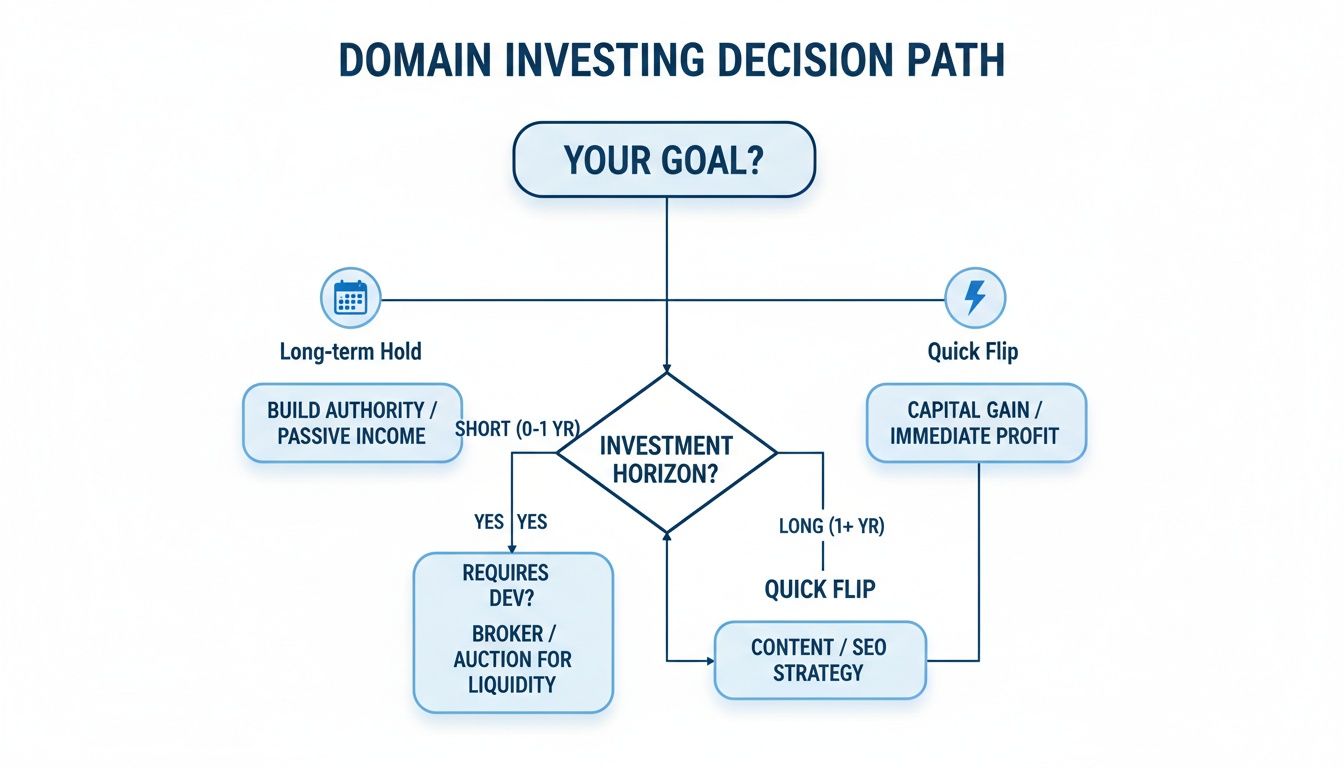
As you can see, the path you take—a quick flip versus a long-term project—changes which domains you should be looking for and what valuation metrics matter most.
Key Factors in Your Valuation Checklist
When you're ready to put a number on a name, don't just wing it. Run it through a systematic checklist that balances its technical strengths with its market appeal. For a much deeper dive, definitely check out our full guide on how to value domain names.
Here are the core factors to put under the microscope:
- Historical Sales Data: What have similar domains sold for? Use marketplace tools to find "comps," just like a real estate agent does. This gives you a crucial reality check on pricing.
- SEO Metrics: Time to dig into the numbers. How many high-quality referring domains does it have? What’s its Trust Flow? A strong, clean backlink profile is a massive value-add right out of the gate.
- Brand Potential: This is where the "art" comes in. Is the name short, memorable, and easy to spell? Does it sound like a real brand? A clunky, forgettable name has a very low ceiling, no matter how great its metrics are.
- Commercial Intent: How easily could someone make money with this domain? A name like
BestRunningShoes.comscreams commercial value. A more abstract or obscure name might be a much tougher sell.
By combining these factors, you can build a well-rounded valuation grounded in reality, not just hype. This methodical approach is what separates the pros from the amateurs and is the key to consistently finding domains that deliver a real return.
Building and Managing Your Domain Portfolio
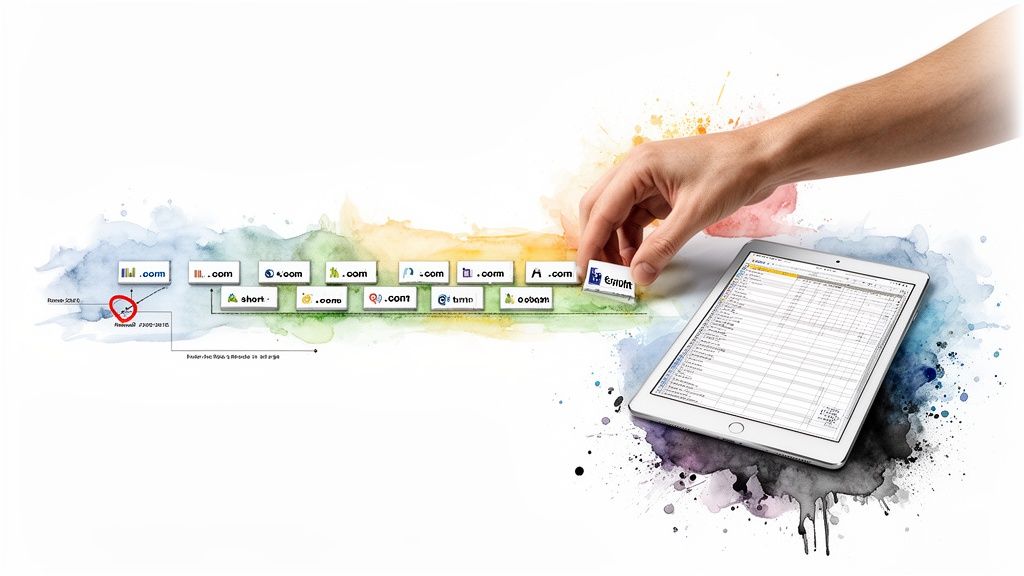
So, you've started snapping up some digital real estate. Congratulations! But just like buying a house, the work doesn’t stop when you get the keys. Now it's time to stop thinking like a collector and start acting like a portfolio manager.
This is the moment a casual hobby morphs into a serious investment strategy. The difference between sitting on a pile of digital clutter and cultivating a garden of high-growth assets comes down to one thing: having a clear plan for every single domain you own.
Organizing Your Digital Assets
Once your portfolio balloons from a handful of names to dozens—or even hundreds—organization becomes your secret weapon. Kicking things off with a simple spreadsheet is fine, but you need to track a lot more than just the domain names themselves.
For every single domain, you should be tracking:
- Acquisition Date and Cost: Pinpoint exactly when you bought it and for how much. This is non-negotiable for calculating your ROI down the line.
- Renewal Date: Missing a renewal is the cardinal sin of domain investing. Seriously. Set multiple calendar reminders to avoid the nightmare of losing a valuable asset by accident.
- Key Metrics at Purchase: Jot down the SnagScore, Trust Flow, referring domains, and other vital stats. This gives you a baseline to track how the domain’s value is maturing over time.
- Intended Exit Strategy: Earmark each domain for a specific play—is it a quick flip, a long-term hold, a development project, or a lease?
This simple habit of organization gives you a powerful, at-a-glance dashboard of your entire operation, helping you make smarter, faster decisions.
Deciding on an Exit Strategy
Not every domain in your portfolio is created equal. You need a specific game plan for each one, and it usually boils down to a few core options.
Think of yourself as the general manager of a sports team. Some players are brought in for immediate impact (a quick flip), while others are promising rookies you nurture for future stardom (a long-term hold).
Your primary strategies will almost always fall into one of these buckets:
- The Quick Flip: This is your play for domains with immediate, obvious commercial appeal that you scooped up for a bargain. The goal here is simple: list it on a marketplace like Sedo or Afternic within weeks or months and lock in a fast profit.
- The Buy-and-Hold: This strategy is reserved for your blue-chip assets—the highly brandable .coms or keyword-rich names in booming industries. The plan is to sit on these for years, letting their inherent value and market demand appreciate significantly.
- Leasing for Recurring Revenue: An often-overlooked but incredibly powerful move. Leasing a high-value domain to a business gives you a steady stream of monthly income while you wait for the perfect buyer to come along with a blockbuster offer.
This kind of structured approach ensures every asset you own is actively working for you, not just collecting digital dust. It’s the disciplined framework that separates the amateurs from the pros in the world of investing in domains.
Common Questions About Investing in Domains
Going after any new investment feels like stepping into the unknown. You can have the best map and all the right gear, but a few nagging questions can still hold you back from taking that first step. Let's clear the air and tackle the most common questions about domain investing so you can get started with confidence.
How Much Money Do I Need to Start?
This is the best part of the whole game—you don't need a Wall Street-sized bankroll to get in on the action. The barrier to entry is shockingly low. In fact, you can hand-register a brand-new domain name for as little as $10-15.
Plenty of successful investors got their start hunting for recently dropped domains, which you can often pick up for that standard registration fee. Platforms like NameSnag make this a lot easier by serving up a curated list of Available domains the moment they hit the market. It's a great way to find potential gems without a huge upfront investment.
Is Domain Investing Still Profitable?
Absolutely, but the game has changed. The old days of grabbing every obvious keyword domain are long gone, but the hunger for high-quality, brandable names has never been greater. Every single day, thousands of new businesses fire up their websites, and every single one of them needs a great online address.
The key today is to be strategic. You have to focus on specific niches, target expired domains that have some SEO history, and prioritize short, memorable names. The profit is still there for the taking; it just requires a much smarter, data-driven playbook.
The gold rush isn't over; the prospectors just have better tools now. Success in modern domain investing comes from leveraging data and spotting trends before the crowd does.
How Do I Know Which Domains Will Sell?
There's no crystal ball, but with the right data, you can get pretty close. A domain with real value usually checks a few key boxes: it’s short, memorable, easy to spell, and it ends in a trusted extension like .com.
Look beyond the name itself for signs of commercial appeal. Does it fit a growing industry? Does it have a clean history with strong SEO metrics, like a high Trust Flow or backlinks from reputable sites? Using a tool that rolls all this data into a simple score can save you countless hours of guesswork and steer you toward names with genuine market potential.
Where Should I Look for My First Domain?
If you're just starting out, your two best hunting grounds are available domains and expiring domains. Available domains are perfect for getting your feet wet because you can register them instantly and they're yours.
Once you’re more comfortable, you can start digging into Expiring domains. These are often higher-value assets with established histories that are about to drop. Setting alerts for these lets you do your homework ahead of time so you can be ready to pounce the second they're up for grabs.
Ready to find your first digital asset? NameSnag gives you the tools to discover, analyze, and acquire high-value domains without the endless manual research. Start your search and snag your perfect domain today at https://namesnag.com.
Find Your Perfect Domain
Get access to thousands of high-value expired domains with our AI-powered search.
Start Free Trial