So, you’ve stumbled upon the perfect domain name. It’s short, memorable, and captures your brand perfectly. There’s just one problem: you type it into your browser, and you get the dreaded "This domain is already taken" message.
We’ve all been there. It’s a gut-punch for any entrepreneur, marketer, or domain hunter. But a taken domain isn't always a dead end. The real question isn't if it's taken, but for how long.
Knowing a domain’s expiration date is the first move in a strategic waiting game. It’s the piece of intel that tells you when that name might just drop and become available for anyone to register. This is your entry ticket into the world of domain hunting, giving you the inside scoop on when a prized digital asset could finally be yours.
Why This Date Matters
Think of the expiration date as a clue. It helps you separate immediate opportunities from long-term pipe dreams. Is it expiring next week? Fantastic. Is it locked down for another nine years? Well, maybe don't hold your breath.
This simple piece of data is crucial for:
- Entrepreneurs trying to snag a brandable name for their next big idea.
- SEO professionals on the hunt for aged domains with existing authority.
- Domain investors aiming to acquire valuable assets to flip for a profit.
The fastest way to get this information is by doing a quick WHOIS lookup. This is a public record of who owns a domain and key dates associated with it. You just need to find the "Registry Expiration Date," which shows you exactly when the domain is up for renewal.
For instance, this is what a typical lookup on the official ICANN site looks like:
This guide will walk you through exactly how to find this information quickly and efficiently. We'll start with the most common and straightforward methods, giving you the tools to begin your search right away. Whether you’re just curious or on a serious hunt, you’ll know how to get the data you need.
Understanding the Domain Expiration Lifecycle
Discovering a domain's expiration date is like finding a clue on a treasure map. But what happens after that date passes? The domain doesn't just instantly become available for anyone to grab. Instead, it starts a predictable, multi-stage journey that every serious domain hunter needs to understand.
Mastering this timeline is the secret sauce that separates the amateurs from the pros. It’s why a simple date lookup is only the beginning.
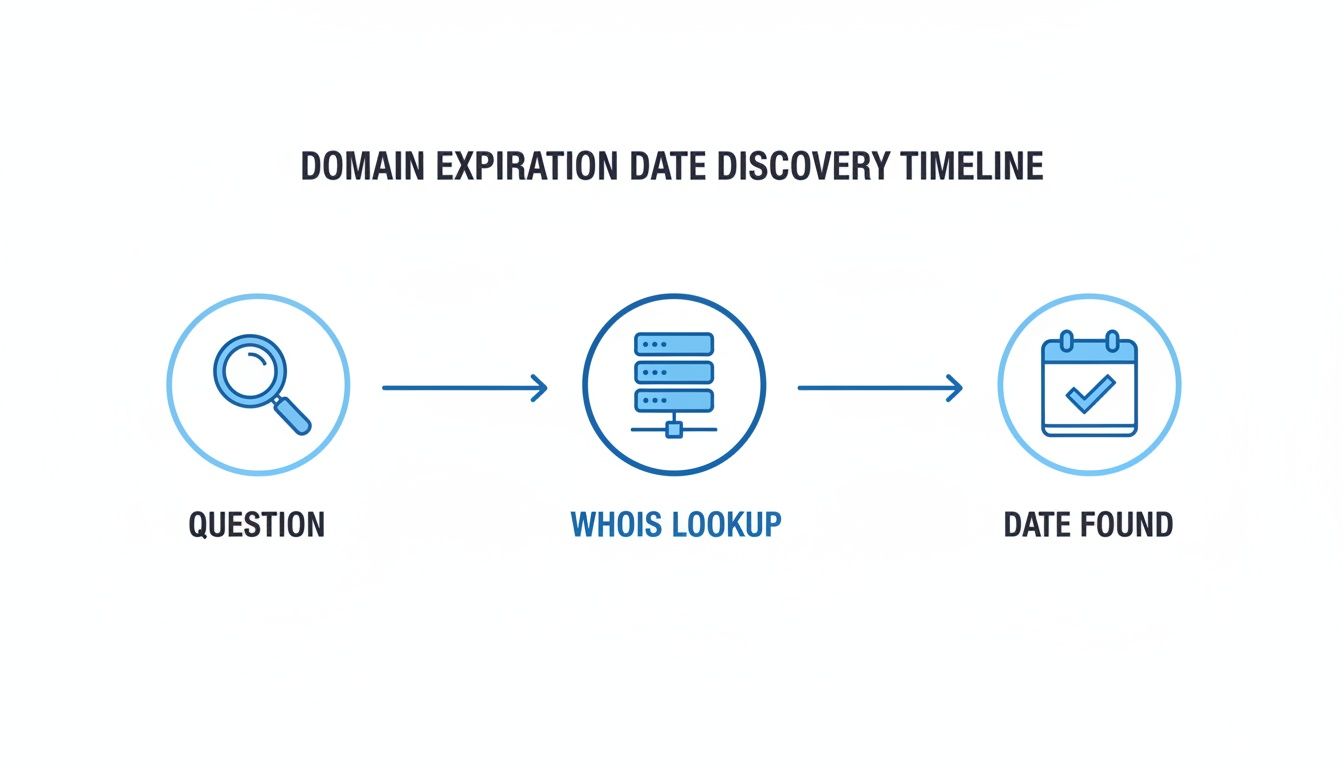
That initial query gives you the starting line, but the real strategy is in knowing the phases that come next. Let's break down this lifecycle so you can time your move perfectly.
The Grace Period
Once the expiration date hits, the domain enters the Grace Period. Think of this as the original owner's last chance to renew at the normal price, no questions asked. The length of this period varies by registrar but typically lasts anywhere from 0 to 45 days.
During this time, the domain usually stops working—the website goes down, and email services fail. However, it's still very much owned by the original registrant. For domain hunters, this phase is a waiting game.
The Redemption Period
If the owner doesn't renew during the grace period, the domain slides into the Redemption Period. This stage is much more serious and generally lasts for 30 days. The owner can still get their domain back, but now it comes with a hefty redemption fee on top of the regular renewal cost.
Pro Tip: A domain hitting the Redemption Period is a strong signal the owner might be letting it go. The high cost of recovery deters many people, which means the odds of it eventually dropping just went way up.
Understanding these first two phases is crucial. Just because a domain expired yesterday doesn't mean it's up for grabs. It has simply started its journey through this cycle.
The Pending Delete Phase
After redemption ends, the domain enters its final stage before being released: Pending Delete. This phase is short, lasting for just five days. At this point, the domain is locked down completely. No one—not even the original owner—can renew it. It's essentially in a queue, waiting to be wiped from the registry.
Once those five days are up, the domain is officially dropped. It becomes available for anyone to register on a first-come, first-served basis. This is the moment every domain hunter is waiting for.
This whole lifecycle, usually spanning 75 to 90 days, creates a predictable timeline you can use to acquire valuable domains. For a deeper dive into this process, check out our guide on what happens when a domain expires.
This is also why platforms like NameSnag make a critical distinction. We categorize domains still in their grace period as Expiring domains to give you a heads-up on what's coming. Domains that have completed the full cycle and can be registered instantly are labeled as Available domains, so you know you can act immediately.
Mastering the Tools of the Domain Trade
Alright, let's get our hands dirty. Enough with the theory—this section is your practical, no-fluff toolkit for domain hunting. We’re diving into the exact tools and techniques the pros use to find out when a domain expires and, more importantly, figure out which ones are actually worth your time.
First up is the classic WHOIS lookup. It's the bread and butter of domain investigation, kind of like running a license plate on a car. You can use web-based tools like the official ICANN Lookup service, which is dead simple to use and spits out all the key dates in a clean, easy-to-read format. Just pop in the domain, and you'll see its creation date, last update, and the all-important registry expiration date.

If you're more of a command-line person, you can often run a WHOIS lookup right from your computer's terminal. It’s faster, cuts out the website middleman, and gives you the raw, unfiltered data straight from the source. No fluff, just facts.
Understanding Market Trends and TLDs
Knowing how to check a date is one thing. Knowing which domains to check is where the real strategy kicks in. It turns out not all Top-Level Domains (TLDs) are created equal, and their expiration patterns tell a fascinating story about where the real opportunities lie.
The domain market is enormous, with over 375 million registrations globally, but the renewal rates tell the real story. Old-school, legacy TLDs like .com and .net have impressive renewal rates of around 75.3%. This tells us that owners see them as stable, long-term digital real estate and rarely let them go.
On the flip side, many newer generic TLDs (ngTLDs) like .tech, .shop, or .app have much lower renewal rates, sometimes hovering around 34.2%. You can learn more about these domain trends and how they’re shaping the market.
This difference is a goldmine for domain hunters. It means the market is constantly being flooded with expiring ngTLDs, creating a massive pool of opportunities. High-quality .com domains, in contrast, are like rare collector's items—they seldom drop, which only makes them more valuable when they do.
This knowledge helps you focus your energy. Instead of chasing a .com that’s probably locked down for another decade, you might find an absolute gem with a newer TLD that its owner is about to abandon.
A Tale of Two TLDs
Let’s say you’re looking for a domain for your new AI-powered scheduling app.
- You stumble upon
schedulepro.com. A quick WHOIS lookup shows it's registered for another eight years. The high renewal rate for .coms suggests the owner is almost certainly going to keep it. Chasing this one is likely a waste of time. - Then you find
schedule.io. Its expiration date is just next month. Since .io is a newer TLD with a lower renewal rate, there’s a much better chance the current owner might not renew, especially if it was for a side project they've since forgotten. This is a lead worth watching closely.
Understanding these market dynamics helps you hunt smarter, not harder. It lets you filter out the long shots and zero in on domains that are genuinely likely to hit the market soon. This is exactly how you can find killer names on NameSnag's list of expiring domains that are just about to enter the drop cycle.
How to Vet an Expiring Domain for SEO Value
Knowing when a domain expires is just the entry ticket. The real game is finding a name with serious SEO juice already baked in. Snagging a domain with built-in authority is like buying a used car and finding out it has a full tank of gas, a loyal fan club, and gets incredible mileage—it gives you a ridiculous head start.
This is all about turning a simple domain registration into a strategic asset. It means you have to look past the name itself and start digging into its history. The goal here is to find a diamond in the rough, not a ticking time bomb of spam that's going to blow up in your face.
Gauging a Domain's Strength with Key Metrics
The first thing any pro looks at is a domain's authority. Metrics like Domain Rating (DR) from Ahrefs or Trust Flow (TF) from Majestic give you a quick, at-a-glance snapshot of its backlink profile's strength.
A high DR usually means the domain has links from reputable sources. A high TF suggests those links are high-quality and trustworthy. Think of these metrics as your first filter. A domain with a DR of 30+ and a clean history is immediately more interesting than one with a DR of 2. It’s a simple way to separate the contenders from the pretenders without spending hours digging manually.
To really get a feel for a domain's potential, it helps to understand the fundamentals of what makes a site rank. Brushing up on essential ecommerce SEO best practices can give you a solid framework for your evaluation.
The Holy Grail: Residual Organic Traffic
Now for the real prize: residual organic traffic. This is the magic that happens when an expired domain still gets visitors from search engines, even though the website itself has been offline for ages. Imagine buying a domain that starts sending you a trickle of targeted visitors from the moment you put something—anything—live. That's the dream.
You can sniff this out using tools like Ahrefs or SEMrush. Just pop the domain in and see if it still ranks for any keywords. Even a handful of rankings for decent terms can mean instant, free traffic the second you launch.
Avoiding Hidden Traps and Spammy Histories
Heads up: not all old domains are good domains. Some come with a shady past, like being part of a private blog network (PBN) or getting smacked with a Google penalty. A spammy backlink profile can do way more harm than good, torpedoing your SEO efforts before you even get started.
This is why a thorough history check is absolutely non-negotiable. You need to look at its past content using the Wayback Machine to make sure it wasn't used for anything sketchy. For a more detailed breakdown of what to look for, you might want to check out our guide on how to properly check a domain's history.
This whole vetting process—checking metrics, traffic, and history—is precisely what we built NameSnag to automate. Instead of juggling multiple tools and subscriptions, you can see all these data points in one clean interface. We analyze over 170,000 domains every single day, scoring each one to surface the hidden gems and flag the risky ones. It saves you from hours of tedious, mind-numbing research so you can just focus on finding high-value domains for your next project.
Automate Your Hunt to Never Miss a Great Domain
Let's be real: manually checking dozens of domains every single day is a surefire way to burn out. The pros don’t do it, and you shouldn't either. The secret to consistently snagging high-value domains isn't grinding harder—it's automating smarter. It's time to stop chasing opportunities and start having them delivered right to your inbox.
This is where you gain a serious edge. By setting up alerts and watchlists, you build a system that pings you the moment a domain you're tracking hits a new expiration phase. This isn't just about saving time; it’s about being first in line when a killer name finally drops.
Your Secret Weapon: Early Access Alerts
Imagine getting a heads-up before a valuable domain hits the public auctions or becomes a free-for-all. That's the power of strategic monitoring. Tools like "Early Access Alerts" and "Watchers" become your personal scouts, keeping an eye on the domains you care about 24/7.
Here’s how this plays out in the real world:
- You build a watchlist. You've found a handful of perfect domains, but they're all taken. Instead of a flimsy calendar reminder, you add them to a dedicated watchlist.
- You get instant notifications. The system monitors their status around the clock. The second one of them isn't renewed and slips into its grace period, you get an alert.
- You stay ahead of the curve. Now you know exactly which domains are starting their journey toward deletion, giving you weeks to map out your acquisition strategy.
This proactive approach is an absolute game-changer. For a deeper dive into building an effective system, check out our complete guide to creating a custom domain name monitor.
By automating your search, you transform domain hunting from a reactive, time-consuming chore into a strategic, opportunity-driven process. You’re no longer guessing; you're operating with intel.
Filtering for the Gold
Automation isn't just about getting alerts for names you already know. It's also about building a pipeline of high-quality leads that match your exact criteria. Forget sifting through endless lists of junk—you can set up filters that bring the best opportunities directly to you. To pull in this kind of data at scale, many pros use things like web scraping proxies to gather information without getting blocked.
Platforms like NameSnag let you zero in on what truly matters. You can browse domains that just became Available domains today or look ahead at Expiring domains that will be dropping in the next 7 or 30 days. This lets you build a system that works for you, whether you’re flipping for profit or building out a new niche site.
A Few Lingering Questions About Domain Expiration
Got a few more questions rattling around in your head? Good. That means you're taking this seriously. Let's tackle some of the most common things people ask about finding when a domain expires and what that information is really worth.
What's the Fastest Way to Check a Bunch of Domain Expiration Dates at Once?
If you're just kicking the tires on a handful of domains, a free bulk WHOIS lookup tool online is your best bet. They're quick, dirty, and get you the basic dates without any fuss.
But let's be real: for serious investors, agencies, or anyone tracking hundreds of domains, that method falls apart fast. It just doesn't scale. That's when you graduate to a specialized platform. These services are built for volume, giving you a full dashboard of metrics that go way beyond a simple expiration date and saving you from a world of manual, soul-crushing work.
The Domain Just Expired. Can I Snag It Right Now?
This is a big one, and the short answer is almost always no. When a domain's registration officially lapses, it doesn't just fall into the open market. First, it enters a "Grace Period," which can be up to 45 days, where the original owner can waltz back in and renew it. It's still their property, even if the website is down.
If they don't bite, it then moves into a "Redemption Period" for another 30 days or so. They can still get it back, but now it comes with a hefty penalty fee. Only after jumping through all those hoops does the domain finally get "dropped" and become available for anyone to register. You can find these freshly dropped, ready-to-register gems on our list of Available domains.
Why Is Some WHOIS Information Marked "Private" or "Hidden"?
Ever run a WHOIS check and hit a wall of generic, redacted info? You've just met a WHOIS privacy service. A lot of domain owners use these to shield their personal info—name, address, phone number—from spammers, scammers, and the public eye.
The service acts like a middleman, swapping the owner's real details with the registrar's generic contact information. It’s an effective shield for personal identity, but here's the key: it almost never hides the registration dates. You can almost always still see when the domain was created, last updated, and—most importantly—when it's set to expire.
Does a Domain's Age Actually Matter for SEO?
Absolutely. Think of an older domain like a business that's been on the same street corner for years. It has history, a reputation, and a certain amount of built-in trust. Search engines tend to see older domains in a similar light, viewing them as more established and trustworthy, which can give you a nice SEO head start.
An aged domain often comes with a legacy of backlinks and authority that a brand-new domain just can't compete with. But—and this is a big but—age alone isn't a silver bullet. A 10-year-old domain that spent its life as a spam farm is poison. It’s far less valuable than a 3-year-old domain with a squeaky-clean history and links from reputable sites. Always, always dig into its past before you commit.
Ready to stop the guesswork and start finding high-value domains with clean, verified histories? NameSnag automates the entire discovery and vetting process. Find Expiring domains with serious SEO potential today.
Find Your Perfect Domain
Get access to thousands of high-value expired domains with our AI-powered search.
Start Free Trial