Ever feel like all the good domain names are taken? You’re not entirely wrong, but you might be looking in the wrong place. The internet is a digital graveyard of abandoned properties, and some of them are prime real estate. I'm talking about expired domains packed with SEO power, just waiting for a savvy treasure hunter like you to scoop them up. This isn't about luck; it's about knowing where to dig.
Welcome to the Expired Domain Gold Rush
If you've ever launched a new website, you know the soul-crushing grind of building authority from zero. It can take months, sometimes years, of relentless effort just to earn a few decent backlinks and convince Google you're not another fly-by-night operation. Finding a great expired domain lets you skip that entire ordeal.
Think of it like buying a house versus building one from scratch. Instead of pouring a foundation on an empty lot, you're acquiring a property that already has plumbing, electrical, and maybe even a bit of history. You get established backlinks, domain age, and sometimes a trickle of leftover traffic. You get to bypass Google's dreaded "sandbox" and start with a real foundation of authority. For SEOs and niche site builders, this is a total game-changer.
Why Is Everyone Talking About This Now?
The secret's been out for a while, and the market is officially booming. We're looking at a domain aftermarket industry already valued at $0.64 billion and projected to rocket to $1.17 billion by 2033. With over 370 million registered domains out there, the competition for good ones is insane. The big marketplaces see millions of searches every month from pros hunting for gems, which is why smart investors are turning to specialized tools to get an edge. You can learn more about these market dynamics to see just how hot this space has become.
Before we dive deep, let's quickly break down why this strategy is worth your time.
Why Bother with Expired Domains? A Quick Look
| Benefit | What It Means for You | Best For |
|---|---|---|
| Instant Authority | Skip the "Google sandbox" and inherit an existing backlink profile and domain age. | SEO projects, new niche sites, authority sites. |
| Cost-Effective SEO | Acquire powerful links for a fraction of the cost and effort of manual outreach. | Anyone on a budget trying to compete with bigger players. |
| Ready-Made Traffic | Some domains still receive direct or referral traffic you can redirect or build upon. | PBNs, 301 redirects to a primary money site, affiliate marketing. |
| Brandability | Find short, memorable, or keyword-rich names that are no longer available new. | New businesses, product launches, rebranding efforts. |
Simply put, finding a great expired domain isn't just some clever trick; it's a proven, data-backed strategy. You can accelerate your SEO results and snap up valuable digital assets for pennies on the dollar.
Key Takeaway: Finding expired domains isn't just a clever trick; it's a proven, data-backed strategy for accelerating SEO results and acquiring valuable digital assets for a fraction of their worth.
In this guide, we’re going to ditch the dry, technical stuff and get straight to the good part: how to actually find and buy domains that can make you money. You’ll learn exactly how to uncover domains with powerful backlinks, how to vet them like a pro so you don't buy a lemon, and how to snag them before your competition even knows they're available. Let’s get to it.
How to Find Diamonds in the Digital Rough
So where do these digital gems actually hide? Finding valuable expired domains is part art, part science. You could manually sift through endless lists, but that’s like panning for gold with a teaspoon. The real magic happens when you use a smart platform that does the heavy lifting for you.
You'll generally run into two main categories of these domains. Each one is at a different stage of its lifecycle and, as you'd expect, requires a slightly different game plan. Honestly, to get a real edge in either category, learning how to extract data from a website is a killer skill. It lets you pull together the right info and make calls based on data, not just a gut feeling.
Available Domains: The Instant Gratification Grab
First up are the Available domains. These are the ones that have gone through the entire expiration cycle—grace periods, redemption periods, the whole nine yards. They've been officially dropped by the registry and are now fair game for anyone to register immediately.
Think of them as move-in-ready properties. You see one you like, you can claim it on the spot at any registrar. The upside is speed and simplicity. The downside? The best ones get snatched up in milliseconds.
Using a platform like NameSnag lets you filter specifically for these domains, giving you a real-time list of what just hit the open market.
This process chart shows the simple flow from uncovering an opportunity to making it yours.
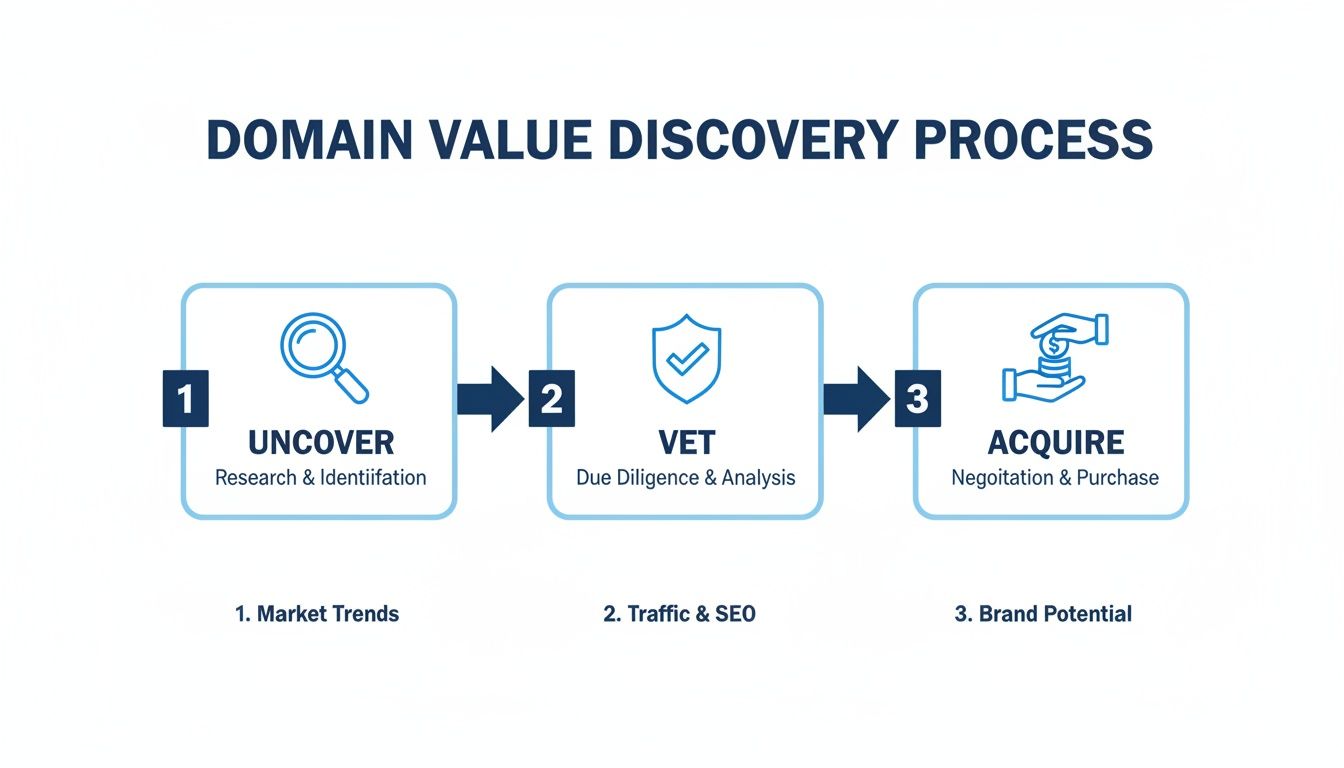
Ultimately, success hinges on a disciplined process of discovery, rigorous vetting, and swift acquisition.
Expiring Domains: Your Early Access Pass
The second category is Expiring domains, and this is where the real strategic advantage lies. These domains have expired but are still locked in a grace or redemption period. They haven't been released to the public yet, but they will be soon.
This is your early warning system. It gives you a crucial head start to do your research, vet the domain's history, and decide if it's worth pursuing before it becomes a free-for-all. NameSnag’s list of expiring domains is essentially your backstage pass to see what's coming down the pipeline.
You can then place a backorder, which is like calling dibs. If you’re the only one, you get it for a standard fee. If others want it too, it usually goes to a private auction.
Pro Tip: Don't just look at the raw numbers. A domain's story—its past content, the quality of its backlinks, and its brand potential—often tells you more than a simple metric score. A good expired domain finder will give you the tools to investigate this history.
Using Time Filters to Your Advantage
The sheer volume of domains dropping daily can be overwhelming. This is why time filters are your best friend. Instead of looking at a massive, soul-crushing list of everything that has ever dropped, you can narrow your focus to what's fresh and actionable.
Most tools, including NameSnag, let you slice and dice the data by timeframes like Today, 3 Days, 7 Days, 14 Days, or 30 Days.
- Today: See what just became available right now. This is for the fast movers who are ready to pounce.
- 3 or 7 Days: A great way to catch recent drops you might have missed over the weekend or a few busy days.
- 14 or 30 Days: Useful for broader research and spotting trends without the pressure of a ticking clock.
This constant churn of domains is a predictable market force, driven by something as simple as domain renewal habits. Legacy domains like .com maintain rock-solid renewal rates above 80%. But newer TLDs? They lag at just 34.2%, meaning over 65% drop off annually—pumping millions into the expired pool each year.
This is what creates consistent waves of opportunity for savvy hunters. By focusing your search, you avoid analysis paralysis and can zero in on the freshest domains before your competition even knows they exist.
Your Ultimate Vetting Checklist
Grabbing an expired domain without doing your homework is like buying a used car without popping the hood. It might look shiny on the outside, but you could be buying a total lemon. A high Domain Authority (DA) score is a decent starting point, but trust me, it’s just the tip of the iceberg.
This is your due diligence checklist. We're going to get our hands dirty and inspect every part of the engine before you even think about placing a bid.
Uncovering Spam and Penalties
First thing's first: you need to play detective. Has this domain lived a clean life, or does it have a sketchy past? A domain that was part of a shady Private Blog Network (PBN) or got blasted with thousands of junk links could land a Google penalty right in your lap.
Start by digging into its history. The Wayback Machine is your time machine here. It shows you snapshots of what the site looked like over the years. Look for sudden, jarring changes in content or design. Did it flip from a legitimate business blog to a site pushing casino links or pharma ads overnight? That’s a massive red flag.
Next, check its Google Index status. A quick site:domain.com search in Google reveals if its pages are still indexed. If nothing shows up, the domain was likely de-indexed—often a sign of a penalty you don't want to inherit. To really get the full story, you should also check the domain's full history to get a complete picture of its past lives.
Analyzing the Backlink Profile
Let's be clear: not all backlinks are created equal. A domain with 10 links from authoritative university sites is worlds more valuable than one with 10,000 links from spammy, foreign-language forums. This is where you separate the contenders from the pretenders.
Your job is to assess the quality, not just the quantity, of its links.
- Referring Domains: Who is linking to this domain? Are they reputable sources in a relevant niche? High-authority links from
.eduand.govsites are the gold standard. - Anchor Text Distribution: What's the clickable text in the hyperlinks look like? A natural profile has a healthy mix of brand anchors (like "NameSnag"), naked URLs ("namesnag.com"), and generic phrases ("click here"). If you see a ton of exact-match keywords (like "best expired domain finder"), it’s a dead giveaway of manipulative link building.
- Link Velocity: A sudden, unnatural spike in backlinks often means the previous owner bought a spammy link package. A healthy backlink profile is one that grew steadily over time.
A clean, relevant, and authoritative backlink profile is the engine of an expired domain's SEO value. A toxic profile is a guaranteed way to stall your project before it even starts.
Assessing Brandability and Potential
Once a domain clears the technical checks for spam and backlinks, it’s time to think about its future as a brand. A domain could have stellar metrics, but a name like top-seo-guru-123.net probably isn't the foundation for your next big project.
Ask yourself a few simple questions:
- Is it memorable and easy to spell? If you have to spell it out every time you say it, it's not a winner.
- Is it relevant to your niche? The name should give people a clue about what you do.
- Is it concise? Shorter is almost always better.
- Are there any trademark issues? A quick search can save you from a legal nightmare.
This step is easy to overlook but is absolutely crucial for long-term success. You want a name you can build a real brand around, not just a temporary SEO play.
To make this process more systematic, I've put together a simple scorecard. Run every potential domain through this checklist before you pull the trigger.
Expired Domain Vetting Scorecard
This simple table helps you systematically evaluate a domain's quality and potential risks, turning a complex process into a straightforward checklist.
| Checklist Item | What to Look For (Green Flags) | What to Avoid (Red Flags) |
|---|---|---|
| Google Index Status | Pages are indexed (site:domain.com search). |
Domain is de-indexed (no results appear). |
| Wayback Machine History | Consistent, on-topic content history. | Sudden topic changes, spam, foreign content. |
| Backlink Quality | Links from relevant, high-authority sites. | Links from PBNs, spam sites, irrelevant niches. |
| Referring Domains | A diverse profile of quality linking sites. | A high number of low-quality or spammy domains. |
| Anchor Text Profile | Natural mix of branded, URL, and generic anchors. | Over-optimization of exact-match keyword anchors. |
| Brandability | Short, memorable, easy to spell, no hyphens. | Long, awkward, includes numbers, potential TM issues. |
| Domain Extension | Reputable TLD like .com, .org, or .net. |
Obscure or spam-prone TLDs. |
This scorecard isn't exhaustive, but it covers the most critical red flags. If a domain trips more than one of these, it's usually best to walk away and find a better opportunity.
The Power of a Consolidated Score
Juggling all these data points—DA, backlink quality, spam signals, brandability—can get overwhelming fast. This is where a consolidated score becomes your best friend.
Platforms like NameSnag use a SnagScore that rolls dozens of these metrics into one simple number. It crunches Trust Flow, referring domains, domain age, spam flags, and even brand potential to give you an at-a-glance verdict.
Think of it as the final inspection report from a trusted mechanic. It saves you hours of manual work, helping you filter out the junk and focus your energy only on the domains with real potential. It's an essential tool if you want to find great expired domains efficiently and at scale.
Matching Domain Value to Your Goals
Not every good domain is good for the same reason. It's a classic case of "different horses for different courses." A killer one-word .com might be a branding goldmine but totally wrong for a quick SEO project. On the flip side, a domain with a clunky name but a powerhouse backlink profile could be an affiliate marketer's dream.
It all boils down to matching a domain's innate strengths to what you’re trying to accomplish.
You've got to develop an instinct for value. Think of it like this: you wouldn’t buy a pile of lumber without knowing what you plan to build. A solid grasp of fundamental Search Engine Optimization (SEO) principles is your starting point, as it forms the bedrock for seeing the true potential in these digital assets.
Let’s get into the three main ways people put these domains to work.
The SEO Powerhouse
This is the classic play, the one that got most of us into hunting for expired domains in the first place. The mission is simple: inherit authority. You're on the hunt for domains with raw, unfiltered SEO muscle—we're talking strong backlinks from legit sites, high Trust Flow, and a history cleaner than a whistle.
Honestly, the name itself often doesn't matter much.
These domains are perfect for two main strategies:
- 301 Redirects: Find a powerful, relevant domain, buy it, and slap a permanent redirect on it pointing to your main money site. This is a direct way to pass its "link juice" and authority over, often giving your primary site a very nice bump in the rankings.
- Building New Niche Sites: Starting a new affiliate or content site on an aged domain gives you a ridiculous head start. You get to skip Google's dreaded "sandbox" period and launch with an authority profile that might otherwise take years of blood, sweat, and tears to build from scratch.
When you're after an SEO powerhouse, you filter for high metrics, period. A name like IndustrialCompressorPartsJournal.net isn't going to win any beauty contests, but if it has a dozen links from top engineering universities? That thing is an absolute beast for the right project.
The Brandable Asset
Here, we flip the script completely. When you're launching a startup, a new product, or doing a full-on rebrand, the name is everything. Your search criteria shifts to domains that are short, memorable, easy to spell, and ideally, a .com. SEO metrics are a fantastic bonus, but they are not the main event.
Think about it. A name like Glow.com or Mint.com is a priceless brand asset on its own. It just sounds right.
When you're hunting for brandable gems, you're looking for:
- Brevity: One or two words is the holy grail.
- Memorability: Does it stick in your head after you hear it once?
- Pronounceability: If you can't say it, you can't share it. Simple as that.
- Market Relevance: Does the name feel at home in the industry you’re targeting?
The search for these brandable names is incredibly competitive, but man, the payoff can be huge. Finding a short, catchy name that was simply forgotten or dropped is one of the most exciting wins you can have in this game.
The perfect brandable domain tells a story and creates an instant connection. The SEO value is the cherry on top, not the whole sundae. Your priority is finding a name that can carry a brand for the next decade.
The Lucrative Domain Flip
The final category is all about the art of the deal: domain flipping. This is where you acquire an undervalued domain with the sole intention of selling it for a profit. This strategy demands a unique blend of the first two. A great flip candidate needs to have both a marketable, brandable name and some solid underlying metrics to back it up.
A flipper is like a connoisseur, spotting potential that others miss. They might find a domain with a great name that also happens to have a decent backlink profile, clean it up a bit, and then market it to an end-user who needs both of those qualities. The value proposition is crystal clear: you're selling a turnkey asset that combines brand appeal with an SEO foundation.
In this massive digital world, where global domain registrations have rocketed past 375 million names, the hunt for expired domains is a true gold rush. Keep an eye on the new gTLDs (ngTLDs), which have 37.8 million registrations and are seeing a huge 13.5% growth spurt. They often have lower renewal rates, which means they spit out high-potential expired gems more frequently. This is where tools that sift through 170,000+ domains every single day become your best friend.
Whether you're building, branding, or flipping, matching the domain to the mission is the secret sauce.
Mastering the Acquisition Game
You’ve done the hard work. You've sifted through countless options, vetted a prime candidate until you know its history better than its last owner, and confirmed it's a perfect match for your goals. Now for the fun part: making it yours. Finding a great expired domain is only half the battle; actually acquiring it is where strategy and speed really come into play.
The acquisition itself can be anything from a ridiculously simple registration to a nail-biting, adrenaline-fueled auction. The path you take depends entirely on whether the domain is just expiring or has already dropped.

The Backorder Gambit for Expiring Domains
Let's start with domains that are still in their final countdown. These are the gems you find on an Expiring domains list—they aren't publicly available yet, but their doom (or your payday) is imminent. For these, your weapon of choice is the backorder.
Think of a backorder as calling "shotgun." You're telling a specialized service, "Hey, the second that domain becomes available, I want you to register it for me." It’s a proactive move that puts you right at the front of the line.
- If you're the only one who backordered it: Congratulations! The domain is usually yours for the cost of the backorder fee plus a standard registration fee. It’s a clean, simple win.
- If multiple people backorder the same name: This is where things get interesting. The domain typically heads to a private auction, open only to those who placed a backorder. The highest bidder takes it home.
The key to winning these auctions without emptying your wallet is to set a firm budget before the bidding starts. Know exactly what the domain is worth to your project and stick to that number. It’s way too easy to get swept up in the heat of the moment and overpay.
Don’t let ego drive your bids. The goal is to acquire a valuable asset, not just to win. If the price climbs past your calculated ROI, walk away. There will always be another domain.
The Race for Available Domains
Now, what about domains that have already completed their expiration cycle? These are the Available domains that have been officially dropped by the registry and are back on the open market. Grabbing one of these is less about strategy and more about pure, unadulterated speed.
The moment a valuable dropped domain becomes available, it's a mad dash. High-value names are often snagged by automated bots—"drop catchers"—within milliseconds of being released. Trying to manually register a top-tier domain the second it drops is like trying to catch a bullet with your bare hands. Possible, but highly unlikely.
This is why having a system is crucial. Using a platform that sends you an alert the instant a domain on your watchlist drops is non-negotiable. This gives you the head start you need to get to your registrar and hit that "register" button before anyone else. Every second counts.
Navigating Aftermarket Marketplaces
There's a third route to acquiring a great domain, and it often involves one that never truly expired. Sometimes, a savvy investor grabs a high-potential domain and lists it for sale on an aftermarket marketplace like GoDaddy Auctions, Sedo, or Flippa. These aren't expired domains in the technical sense; they're pre-owned domains being sold by their current owner.
Buying from a marketplace has its own set of rules:
- Set Prices: Some domains are listed with a "Buy It Now" price. If you like the price, you can purchase it instantly.
- Negotiation: Others are open to offers, allowing you to haggle directly with the seller.
- Public Auctions: Many of the best names go to a public auction where anyone can place a bid.
When you're buying from a marketplace, your vetting process is just as critical as ever. You still need to dig into the domain's history and backlink profile. The seller might highlight its strengths, but it's your job to uncover any hidden weaknesses. For a deeper dive into the nuances of this process, our guide on how to buy expiring domains offers more advanced tactics.
Ultimately, whether you're placing a backorder, racing to register, or negotiating on a marketplace, the principle is the same. Be prepared, act fast, and know your budget. That’s how you master the acquisition game.
A Few Lingering Questions
Alright, we've walked through the whole nine yards, from spotting gems in the digital junkyard to closing the deal. Still, if you're like me, there are probably a few questions rattling around in your head. Happens to everyone, from first-timers to grizzled domain veterans.
Let's clear the air and tackle some of the most common ones I hear.
What's the Real Difference Between Expiring, Expired, and Dropped?
It all comes down to where a domain is in its lifecycle, and timing is absolutely everything. Think of it like a countdown.
An expiring domain is the first warning shot. The owner blew past their renewal date, kicking the domain into a grace period. It's not available to the public yet, but it's on deck. This is your chance to get ahead of the competition by placing a backorder after spotting it on an expiring domains list.
An expired domain is the next stage. It survived the grace period and is now in what's called "pending deletion." The domain is effectively locked—you can't register it, but it's about to be jettisoned back into the wild.
A dropped or available domain is the main event. It's been fully released by the registry and is now up for grabs. Anyone can register it instantly on a first-come, first-served basis. You'll find these on an available domains list, but the good ones disappear in a flash. You have to be quick.
Can I Get in Trouble for Buying a Domain with a Bad History?
Oh, absolutely. This isn't just a boogeyman story; it's a real and potentially painful lesson.
If a domain was a spam cannon, part of a shady PBN, or got smacked with a manual penalty from Google, all that baggage comes with it. You inherit its history, good or bad. It's like buying a beautiful classic car, only to discover it was used in a bank heist—you’re going to have some explaining to do, and it won't be fun.
This is precisely why the vetting process we covered earlier isn't just a suggestion. It's mandatory.
Key Insight: Buying a domain blind is the single biggest—and most expensive—mistake you can make. A toxic backlink profile or a Google penalty can make a domain completely worthless, turning your investment into a write-off.
You absolutely have to check its past with the Wayback Machine, run its backlink profile through a tool to look for poison, and confirm its Google index status. A clean bill of health isn't a bonus feature; it's the price of entry.
Should I 301 Redirect or Build a New Site?
This is the classic fork in the road, and the right path depends entirely on what you're trying to accomplish. There's no single "best" answer, just the best strategy for your project.
Go with a 301 Redirect if: You already run an established website and stumble upon a highly relevant expired domain with a killer backlink profile. A 301 is a fantastic way to pipe all that valuable "link juice" and authority straight to your main site, giving it an immediate SEO shot in the arm. The key here is relevance. Redirecting a blog about dog grooming to your SaaS company is a waste of time.
Build a New Site if: You snag a domain with solid metrics in a niche you've been wanting to break into. Building a fresh site on it gives you a massive head start. You get to skip the dreaded "Google sandbox" that plagues brand-new domains and begin with a foundation of authority already in place.
Think of it this way: a 301 redirect reinforces the castle you already own. Building a new site is like acquiring a pre-built fortress in new territory.
How Much Should I Expect to Pay for a Good Domain?
That's the million-dollar question—and sometimes, the answer is literally a million dollars. The price for an expired domain is all over the map, driven by its value, the demand for it, and how you acquire it.
On the low end, a recently dropped domain with decent-but-not-amazing stats can often be hand-registered for a standard fee, usually around $10 to $15. These are your bread-and-butter finds, and they happen all the time.
But for a high-value domain? The kind with premium backlinks from .edu or .gov sites, a squeaky-clean history, and a short, brandable name? That's going to attract a crowd. If it goes to a backorder auction, the price can jump from a few hundred dollars to several thousand in a hurry.
Your budget should always be anchored to the domain's potential ROI for your specific project. Don't get sucked into a bidding war for a domain that won't pay for itself.
Ready to stop guessing and start finding high-value domains with confidence? NameSnag uses AI to analyze over 170,000 domains daily, giving you a clear SnagScore so you can spot the gems instantly. Start your search for the perfect Available or Expiring domain today.
Find Your Perfect Domain
Get access to thousands of high-value expired domains with our AI-powered search.
Start Free Trial