Welcome to the wild world of GoDaddy Auctions, the internet's biggest marketplace for secondhand domains. Think of it less like a stuffy auction house and more like a sprawling digital bazaar, where thousands of valuable, expired, and forgotten domain names get a second chance with a new owner.
If you’re a savvy entrepreneur or investor, this place is an absolute goldmine. You just have to know where to dig.
So, What's This All About?
Ever wonder what happens to a great domain name when someone forgets to renew it? It doesn’t just poof into thin air. Many of the best ones end up right here, in the bustling aisles of GoDaddy's auction, teeming with opportunity—and the occasional bidding war.
This isn't just about buying a name. It's about acquiring a piece of digital history, a ready-made brand, or a powerful SEO asset that someone else let slip through their fingers.
This guide is your complete playbook. I’m here to walk you through the entire process, from finding those undervalued gems to outmaneuvering the competition. No confusing jargon, no risky guesswork. Just straight-up, actionable strategy.
Here’s What We're Going to Cover
I’ll break down everything you need to know to play the game like a seasoned pro. Here’s a quick look at the game plan:
- Getting Set Up: First things first. We'll get your auction account created and make sense of the fees so there are no surprises.
- Finding the Good Stuff: I'll show you the advanced search and filtering techniques I use to sift through thousands of listings and pinpoint domains with actual potential.
- Vetting Like a Pro: This is critical. You'll learn how to check a domain's past for spam, analyze its backlink profile, and properly gauge its age and brandability. Don't buy a lemon.
- Mastering Your Bidding Strategy: We’ll get into the psychology of bidding, covering everything from proxy bids to last-minute "sniping" to win without overpaying.
- The Winner's Circle: From sealing the deal to handling payment and transfers, I’ll guide you through the entire post-win process.
The secret to winning at domain auctions isn't just about having the deepest pockets. It's about having better information and a smarter strategy. Your real advantage is knowing how to spot value where others don't.
Now, sometimes the smartest move is to avoid the auction frenzy entirely. While a bidding war can land you a premium name, you can often find fantastic Available domains that were just dropped and are ready for instant registration. It’s also a killer tactic to monitor Expiring domains; this gives you a chance to prepare before they even hit the auction block.
This guide is packed with real-world advice to help you land domains that can become powerful brands or profitable flips. Let's dive in.
Finding and Vetting Your Next Winning Domain
Hunting for a great domain on GoDaddy Auctions is part art, part science. Think of it as a digital treasure hunt. Thousands of names are listed every day, but the real gold is almost always buried deep. To find it, you have to become a master prospector, digging past the obvious keyword searches to find the hidden value.
This isn't just about grabbing a name that sounds cool, either. It’s about finding a domain with a clean history and a strong foundation. A name with a sketchy past can bring a world of hurt—from existing Google penalties to a trashed reputation you didn't even know about.
Mastering the Search Filters
First things first: you have to cut through the noise. GoDaddy’s advanced search filters are your best friend here. Don't just type in a keyword and cross your fingers. Get strategic.
- Filter by Age: Older domains often carry more authority with search engines. I like to filter for domains that are at least 5-10 years old to find names with some established history.
- Set a Price Range: To keep yourself honest and on budget, set a maximum price right away. This keeps you from even seeing the high-ticket domains that can distract you from finding a true undervalued gem.
- Traffic and Valuation: Take GoDaddy’s valuation tool with a huge grain of salt. It's just an algorithm. The traffic numbers, however, can sometimes be a clue that a domain was recently active, which is always worth investigating.
This simple flow breaks down the auction journey into its three core stages, from discovery to ownership.
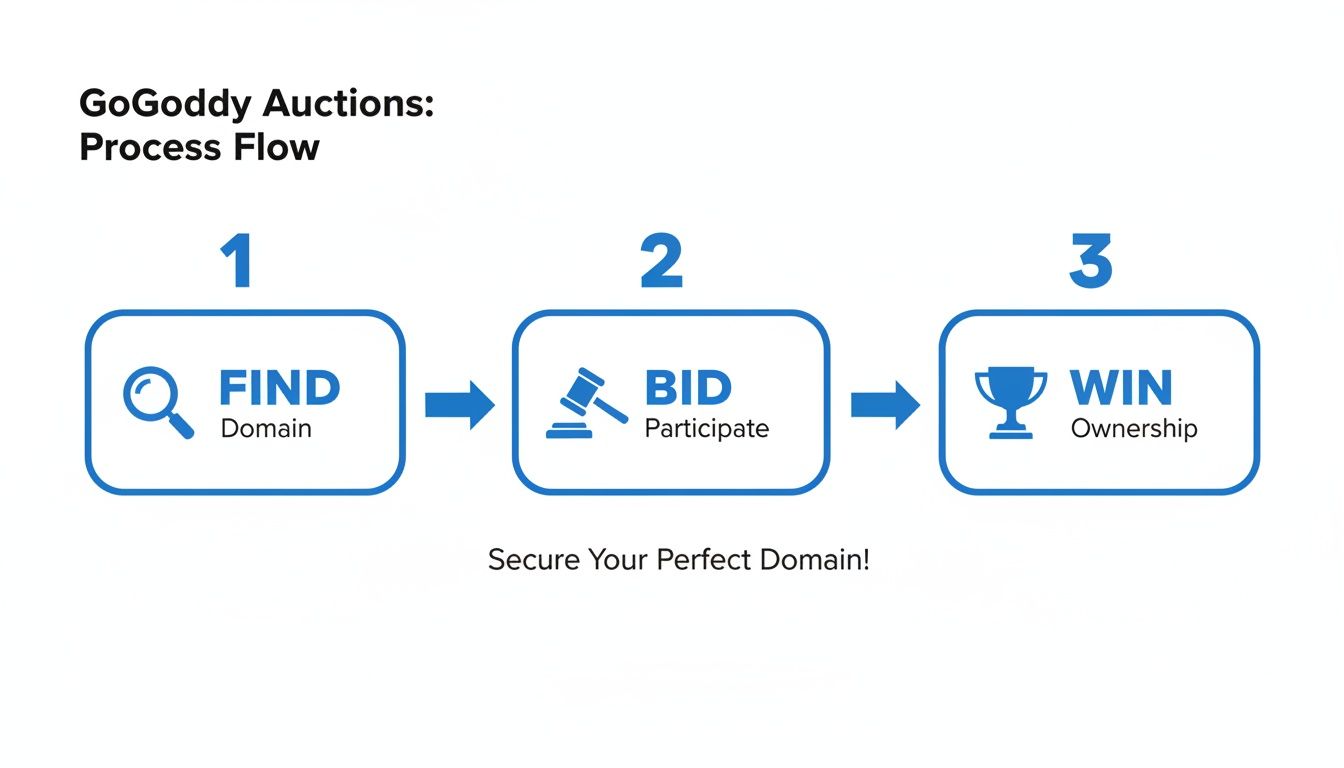
Ultimately, winning isn't just the final click of a button. It’s the result of a disciplined process that starts with smart searching and painstaking vetting.
The Critical Vetting Process
Once you’ve got a shortlist of promising candidates, the real work begins. This is where you separate the digital diamonds from the duds. I’ll say it again: never, ever bid on a domain without doing your due diligence.
A primary tool in your arsenal should be the Wayback Machine from the Internet Archive. This incredible resource shows you snapshots of what a website looked like in the past. Was it a legit business? A spammy link farm? Something much, much worse? This historical context is priceless. We dive deeper into how to use it in our guide to the Archive.org Wayback Machine.
The single biggest mistake new bidders make is falling in love with a name before checking its history. A great-sounding domain with a toxic backlink profile isn't an asset; it's a liability waiting to happen.
Beyond how it looked, you need to dissect its backlink profile. Tools like Ahrefs, Moz, or Majestic show you exactly who has linked to the domain over the years. Keep an eye out for these red flags:
- A ton of links from low-quality, foreign-language, or adult sites.
- Anchor text packed with spammy keywords like "cheap viagra" or "online casino."
- A sudden, sharp drop in referring domains, which could signal a past penalty.
Mastering Your Bidding Strategy and Psychology
Alright, you've found a domain you love and confirmed its history is clean. Now for the fun part: the battle. Winning at a GoDaddy domain name auction isn't just about throwing money at the screen; it’s a game of chess. Psychology, timing, and a cool head are your most powerful pieces.
Getting this right is the difference between snagging a bargain and getting swept up in a bidding war that torches your budget.
This is where so many newcomers stumble. They let emotion take the wheel, fall in love with a name, and start making irrational bids. You have to treat this like a calculated investment, not a must-win contest. Decide on your absolute maximum price before you even think about bidding, and be disciplined enough to walk away if it goes a dollar over.

Understanding Proxy Bidding
GoDaddy's best tool for staying disciplined is the proxy bid. Just think of it as your personal bidding robot. You tell it the absolute highest price you're willing to pay, and it goes to work for you.
Here’s how it plays out in the real world:
- A domain is sitting at $50.
- You decide your walk-away price is $250, so you place a proxy bid for that amount.
- The system doesn't immediately jump the bid to $250. Instead, it places the next minimum bid for you, say $55, making you the high bidder.
- Someone else comes along and bids $60. Your proxy bot instantly outbids them at $65, all without you lifting a finger.
This dance continues until either the auction ends with you winning, or other bidders push the price past your $250 max. Your maximum bid is kept totally secret, which gives you a huge strategic edge. It saves you from babysitting the auction and, more importantly, protects you from those emotional, in-the-moment decisions to bid "just a little bit more."
The Art of Timing: Early Bids vs. Last-Second Sniping
When you place your bid matters just as much as how much you bid. There are two main schools of thought here, and both have their place.
The Early Bidder (The "Shock and Awe" Tactic)
Sometimes, dropping a strong, confident bid early on can scare off the tire-kickers. It signals that you’re serious and can discourage less committed bidders from even entering the fray. This tactic works best when you think a domain might be flying under the radar. The main risk? You show your hand early, potentially drawing more attention to a name that others might have otherwise missed.
The Last-Second Sniper
This is the classic move: waiting until the final moments of an auction to drop your bid. The goal is to catch everyone off guard, leaving them zero time to react with a counter-bid. It’s a thrilling way to play and can definitely help you win a domain for less by avoiding a long, drawn-out bidding war.
Pro Tip: GoDaddy has a built-in anti-sniping feature. If a bid is placed within the last five minutes of an auction, the clock gets extended by another five minutes. This prevents true last-second wins and often turns the finale into an intense, rapid-fire bidding frenzy.
So, which one is better? Honestly, it depends. For high-value, popular domains that everyone is watching, sniping is less effective because of the auction extension. For less competitive names, it can be a fantastic way to win without needlessly inflating the price.
My advice? Start with proxy bidding. Set your max, let the system do the heavy lifting, and only consider manual sniping if you have a specific tactical reason to do so.
And remember, sometimes the best move is to avoid the auction entirely. While you're waiting for a competitive auction to end, you could find an equally good—or better—name that just dropped. A quick search for Available domains on NameSnag can uncover gems you can register immediately for a standard fee, completely sidestepping the drama. Knowing when to fight and when to find an alternative path is the mark of a true domain pro.
The Winner's Circle: What Happens After You Win
So you did it. That heart-pounding moment when the countdown hits zero and your name is at the top—you’ve officially won a GoDaddy domain name auction.
After the adrenaline rush wears off, you're probably asking, "Okay, what's next?"
Don't worry, the post-auction process is a whole lot calmer than the bidding war you just survived. GoDaddy has this down to a science and makes it pretty painless to take official ownership of your new digital real estate. Let's walk through what actually happens.
Securing Your Prize: Payment and Transfer
First things first: you've got to pay up. GoDaddy will send you a notification to pay for the domain, which you can handle right inside your account. The process is as simple as any other online purchase.
Just remember, the final price isn't just your winning bid. You'll also pay for a one-year registration fee on top of that. It's a standard part of the deal.
Once your payment clears, the domain transfer kicks off. The name will be moved from the seller's account (or from GoDaddy's own holding account if it was an expired domain) directly into yours.
The transfer timeline can vary a bit. For expired domains, I've found it usually takes about 7 to 10 days for the domain to show up in your account. It's not instant, so a little patience is key while the backend gears turn.
This whole transfer is almost entirely automated. You won’t be messing around with EPP codes or manual transfer requests. Just keep an eye on your "My Domains" section, and soon enough, your new asset will be there waiting for you.
These are high-volume operations. For context, GoDaddy's December 2025 Premium Auction featured over 1,000 domains, including huge names like Recovery.co and Whiskeys.com. Every single one of those had to be processed for the winning bidders, which gives you a sense of the scale. You can read more about how these large-scale auctions work and see insights on these high-value events.
Understanding the 60-Day Transfer Lock
Here’s a critical detail every new domain owner needs to know: the 60-day transfer lock. It catches a lot of people by surprise.
After a domain changes hands, ICANN—the organization that governs all domain registrations—requires that it cannot be transferred to another registrar for 60 days.
So, what does this mean for you in practical terms?
- You can use the domain right away. Go ahead and point it to your website, set up email, or park it. It's yours to control.
- You cannot move the domain from GoDaddy to another registrar like Namecheap or Google Domains for two months.
This isn't a GoDaddy-specific rule; it's a standard industry-wide security measure to prevent domain hijacking and unauthorized transfers. While the domain is locked to GoDaddy's platform for that period, it's fully yours to manage and use as you see fit.
If you're curious about the previous owner or other registration details post-transfer, our guide on how to find who owns a domain name can give you some helpful tools and techniques.
Common Auction Pitfalls and How to Sidestep Them
Navigating a GoDaddy domain name auction can feel like a treasure hunt, but every treasure map has its fair share of traps. The landscape is littered with pitfalls that can turn a promising investment into a costly headache in a heartbeat. Knowing what to watch out for is just as important as knowing what to bid on.
The most common trap? Emotion. It's way too easy to fall in love with a domain name, especially if it clicks perfectly with a project you're passionate about. You start seeing it as "the one," and before you know it, you're locked in a bidding war, driven by ego instead of logic. This is the fastest way I've seen people burn cash and overpay for an asset.
Another major pitfall is simply failing to do your homework. I've seen countless buyers win what they thought was a gem, only to discover it has a toxic backlink profile, a history of spam, or even a trademark infringement issue just waiting to explode. A great-sounding name with a bad past isn't a deal; it's a liability you just paid for.

Sidestepping the Most Dangerous Traps
The key to avoiding these problems is to build a disciplined, repeatable process for every single domain you consider. This is what separates the pros from the amateurs. It removes emotion from the equation and forces you to rely on data, not just gut feelings.
Here are a few essential rules I live by:
- Set a Hard Maximum Bid: Before you even think about placing your first bid, decide the absolute maximum you're willing to pay and stick to it religiously. If the price goes one dollar over, you walk away. No exceptions.
- Verify Trademark Status: A quick search on the USPTO's TESS database can save you from a world of legal trouble down the road. Bidding on a trademarked term is a losing game from the start, and it’s a rookie mistake.
- Analyze the Backlink Profile: Use tools to check for spammy links from irrelevant or malicious sites. A high number of low-quality links is a massive red flag and can be an absolute nightmare to clean up. For a deeper dive, check out our guide on how to use a domain spam score checker.
Knowing When to Skip the Auction Entirely
Sometimes the smartest move in a GoDaddy domain name auction is to not play at all. Bidding wars are time-consuming and can quickly inflate prices far beyond a domain's actual worth. The real pro move is knowing how to find incredible value without the competition.
The reality of large auctions is that most of the inventory isn't worth bidding on. Being a smart investor means having the discipline to ignore the noise and focus only on the top tier of opportunities.
This isn't just an opinion; the data backs it up. For instance, in a recent large-scale auction with roughly 1,000 domains, bidders only showed interest in about 150 of them—just 15% of the total inventory. This shows how selective successful investors are, avoiding the temptation to bid on subpar names just because they're available. You can see more details on how experienced buyers approach these large-scale GoDaddy auctions.
Instead of getting sucked into a frenzy, you can often find incredible domains by looking where others aren't. A powerful alternative is to find domains that have just dropped and are available for immediate registration at a standard price.
This is exactly how you can use NameSnag to filter for high-value domains that are Available domains right now, completely bypassing the auction chaos.

By using tools like this, you can instantly see powerful metrics like domain age, authority, and backlink quality to snag a winner for a fraction of what it might cost at auction. This strategic approach saves you time, money, and the stress of a last-minute bidding war.
Got Questions About GoDaddy Auctions?
You've made it this far, so your head is probably swimming with strategies for snagging your next great domain. It's totally normal, though, for a few nagging questions to pop up, even when you think you've got a solid game plan. Let's dig into some of the most common things people wonder about when they're getting started with the GoDaddy domain name auction scene.
I've pulled these questions right from the trenches to clear up any lingering confusion. The goal is to get you bidding with absolute confidence.
What's the Real Difference: Expiring Auction vs. Buy Now?
This is a classic one, but the distinction is actually pretty straightforward.
An Expiring Domain Auction is exactly what it sounds like: a domain a previous owner didn't renew. GoDaddy grabs it and puts it up for public auction. The highest bidder at the buzzer gets the domain. This is where you can often find some incredible, undervalued gems if you're willing to hunt.
A "Buy Now" listing, on the other hand, is just a domain being sold by its current owner for a set price. Think of it as the "buy it now" button on eBay. You pay their price, and it's yours instantly—no auction drama. So, expiring auctions offer the chance for a steal, while Buy Now gives you speed and certainty.
How Does GoDaddy's Proxy Bidding Actually Work?
Proxy bidding is your best weapon against getting swept up in the moment and blowing your budget. It's basically your own personal bidding robot. You tell it the absolute maximum you're willing to pay for a domain, and it handles the rest.
Here’s how it plays out:
- Let's say the current bid is $50, and you set your secret max proxy bid at $200.
- GoDaddy's system immediately places the next required bid for you—say, $55—to make you the high bidder. Your $200 max is kept totally under wraps.
- If someone else comes in and bids $60, your proxy bot instantly outbids them at $65.
- This back-and-forth continues until the clock runs out or until other bidders push the price past your $200 limit.
Proxy bidding is the ultimate "set it and forget it" strategy. It stops you from making emotional decisions in a bidding war and guarantees you never pay a penny more than you decided that domain was worth.
Using this tool keeps your strategy disciplined and driven by your initial research, not by last-minute adrenaline. It's a non-negotiable tactic for any serious bidder in a GoDaddy domain name auction.
Are There Any Hidden Fees I Should Be Aware Of?
This is a fantastic question, because a couple of costs tend to catch new bidders by surprise. The big one is this: your winning bid does not include the first year of domain registration.
When you win an auction, you're on the hook for two separate payments:
- Your final, winning bid amount.
- The cost of a one-year registration fee for that domain's extension (.com, .net, etc.).
Also, just to get in the game, you need a GoDaddy Auctions membership, which costs a few bucks a year (it's currently around $4.99). Always, always factor that first-year registration cost into your total budget before you decide on your maximum bid.
What Happens if I Win an Auction and Don't Pay?
Don't do it. Seriously, this is a situation you want to avoid at all costs. If you're the winning bidder and you flake on the payment, the consequences are pretty severe.
GoDaddy will suspend your auction account. That suspension often lasts for a full year, locking you out from bidding on, buying, or selling any domains on their platform. As for the domain you won, it's usually offered to the runner-up in a "Second Chance Offer" or just tossed back into a new auction.
The rule of thumb is dead simple: only bid if you are 100% prepared to pay. Ghosting on a payment doesn't just get you banned; it messes up the marketplace for everyone else who was bidding in good faith.
Can I Sell a Domain Immediately After I Win It?
Yep, you absolutely can, but there’s one major catch. You can immediately list the domain for sale right back in the GoDaddy ecosystem. That means you can flip it in another auction or stick a "Buy Now" price on it right away.
The limitation comes from the industry-wide 60-day transfer lock. You cannot transfer the domain to a different registrar (like Namecheap or Google Domains) for two months after you acquire it. You have full control to use it or sell it on GoDaddy, just not to move it off their platform until that 60-day lock is up.
How Can I Find Good Domains Without an Auction?
While the thrill of the auction is real, some of the best domains are found by sidestepping the competition completely. A huge number of quality domains expire and are simply "dropped," becoming available for anyone to register at the standard price.
This is where a little bit of smart searching makes a huge difference. You can use tools to find Available domains that were just released back into the wild. This lets you skip the bidding wars and grab a fantastic name for a tiny fraction of what it might have cost at auction.
Getting a heads-up on which domains are about to drop is another massive advantage. By keeping an eye on lists of Expiring domains, you can do all your homework in advance and be first in line the moment they become available. That head start is often all you need.
Ready to find your next winning domain without the auction-day stress? At NameSnag, we specialize in uncovering high-value expired domains before they get caught in bidding wars. Use our powerful filters to find clean, brandable names with real SEO potential and secure your next digital asset with confidence. Start your search with NameSnag today.
Find Your Perfect Domain
Get access to thousands of high-value expired domains with our AI-powered search.
Start Free Trial