So, you want to figure out when a domain expires? Let's cut to the chase. The fastest ways are a public WHOIS lookup tool (ICANN has a solid one) or simply logging into your domain registrar’s dashboard. The WHOIS record will show a "Registry Expiry Date," which is the golden ticket—the exact day the registration is set to lapse.
Why Domain Expiration Dates Are a Goldmine of Opportunity

Ever find the perfect domain name, only to see it's already taken? Your first instinct might be to sigh and walk away. Don't. That domain's expiration date is more than just a calendar entry; it's a strategic clue, a starting pistol for a high-stakes treasure hunt.
Every single day, thousands of valuable domains simply expire. This isn't just about grabbing forgotten names. It's about finding domains with history, authority, and existing backlink profiles that can give a new project a massive, almost unfair, head start.
The Hidden Marketplace of Digital Real Estate
Think about the scale of this for a moment. We're talking about a massive, constantly refreshing marketplace of digital real estate. In just one day, it's not uncommon to see over 150,000 domains hit the expired list. That's an enormous volume of opportunity created by simple non-renewals.
With renewal rates for major TLDs hovering around 74%, that means more than a quarter of all domains are allowed to lapse each year. This constant churn means high-value assets—domains from failed startups, forgotten side projects, or rebranded businesses—are always becoming available. Their loss can absolutely be your gain.
A domain's history is its greatest asset. An expired domain with a clean backlink profile can offer years of accumulated authority, giving you an immediate advantage that a brand-new registration simply can't match.
Timing, Strategy, and Seizing Opportunity
Knowing how to check a domain's expiration date is just the entry ticket. The real game is understanding what to do with that information. It’s about knowing the difference between a domain that’s about to expire versus one that has just dropped and is up for grabs.
This knowledge transforms you from a passive observer into a strategic player who can time their moves perfectly. Suddenly, you can:
- Build a Watchlist: Pinpoint promising domains and keep an eye on them as they near their expiration.
- Acquire SEO Power: Find domains with established authority and backlinks to turbocharge your own projects.
- Discover Brandable Names: Snag memorable and marketable names that others let slip through their fingers.
By pulling back the curtain on this hidden world, you start to see opportunities others completely miss. It's a skill that pays dividends, whether you're building a niche site, an e-commerce brand, or just hunting for valuable digital assets. To learn more about turning these finds into tangible results, check out our guide on finding valuable domains for SEO.
Your Go-To Toolkit for Finding Any Domain's Expiration Date
Alright, ready to roll up your sleeves? Pinning down a domain's expiration date is surprisingly simple once you know where to look. This isn't about deep technical wizardry; it's about knowing which digital doors to knock on.
Let's walk through the most reliable methods. By the end, you'll be able to confidently check the expiration on pretty much any domain out there.
The Classic WHOIS Lookup
The most common, go-to method for any domain you don't own is a WHOIS lookup. You can think of WHOIS as a giant, public phonebook for domain names. It holds the key registration details, including that all-important expiration date.
Dozens of free online tools do this for you. You just pop in the domain name, and the tool fetches its public record from the registry. You'll see a bunch of information, but you're hunting for one specific line: 'Registry Expiry Date' or 'Expires On'. That’s your target.
Here’s what a typical WHOIS tool looks like before you hit search.
Once you run the search, the results will lay out all the registration info, clearly showing you the exact date the domain is set to expire. Simple as that.
Check Your Registrar Dashboard
If you’re just trying to check a domain you already own, it’s even easier. Just log into your domain registrar's account—think GoDaddy, Namecheap, Bluehost, or wherever you bought the domain.
Once you’re in, head over to your list of domains. The expiration date is almost always displayed right there in the main dashboard, sitting next to each domain name. It’s the fastest way to get a bird's-eye view of your portfolio and make sure nothing is about to slip through the cracks. This is also where you'll handle renewals.
Pro Tip: While you’re in there, I strongly recommend flipping on auto-renewal for any domain you absolutely can't afford to lose. It’s the single best defense against an accidental expiration that could take down your website, your emails, and your brand identity with it.
A Quick Peek with Command-Line Tools
For those who are more comfortable in a terminal, you can often pull this information without even opening a web browser. A command-line tool like whois on macOS or Linux fetches the same data instantly.
The exact command can vary a bit, but it’s a powerful and fast way to get what you need. This approach is a real time-saver if you find yourself checking multiple domains frequently and want to streamline your workflow.
Each of these methods gets you to the same place. The best one for you just depends on whether you own the domain and your comfort level with different tools. And if you're looking to turn this sleuthing into a repeatable strategy, our guide on using an expired domain finder shows you how to automate the whole discovery process.
Decoding the Journey From Active to Available
Knowing how to check when a domain expires is just the first clue. What happens next is a multi-stage journey, and understanding it is the key to timing your move perfectly. A domain doesn't just switch from 'taken' to 'available' overnight.
Instead, it enters a fascinating, and often confusing, lifecycle. This process is your window of opportunity. By understanding what each stage means, you transform from a passive observer into a strategic player ready to act at the right moment.
The process of finding a domain's expiration date is the first step in this strategic discovery.
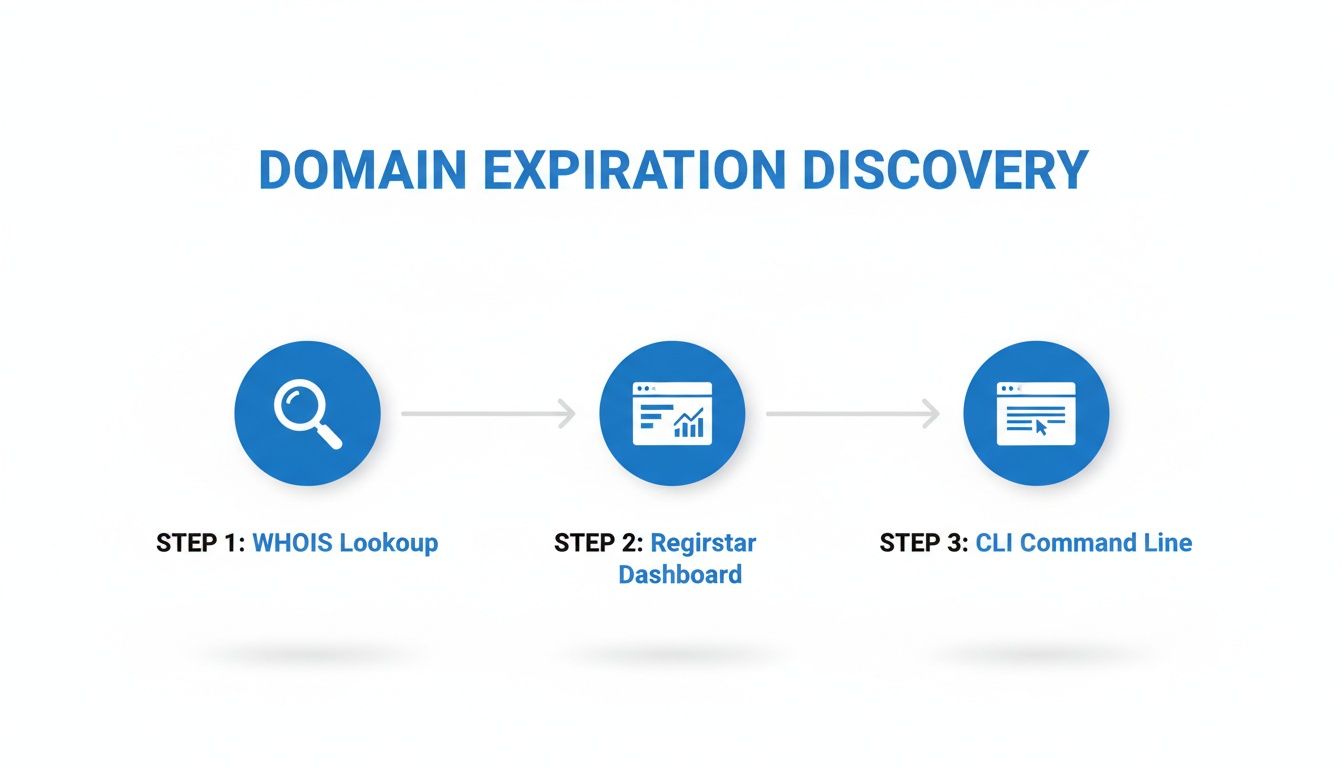
This simple flow—from a public WHOIS lookup to checking your own registrar's dashboard—is your starting point for tracking any domain. Now, let's explore what happens after that date passes.
The Grace and Redemption Periods
The moment a domain expires, it doesn't just vanish. First, it enters the Renewal Grace Period. Think of this as the original owner's last chance to renew at the normal price, typically lasting from 30 to 45 days. During this time, you can't register it, but you can certainly watch it. This is what we call an expiring domain—it’s in limbo, but not yet free. You can find a huge list of these on our Expiring domains page.
If the owner fails to renew, the domain often slides into the Redemption Period. This is a much more serious stage. Lasting around 30 days, this is a costly final opportunity for the owner to reclaim their domain, usually involving a hefty redemption fee on top of the regular renewal cost.
The Grace and Redemption periods are your strategic waiting game. A domain in these phases isn't available, but its chances of dropping increase with each passing day. This is the prime time to add a domain to your watchlist.
The Final Countdown and the Drop
After the Redemption Period concludes, the domain enters its final stage before deletion: Pending Delete. This phase typically lasts about five days, and at this point, it's the point of no return. No one can renew or recover the domain. It is locked and queued for deletion from the registry.
Once this period is over, the domain is finally "dropped" and becomes available for anyone to register on a first-come, first-served basis. This is the moment you’ve been waiting for! The domain is now a clean slate, ready for a new owner. The best part? You can find a freshly updated list of these gems on our Available domains page every day. This entire process can take up to 80 days, making patience and monitoring crucial.
Learning the nuances of this timeline is vital, which is why we created a detailed guide on how to buy expiring domains that breaks down the best tactics for each stage.
A Quick Guide to the Domain Expiration Lifecycle
To make this crystal clear, let's break down the journey a domain takes after its expiration date passes. Understanding these phases helps you know exactly when to monitor, when to prepare, and when to act.
| Domain Status | What It Means for You | Your Strategic Action |
|---|---|---|
| Renewal Grace Period | The original owner can still renew at the normal price. You cannot register it yet. | Monitor. Add the domain to your watchlist and check its status regularly. |
| Redemption Period | The owner can still recover the domain, but it will cost them a significant fee. Still unavailable to you. | Wait & Prepare. The odds of the domain dropping have increased. Keep monitoring. |
| Pending Delete | The domain is locked and cannot be recovered by anyone. It's queued for deletion. | Get Ready. The drop is imminent. Prepare your registration details or backorder service. |
| Available ("Dropped") | The domain is released and can be registered by anyone on a first-come, first-served basis. | ACT! Register the domain immediately through your preferred registrar or backorder service. |
This lifecycle is your roadmap. By knowing where a domain is on this path, you can stop guessing and start planning your acquisition with confidence.
Mastering Your Strategy for Snagging Great Domains

This is where the rubber meets the road. All that data you've dug up now gets turned into a real, actionable game plan. Understanding the domain lifecycle is one thing, but knowing what to do with that information is how you actually win.
Just knowing a domain's expiration date is the starting line. What you do with that date is how you finish first.
When it comes to acquiring valuable expired domains, there are really two ways to play it. One is a patient waiting game; the other is a flat-out sprint. Let's break down when to use each one.
The Watchlist Strategy for Expiring Domains
The first approach is all about playing the long game. This strategy means targeting domains that are currently stuck in their grace or redemption periods. We call these expiring domains. You can't register them just yet, but the clock is ticking down.
This is a waiting game, but an incredibly powerful one. By spotting promising domains before they're actually available, you can build a curated watchlist of future opportunities. Think of it like a fantasy sports draft—you're scouting the talent long before they become free agents.
A great way to do this is to use a specialized tool to find domains on their way out. You could, for instance, browse a list of expiring domains and filter it down to only those dropping within the next 30 days. This gives you a nice window to research their history, backlink profile, and true potential value without the pressure of an immediate buy.
Your goal here isn't to act now, but to prepare. By the time one of your watched domains becomes available, you'll already know if it's a gem worth grabbing. That gives you a massive advantage over someone who just stumbled upon it.
The Sprint for Freshly Available Domains
The second tactic is more immediate and demands quick reflexes. This is the thrill of the hunt for freshly available domains—the ones that have just run the entire gauntlet and can be registered by anyone, right now. These are the names that survived the grace period and redemption phase and are officially back on the open market.
This is a pure race. Being first is everything.
The second a valuable domain drops, it's a free-for-all. You're often competing against automated bots and seasoned domainers who can snatch it up in seconds. Your success hinges on knowing what’s available the moment it hits.
To get a leg up, you need a live feed of just-dropped domains. You can zero in on a list of available domains and apply a "Today" filter to see only the names released in the last 24 hours. This gives you a direct shot at registering them at a standard price, sometimes before the competition even knows they exist.
- Expiring Strategy: You build a list, do your homework, and patiently wait for the perfect moment to strike.
- Available Strategy: You monitor daily drops, identify value in a heartbeat, and act with speed and precision.
Mastering both approaches is what separates the amateurs from the pros. You can play the long game with a high-value watchlist while simultaneously sprinting for quick wins on daily drops.
Why Some Domains Expire and Others Seem to Live Forever
Ever been watching a domain, maybe one owned by a small local business, only to see it suddenly drop? At the same time, major brand domains feel like they're locked down tighter than Fort Knox. It’s not just luck. There are real market dynamics at play, driven by renewal trends and the huge differences between various types of top-level domains (TLDs).
Getting a handle on why certain domains are more likely to expire is a massive strategic advantage. It lets you stop searching randomly and start focusing your efforts on the hunting grounds with the highest turnover. That's how you give yourself the best shot at finding a real gem.
The Great TLD Divide
On one side of the fence, you have the legacy TLDs—the classic .coms, .nets, and .orgs. Think of these as the blue-chip stocks of the domain world. They boast massive registration numbers, and while millions do expire every year when businesses fail or side projects are forgotten, their renewal rates are pretty stable. They offer a steady, predictable pool of opportunities.
Then you have the wild west: the newer generic top-level domains (ngTLDs). This is your .shop, .tech, .ai, or .xyz. These often launch with huge marketing pushes and dirt-cheap introductory prices, leading to a massive spike in initial registrations. But the real story unfolds a year later when the renewal bill comes due.
The real opportunity often lies in the churn. High turnover means more domains are re-entering the market every single day, creating a constantly refreshing pool of potential assets for savvy hunters.
These ngTLDs have notoriously low renewal rates. Recent data shows their renewal rate is hovering around a mere 32%, which is worlds away from their legacy cousins. That means a staggering 68% of ngTLDs expire every year. Compare that to the roughly 75% renewal rate for .com and .net, and you can see where the action is. To get the full picture, you can dig into the latest domain industry renewal trends.
How This Shapes Your Search Strategy
This isn't just trivia; it's actionable intelligence that should directly shape your domain hunting strategy. It helps you answer the most important question: what kind of opportunity are you actually looking for?
Hunting for Authority? If you're after a domain with a solid history, strong backlink profile, and an air of authority, the steady churn of .com and .net is your best bet. You can browse expiring domains and filter specifically for these TLDs to build a watchlist of high-value targets.
Seeking Creativity and Volume? If you need a creative, modern, brandable name and want the highest possible number of new opportunities each day, the ngTLD market is where you need to be. The high turnover means fresh inventory is constantly hitting the market. Filtering for available domains that dropped today in extensions like .io or .app can uncover some absolute fantastic finds.
By understanding these renewal trends, you graduate from randomly poking around for names to strategically targeting the specific pools where your ideal domain is most likely to surface. It's about working smarter, not harder, to find that perfect name before someone else snags it.
Common Questions About Domain Expiration
Let's clear up some of the fog that hangs around domain expiration. Once you start digging into this stuff, a few questions always seem to surface. Here are some quick, no-nonsense answers to the things that cause the most confusion.
Expiring vs. Available Domains
So, what's the real difference between a domain that's "expiring" and one that's truly "available"? It helps to think of it like a house sale.
An expiring domain is like a house that's "under contract." The owner might have missed a payment, but they're still in a grace period where they can salvage the deal. You can keep an eye on it, maybe even put in a back-up offer, but you can't just swoop in and buy it.
An available domain, on the other hand, is one where the deal completely collapsed. It’s officially back on the open market, and anyone can grab it, right now. This distinction is everything when you're forming a strategy. You can browse for expiring domains to build out a future watchlist or go hunting for immediately registerable available domains if you're looking for a quick win.
Can I Register a Domain the Moment It Expires?
Nope, and this is probably the biggest misconception out there. The expiration date you see in a WHOIS record is just the start of a much longer process.
Once that date passes, the domain enters a grace period, usually 30-45 days, where only the original owner can renew it. If they still don't act, it might slide into a redemption period (another 30 days) and finally a short pending-delete phase (around 5 days).
Only after running this entire gauntlet—a process that can take up to 80 days—does the domain finally "drop" and become available for anyone to register. The trick is to monitor it closely so you're ready the moment it becomes public property again.
Don't mistake the expiration date for the drop date. They are two very different points in a domain's lifecycle, and understanding this is essential for timing your acquisition perfectly.
Why Is the Expiration Date Hidden?
Ever run a WHOIS search only to find the expiration date mysteriously missing? This is almost always because the owner has WHOIS privacy protection enabled.
When someone turns on this service, their registrar swaps out their personal details with generic proxy information to shield their identity. A side effect is that it often hides other data, including the domain's expiration date. When this happens, you're left with fewer options. You can use monitoring tools to watch for status changes or simply keep an eye on the domain to see if it becomes available after its likely renewal window has passed.
Ready to turn these answers into action? Stop guessing and start finding high-value domains with a clear history. NameSnag cuts through the noise, analyzing over 170,000 domains daily to surface the gems with real SEO and branding potential. Find your next winning domain today.
Find Your Perfect Domain
Get access to thousands of high-value expired domains with our AI-powered search.
Start Free Trial