Ever feel like all the good domain names are taken? I get it. But here's a little secret I've learned over the years: a treasure trove of powerful, aged domains becomes available every single day. This creates a constant, rolling wave of opportunity for anyone paying attention.
Finding high-quality expired domain names for sale isn't just about grabbing a catchy name. It's a killer strategy to acquire a digital asset with history, authority, and SEO value already baked right in.
Welcome to the Expired Domain Gold Rush
Think of it like buying a house. You could build a new one from scratch on an empty plot of land. That takes time, a ton of effort, and a whole lot of patience to establish.
Or, you could buy an existing home in a great neighborhood that already has mature landscaping, a solid foundation, and established curb appeal. An expired domain is that existing home—it often comes with a history and, if you choose wisely, a ton of immediate value.

Instead of starting your SEO journey from absolute zero, you can get a massive head start by tapping into a domain's pre-existing backlink profile and authority. This is a tactic savvy SEOs and niche site builders have used for years to bypass the dreaded "Google Sandbox" and start competing much faster.
The Booming Market for Aged Domains
This isn't just some niche trend; the interest in expired domains has exploded into a rapidly expanding market.
The aftermarket domain sector was valued at around USD 0.64 billion and is projected to nearly double to USD 1.17 billion by 2033. With an estimated 1.6 million domains hitting the market daily, the supply of potential opportunities is just immense. You can find out more about the growth of the domain aftermarket in recent industry reports.
This constant churn means that valuable assets are always up for grabs. But it also means you need a solid way to sift through all the noise.
The real art isn't just finding an expired domain; it's about finding the right one. A great expired domain can accelerate your growth, while a bad one can be an anchor weighing you down with hidden penalties.
Why Bother With an Expired Domain?
Let's cut to the chase and compare the two paths. Here's a quick look at why so many people are turning to expired domains instead of starting from scratch.
New Domain vs. Expired Domain: The Ultimate Showdown
| Feature | Brand New Domain | Expired Domain |
|---|---|---|
| Authority | Starts at zero. No backlinks, no trust. | Can have an established backlink profile and domain authority. |
| SEO Timeline | The long climb. Months or years to build trust. | Potential to rank faster and bypass the "sandbox." |
| Traffic | Zero visitors. You build your audience from scratch. | May have residual traffic from its previous life. |
| Age | Brand new. Seen as unproven by search engines. | Established age, often viewed as a sign of trustworthiness. |
In short, when you register a brand-new domain, you're starting with a completely blank slate. While that gives you total brand control, it's a long, slow grind.
A quality expired domain, on the other hand, can offer an incredible shortcut. It might come with powerful backlinks from authoritative sites, a trickle of direct traffic, and an age that search engines often see as a sign of trustworthiness. This guide is all about showing you how to find these gems without getting burned.
Finding Diamonds in the Digital Rough
So, where do you actually find these digital gems? The sheer volume of domains dropping every single day can feel like trying to drink from a fire hose. But don’t worry, this is where having a smart strategy separates the pros from the people who just get overwhelmed.
First, you need to understand that not all expired domains are in the same state. Think of it like a production line. Domains enter at one end when they expire and come out the other end when they are either renewed or become available for anyone to grab.
Your job is to know which part of that line to watch. Generally, you'll be looking at two main categories of expired domain names for sale.
Expiring Domains: The Planner's Paradise
First up are the Expiring domains. These are domains that the original owner failed to renew, but they haven't been deleted just yet. They're stuck in what’s called a "grace period," which can last for a month or more.
This is your chance to plan ahead. You can't register these domains immediately, but you know they're coming down the pipeline soon. This gives you precious time to do your homework—analyze their backlink profile, check their history, and decide if they’re worth pursuing before the mad dash begins. This lets you build a watchlist and prepare your strategy, so you’re ready to pounce the second they become available.
Available Domains: The Instant Gratification Crew
Next are the Available domains. These are the domains that have gone through the entire expiration and deletion process and have just been released back into the wild. They are free agents, ready to be registered by the first person who finds them, right now, at any standard registrar.
This is where speed and efficiency are your best friends. The best available domains get snapped up incredibly fast, sometimes within seconds of dropping. Trying to manually check lists of recently dropped domains is a recipe for frustration and missed opportunities.
The real edge in finding top-tier "Available" domains isn't about being lucky; it's about having a system that filters the millions of junk domains to show you the handful of valuable ones the moment they drop.
Using Filters to Find Your Perfect Match
This is where a dedicated tool becomes non-negotiable. Instead of sifting through endless spreadsheets of garbage domains, you can let technology do the heavy lifting. A platform like NameSnag acts as your super-powered metal detector, scanning the digital landscape for treasure.
Imagine you're building a niche site about sustainable gardening. Instead of just searching randomly, you could set up precise filters to find exactly what you need.
- Keyword Filters: Only show domains containing "garden," "eco," or "green."
- Metric Filters: Set a minimum Trust Flow of 10 or a Domain Authority of 20 to weed out weak domains.
- Backlink Filters: Target domains with those highly-coveted .edu or .gov backlinks.
- Time Filters: Focus your search on domains that became available Today for the freshest opportunities, or broaden it to the last 7 Days or 14 Days to catch any gems that might have slipped through the cracks.
By layering these filters, you transform an overwhelming task into a targeted hunt. You’re no longer just looking for any expired domain; you're looking for your next high-performing asset. If you're new to the process, exploring a comprehensive expired domain finder guide can provide even more tactical insights to refine your search. This strategic approach saves you countless hours and dramatically increases your chances of finding a domain that can truly move the needle for your project.
How to Vet a Domain and Avoid Hidden Landmines
So, you’ve got a shortlist of promising expired domains. This is where the real work begins. Finding a domain is like spotting a classic car in a barn; vetting it is popping the hood to make sure you’re buying a treasure, not a rust bucket full of angry raccoons.
Not all expired domains are created equal. Some are pure SEO gold, while others are digital landmines riddled with spam, just waiting to blow up your project. This detective phase is the most critical part of the whole process, and skimping here is a mistake you’ll only make once.
We need to go way beyond surface-level metrics like Domain Authority (DA). A high DA is nice, but it's easily manipulated and doesn't tell the whole story. Let's dig into the signals that truly matter.
Playing Detective with Domain History
Before you even glance at backlinks, you need to become a time traveler. The easiest way to do this is with the Wayback Machine from Archive.org. Think of it as a digital library of the internet, showing you snapshots of what a website looked like in its past life.
What are you looking for? Simple: consistency and relevance.
- Legitimate Business: Was the domain previously a real blog, business, or resource in your niche? That’s a huge plus.
- Spammy Signals: Did it suddenly morph into a foreign-language site plastered with casino links or weird pharmaceutical ads? Run away. Fast.
- PBN Footprints: Was it just a collection of generic articles with links pointing out to dozens of other sites? This could mean it was part of a Private Blog Network (PBN), which can carry a penalty risk from Google.
A clean history is non-negotiable. If a domain's past is sketchy, no amount of SEO juice is worth the potential headache. For a deeper dive, you can explore our complete guide on how to effectively check a domain's history to uncover any red flags.
Decoding the Backlink Profile
The backlink profile is the heart and soul of an expired domain’s value. It’s what you’re really paying for. Performing proper due diligence here is critical, much like the rigorous digital marketing due diligence private equity firms undertake before an acquisition.
You're not just looking at the number of links; you're focused on their quality and relevance. A single, powerful link from a major news site in your industry is worth more than a thousand links from spammy, auto-generated directories. Tools like NameSnag consolidate metrics from various sources, but you have to understand what they mean.
A great backlink profile tells a story of authority and trust. A bad one looks like a random mess of junk mail. Your job is to learn how to tell the difference.
The Magic Ratio of Trust and Citation Flow
Two of the most insightful metrics you'll run into are Trust Flow (TF) and Citation Flow (CF), originally from Majestic. Here’s a simple way to think about them:
- Citation Flow (CF): This predicts how influential a URL might be based on how many sites link to it. It’s a measure of link quantity.
- Trust Flow (TF): This measures the quality of those links. It predicts how trustworthy a page is by measuring its proximity to highly trusted "seed" sites. It’s a measure of link quality.
In a perfect world, you're looking for a domain where the Trust Flow is close to the Citation Flow. A healthy TF/CF ratio—ideally 0.80 or higher—is a strong signal of a clean, natural backlink profile. If you see a domain with a CF of 40 and a TF of 5, it means it has a ton of low-quality, spammy links. That’s a massive red flag.
Your Quick Vetting Checklist
When you're sifting through dozens of expired domains, it's easy to get lost. Use this checklist to stay focused on what truly counts.
- Wayback Machine Check: Does the domain's history look clean, consistent, and relevant to your niche?
- Backlink Quality: Are the links from authoritative, real websites in your industry? Or are they from spammy directories and weird foreign blogs?
- Anchor Text Analysis: Is the anchor text (the clickable text in a link) natural and varied? Or is it over-optimized with exact-match keywords like "best cheap widgets"?
- TF/CF Ratio: Is the Trust Flow reasonably close to the Citation Flow? Avoid any domain with a huge gap between the two.
- Google Index Check: Is the domain still indexed in Google? A quick "site:domain.com" search will tell you. If it's not indexed, it was likely penalized and de-indexed, making it worthless.
This decision tree helps visualize which type of expired domain to focus on, based on whether you're looking for immediate registration or planning for an upcoming drop.
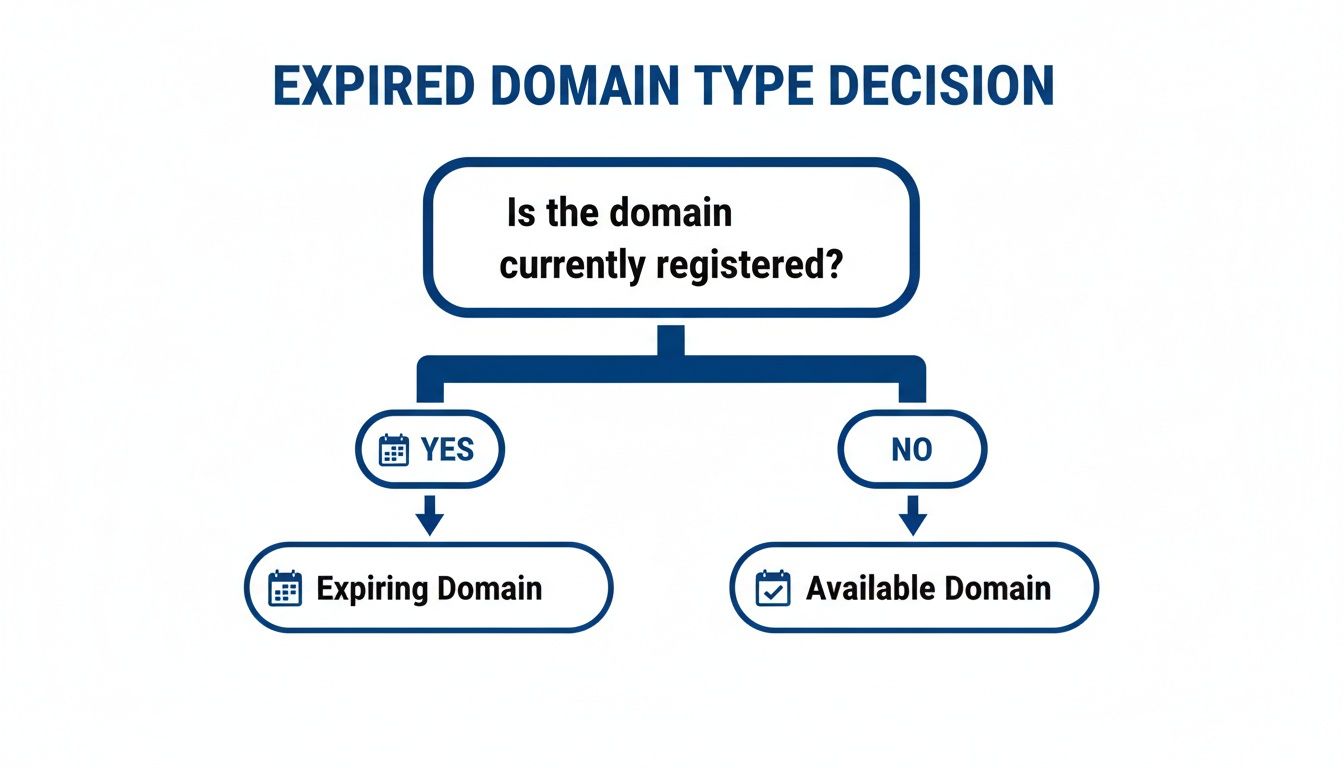
As you can see, "Available" domains offer instant action, while "Expiring" domains give you a window for strategic vetting before they become available.
Using a tool with built-in spam checks and consolidated metrics can save you hours of manual work. It pulls all this data into one dashboard, giving you a clear verdict on a domain's health and turning a complex process into a simple go/no-go decision.
Putting Your New Domain to Work: Three Core Strategies
So, you've done the hard work. You navigated the auctions, dodged the spammy landmines, and now you’re the proud owner of a fantastic expired domain. The real fun starts now: deciding what to do with it. An expired domain is like a lump of high-quality clay; its true value comes from what you shape it into.
You're holding a powerful asset, but what's the game plan? Let's walk through the three most common and effective strategies pros use to turn these digital assets into real returns. Each one has its own strengths, so think about which approach best fits your own goals and resources.
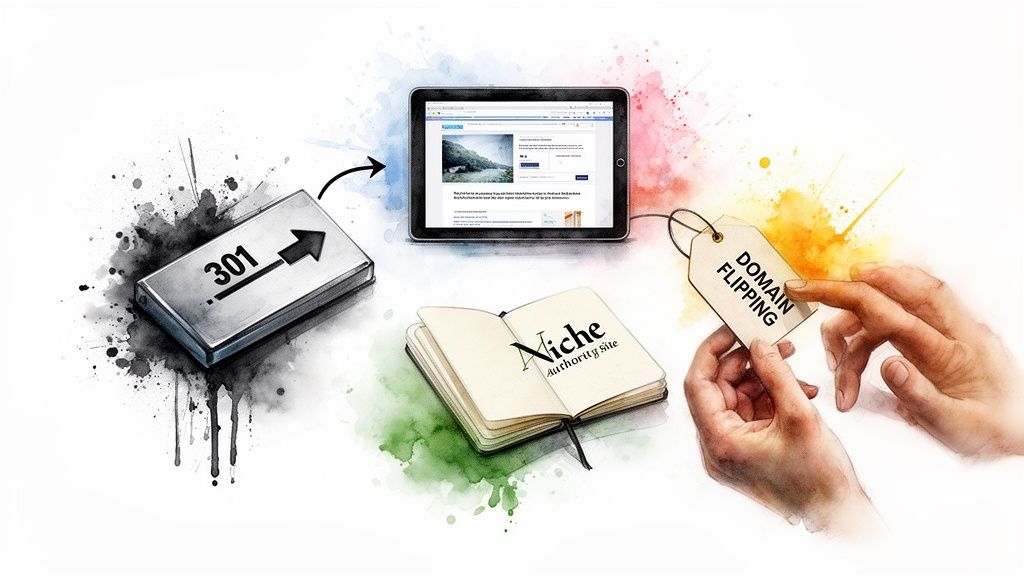
Strategy 1: The 301 Redirect Power Play
This is probably the most direct way to squeeze SEO value out of an expired domain. A 301 redirect is just a permanent instruction that tells search engines, "Hey, this old page has moved for good to this new page." When you do this, you pass most of the old domain's authority—its "link juice"—over to your target site.
Think of it like an old, popular coffee shop closing down. Instead of letting the building sit empty, the new owner puts up a sign that says, "We've moved! All your favorite coffee is now served at this address down the street." All the old customers (and the reputation they bring) are now pointed to the new location.
Real-World Scenario: Let's say you run a blog about eco-friendly travel. You find a high-authority expired domain that used to belong to a popular travel blogger, and it's loaded with great links from big travel magazines. By setting up a 301 redirect from that domain to your main blog, you're essentially inheriting a big chunk of its authority. This can give your site a serious boost in search rankings.
- Best For: Giving your primary "money site" a direct and often quick SEO lift.
- Domain Type Needed: You need one with a squeaky-clean history and a backlink profile that's highly relevant to your site's niche. Random, irrelevant links just don't pass the same kind of value.
Strategy 2: Building a Niche Authority Site
Sometimes, a domain is just too good to be used for parts. If you snag an expired domain with a strong, brandable name and a stellar backlink profile, it might be the perfect foundation for a brand-new website. This play involves resurrecting the domain and building it out into a standalone authority site—a niche blog, an affiliate review site, or a resource hub.
The massive advantage here is that you’re not starting from zero. Instead of waiting months or even years for Google to start trusting your new site, you're starting on third base. The domain already has age, authority, and backlinks, which means your new content can get indexed and start ranking much faster. It's like planting a tree that's already halfway grown.
Building a niche site on an expired domain gives you an incredible head start. You're leveraging years of accumulated trust and authority from day one, which can shave a massive amount of time off the journey to profitability.
If you're just starting out, it can be helpful to map out the next steps after you've made the purchase. To get a feel for the initial setup, check out our guide that answers the common question, "I bought a domain, now what?" which walks through the essentials.
Strategy 3: The Art of the Domain Flip
The final strategy is to treat expired domain names for sale as a pure investment: buy low and sell high. Domain flipping is the digital version of flipping real estate. Your job is to spot undervalued assets—domains with great metrics that nobody else has noticed yet—acquire them, and then sell them for a profit to someone who sees their full potential.
This requires a sharp eye for value and a solid understanding of what makes a domain desirable. Flippers are always on the lookout for domains with:
- Strong SEO Metrics: High DA, TF, and a clean backlink profile are non-negotiable.
- Brandability: Short, memorable, and easy-to-pronounce names are gold.
- Commercial Intent: Keywords that are valuable in a specific industry (think "denverplumbing.com") can command high prices.
Real-World Scenario: Imagine you're scrolling through NameSnag's list of Available domains that dropped Today and you spot a gem: a short, two-word .com domain related to the booming AI industry. A quick check of its metrics shows a decent backlink profile and a clean history. You register it for the standard fee and then list it on a domain auction marketplace. A few weeks later, a startup pays a premium for the perfect brand name. This strategy is less about long-term building and all about spotting immediate market opportunities.
How to Secure Your Domain Without the Headache
You’ve done the detective work, vetted your target, and have a clear strategy. Now for the exciting part—making that domain yours. The acquisition process for expired domains can feel a bit like a covert operation, but it’s actually pretty straightforward once you understand the lay of the land.
Your approach will change depending on the domain's current status.
You'll generally go down one of two roads: either you'll hand-register a freshly dropped domain, or you'll dive into the thrill of a public auction for a high-value name. Each path demands a slightly different mindset and set of actions.
The Two Roads to Ownership
First things first, you need to know what you're chasing. Is it an "Available" domain that just dropped, or an "Expiring" one that's about to?
Available Domains: These are the low-hanging fruit. They've gone through the full expiration cycle and are now fair game for anyone. You can just head over to any domain registrar, search for the name, and register it on the spot for a standard fee. The key here is speed; a tool like NameSnag can give you a list of Available domains that dropped Today, but the really good ones get snatched up in a flash.
Expiring Domains: These domains are still in their grace or auction period. You can't just register them. Instead, you'll most likely need to place a backorder or get involved in an auction. This is the common route for domains with strong metrics, since you won't be the only one vying for them.
Mastering the Art of the Auction
Bidding in a domain auction can be exhilarating, but it’s dangerously easy to get swept up in the moment and blow your budget. Success here isn't about having the deepest pockets—it's about discipline and preparation.
Before you even think about placing a bid, you need a hard-and-fast budget. This number should be based on the domain's real metrics (DA, TF, backlink profile) and its potential return on investment for your strategy. Using it for a 301 redirect? Calculate the potential SEO lift. Building a new niche site? Estimate its future earnings.
The most important skill in an auction isn't knowing when to bid, but knowing when to walk away. Set your maximum price based on data, not emotion, and stick to it no matter what.
Once you win, the process shifts to a secure transfer. The auction house will send instructions for moving the domain into your account at a registrar you choose. Follow their steps to the letter to ensure you gain full and undisputed ownership.
Securing Your New Digital Asset
After the domain is safely in your account, there’s a little more housekeeping to do. To protect your investment, it's vital to understand how to make a website secure right from the start.
This final checklist includes updating the contact information, enabling the registrar lock to block unauthorized transfers, and turning on domain privacy protection.
Think of this as the final leg of the race. Once you've checked these boxes, the domain is locked down in your account and ready for you to put it to work.
A Few Common Questions About Expired Domains
Jumping into expired domains can feel a bit like learning a new language. You’ve got a whole new set of terms, strategies, and a ton of questions. Let's walk through some of the most common ones I hear to help you get your bearings and move forward with confidence.
Is Buying an Expired Domain Actually Better Than a New One?
This is the big one, and the honest answer is: it really depends on what you're trying to accomplish.
For a totally new project where a specific brand name is everything, a fresh domain might be the perfect clean slate. You get full control and zero historical baggage. It's all yours from day one.
But if SEO performance is your main game, a quality expired domain can give you a massive, almost unfair, head start. You're essentially starting the race on the second lap, inheriting an established backlink profile and domain authority that could otherwise take you months—or even years—of grueling work to build from scratch.
What's the Biggest Mistake People Make Buying These Things?
The single biggest—and most expensive—mistake is skipping the homework. It's so easy to get excited by a domain with a high DA score or a catchy name and just slam the "buy" button. That's a recipe for disaster.
So many expired domains are cheap for a reason. They might have a toxic past, like a Google penalty, a truckload of spammy backlinks from shady corners of the web, or a history of being used for things you wouldn't want your brand associated with. Buying one without digging into its history with tools like the Wayback Machine and really picking apart its backlink profile can do way more harm than good.
A cheap expired domain with a bad history isn't a bargain; it's a liability. Taking the time to properly vet a domain is the single most important investment you can make in this entire process.
How Quickly Will I See SEO Benefits?
This all comes down to how you plan to use the domain. The timeline can vary quite a bit.
- For a 301 Redirect: If you find a powerful, relevant domain and redirect it to your main site, you can often see a nice little bump in your rankings within a few weeks to a couple of months. It all depends on how quickly Google re-crawls everything and passes that link equity along.
- For a New Niche Site: If you build a new site on the domain, it's not instant magic. You still need to create great content and get the site indexed. The key difference, though, is that you're starting from a position of trust and authority. This can dramatically shorten the time it takes to start ranking for your target keywords compared to starting with a brand-new domain.
What's the Deal with "Available" vs. "Expiring" Domains?
This is a common point of confusion, but the distinction is pretty simple—and important for how you hunt for domains.
Available domains are the ones that have gone through the entire expiration process and have just been released back into the wild. Anyone can register them right now at any standard registrar.
Expiring domains, on the other hand, have expired but they're still in a grace or redemption period. You can't register them just yet, but you know they'll be dropping soon. This gives you a valuable window to do your research and get ready to pounce.
Where Do All These Expired Domains Even Come From?
The supply is constantly refreshing itself. Market data shows that legacy domains like .com and .net have a pretty high renewal rate of 75.3%. But the newer generic top-level domains (ngTLDs) have a much lower renewal rate, hovering around 34.2%.
This churn means thousands of potentially valuable domains are dropping back into the marketplace every single month. It creates a steady stream of new opportunities for anyone paying attention. You can discover more insights about domain renewal trends on Hostinger.com to get a better feel for the market.
Finding the perfect expired domain is a powerful way to put your online projects on the fast track. Instead of drowning in endless lists of junk, let NameSnag do the heavy lifting for you. Our platform analyzes over 170,000 domains every day, using smart metrics to surface the best expired domains for sale. You can find SEO-ready assets in minutes, not weeks. Discover your next high-value domain with NameSnag today.
Find Your Perfect Domain
Get access to thousands of high-value expired domains with our AI-powered search.
Start Free Trial