Welcome, fellow treasure hunter, to the thrilling world of digital gold! Finding a high-value expiring domain isn't about dumb luck; it's a skill you can master, and I’m going to show you the exact process I use. The whole game is about using the right tools to find domains that are past their renewal date but haven't been released to the public yet. This gives you a crucial window to evaluate them and plan your strike.
Your Guide to Finding Digital Real Estate
You’ve probably heard the legends—powerful domains that were once major online hubs, now sitting expired and waiting for someone savvy enough to scoop them up. These aren't just empty web addresses; they're valuable digital assets. Why? Because they often come with years of established authority, a strong backlink profile, and sometimes, even a trickle of existing traffic.
Think of it like buying a piece of commercial real estate that already has roads, power, and water hookups ready to go. You get a massive head start.
This has become a go-to strategy for SEOs and domain investors alike. And the market is huge. As of Q3 2025, there were over 378.5 million registered domains. With a renewal rate for .com and .net domains hovering around 75%, a fresh batch of potentially valuable domains hits the market every single quarter. It’s a constant stream of opportunity if you know where to look.
The Lifecycle of a Domain
To actually win at this game, you gotta understand the domain lifecycle. It’s not complicated, I promise. Knowing the different stages—from active to expired and through all the grace periods—tells you exactly when and how to make your move.
- Active: The domain is registered, paid for, and living its best life.
- Expired: Uh-oh. The owner missed the renewal date. It now enters a registrar grace period (usually 30-45 days) where the original owner can still renew it, no questions asked.
- Redemption Period: After the grace period, it's not over yet. The domain goes into a 30-day redemption phase. The original owner can still get it back, but now they have to pay a hefty "get out of jail" fee.
- Pending Deletion: If it's still not renewed, the domain is queued for deletion, which takes about five days. This is the final countdown before it’s released back into the wild for public registration.
The real opportunity is in spotting great domains during the 'Expired' and 'Redemption' phases. This is your window to get a backorder in place or prepare your auction strategy before it becomes a total free-for-all.
This whole process can be boiled down to a simple, effective workflow.
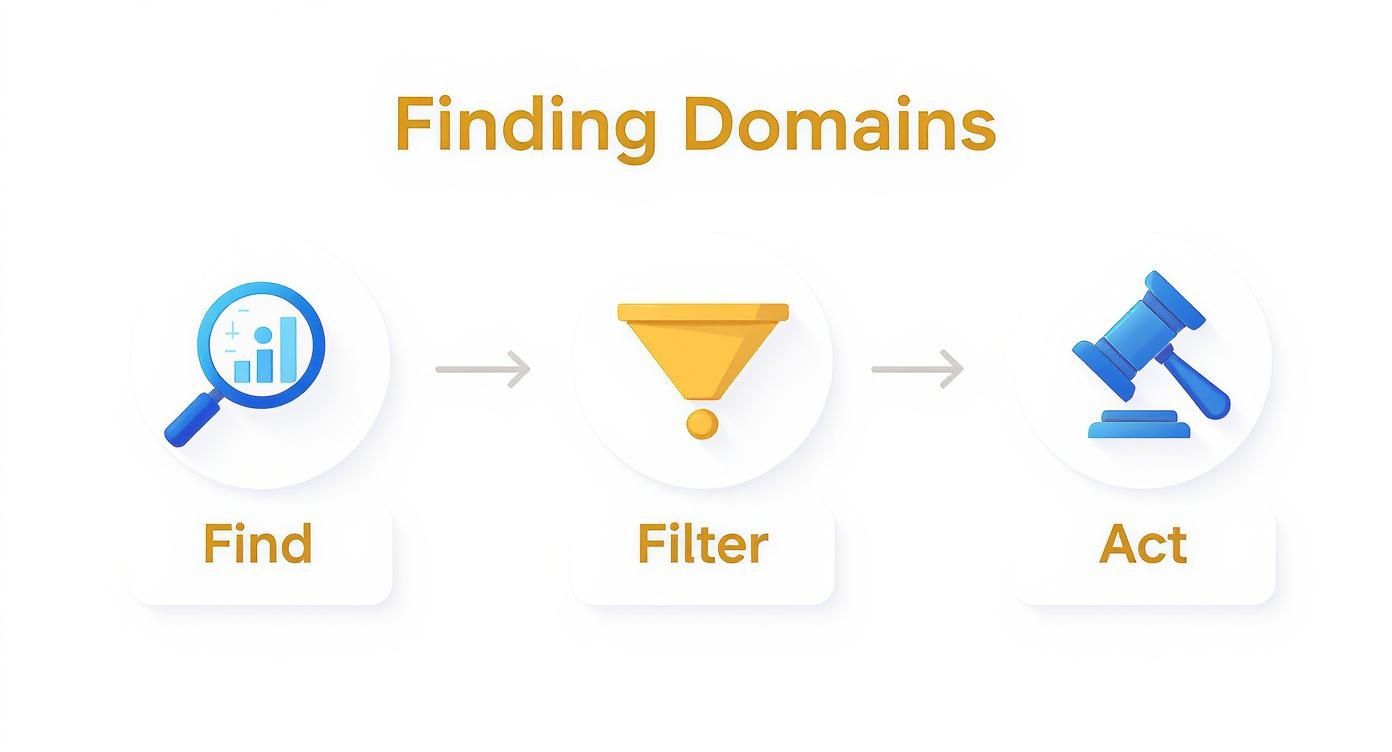
As you can see, success isn't just about finding domains; it's about having a system to filter the noise and then acting decisively. Using a dedicated tool like NameSnag helps automate the heavy lifting, turning what feels like a complex hunt into a straightforward search.
Domain Status Cheat Sheet
Navigating the different domain statuses can feel a bit confusing at first. Here’s a quick reference table to keep the key stages straight and know what your acquisition options are at each point.
| Status | What It Means for You | How to Acquire It |
|---|---|---|
| Expired (Grace Period) | The original owner can still easily renew it. You can't register it directly yet, but you can place a backorder. | Place a backorder through a service like GoDaddy Auctions or SnapNames. |
| Pending Deletion | The domain is locked and about to be released. This is the final countdown before it's available to the public. | Your backorder service will attempt to "catch" it the moment it drops. |
| Auction | The domain is in an auction because multiple people placed a backorder on it. | Participate in the auction and place bids. Highest bidder wins. |
| Closeout / Buy Now | The domain went to auction but received no bids. It's now available for a fixed price, usually for a limited time. | Purchase it directly at the listed "Buy Now" price before someone else does. |
This table should help you quickly identify where a domain is in its lifecycle and what your next move should be. Remember, timing is everything. Now, let's get into the specifics of how to find these gems.
Where to Find Your Next High-Value Domain
Alright, you know what makes a great expiring domain, but where do you actually find these digital gems? Manually searching is like trying to pan for gold with a fork—it’s slow, messy, and you’ll probably give up before finding anything good. It’s time to move past that and get into the modern prospector's toolkit.

Forget endless manual searches. The market for expiring domains is incredibly competitive, but thankfully, it's also filled with specialized platforms and auction houses that list these opportunities daily. Think of them as organized marketplaces where you can browse, bid, and buy.
The sheer volume is staggering. Hundreds of thousands of domains drop every single day, creating a highly active market with dedicated tools providing access to enormous databases. To give you some perspective, a well-known platform like ExpiredDomains.net tracks over 710 million domains and adds around 1.17 million more every 24 hours. That's a lot of noise to sift through, but it highlights the scale of the opportunity.
Streamlining Your Search with The Right Tools
While massive databases are great, they're also overwhelming. The real secret to finding expiring domains efficiently is to use a tool that does the heavy lifting for you. Instead of digging through millions of listings, you want a high-tech metal detector that surfaces only the most promising targets.
This is where a platform like NameSnag becomes your best friend. It’s designed to cut through the junk and highlight domains with real SEO and branding potential.
Pro Tip: Don't just look at a domain's metrics in isolation. The best tools help you see the bigger picture—how age, backlinks, and brandability all come together to create value. A domain with fewer links from amazing sources is far more valuable than one with thousands of spammy links.
Using a dedicated platform allows you to apply smart filters that save you countless hours. Let’s dive into two core strategies you can use right away.
Strategy One: The Planner’s Approach
If you like to strategize and get ahead of the competition, this method is for you. The goal here is to identify valuable domains before they drop and become a free-for-all.
On a platform like NameSnag, this is incredibly simple. You just head over to the Expiring domains section to see a curated list of domains that are currently in their grace or redemption period. They aren't available to register just yet, but they will be dropping soon.
- Why this works: It gives you time to do your homework. You can thoroughly research the domain's backlink profile, check its history on the Wayback Machine, and decide on a budget for a backorder or auction.
- Actionable Tip: Use the time filters! You can set the filter to see domains dropping within 3 Days, 7 Days, or even 30 Days. This lets you build a watchlist and prioritize your targets without feeling rushed.
This approach is perfect for high-value, competitive domains where preparation is key to winning. For more advanced strategies, we've got some other great reads on the NameSnag blog.
Strategy Two: The Instant Gratification Method
Sometimes you just need a great domain now. Maybe you have a new project idea or want to grab a relevant domain for a quick SEO boost. This is where you hunt for domains that have already completed the expiration cycle and are ready for immediate registration.
For this, you’ll want to filter for Available domains. This view shows you domains that have just dropped and can be registered instantly at any standard registrar.
There’s no waiting, no auctions, and no backorders. It’s a first-come, first-served game. You find one you like, you go register it. This is the fastest way to acquire a domain with an aged history and existing authority. The only catch is that you have to act fast, because the best ones get snapped up in minutes.
Separating Diamonds from Dirt with Key Metrics
Finding a promising list of expiring domains is just the starting line. Now comes the real work—playing detective to figure out which ones are genuine treasures and which are just digital fool's gold. Not all aged domains are created equal; some come with serious baggage from a past life.
This is where you roll up your sleeves and really analyze a domain's health. You don't need a PhD in data science, just a solid handle on a few key metrics that tell the story of a domain's authority and history. Think of it like pulling the CarFax report before buying a used car.
The Big Three SEO Metrics
First up are the metrics most people have heard of but few truly understand. High scores are nice, but what those scores represent is what really matters. Let's break down the essential trio you'll see everywhere.
Domain Authority (DA): This is a metric from Moz that predicts how well a site might rank. On a scale of 1-100, a higher number is better, and a DA of 20+ is a decent starting point. But don't get obsessed. A DA of 25 with clean, relevant links beats a DA of 40 built on spam any day of the week.
Backlinks: This is the raw total of links pointing to the domain. Chasing domains with thousands of backlinks is a classic rookie mistake. Quantity means nothing without quality. One single, powerful link from an authority site in your niche is worth more than 1,000 links from junk directories.
Referring Domains: Now this is a number I pay attention to. It counts the number of unique websites linking to the domain. It’s a much better sign of a healthy link profile than the raw backlink count. A domain with 100 backlinks from 80 different sites is far more valuable than one with 1,000 backlinks from just 10 sites.
Finding and vetting these domains has gotten a lot more sophisticated over the years. Back in the day, it was a manual grind. Now, in 2025, tools like Domain Hunter Gatherer and Spamzilla are staples for SEOs and investors trying to find domains with clean histories. They let you filter by these metrics, and modern AI analysis makes spotting red flags faster than ever. For a deeper dive into how this has changed, check out this insightful article on domain science.
Gauging Trustworthiness with Flow Metrics
Beyond the basics, the "Flow Metrics" from Majestic give you a more nuanced view. They're my go-to for quickly spotting domains that look good on the surface but are actually built on a foundation of spam.
Key Takeaway: The relationship between Trust Flow and Citation Flow is one of the fastest ways to spot a potentially toxic domain. A balanced ratio is a green light, while a huge gap is a major red flag.
Trust Flow (TF) is all about the quality of a domain's backlinks. It's a score from 0-100 that measures how close a site is linked to a seed set of highly trusted sites. A higher TF means the domain earned links from sources that Google actually respects.
Citation Flow (CF), on the other hand, measures the raw quantity or influence of backlinks, regardless of their quality. A domain with tons of links, even spammy ones, can pump up its CF score.
The real magic happens when you compare the two. A healthy domain will have a TF and CF that are relatively close. If you find a domain with a CF of 40 and a TF of 5, run for the hills. That huge gap is screaming that it has a massive number of low-quality, spammy links propping up its numbers.
Essential Domain Metric Scorecard
To make this even easier, I've put together a quick-reference scorecard. Think of this as your pre-flight checklist when you’re sifting through a list of potential domains.
| Metric (Tool) | What It Measures | Good Score to Aim For | Potential Red Flag |
|---|---|---|---|
| Domain Authority (Moz) | Overall ranking potential and strength. | 20+ | A high DA with a very low number of referring domains. |
| Trust Flow (Majestic) | The quality and trustworthiness of backlinks. | 15+ | A score significantly lower than the Citation Flow. |
| Citation Flow (Majestic) | The quantity and influence of backlinks. | 20+ | A score that is 2x or more higher than the Trust Flow. |
| Referring Domains | The number of unique websites linking in. | Varies, but look for a healthy ratio to total backlinks. | A huge number of backlinks coming from very few domains. |
Once you get a feel for these metrics, you'll stop being a hopeful prospector and become a skilled surveyor. You'll learn how to spot the hidden gems and, just as importantly, how to sidestep the toxic domains that could sink your projects before they even get started.
Uncovering a Domain's Hidden History
So you've found one. A domain with killer metrics that looks perfect on paper. The Domain Authority is solid, Trust Flow is high, and the backlink profile seems clean. Before you celebrate and slap down a backorder, you've got to put on your detective hat. This is, without a doubt, the most critical step: digging into the domain's past life.
Was it a respected industry blog, or was it a front for a spammy PBN or something far shadier? Strong metrics can be incredibly deceiving, and a domain's history holds all the secrets. Skipping this is like buying a used car without checking the accident history—you might end up with a lemon that costs you way more in the long run.

Time-Traveling with The Wayback Machine
Your first and most important stop is the Wayback Machine from Archive.org. This digital archive takes snapshots of websites over time, giving you a window into what a domain was actually used for over the years. It's an absolutely essential tool for finding expiring domains that are safe to build on.
When you plug in a domain, you get a calendar view showing every snapshot ever taken. Your job is to click through different years and look for red flags.
- Sudden Content Changes: Did the site abruptly pivot from a pet grooming blog to one peddling suspicious pills? That's a massive red flag. It almost certainly means it was repurposed for spam.
- Foreign Language Spam: Be on the lookout for pages that suddenly appear in Chinese, Russian, or any other language unrelated to the domain's original purpose. This is a classic sign of a hacked site that was exploited to host spammy links.
- The Generic PBN Look: Did the site's design suddenly devolve into a cookie-cutter WordPress theme with thin, keyword-stuffed articles? This screams Private Blog Network (PBN), which can carry a nasty penalty risk.
A clean history shows consistency. You're looking for a domain that stuck to its niche, whether it was a small business site, a personal blog, or an e-commerce store. Minor redesigns are normal; drastic, irrelevant pivots are not.
Think of it this way: a domain that was a local bakery's website from 2012 to 2022 is a green light. But a domain that was a local bakery in 2018, a casino affiliate in 2020, and then a parked page in 2022 is a toxic asset. Avoid it at all costs.
Checking for Google Penalties
A domain's history isn't just about its old content; it's also about its relationship with Google. If a domain got hit with a penalty, that negative history can cling to it and sabotage your project before you even start.
Luckily, there are a couple of dead-simple ways to check.
The easiest is a site: search in Google. Just type site:yourdomain.com into the search bar. If a list of indexed pages pops up, that's a good sign. If Google comes back with zero results, the domain is likely de-indexed—a major warning that it was penalized for spam.
Another quick check is to search for the domain name in quotes, like "yourdomain.com". If there are no mentions of it, or the only mentions are on spammy forum lists, that's another bad sign.
Avoiding Legal Headaches with Trademark Checks
Finally, before you get too attached, do a quick trademark search. Snapping up a domain that infringes on an existing trademark is just asking for a legal nightmare. The last thing you want is a cease-and-desist letter forcing you to hand over your new asset.
You can run a basic search for free using the U.S. Patent and Trademark Office's (USPTO) TESS database or your country's equivalent. If the domain name is identical or confusingly similar to a registered trademark, especially in the same industry, just walk away.
This check takes five minutes and can save you thousands in legal fees down the road. By doing this deep-level vetting, you can grab a domain with confidence, knowing it's a clean and powerful asset ready for its next chapter.
You’ve done the heavy lifting. The research is done, the domain's history is spotless, and you're ready to make it your own. Now it’s time to switch hats from detective to buyer, and your strategy here really depends on where the domain is in its lifecycle.

Making that final move can be a little nerve-wracking, especially for a domain you’re really excited about. But the process is pretty straightforward once you know which path to take. Let's break down the three main ways you'll lock down your chosen domain.
The Instant Snag
This is the dream scenario—simple and satisfying. You've found a gem that has already passed through all its grace and redemption periods and is now sitting there, available for public registration. It's the digital equivalent of finding a prime piece of real estate with a "For Sale" sign and an open door.
To grab one of these, you just register it like any other new domain at your favorite registrar—GoDaddy, Namecheap, you name it. There's no bidding, no waiting, just a standard registration fee.
The best way to find these is with a tool built to catch them the second they drop. For instance, the Available domains filter on NameSnag shows you a live list of domains you can go out and register right now. The key is speed; the best ones are often snapped up within minutes of becoming available.
The Backorder Gambit
So what if the domain you want is still in that "expiring" phase and hasn't dropped yet? If it's a high-value domain with great metrics, you can bet you’re not the only one watching it. This is where backordering comes in.
A backorder is a service where you pay a company like SnapNames or DropCatch to try and "catch" the domain for you the instant it becomes available. Think of it as hiring a professional line-sitter for a new iPhone release.
How it works: You place a backorder, and the service uses its high-speed connections to bombard the registry with registration requests the millisecond the domain drops. If their system snags it, it's yours. The best part? You only pay if they succeed.
The catch? If multiple people backorder the same domain through the same service, it usually goes to a private auction between those bidders.
Winning at Domain Auctions
When a domain has multiple backorders or is considered premium by the registrar, it will end up in a public auction. This is where things get exciting—and potentially expensive. It becomes a classic bidding war where the highest bidder takes home the prize.
Platforms like GoDaddy Auctions are the main hubs for these events. To avoid getting caught up in the frenzy and overpaying, keep a few things in mind:
- Set a Hard Budget: Before you even think about bidding, decide the absolute maximum you are willing to pay. This number should be based on the domain's value to you. It's way too easy to get emotional and blow your budget.
- Bid Late (Sniping): Many seasoned bidders place their real bid in the final minutes (or even seconds) of the auction. This keeps them from driving the price up early and gives competitors less time to react.
- Understand Proxy Bidding: Most auction sites use proxy bidding. You enter your max bid, and their system will automatically bid for you in small increments up to that amount. It saves you from having to sit there manually outbidding everyone.
No matter which path you take, having a clear plan is everything. For those looking to automate their monitoring and acquisition process even further, you can find more information about integrating these strategies in the NameSnag API documentation. By understanding these three acquisition methods, you'll be ready to act decisively and turn all that hard research into a tangible asset.
Your Questions Answered: Expiring Domains FAQ
Diving into expiring domains for the first time? It’s totally normal to have a million questions. Honestly, it's a corner of the internet with its own weird rules and lingo.
I’ve put together the most common questions that hit my inbox. Think of this as the cheat sheet I wish I had when I was starting out. Let's clear up the confusion so you can get straight to finding those hidden gems.
https://www.youtube.com/embed/7ZCaLRWE4Vg
What's The Difference Between Expiring and Dropped Domains?
This is easily the biggest point of confusion, and getting it right is fundamental to your strategy.
An expiring domain is one where the owner has missed the renewal date. It's now stuck in a grace period—you can't register it directly, but you can see it's about to become available. This is your chance to place a backorder or get ready for an auction.
A dropped domain is one that has gone through all the grace and redemption periods without being renewed. The registry has officially deleted it, releasing it back into the wild. Anyone can register it instantly, first-come, first-served.
The easiest way I explain it is this: expiring domains are on deck, while dropped domains are at bat. Platforms like NameSnag let you scout the players on deck with their Expiring domains list or grab the ones at bat from the Available domains list.
How Much Should I Pay for a Good Expiring Domain?
This is the classic "it depends" question. The price can be anything from a cup of coffee to a down payment on a house. It all boils down to the domain's value and how you acquire it.
- Standard Registration Fee ($10-$20): This is your best-case scenario. You stumble upon a great domain the second it drops and register it like any other new domain.
- Backorder Fee ($60-$100): If you're targeting a more competitive domain, you'll use a backordering service. This is the typical price, and you only pay if the service successfully snags the domain for you.
- Auction Price ($100 - $10,000+): This is where things get interesting. When multiple people want the same domain, it goes to a public auction. A premium name with killer metrics and a squeaky-clean history can easily go for thousands.
Your budget should always be tied to what the domain is actually worth to your project. Don't get caught up in auction fever for a domain that isn't a perfect fit.
Can Using an Expiring Domain Get Me Penalized by Google?
Absolutely. It’s a real risk, and it’s precisely why the vetting process we walked through earlier is non-negotiable.
If a previous owner used the domain for spam, PBNs, or other black-hat SEO tricks, that toxic history can stick to it like glue. Inheriting that baggage can seriously kneecap your site before you even start.
This is why you always use tools like the Wayback Machine to see what was on the site before. You need to meticulously pick apart its backlink profile for anything that looks shady. But if you do your homework and find a domain with a clean, relevant history, the risk is incredibly low. You're buying its authority, not its past mistakes.
What Should I Do with an Expiring Domain After I Buy It?
Alright, you've got the keys to your new digital real estate. Now what? Time to put that built-in authority to work. There are a few tried-and-true paths you can take.
- Build a Niche Site: This is the most common play. You're building a brand-new website but with a huge head start—you've already got backlinks and domain age on your side from day one.
- 301 Redirect: Redirect your new domain to your main website. This is a powerful move that passes along a good chunk of its link equity and authority, often giving your primary site a nice little SEO bump.
- Create a Private Blog Network (PBN): This is an advanced, high-risk strategy, and I absolutely do not recommend it for beginners. It involves building a network of sites to prop up your main "money" site. If Google catches on—and they're very good at it—you can expect severe penalties.
The right strategy depends entirely on your goals, your resources, and how much risk you're willing to stomach.
Ready to stop digging and start discovering? NameSnag uses AI to analyze over 170,000 domains daily, surfacing only the clean, powerful, and brandable gems. Find your next high-value domain in minutes, not weeks, by exploring our curated lists at https://namesnag.com.
Find Your Perfect Domain
Get access to thousands of high-value expired domains with our AI-powered search.
Start Free Trial