Think of an expired domain checker as your secret weapon for uncovering aged, powerful domain names that are already old pals with search engines. Instead of starting from square one with a shiny new domain, these tools let you find digital real estate with value baked right in—things like existing backlinks and SEO authority—giving you a massive head start.
Welcome to the Digital Real Estate Boom
Imagine scouting for a prime piece of land in a bustling city. You find a great spot, but this one comes with roads, utilities, and a foundation already poured. That’s pretty much what using an expired domain checker feels like. It’s less about building from the ground up and more about making a ridiculously smart acquisition.

Why Old Domains Are Digital Gold
Every single day, thousands of domains expire simply because their owners forgot to hit "renew." Most are junk, sure, but hidden among them are some absolute gems. We're talking about domains that spent years earning a reputation with Google through solid content and high-quality backlinks. When they expire, all that hard-earned "link equity" doesn't just evaporate—it's waiting for someone savvy to scoop it up.
This guide is your treasure map. We're skipping the dense, technical jargon to give you a clear, fun walkthrough of how to find, evaluate, and cash in on these hidden assets.
The core idea is simple: instead of waiting months or years for a new domain to gain traction, you can acquire one that already has the authority you need. This can drastically shorten the time it takes to see real SEO results.
What Can You Do with an Expired Domain?
The possibilities are exciting and incredibly practical. Once you find a great domain, you can put it to work in a few high-impact ways.
You could:
- Build an Authority Site: Launch a new blog or business on a domain that's already got some clout, helping you rank faster for competitive keywords.
- Boost an Existing Website: Redirect the old domain to your main site, passing along its valuable link equity for a serious SEO lift.
- Flip for Profit: Buy undervalued domains and sell them to other marketers, investors, or businesses for a tidy profit. It's a classic buy-low, sell-high play.
This isn't just a niche tactic for SEO pros; it's a legitimate strategy for anyone looking to get a leg up online. Whether you want to supercharge a project or start a domain-flipping side hustle, knowing your way around an expired domain checker is the first step. Let's start digging.
How an Expired Domain Checker Uncovers Hidden Value
So, what exactly is an expired domain checker? Forget the textbook definitions. Think of it as a specialized search engine that’s completely obsessed with domains that people have forgotten to renew. It’s constantly scanning the web, flagging domains the moment they drop, and organizing them into a massive, searchable database. It’s like having your own private lookout watching over the entire digital landscape for you.
But the real magic isn’t just in finding the names. A top-tier checker pulls in vital SEO metrics for each one, turning a simple list into a strategic goldmine.
You don't just see that a domain is available; you see its entire resume—its backlink profile, historical authority, and overall trustworthiness. It’s the difference between panning for gold by hand and using modern ground-penetrating radar to pinpoint the richest veins.
Sorting the Signal From the Noise
Every single day, over 100,000 domains expire. That’s not a typo. This creates a chaotic flood of digital junk, and trying to sift through it manually is a recipe for madness. An expired domain checker cuts through this mess with surgical precision. Instead of you spending days checking domain after domain, the tool does all the heavy lifting, pre-qualifying candidates with hard data.
This is what separates the treasure from the trash. A good tool helps you spot domains that aren't just old but are also respected by search engines, giving you a massive head start. That built-in value can save you months, or even years, of grinding away to build authority from scratch.
The real power of an expired domain checker lies in its ability to translate raw data into actionable intelligence. It shows you not just what a domain is, but what it could be for your project.
Finding Available vs. Expiring Domains
A great checker also lets you play the field strategically by sorting domains based on their current status. This effectively creates two distinct hunting grounds for you to explore.
- Available Domains: These are the instant wins. They've gone through the full expiration cycle and are ready for anyone to register immediately. If you’re looking for a domain you can snap up right now, you can find a list of domains that became Available domains today and put them to work instantly.
- Expiring Domains: Think of these as the ones on deck. The owner has failed to renew, but the domain is still stuck in a grace or redemption period. You can’t register it just yet, but you know it's coming. This gives you time to do your homework and get ready to pounce. Scouting Expiring domains lets you get ahead of the competition for high-value assets that are about to drop.
By giving you these distinct views, a checker lets you tailor your approach to your timeline and goals. You get to decide whether you need a domain today or if you’re willing to wait for the perfect one to come along.
The Critical Metrics That Separate Treasure from Trash
Alright, let's get real for a minute. Not all expired domains are created equal. Sifting through lists of dropped domains can feel a lot like rummaging through a digital garage sale—most of it is junk, but every now and then, you stumble on a priceless antique. The secret is knowing what to look for.
A good expired domain checker doesn't just show you a list of names. It gives you the hard data you need to separate the treasure from the trash. It’s easy to get excited by a domain with thousands of backlinks, but raw quantity is a vanity metric. What really matters is the quality and relevance of those links.
Think of it this way: one glowing letter of recommendation from a respected industry leader is worth more than a thousand generic "attaboys" from total strangers. Your domain's backlink profile works the exact same way.
Beyond Domain Authority
For years, Domain Authority (DA) was the go-to metric, but savvy domain hunters have learned to look deeper. A high DA score can be incredibly misleading if it’s built on a shaky foundation of spammy, irrelevant links. We need to put on our detective hats and examine the nuanced metrics that paint a much clearer picture of a domain's true health and history.
The market has shifted, and modern strategies now favor relevance and trust over raw authority. Metrics like Trust Flow, the domain's past content, and its niche fit are now considered far better indicators of a domain's real value. This focus on quality is what helps you find domains that provide real, sustainable SEO benefits.
Trust Flow and Citation Flow
The metrics from Majestic, Trust Flow (TF) and Citation Flow (CF), are a fantastic starting point for quality control. They give you a quick, powerful snapshot of a domain's link profile.
Citation Flow (CF): This predicts how influential a URL might be based purely on the quantity of sites linking to it. A high CF means lots of links, but it tells you nothing about where they came from.
Trust Flow (TF): This is where the magic happens. TF measures the quality of those links, predicting how trustworthy a page is by analyzing how close it is to highly trusted "seed sites."
A healthy domain has a balanced ratio between the two. A domain with a CF of 40 and a TF of 5 is a massive red flag—it suggests tons of low-quality, spammy links. But a domain with a CF of 25 and a TF of 20? That’s a potential gem, signaling its links come from reputable sources.
A good rule of thumb is to look for a Trust Flow that is at least half of the Citation Flow. A 1:2 ratio is decent, but a ratio closer to 1:1 is a sign of a very clean, high-quality backlink profile.
A quick-glance table is often the best way to keep these core metrics straight. Here’s a simple breakdown of what to look for when you're digging through potential domains with a checker tool.
Key Metrics for Evaluating Expired Domains
| Metric | What It Measures | Good Sign | Red Flag |
|---|---|---|---|
| Trust Flow (TF) | The quality and trustworthiness of backlinks. | TF is close to or greater than half of CF. | A low TF compared to a high CF. |
| Referring Domains | The number of unique websites linking to the domain. | A high number of diverse, relevant domains. | A huge number of links from just a few domains. |
| Backlink Quality | The authority and relevance of individual links. | Links from industry-leading sites, news outlets. | Links from PBNs, comment spam, foreign sites. |
| Domain History | The domain's past usage and content. | Consistent, on-topic content in the Wayback Machine. | Signs of spam, pharma ads, or multiple pivots. |
| Penalties | Any past manual or algorithmic penalties from Google. | A clean bill of health in Google Search Console. | Sudden, drastic drops in historical traffic. |
Remember, no single metric tells the whole story. You have to look at them together to get the full picture of a domain's past and potential future.
Referring Domains and Backlink Quality
Instead of just counting total backlinks, you need to be looking at the number of unique referring domains. One single link from a high-authority site like a major news outlet or a top university is infinitely more valuable than 1,000 links from spammy blog comment sections.
A diverse profile of links from different, relevant websites tells Google that your domain is a respected resource. This is where you need to do a bit of manual digging. Inspect the most powerful links pointing to the domain. Are they from sites in your niche? Is the anchor text natural, or is it stuffed with spammy keywords? This hands-on check is non-negotiable.
For a more detailed walkthrough on this process, check out our guide on how to use an expired domain name finder effectively.
Domain Age and History
Older domains are often seen as more trustworthy by search engines, but age alone is not enough. A domain's history is absolutely crucial. You have to know what it was used for in its past life. Was it a legitimate business blog, or was it a front for a shady PBN (Private Blog Network)?
The Wayback Machine from Archive.org is your personal time machine. Plug in the domain and look at old snapshots of the site. If you see clean, relevant content, you're on the right track. If you find pages in a foreign language, pharma ads, or spammy articles, drop it and run.
A domain with a toxic past can bring a Google penalty along for the ride, and that's a headache you definitely don't want.
Your Hands-On Guide to Finding a Domain Gem
Alright, you’ve got the lingo down and know which metrics to watch. Now for the fun part—the actual treasure hunt. This is your practical playbook for using an expired domain checker to sift through a sea of options and pull out a shortlist of pure gold.
Let's get our hands dirty.
The first move is a simple but crucial one that will shape your entire search: deciding whether you're hunting for a quick win or playing the long game.
Available Now vs. Dropping Soon
Your search starts with a choice between two buckets of domains, each with its own rhythm and reward.
Available Domains: These are domains that have already run the full expiration gauntlet and are back on the open market. You can find them, register them at any standard registrar, and get to work within minutes. If you need a domain today, this is your best bet.
Expiring Domains: Think of these as the "coming soon" attractions. They've expired but are still in a grace period, meaning they'll become available in the near future. Scouting this list lets you get ahead of the competition, giving you time to research a high-value asset before it even hits the market.
This simple decision tree maps out the process for evaluating any expired domain you stumble upon.
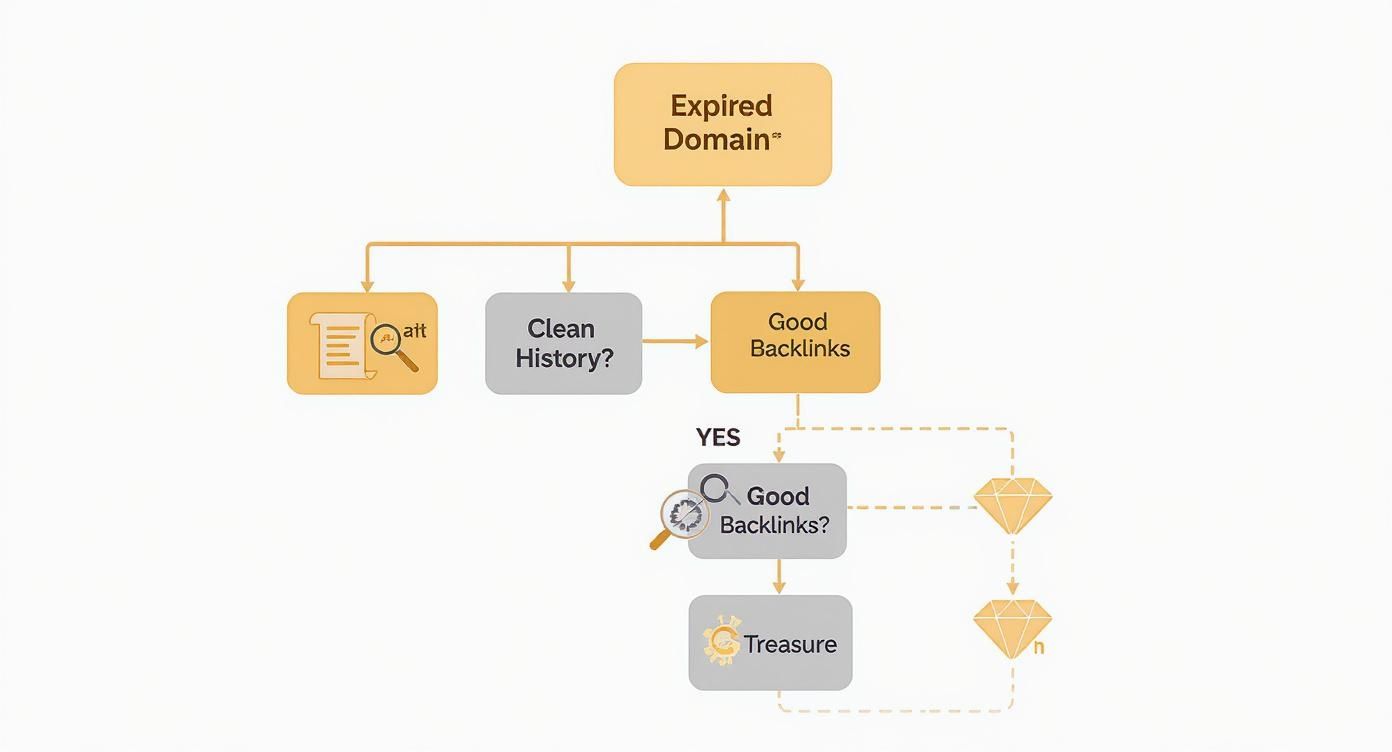
This flowchart boils the whole vetting process down to its essential questions—Is the history clean? Are the backlinks any good?—and points you right toward a potential treasure.
Filtering Down to a Manageable Shortlist
Once you’ve picked your hunting ground, it’s time to apply filters. Without them, you're just drowning in data. A good expired domain checker lets you slice and dice the list using the key metrics we just covered.
Start by setting some minimums. You might filter for domains with a Trust Flow of at least 15 and more than 20 referring domains. This one move clears out the low-quality noise instantly, ensuring you’re only looking at candidates with a baseline of authority.
You can also use time to your advantage. Filtering for domains that dropped 'Today' or within the 'Last 3 Days' often means you’re up against less competition. It’s a fantastic tactic for uncovering gems before the rest of the world has had a chance to spot them.
The Final Vetting Process
With a tight shortlist of promising candidates, it’s time for the final, manual inspection. This is the step that separates the pros from the amateurs—and makes sure you don't end up with a lemon.
- Deep Dive into the Backlink Profile: Open up the backlink report for your top contenders. Where are the most powerful links coming from? Are they from relevant, reputable sites in your niche, or a bunch of spammy directories and foreign-language blogs? The context of the links is everything.
- Travel Back in Time with the Wayback Machine: Take each domain and plug it into Archive.org's Wayback Machine. Click through its history. Was it a legitimate business or a real blog? Or do you see signs of spam, hacked content, or anything else that looks shady? If so, it's an immediate red flag.
This final check is non-negotiable. A domain can have stellar metrics on paper, but a toxic history can carry hidden penalties that will sabotage your project before you even start.
By following this hands-on approach, you can confidently navigate any expired domain checker and consistently find high-potential domains. For a deeper look, explore our complete guide on how to find expiring domains and truly master the art of the hunt.
Smart Strategies for Your New Domain
So, you’ve used an expired domain checker, crunched the numbers, and landed a fantastic domain. High-five! Now what? Owning a powerful expired domain is like finding a perfectly tuned engine at a scrap yard—it has the potential to absolutely fly, but you've got to build the right car around it.
Let's walk through three smart, white-hat strategies to turn that new digital asset into a serious advantage. These aren't shady shortcuts; they're sustainable ways to cash in on the value you just acquired.
Build a Niche Authority Site
This is easily the most exciting play. Instead of starting a new website from scratch on a fresh domain—which Google tends to stick in a "sandbox" for months—you build it right on your expired domain. You’re essentially starting the race already halfway to the finish line.
Because the domain comes with a history of trust and a ready-made backlink profile, you can start ranking in search results much faster. Imagine launching a blog about sustainable gardening on a domain that used to belong to a beloved local nursery. That built-in topical authority gives you an immediate leg up, helping you find an audience quicker than you ever could starting from zero.
The real advantage here is momentum. You inherit a foundation of trust that can take years to build from scratch, letting you focus on creating great content while the domain's history does the heavy lifting for you.
The Power of the 301 Redirect
What if you already have a main website you love, but it's struggling to get traction? The 301 redirect is your secret weapon. By setting up a permanent 301 redirect from the expired domain to your main site, you're basically telling search engines, "Hey, see all that trust and authority this old domain has? Send it all over to my main site now."
This move can give your primary website a major, and often immediate, SEO boost. But for this to work, topical relevance is everything. Redirecting an old pet grooming blog to your new tech startup site is a waste of time. But redirecting it to your existing dog walking business? That’s a match made in SEO heaven, and it can help your main site climb the rankings for the keywords that matter.
The Art of Domain Flipping
Finally, there's the straightforward business of domain flipping. Think of it as digital real estate investing—you buy undervalued assets, maybe do a little cleanup work like disavowing spammy links, and then sell them for a tidy profit. SEO pros and marketing agencies are always hunting for domains with strong metrics to jumpstart their own projects.
If you can develop a good eye for spotting gems—domains with clean histories and solid backlink profiles—you can turn this into a profitable side hustle. The trick is to find domains with metrics so good that another buyer sees the value immediately. This is where you can really leverage the time filters in a tool like NameSnag. Scoping out domains that dropped 'Today' or within the 'Last 3 Days' often surfaces undervalued assets before anyone else snaps them up.
Common Pitfalls to Avoid in Your Search
Diving into the world of expired domains feels a bit like treasure hunting. The potential rewards are massive, but so are the odds of stepping into a cleverly hidden trap. A good expired domain checker points you toward the gold, but you still need a keen eye for the red flags. Getting this part right will save you a world of time, money, and frustration down the road.
The absolute biggest mistake you can make is failing to dig deep into a domain's past life. It's incredibly easy to get dazzled by big, shiny metrics, but a domain that was previously a home for spam, shady affiliate schemes, or a Private Blog Network (PBN) can carry a Google penalty that’s nearly impossible to shake. That's a ghost in the machine you do not want haunting your new project.
Chasing Vanity Metrics
Another classic blunder is getting hypnotized by vanity metrics. Seeing a domain with 10,000+ backlinks might feel like you've hit the jackpot. But what if 9,900 of them come from garbage-tier, spammy directories or blogs in a language you can't even read? Those links aren't just worthless—they're toxic.
You have to train yourself to see quality over sheer quantity. A handful of powerful, relevant links from sources with real authority is infinitely more valuable. It’s the difference between having a thousand acquaintances who barely know your name and five close friends who would vouch for you in a heartbeat.
A domain's backlink profile tells a story. Your job is to read between the lines and figure out if it's a heroic epic or a cautionary tale of spam and shortcuts.
Overlooking Niche Relevance
This one sounds almost too obvious to mention, but it snares even seasoned domain hunters. Imagine you unearth a domain with a fantastic Trust Flow and juicy links from major news outlets. The only problem? It used to be a blog about competitive dog grooming, and you’re planning to launch a site about cryptocurrency.
Those backlinks, as powerful as they are, are completely off-topic. Search engines are more than smart enough to see the disconnect. All that amazing "link equity" you thought you were buying won't pass nearly as much authority as you'd hope. The domain’s history has to line up with where you plan to take it.
Forgetting the Legal Check
Finally, and this is a big one: never, ever skip the trademark check. Sometimes domains get dropped for a very simple reason—the previous owner got a cease-and-desist letter. Building your entire brand on a domain that tramples on someone else's trademark is a surefire way to land yourself in a legal nightmare.
A quick search on the US Trademark database is all it takes to avoid a headache that no amount of SEO value can cure. By sidestepping these common pitfalls, you can confidently find domains that are genuine assets, not just liabilities wearing a clever disguise.
A Few Lingering Questions About Expired Domains
Jumping into the world of expired domains can feel like learning a new language. You've got the core strategies down, but a few nagging questions might still be bouncing around in your head. Let's clear up some of the most common ones and get you ready for your first big find.
Think of this as your final checklist before you start the treasure hunt. Getting these answers straight will give you the confidence to really put a domain checker to work.
Is It Really Safe to Use Expired Domains for SEO?
Absolutely—as long as you do your homework. That's the entire game. An expired domain is only a risky bet if you skip the critical step of investigating its past.
The key is to treat each domain like a used car. You wouldn't buy one without checking its history report and looking under the hood first, right? If you use a tool like the Wayback Machine to confirm its past life was clean and its backlinks are from relevant, high-quality sources, it can be one of the most powerful tools in your SEO arsenal.
What’s the Difference Between "Available" and "Expiring" Domains?
This is a fantastic question that gets right to the heart of domain hunting strategy. It all comes down to timing and availability.
Available domains are the ones that have already gone through the entire expiration process and have been released back into the wild. You can register them right now for a standard fee at any registrar. They're perfect for when you need a domain immediately.
Expiring domains are still in a grace period after the owner failed to renew. They aren't available to register just yet, but they will be dropping soon. Keeping an eye on these gives you a head start to research and prep for high-value domains before they ever hit the open market.
You can easily find both on our platform. Check out the freshest Available domains that just dropped, or scout the list of soon-to-be-released Expiring domains to plan your next move.
How Fast Can I Realistically See Results?
The results are almost always faster than starting from scratch with a brand-new domain. It’s a way to skip the infamous "Google sandbox" and get right to competing.
If you build a new site on an expired domain that already has some authority, you can often see positive ranking signals within a few weeks to a couple of months. For a 301 redirect strategy, the SEO value often starts passing to your main site in a similar timeframe, depending on how quickly search engines recrawl and process the change.
Ready to stop starting from scratch and find a domain with built-in power? NameSnag is your all-in-one expired domain checker, using AI to sift through the noise and find you valuable, spam-free domains with real SEO potential. Start your search on NameSnag today and discover your next digital asset.
Find Your Perfect Domain
Get access to thousands of high-value expired domains with our AI-powered search.
Start Free Trial