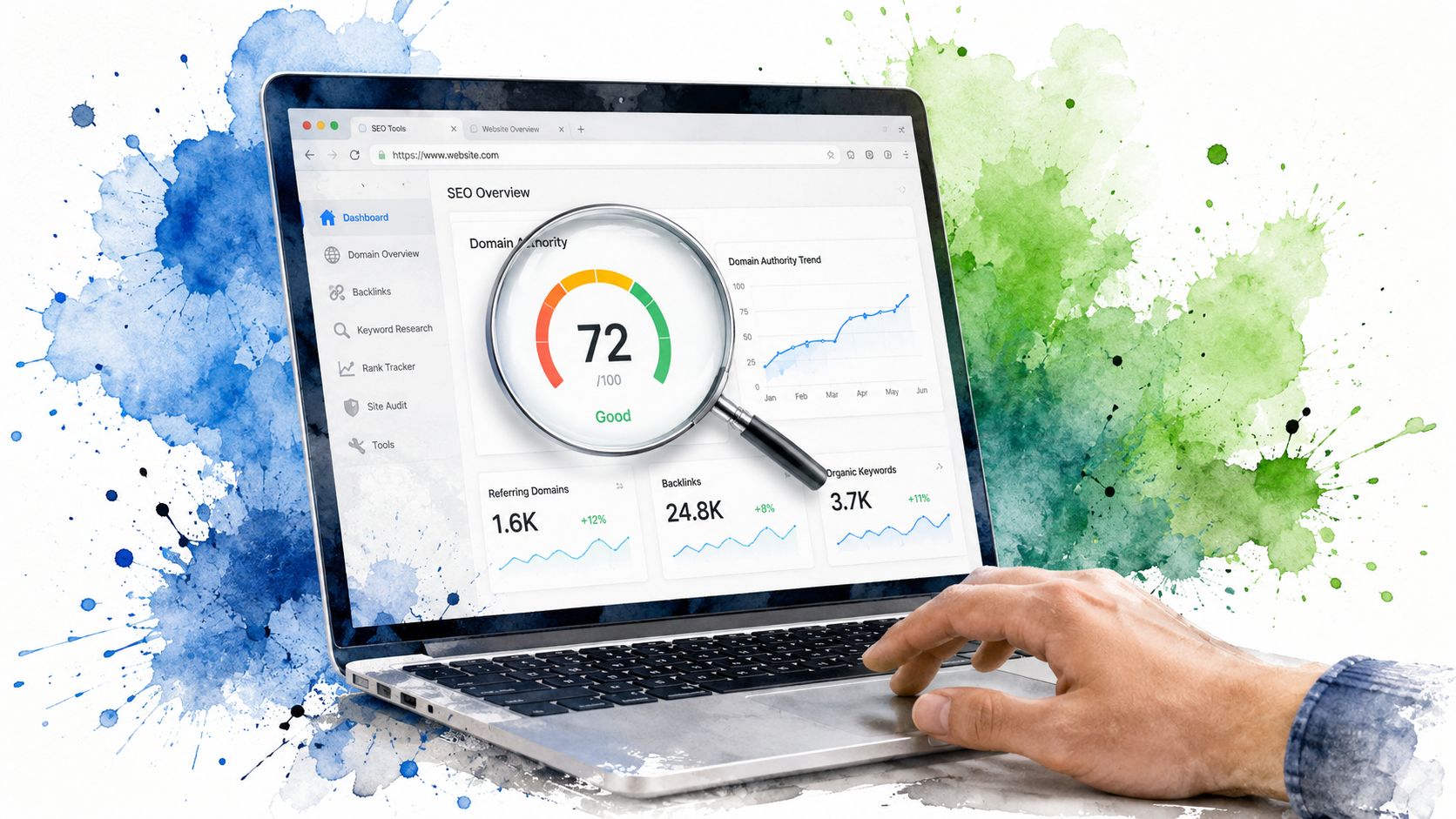
You're probably doing one of two things right now. You're either staring at a giant list of expired domains, wondering which ones are real opportunities and which ones are polished garbage. Or you've found a domain that looks good on the surface, but you don't trust the number next to it enough to spend money.
That skepticism is healthy.
A Domain SEO score checker is useful, but only if you treat it like a metal detector, not a treasure map. It helps you find where to dig. It does not tell you what's buried there. The people who lose money on domains usually skip that distinction. They chase the score, ignore the history, and end up buying a name that looks powerful in a dashboard but carries baggage you'd never want near a real project.
The people who get ahead use the score differently. They use it to narrow the field fast, then they investigate why the score exists in the first place. That's where the hidden gems show up.
The Agony of the Endless Domain Hunt
If you've hunted domains for any length of time, you already know the routine is ridiculous.
You start with a list full of names that sound like failed crypto side projects, abandoned coupon sites, and domains that somehow combine three hyphens with a misspelled brand term. You scroll for an hour before finding one that seems halfway decent. Then the main event begins. You open one tab for authority, another for backlinks, another for archive history, another for competitors, another for spam checks.
By the time you've stitched together enough evidence to make a decision, two things usually happen. Someone else grabs the domain first, or you discover the site used to host junk content that would make any serious buyer run.
I've seen people spend more time “researching” a mediocre domain than they'd spend evaluating an actual business lead. That's backwards. Domains move fast. If your process needs a dozen tabs and a spreadsheet just to decide whether something deserves a closer look, your process is broken.
Why the old manual method falls apart
The problem isn't that the data is useless. The problem is that the data is scattered.
When you check domains one by one, your brain starts playing tricks on you. A decent authority score feels more impressive than it is. A cool brand name makes you overlook a rotten link profile. Aged domains get treated like antiques, as if “old” automatically means “valuable.” It doesn't. Some old domains are just old trash.
Here's what a bad workflow looks like:
- You screen too slowly. Good domains don't wait for you to finish your detective novel.
- You overweight one metric. Usually authority, sometimes backlinks, occasionally age.
- You get emotionally attached. Brandable names make smart people ignore obvious warning signs.
- You miss context. A number without history is just decoration.
Practical rule: If a domain takes too long to triage, you need a faster first filter, not more tabs.
That first filter is where a domain SEO score checker earns its keep. Not as a final answer. As a fast way to cut a junk pile down to a shortlist worth investigating.
The shift that actually saves time
The smart move is simple. Use the score to eliminate obvious losers fast, then spend real attention only on domains that survive the first pass.
That changes the whole hunt. Instead of asking, “Is this score high enough?” you start asking better questions:
- Why is the score high?
- Is it backed by link quality or inflated by noise?
- Does the domain have a clean story?
- Could this name work for an investor, a redirect, or a real brand?
That's when domain hunting stops feeling like dumpster diving and starts feeling like buying assets.
What Exactly Is a Domain SEO Score
A Domain SEO score is basically a credit score for a website's search reputation. Not perfect, not official, and definitely not something Google hands out. But it's useful because it compresses a messy pile of signals into one number you can glance at quickly.
That speed matters. If you're sorting through a big list of domains, you need triage before you need nuance.
It's a proxy, not a Google metric
This is the part a lot of beginners miss. A domain score is a third-party estimate. It's not a direct ranking signal from Google. It's a model built by SEO tools to predict strength, authority, or ranking likelihood.
Historically, that idea traces back to tools like Moz. Moz's Domain Authority is a proprietary score created to predict how likely a website is to rank in search results, and its domain analysis tool can also show Page Authority, ranking keywords, and top search competitors in a single click through Moz Domain Analysis. That mattered because it pushed the industry toward ranking-prediction models instead of treating raw backlink counts like the whole story.
That's also why experienced buyers don't say, “Google gave this domain a strong score.” Google didn't. A tool did.
Why the score still matters
Even though it isn't a Google number, it's still useful because it helps you sort fast.
A score gives you a rough answer to a practical question: “Should I spend another five minutes on this domain, or should I move on?” When you're screening a lot of names, that shortcut is valuable.
Consider it this way:
| What the score does | What the score doesn't do |
|---|---|
| Helps you compare domains quickly | Guarantee rankings |
| Flags domains worth deeper review | Reveal spam history by itself |
| Summarizes authority signals | Replace backlink and history checks |
| Speeds up shortlist creation | Tell you whether the name fits your goal |
A lot of mistakes happen when people confuse the left column with the right one.
Why modern score checkers look different now
The old-school version of domain checking was mostly about authority. Today, tools are moving toward broader audits.
Google Lighthouse-based SEO checkers now score pages on a 0–100 scale using 14 key metrics, with published bands of 100–90 for “Optimized,” 90–50 for “Needs work,” and 50–0 for “Not optimized,” as shown by SEO Review Tools' Google SEO checker. That same source also notes analyses across 100 website data points. The practical takeaway is clear. A modern domain SEO score checker increasingly acts as shorthand for a much bigger audit stack.
A strong-looking number is useful for triage. It gets dangerous when you treat it like a verdict.
That's why I like score checkers most at the very start of a workflow. They're excellent at narrowing a field. They're terrible at replacing judgment.
Deconstructing the Score Key Metrics Explained
Once a domain passes the quick glance test, the actual work starts. A single score is just the wrapper. You need to inspect what's inside.
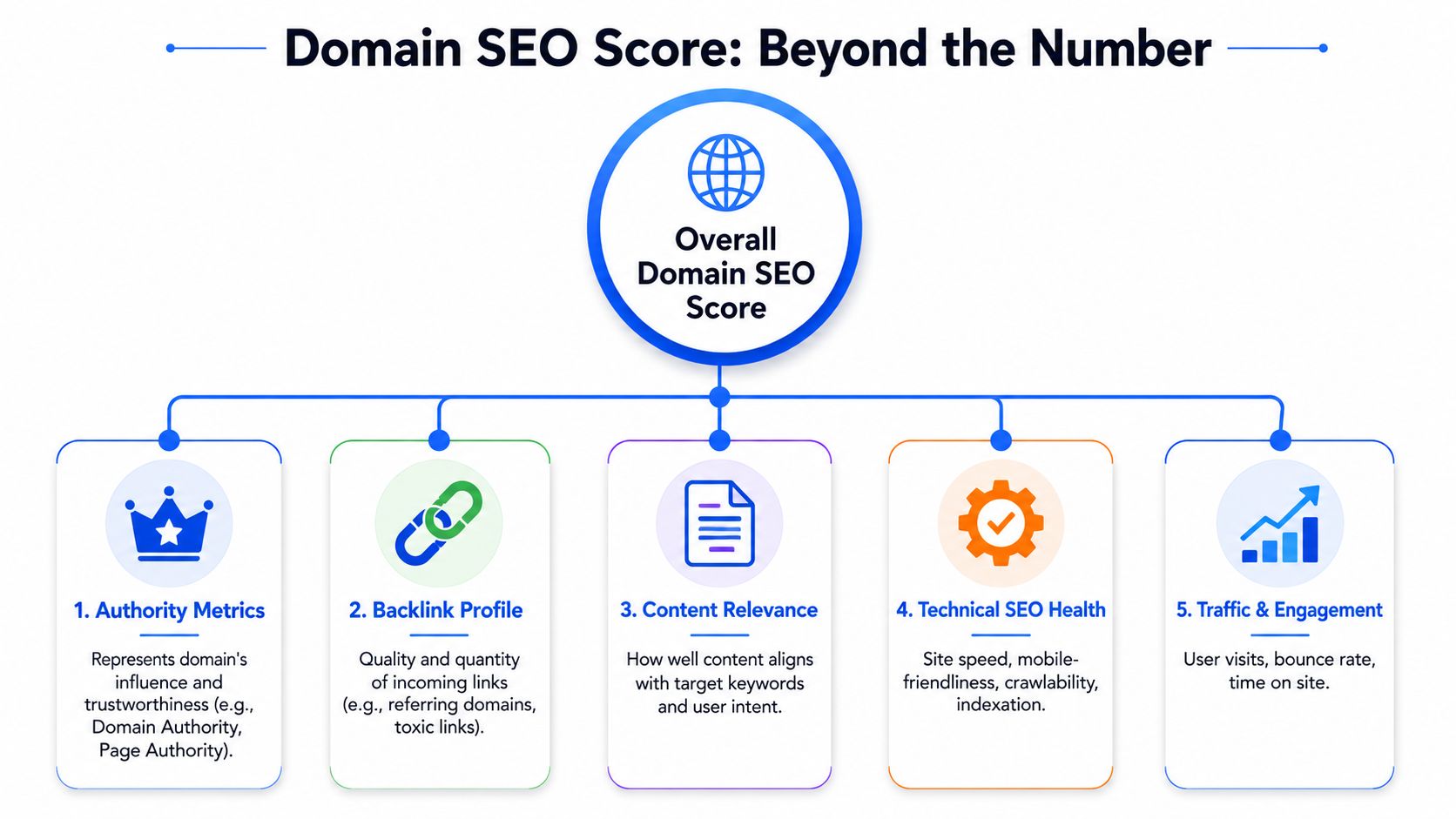
Authority metrics are summaries, not proof
Authority metrics exist to give you a compressed view of a domain's relative strength. They're useful because they help with comparison. They're dangerous because they can make two very different domains look equally attractive on paper.
Ahrefs frames domain authority around the quality and quantity of external backlinks and exposes DR and UR as link-based metrics, while Moz's Domain Authority is a 1–100 predictive score intended to estimate ranking likelihood rather than directly measure Google rankings, as shown in Ahrefs' website authority checker.
That difference matters. One score may lean harder into backlink structure. Another may be more predictive in spirit. Either way, neither tells the full story by itself.
If you want a good plain-English comparison of how SEO tools differ in practice, Toolradar's SEO tool breakdown is worth a read. It's useful when you're trying to understand why one platform surfaces a domain differently than another.
Backlink profile is where the truth usually lives
This is the first place I look after the headline score.
A domain with a healthy backlink profile usually shows a believable pattern. The links make sense. The referring domains aren't all weird. The anchors don't look like someone hired a bargain-basement link vendor and gave them a list of exact-match keywords.
A domain with a sketchy profile often has the opposite feel. Too much repetition. Too many low-quality sites. Too little relevance. Too much “SEO smell.”
What matters most here isn't raw volume. It's quality plus distribution.
- Referring domains matter more than link piles. A hundred links from one corner of the web doesn't carry the same weight as links from varied, relevant sites.
- Context matters. Links from sensible pages in related spaces tell a better story than random placements on forgotten blogs.
- Anchor text matters. Natural anchors usually look boring. That's a good sign.
For a deeper explanation of how composite scoring works in domain investing, NameSnag's write-up on how domain score works is a useful companion to this topic.
Content relevance and topic fit change the math
A lot of buyers ignore this because it isn't as shiny as authority metrics.
A domain can have respectable authority and still be a terrible fit for your use case. If the historical content sits in one topic neighborhood and you're planning to use it for something completely different, you may not get the smooth carryover you hoped for. Relevance doesn't always show up as a clean number, but it shows up in outcomes.
I'd rather buy a domain with a coherent topical story than a flashier one with a chaotic past.
Technical health filters out fake comfort
Strong authority can hide a weak website foundation. If the site history suggests crawl issues, sloppy structure, or neglected pages, the score alone won't save you.
This is why multi-metric audits have become more useful than the old one-number worldview. Modern checkers increasingly blend authority with technical and on-page signals because buyers now need a broader picture before they commit.
A good domain isn't just “strong.” It's usable, believable, and clean enough to build on.
Brandability is the metric too many SEOs ignore
Investors usually understand this faster than pure SEO people do.
You can't separate search value from resale value forever. A domain with decent authority and a memorable, commercially usable name can be much more valuable than a stronger-looking domain nobody would want on a logo. If a name sounds spammy, confusing, or awkward to say out loud, it limits your upside.
That's why the best domains often win across multiple dimensions at once. They have authority, history, relevance, and the kind of name a real person could build on.
Interpreting Scores and Spotting Spam Signals
A high score is nice. A clean domain is better.
That's the mental shift. Stop asking whether the number is impressive. Start asking whether the domain deserves to be trusted.

A good score depends on your goal
People love asking what counts as a “good” score, but that question is too blunt to be useful.
A niche content site, a local service project, a startup brand, and a redirect target don't need the same kind of domain. If you're buying for a founder, brandability may matter almost as much as authority. If you're buying for an SEO play, link quality and history may matter far more than the name itself. If you're buying to flip, you need both the numbers and a believable buyer story.
That's why score interpretation is contextual. Not every decent domain is a deal. Not every average-looking domain is a miss.
Red flags that ruin “great” domains
The classic trap is a domain with pretty metrics and an ugly past.
When I see a strong-looking score, I check for these problems before I get excited:
- Spammy historical use. Archive history can expose old abuse fast.
- Manipulated backlink patterns. If the profile feels engineered, it probably was.
- Topic mismatch. A domain that bounced between unrelated uses often carries a messier signal.
- Thin or junk content footprints. These can poison the domain's practical value.
- PBN fingerprints. If it looks like a network toy, treat it like one.
If you're actively reviewing suspicious domains, a dedicated domain spam score checker guide can help tighten that part of your screening process.
The ugliest losses in domain investing rarely come from low scores. They come from believable scores attached to bad histories.
Why authority alone doesn't settle the case
At this point, the market has changed.
Recent tools like Seobility now scan for technical errors, on-page issues, optimization gaps, and AI visibility, which points to a newer question buyers are asking: will domain authority translate into modern discovery surfaces? Seobility also frames checking in terms that include “AI visibility,” as shown on Seobility's SEO Checker. That matters because a high domain score can be less useful if the site isn't technically sound or ready for modern SERP features.
A domain can look authoritative and still be weak where it counts next. Poor crawlability, brittle structure, stale content patterns, and thin usability can all drag down the practical value of that authority.
A short explainer helps here:
The detective mindset wins
The best domain buyers act more like investigators than shoppers.
They don't fall in love with metrics. They build a case. If the score, backlink profile, archive history, technical readiness, and use case all line up, then the domain earns attention. If one of those pieces doesn't fit, they keep moving.
That discipline saves money. It also saves you from the worst kind of purchase. The one that feels smart until you own it.
The Smart Way to Find High Value Domains
The old workflow for domain hunting is part research, part punishment.
You collect lists in one tool, check authority somewhere else, inspect backlinks in another place, verify history in another, and then try to remember which domains proved worth revisiting. It's clumsy, and clumsy workflows create expensive mistakes.
A smarter process starts with centralization. You want one place to narrow the field before you spend energy on close inspection.
Speed matters more than people admit
If you're looking at recently dropped or about-to-drop domains, timing changes the game. A decent process done slowly still loses to a decent process done early.
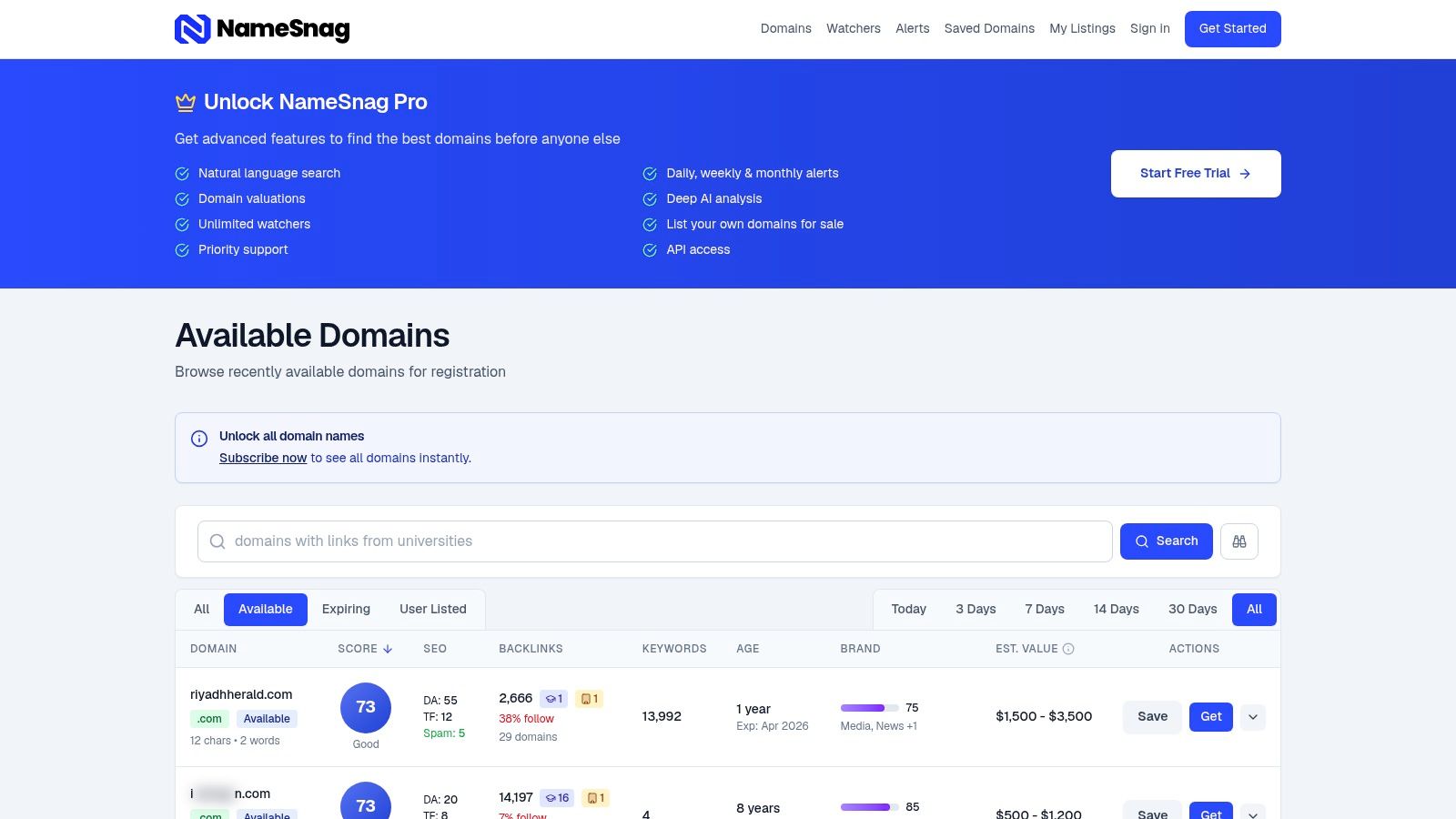
That's why filtered discovery is so useful. Instead of browsing random lists, you can search specifically for Available domains that can be registered immediately or Expiring domains that are still in the grace period and likely to drop soon. Those views become more practical when you combine them with time windows like today, recent days, or longer ranges, because the value of a domain list often decays fast.
What a streamlined hunt looks like
Here's the version that works in practice:
| Old way | Smarter way |
|---|---|
| Start with giant junk lists | Start with filtered domain pools |
| Open multiple tools immediately | Use score and filters to shortlist first |
| Review every interesting name deeply | Review only survivors deeply |
| Rely on memory and tabs | Keep evaluation in one workflow |
| Miss timing windows | Prioritize domains by availability stage |
A platform like NameSnag is one such option. It surfaces available and expiring domains and organizes discovery around searchable filters, which is more efficient than manually bouncing between disconnected tools. That kind of setup doesn't replace due diligence, but it does make due diligence manageable.
The real edge is not “more data”
It's often believed that the edge comes from having access to more metrics. Usually it doesn't.
The edge comes from reducing friction. If you can spot promising names faster, discard weak ones faster, and preserve your attention for the short list, you make better decisions. You also stop wasting prime brainpower on domains that should've been filtered out in the first minute.
Good domain hunting isn't about checking everything. It's about ignoring the right things quickly.
That's what makes a domain SEO score checker useful in practice. Not because it magically finds winners. Because it helps you stop treating every domain like it deserves a full investigation.
Your Action Plan A Domain Evaluation Workflow
A repeatable process beats instinct on tired days. And domain buying creates a lot of tired days.
When you use the same workflow every time, you make fewer emotional decisions. That matters because excitement is expensive in this business.
Step one starts before the score
Define the job the domain needs to do.
Are you buying for a brand launch? A content site? A redirect? A future flip? The same domain can look smart for one purpose and useless for another. If you skip this part, you'll misread everything that comes after.
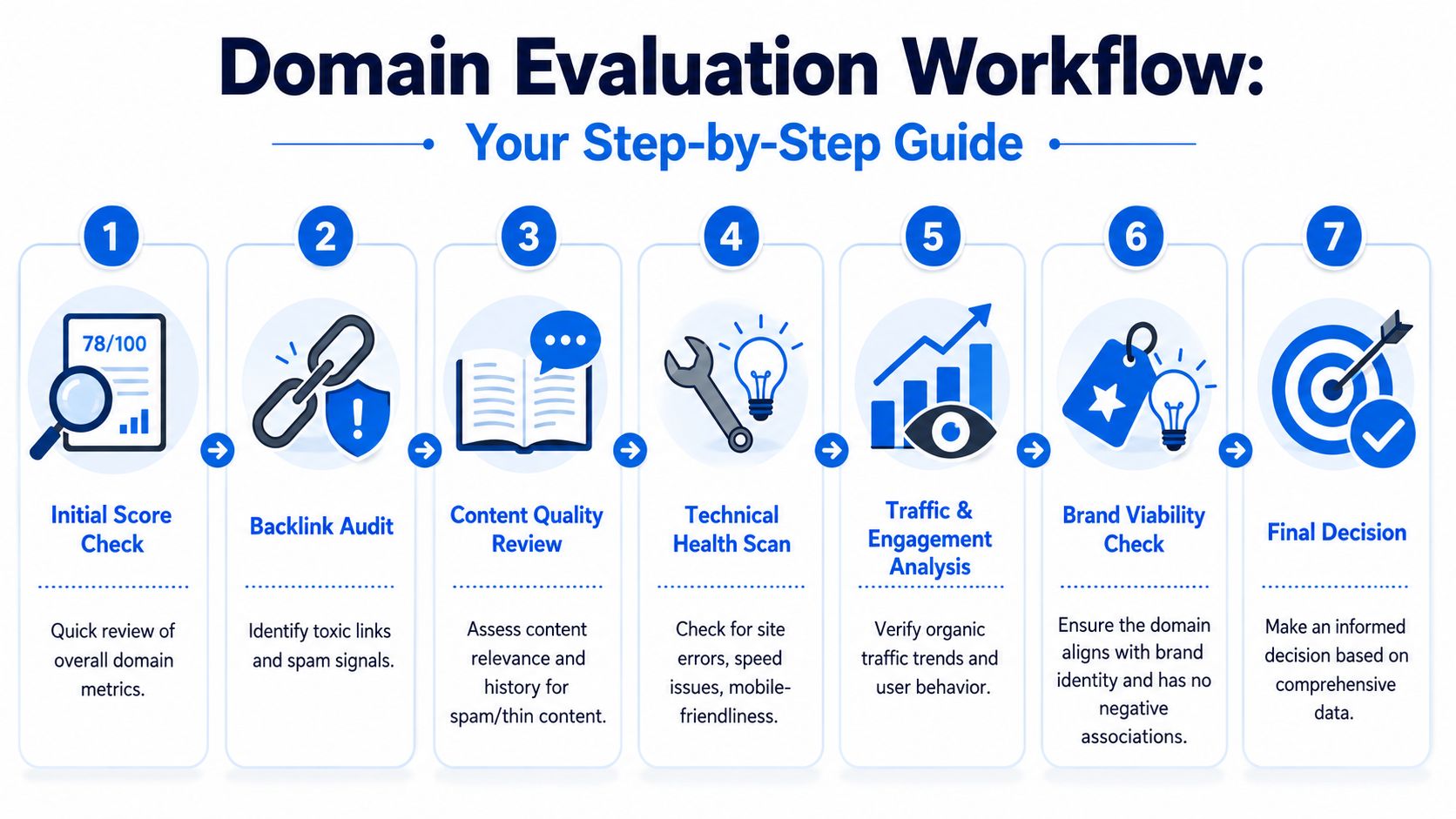
Use this workflow every time
Set the goal first.
Write down the intended use in one line. If you can't explain the purpose clearly, don't buy yet.Run an initial score check.
Use a domain SEO score checker to eliminate obvious weak candidates. This is triage, not conviction.Audit the backlink story.
Look for coherence, relevance, and signs of manipulation. You're not chasing quantity. You're checking whether the profile makes sense.Review the historical use.
Archive snapshots can save you from buying a domain with a sketchy past. This step catches more disasters than people admit.Check technical and content readiness.
You want evidence that the domain can support modern search expectations, not just coast on old authority.Assess brand viability.
Say the name out loud. If it sounds awkward, spammy, or forgettable, that limits its upside.Make the final call only after the whole file is clean.
If one key area feels wrong, pass. There will always be another domain.
A simple decision filter
I like to classify domains into three buckets:
- Buy now if the score is supported by a believable history and a clean backlink story.
- Watch closely if the core signals are promising but one area needs more verification.
- Walk away if the numbers look better than the narrative.
If you routinely screen lists in batches, a resource on bulk domain authority checking can help you tighten the first-pass stage before deeper review.
Your workflow should make it hard to talk yourself into a bad domain.
What doesn't work
A few habits keep burning buyers:
- Falling for one shiny metric
- Skipping historical review because the name sounds strong
- Treating every aged domain like a hidden gem
- Rushing into purchase because someone else might grab it
Scarcity makes people sloppy. A checklist keeps you honest.
How Different Pros Win with Scored Domains
The same domain can be valuable for completely different reasons. That's why broad advice on domain SEO score checkers often falls flat. It ignores the buyer.
Three buyers, three ways to win
An SEO buyer often wants an advantage. They're looking for a domain with a clean profile, relevant history, and authority that can support a site build or selective redirect strategy. Their version of “good” is practical. Less glamour, more transferability.
A domain investor wants asymmetry. They're hunting names where the market will notice value later than they do now. That usually means the score opens the door, but brandability and cleanliness close the deal.
A founder wants momentum without baggage. They don't need a museum piece with vanity metrics. They need a domain that can carry a brand, avoid weird associations, and offer a head start instead of a cleanup project.
I like reading operator interviews because they reveal how commercial people think about digital assets beyond pure SEO metrics. This interview with Ant Hebblethwaite is a good example of how sales-minded professionals think about positioning and value, which maps nicely to domain buying too.
The common thread is simple. Score gets attention. Context creates profit.
If you want a faster way to sort through dropped and soon-to-drop domains without the usual tab chaos, NameSnag is worth a look. It's built for finding available and expiring domains, then narrowing the field so you can spend your time investigating the few names that deserve it.
Find Your Perfect Domain
Get access to thousands of high-value expired domains with our AI-powered search.
Start Free Trial