
Ever feel like you're trying to crack a secret code when SEOs start throwing around "DA" and "PA"? Don't sweat it. We're about to demystify these terms for good. The difference is actually pretty simple: Domain Authority (DA) is a measure of the ranking strength of your entire website, while Page Authority (PA) zooms in on the ranking strength of one single page.
Think of it this way: DA is like a university's overall reputation. PA is the prestige of a single, rockstar professor at that university. Both are super important, but they operate on completely different scales. Understanding this dance between the two is your ticket to a smarter SEO strategy.
DA vs PA The Fundamental Difference

Let's unpack this a bit more, shall we? Both DA and PA are metrics cooked up by the SEO geniuses at Moz to predict how well a website or page might perform in search engine rankings. They both use a 1 to 100 logarithmic scale. That fancy term just means it's way easier to jump from a score of 10 to 20 than it is to climb from 70 to 80. The higher you go, the tougher the climb gets.
Imagine your website is a brand-new restaurant. Its Domain Authority is the overall buzz it has around town. You build this up slowly over time with great reviews (backlinks), a solid history (domain age), and consistent quality across your whole menu. A high DA tells everyone—and search engines—that your entire brand is legit and trustworthy.
Page Authority, on the other hand, is the fame of one specific signature dish. Maybe your truffle pasta goes viral and gets written up in every food blog in the city. That specific menu page would have a sky-high PA, even if your restaurant is still finding its footing. The strength of that individual page comes from links and attention aimed directly at it.
How They Influence Each Other
The relationship between DA and PA isn't a one-way street; it's more like a dance. A rising tide lifts all boats. As you build your website's overall DA by earning awesome, high-quality links, every new page you publish gets a nice little head start with its initial PA.
On the flip side, creating a blockbuster piece of content that pulls in a ton of links to that one page (driving its PA through the roof) also adds a bit of muscle to your site's overall Domain Authority. Each successful page contributes to your domain's total reputation. Getting a feel for this interplay is where the magic happens for a smart SEO strategy.
To make it dead simple, let's put them side-by-side.
DA vs PA At a Glance
Here’s a quick table to break down the core differences at a glance, so you know exactly which metric to look at and when.
| Attribute | Domain Authority (DA) | Page Authority (PA) |
|---|---|---|
| Scope | Entire Domain/Subdomain | Single, Individual Page |
| What It Measures | Overall predictive ranking strength of a website | Predictive ranking strength of one specific page |
| Primary Use Case | Evaluating a domain's overall health and acquisition value | Analyzing content performance and specific keyword competition |
| Analogy | A university's overall reputation | The prestige of a single, renowned professor |
This table should help clarify which metric to use for which task. DA is for big-picture analysis, and PA is for getting into the nitty-gritty.
Key Takeaway: DA is your strategic, big-picture metric. It's perfect for sizing up the long-term value of an entire website. PA is tactical and granular, used to see how a single piece of content stacks up against the competition.
Both of these scores are heavily influenced by your backlink profile, especially the number of referring domains—which are just the unique websites linking to you. The more distinct, high-quality sites that link to your domain or pages, the more authority you build. Getting these metrics down is the first step toward building a powerful online presence or snagging a high-value domain with authority already baked in.
Deconstructing Domain Authority
Let's put Domain Authority (DA) under the microscope. This is the big one, the metric everyone talks about when they’re sizing up a website's overall mojo. Hatched by the SEO wizards at Moz, DA is a score from 1 to 100 that predicts how well an entire site is likely to perform in search engine results.
Think of it as your website's credit score. A high score suggests to search engines that your domain has a strong, trustworthy history and is a credible source. Just like a good credit score opens doors to better loans, a high DA gives all of your pages—from the homepage to that blog post you just published—a better shot at ranking well from day one.

It’s not just a vanity metric; it's a solid indicator of your site's overall SEO health and competitive muscle. Building it is a long game, but man, the payoff is huge.
The Secret Sauce Behind the DA Score
So, how does Moz actually cook up this number? The exact formula is a closely guarded secret (think Colonel Sanders' recipe), but we know it's powered by a machine-learning algorithm that crunches over 40 different factors. The most important ingredients are all tied to your backlink profile.
Here’s a quick look at the key elements that really move the needle:
- Linking Root Domains: This is arguably the most critical piece. It counts the number of unique websites linking back to you. Getting 50 links from 50 different domains is infinitely more valuable than getting 50 links from just one. Diversity is everything.
- Total Number of Backlinks: While diversity is king, the sheer volume of links pointing to your site still counts for something. More links act as more "votes of confidence" from around the web.
- Quality of Backlinks: Not all links are created equal. A single link from a high-authority site like a major news publication or a respected industry blog can carry more weight than hundreds of links from low-quality directories or spammy sites.
At its core, DA is an attempt to model how search engines see your site's authority based on who is vouching for it online. It’s all about the company you keep.
Pro Tip: When you're on the hunt for a domain, a high DA is a massive green flag. It means you aren't starting from scratch. You're inheriting a pre-built reputation that can give your project an immediate leg up.
Why DA is Crucial for Domain Hunting
This metric becomes absolutely vital when you're sifting through domain lists, trying to find that hidden gem. A strong DA score can be the difference between a project that takes off right away and one that struggles for months just to get noticed.
When you find a domain with a solid DA, you’re basically acquiring a digital asset with built-in trust. This is a game-changer whether you're browsing for Available domains that just dropped and can be registered immediately, or keeping an eye on high-DA Expiring domains that will be dropping soon.
The link between a high DA and ranking potential is undeniable. Moz first rolled out Domain Authority back in 2004 specifically to estimate a website's ranking likelihood. According to their own data, sites with a DA score above 60 are 5.2 times more likely to rank in the top 10 search results compared to sites with a DA below 30. That stat alone shows just how powerful a high DA can be for search visibility. You can find more analysis on this in the DA vs PA comparison on autopagerank.com.
Understanding DA isn't just about tweaking your own site; it’s about making smarter, more strategic bets when you invest in your next online venture.
Unpacking Page Authority for Content Strategy
If Domain Authority gives you the 30,000-foot view of your site’s overall reputation, then Page Authority (PA) is what’s happening down in the trenches. It’s the metric that tells you about the individual star power of a single page. Scored from 1 to 100 by Moz, PA predicts the ranking potential of one specific URL, and it’s where your on-page SEO, content quality, and page-specific backlinks really show their muscle.
A single, knockout blog post can build a high PA and start ranking for tough keywords, even while the domain's overall DA is still climbing. It's the ultimate equalizer in the SEO world.
Think of it like a band. The band's overall fame is its DA. But that one smash-hit single that tops the charts for weeks? That’s its high-PA page.
Why PA Is Your Secret Weapon for Content Planning
Page Authority is the metric you'll live and breathe when you're in the weeds of a content strategy. It’s all about winning individual keyword battles. By analyzing the PA of the top-ranking pages for a keyword you’re targeting, you can set a clear, measurable goal for your own content.
If the top three results all have a PA floating around 45, you know exactly the level of authority you need to build to that specific page just to have a fighting chance. This flips a vague goal like "rank for this keyword" into a data-driven mission.
Here’s how you can use PA to sharpen your strategy:
- Competitive Analysis: Pinpoint which of your competitor's pages have the highest PA. These are their heavy hitters. Dig into what makes them successful—is it their content depth, unique data, or the powerful backlinks they've attracted?
- Content Prioritization: Not all content pulls its weight. Use PA to find your own pages that have high potential but are underperforming. A little link-building love aimed at these pages can deliver some surprisingly quick wins.
- Surgical Link Building: When you're building links, PA helps you be precise. Instead of pointing every link to your homepage (a common mistake), you can direct them to specific blog posts or service pages you want to push up the rankings.
By focusing on PA, you can reverse-engineer what works for top-ranking content and build a targeted plan to outrank them. It’s less about boiling the ocean and more about winning one battle at a time.
The Power of Page-Level Optimization
Improving a single page's authority is often far more manageable than trying to lift your entire domain's DA. You can concentrate your efforts—like guest posting, internal linking, and content promotion—on one specific asset.
This focused approach is incredibly powerful. A 2021 analysis found that pages with a PA score above 70 were 3.8 times more likely to rank in the top 10 for their target keywords compared to pages with a PA below 40. This really drives home how crucial it is to optimize individual pages, especially when you're up against tough competition. You can discover more insights about the impact of PA on rankings on 3way.social.
At the end of the day, the quality of backlinks pointing directly to that page is the number one driver of its PA score. For a deep dive on how to evaluate link quality, check out our guide on how to check backlink quality. Getting this right is the key to building a page that can climb the search engine rankings and bring in meaningful traffic.
When to Focus on DA vs PA
Knowing the difference between Domain Authority and Page Authority is just step one. The real skill is knowing which metric to focus on, and when. This isn't just theory—it's the core of a smart SEO strategy, the part where you turn abstract numbers into real-world decisions.
So, how do you decide whether to put on your DA hat or your PA glasses? It really just boils down to your immediate goal. Are you looking at the big picture for your entire brand, or are you trying to win a specific, targeted battle?
This simple diagram helps frame the choice: are you focused on the entire site's strength, or just one page's power?
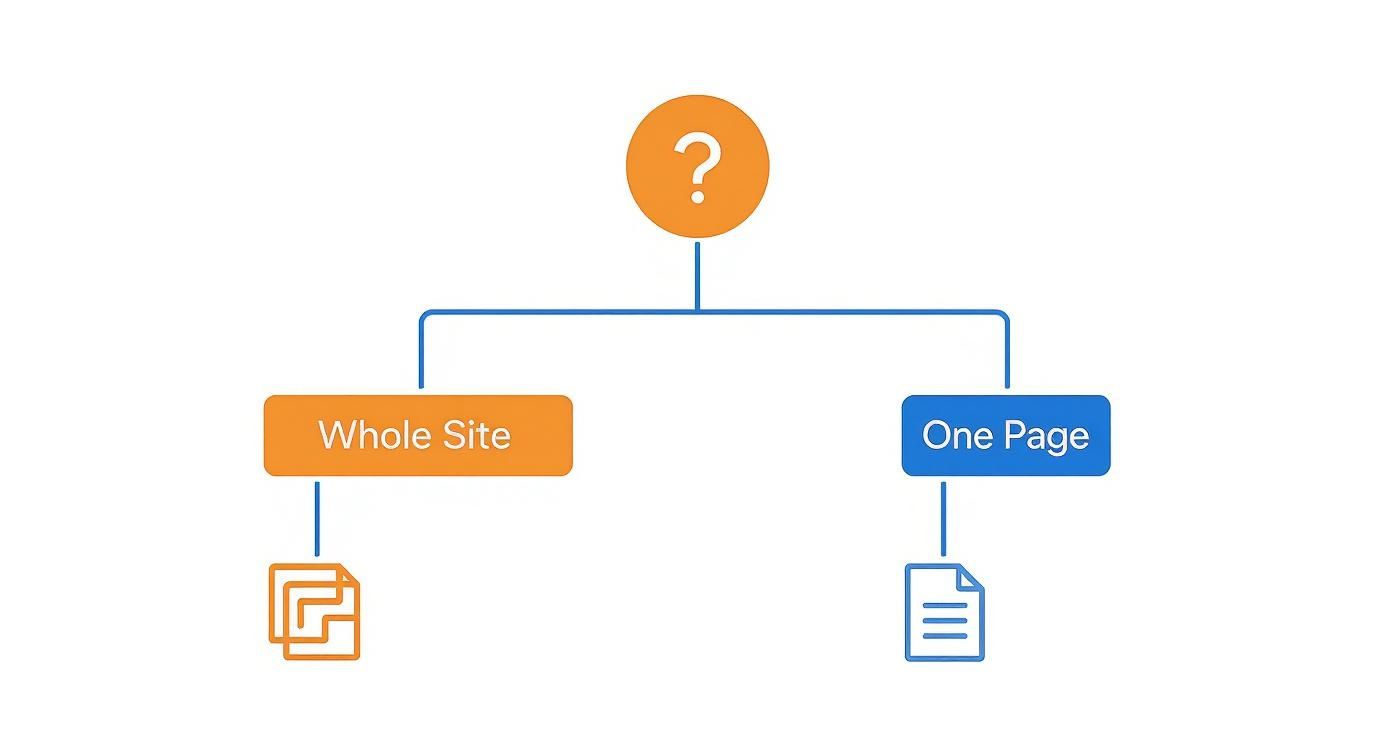
The visual makes it clear: DA is your go-to for site-wide initiatives, while PA is your weapon of choice for page-specific campaigns. Let’s break down the most common scenarios you'll run into.
Prioritize Domain Authority for Strategic Moves
Think of Domain Authority as your long-term investment portfolio. You zoom in on it when you're making big, foundational decisions that will impact your site's health for years to come. It’s all about building and assessing your overall brand credibility in the eyes of search engines.
You should zero in on DA in these situations:
- Buying a New Domain: This is the big one. When you're hunting for a new domain, a high DA is like finding a house with a solid foundation already built. The domain has an established history and a backlink profile you can inherit, giving you a massive head start.
- Analyzing Competitors: Sizing up the competition? DA gives you a quick, at-a-glance snapshot of who the heavyweights are in your niche. If the top players all have DAs in the 60s, you know you're in for a long fight to build similar authority.
- High-Level Site Audits: During a quarterly or annual review of your SEO performance, tracking DA over time is a fantastic way to measure the overall success of your long-term link-building and branding efforts.
For anyone looking to find a powerful domain, focusing on DA is non-negotiable. It’s your golden ticket when browsing NameSnag’s list of Expiring domains, where you can find gems with pre-built authority just waiting to be claimed. A domain with a DA of 30+ can save you months, if not years, of grinding.
Lean on Page Authority for Tactical Wins
Now let's get tactical. If DA is the portfolio, Page Authority is your specialist tool for surgical strikes and targeted campaigns. It’s about winning the small battles that, over time, win you the war.
Switch your focus to PA for these tasks:
- Content Planning: Before you write a single word, check the PA of the pages currently ranking for your target keyword. This tells you the "authority bar" you need to clear.
- Targeted Link Building: Running a campaign to promote a new blog post or service page? Your goal is to increase that specific page's PA by building high-quality links directly to it.
- Prioritizing Content Updates: Have an important but underperforming blog post? Check its PA. A low score might signal it needs more internal links or a dedicated backlink campaign to get the boost it needs.
- Internal Linking Strategy: Identify your pages with the highest PA. These are your power players. Linking from these high-PA pages to newer or less authoritative pages on your site is a fantastic way to spread the link equity around and give them a lift.
Key Insight: DA is for evaluating assets (like domains), while PA is for evaluating efforts (like content campaigns). Knowing which lens to look through is the key to making smarter, more efficient SEO decisions.
For domain hunters and sharp entrepreneurs, Domain Authority and Page Authority aren't just abstract metrics—they're treasure maps. Picking up an expired domain with high DA is like getting the keys to a storefront on a prime street. You get to sidestep the brutal, slow grind of building a reputation from zero and instead inherit an asset that already has history, credibility, and a ton of backlinks.
This is where the real game is played, especially when you're digging for gold in the domain aftermarket. Once you get the hang of the DA vs. PA dynamic, you can make smarter investments that give you a massive head start.

Hunting for Gems on NameSnag
Let's get practical. When you're scanning domain lists, your first filter should almost always be Domain Authority. A domain with a DA of 25+ or 30+ is a serious find. This number tells you the entire site has a strong backlink profile and has earned credibility in the eyes of search engines over time.
This is your main sorting mechanism when you're using NameSnag's core features:
- Available Domains: These domains have already dropped and are ready to be registered at any registrar. Filtering for a high DA here lets you find established names you can build on immediately. Imagine grabbing an Available domain with a DA of 32 that’s a perfect fit for your new project—that’s an instant win.
- Expiring Domains: These are domains in their grace period that will be available soon. This is where you can unearth some absolute monsters. By setting alerts for high-DA Expiring domains, you can get ready to pounce the moment a powerhouse name drops.
A domain with a solid DA is a flexible asset. You can use it to launch a new authority site, build out a private blog network (PBN), or execute a slick 301 redirect to funnel all its "link juice" over to your main website.
Look Beyond the DA Score
Here’s where a smart investor pulls ahead of the pack. A high DA is a great signal, but it’s not the whole picture. The next move is to dig into the domain’s Page Authority. Why? You need to know where that authority is actually coming from.
Is that domain's DA of 40 propped up by a single, bizarrely viral blog post about a topic that has nothing to do with your niche? Or is the authority spread nicely across several relevant, high-PA pages?
Critical Insight: A high DA is the headline, but the PA distribution across its top pages tells the real story. You want a domain where the authority is relevant and well-distributed, not one held up by a single, off-topic page that brings you no real value.
Before you commit to buying a domain, run this quick PA check:
- Find the Top Pages: Use an SEO tool to see which pages on the domain have the most backlinks.
- Check Their PA: Make a note of the Page Authority scores for these heavy-hitters.
- Analyze Relevance: Are these high-PA pages topically aligned with what you plan to do with the domain? A domain with a DA of 30 and three relevant pages with PA scores between 25-35 is often way more valuable than a DA 40 domain whose top page is a random, off-topic fluke.
A Quick Case Study
Imagine you find two expiring domains, both with a DA of 35.
- Domain A: Its strongest page (PA 42) is a 10-year-old list of "Top 10 Viral Cat Videos." Every other page has a PA below 15. Unless you're launching a cat video empire, this domain's authority is pretty much worthless to you.
- Domain B: Its authority is spread across a homepage (PA 38), a "Resources" page (PA 33), and a popular blog post (PA 31), all directly related to your niche. This is the one you want. The authority is clean, relevant, and ready for you to put to work.
This simple two-step analysis—filtering by DA, then qualifying with PA—is what separates amateur domain flippers from strategic investors. It makes sure you’re not just buying a number, but a genuinely valuable digital asset. To get more comfortable with this process, you can learn more about how to use an expired domain checker to analyze these metrics effectively. It's a crucial skill for anyone serious about finding the good stuff.
A Practical Checklist to Improve Your SEO Metrics
All this theory is great, but how do you actually put it to work? Let's turn knowledge into action. Here's a practical checklist for boosting both your Domain and Page Authority, whether you're working on an existing site or starting fresh with a powerful domain you just snagged.
Think of these strategies as a one-two punch: long-term foundation building for your DA, and targeted, surgical strikes for your PA. The goal is to create a powerful feedback loop where every single action builds on the last, adding to your overall SEO strength.
Boosting Your Existing Site's Authority
If you already have a website, your mission is to systematically improve its credibility and trustworthiness. Here's a step-by-step game plan focused on quality over sheer quantity.
- Conduct a Backlink Audit: The very first move is to clean house. Use your favorite SEO tool to hunt down and disavow any "toxic" or spammy backlinks pointing to your domain. A clean backlink profile is the bedrock for everything that follows.
- Create "Linkable Assets": Let's be honest, you can't just ask for links anymore; you have to earn them. Develop high-value content that people genuinely want to reference and share. We're talking original research, free tools, ultimate guides, or compelling infographics. These are your authority-building magnets.
- Master Strategic Internal Linking: This is your secret weapon for pumping up PA. Find your pages with the highest existing authority and link from them to newer or less powerful pages you want to rank. This is how you spread the "link juice" around your site and signal to search engines which pages really matter.
- Optimize Your On-Page SEO: Never forget the basics. Make sure your target keywords are properly placed in your titles, headers, and meta descriptions. A well-optimized page is far more likely to rank, which in turn attracts the natural backlinks that boost its PA.
Key Takeaway: Improving authority isn't about chasing a score. It’s about consistently creating value and building a website that both search engines and real people can trust.
Quick Checklist for Buying a Domain
When you're sizing up a domain to purchase, the process needs to be fast and decisive. You're looking for a running start, not a fixer-upper. This is the mini-checklist to quickly vet domains on platforms like NameSnag.
- DA as the First Filter: Is the Domain Authority 20+? This is a great baseline to ensure the domain has some established history and isn't starting from absolute zero.
- Check the Backlink Profile: Are the links coming from relevant, high-quality websites, or are they from spammy directories and junk sites? A quick scan of the top referring domains tells you the whole story.
- Analyze PA Distribution: Where is the authority actually concentrated? You want to see a healthy distribution of Page Authority across multiple, relevant pages—not just a single, off-topic page propping up the entire DA.
- Review Historical Content: Use the Wayback Machine to see what the site used to be. You're searching for a clean, relevant history, not a domain that was previously a spam farm or got slapped with a penalty.
Whether you're browsing for Available domains to register today or watching the Expiring domains list for a hidden gem, this process ensures you invest in a real asset. Following these steps will help you build a powerful SEO foundation, one strategic move at a time.
Your Questions, Answered
Got a few last questions swimming around about Domain Authority versus Page Authority? Perfect. Let's clear those up right now with some quick, straight-to-the-point answers to what we hear most often.
Is Domain Authority a Real Google Ranking Factor?
In a word: no. Domain Authority is a third-party metric created by Moz, and it plays no direct role in Google's algorithm.
But here's the catch: DA is calculated using signals that Google definitely cares about, like the quality and quantity of backlinks. So while Google doesn't look at your DA score, a high DA is an incredibly strong predictor of a site's ability to rank. Think of it as a solid proxy, not a direct cause.
How Do I Actually Check DA and PA Scores?
The original and most direct way is with Moz's Link Explorer. That's where the metrics were born.
However, other major SEO platforms have developed their own versions of this idea. You'll see Domain Rating (DR) from Ahrefs and Authority Score (AS) from Semrush. They all use slightly different formulas but aim to measure the same thing: a domain's overall strength based on its backlink profile.
A word to the wise: Don't just rely on one tool. A domain that looks strong across Moz, Ahrefs, and Semrush is usually a much safer bet than one that only shines on a single platform.
Is It Easier to Increase PA or DA?
Generally, yes, it's easier to bump up your Page Authority. Think about it—increasing the Page Authority for a single page is a focused, manageable task. You can aim all your link-building firepower and content optimization efforts at one specific URL.
Boosting your site's overall Domain Authority, on the other hand, is a long game. It's a marathon, not a sprint, requiring you to build a healthy, diverse backlink profile across your entire website over months or even years.
So, What's a Good DA Score to Aim For?
This is the million-dollar question, but the answer is surprisingly simple: a "good" DA is entirely relative. Chasing a vanity number like 50 is pointless if all your competitors are sitting at 70.
Your real target should be to build enough authority to outmuscle your direct competitors. The first step is to analyze the DA scores of the sites already ranking on the first page for your most important keywords. That's your benchmark. Your goal is to build a profile that's strong enough to go toe-to-toe with them in your specific arena.
Ready to find your own high-authority domain? Use NameSnag to discover powerful Available domains you can register right now or find high-value Expiring domains before they drop.
Find Your Perfect Domain
Get access to thousands of high-value expired domains with our AI-powered search.
Start Free Trial