
Ever wondered what happens to a website when the owner just... walks away? It doesn't just poof into the digital ether. It enters a fascinating lifecycle, eventually becoming a deleted domain name—a piece of digital real estate that can be crammed with years of valuable SEO history, just waiting for a savvy investor like you to scoop it up.
The Secret World of Deleted Domain Names
Think of a deleted domain like an established storefront in a prime downtown spot that the previous owner simply forgot to renew the lease on. The foundation is solid, the foot traffic patterns are there, and the reputation (its backlink profile and authority) often remains intact. For SEO pros, affiliate marketers, and entrepreneurs, these domains are a secret weapon.
Instead of starting from scratch with a brand-new website and spending months praying Google even notices you exist, you can buy a domain that already has a history of trust and authority. This can give your project an instant leg up, helping you sidestep the dreaded "Google Sandbox" and start pulling in traffic almost from day one. It's the ultimate head start.
A deleted domain is more than just a name; it’s a pre-built foundation for SEO success. Acquiring one is like starting a race halfway to the finish line, with the track already paved by its previous history and backlinks.
A Constant Stream of Opportunity
The sheer number of domains being let go every day is staggering. This constant churn creates a massive pool of opportunities for anyone willing to sift through the digital slush pile. Trying to do this by hand, though? That’s a real fool's errand.
The scale here is enormous. Every single day, the domain industry spits out an incredible volume of deleted names. Platforms that track these changes, like ExpiredDomains.net, manage databases with hundreds of millions of these domains, part of a massive ecosystem of over 700 million names. Some registrars will drop over 10,000 domains in a single day. This relentless flux means millions of domains become available every month, many carrying residual SEO value that smart investors are hungry for.
This is where the treasure hunt begins. Hidden within this sea of dropped names are absolute gems with powerful metrics:
- Established Backlinks from authoritative sources.
- Domain Age that signals trust to search engines.
- Existing Traffic from old links and people typing the name directly.
- Brandable Names that are short, memorable, and make sense.
Deleted vs. Expiring vs. Available Domains Explained
To succeed in this hunt, you need to understand the lingo. The terms can be a bit confusing, but they represent different stages in a domain's journey—and more importantly, different opportunities for you. Knowing the difference between a domain that's about to drop and one that has already dropped is key to your strategy.
For example, on NameSnag, you can filter for Expiring domains. These are domains in their grace period that will be deleted soon. This is your chance to watch a high-value name and get ready to pounce. It's like having a watchlist for future superstars.
On the other hand, you can also filter for Available domains. These have already gone through the entire deletion process and are ready for immediate registration. No waiting, no auctions—just pure, unadulterated opportunity. These are often the hidden gems that slipped through the cracks.
Here’s a quick summary to help you get your bearings.
| Domain Status | What It Means | Acquisition Method | Best For |
|---|---|---|---|
| Expiring | The owner failed to renew, but it's still in a grace/redemption period. | Backordering or waiting for it to drop. | High-value, competitive domains that you want to secure proactively. |
| Deleted | The domain has passed all grace periods and is now released to the public. | Instant hand-registration at any registrar. | Finding undervalued gems that you can claim immediately without a fight. |
| Available | A general term for any domain that can be registered right now, including newly deleted ones. | Instant hand-registration. | Quickly launching a new project or snagging a great name you just thought of. |
Understanding these distinctions will help you focus your search and choose the right acquisition method for the type of domain you're after.
So, you’ve got your eye on a domain that seems perfect, but someone else owns it. The good news? That might not be a permanent problem. Domains don't just vanish into thin air when they expire; they go on a predictable journey, one that savvy people can use to their advantage.
Think of it less like a switch flipping off and more like a property going through foreclosure. There are official notices, grace periods, and final warnings. It’s a process. If you understand the steps, you can position yourself to be the one who swoops in and picks it up when it finally hits the open market.
From Expiration To Deletion: The Domain Lifecycle
Knowing this timeline is everything. It tells you when to be patient, when to get ready, and when to act. Let's break it down.
The First Step: Expiration and the Grace Period
It all kicks off the moment a domain owner misses their renewal deadline. But don't get too excited—the domain doesn't immediately become a free-for-all. First, it enters the Grace Period.
This window, typically between 0 to 45 days (it varies by registrar), is the owner's chance to fix their mistake. Their website and email might be down, but they can still stroll back in and renew the domain, usually for the standard fee. For the rest of us, it’s a waiting game. The original owner still holds all the cards.
The Second Chance: Redemption Period
If the grace period comes and goes with no action, things get more interesting. The domain then slides into the Redemption Period, which usually lasts for 30 days.
This is the registrar’s version of a final, serious warning. The original owner can still get their domain back, but it's going to cost them. On top of the normal renewal fee, they’ll get hit with a hefty redemption penalty—often over $100. This is where many owners decide to just let it go. The added cost and hassle are often enough to make them walk away for good, which is exactly what you’re hoping for.
This whole process has a clear, predictable flow.
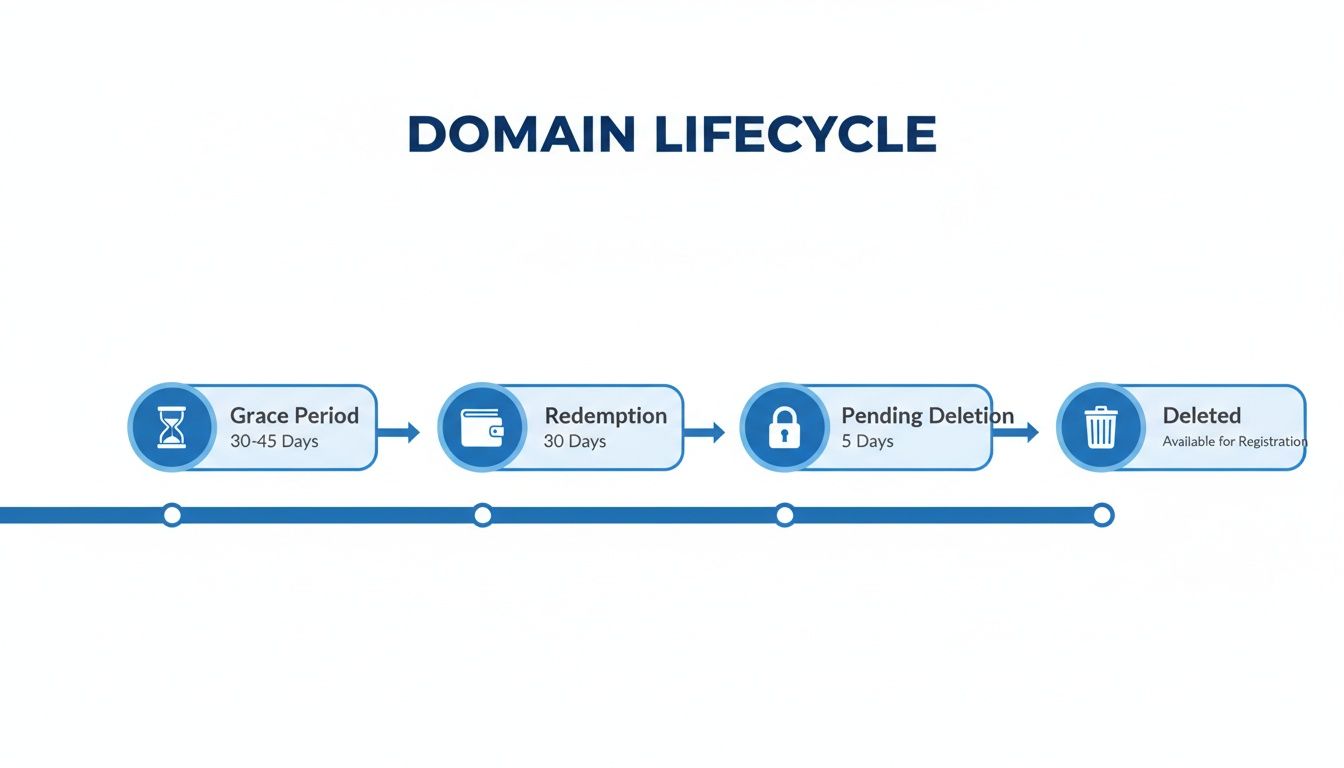
As you can see, your strategy completely depends on where a domain is in this cycle. Are you just watching an expired name, or are you getting your tools ready for one that’s about to drop?
The Final Countdown: Pending Deletion
After redemption, the domain enters its last phase before release: Pending Deletion. It's a short, 5-day lockdown.
During this time, nobody can touch it. The original owner can't renew it, and you can't register it. The domain is basically in purgatory, waiting for the central registry to officially scrub it from the records. This is the moment of truth. Backorder services and drop-catching pros are lining up, ready to pounce the second it's released.
After a domain passes through grace and redemption, it enters the 'Pending Deletion' phase. This is the point of no return—the domain is locked, loaded, and will be released to the public within days.
Finally Released and Available
Once the 5-day pending period is up, the domain is officially deleted. It’s wiped from the registry and thrown back into the pool of available names for anyone to register.
This is the moment a deleted domain name becomes real. It's now first-come, first-served. You can try to "hand-register" it by refreshing your registrar's site at the right moment, or you can use a tool like NameSnag and filter for just-dropped gems.
If you’re hunting for these, you're looking for Available domains that have just gone through this entire lifecycle. Understanding why and how this happens is half the battle; you can read more about why a domain name might be deleted to fine-tune your strategy. Mastering this process is what separates the amateurs from the pros who consistently snag high-value names.
Unlocking The SEO Superpowers of Aged Domains
Why would you build a website’s reputation from scratch when you could start on level 50? That’s really the question at the heart of buying a quality **deleted domain name**. You’re not just buying a name; you’re buying its history, and sometimes, that history is packed with SEO gold.The real prize is the domain’s pre-existing backlink profile. Think about it: a domain might have spent years as a legitimate business, collecting natural, earned links from news outlets, industry blogs, or even university websites. When that business goes under and the domain drops, those backlinks are often still live, pointing to a dead end.
Until you pick it up. To Google, those links are still powerful votes of confidence. A backlink from a trusted, authoritative source is one of the strongest ranking signals you can possibly get. Starting with a foundation of these gives your new site an instant authority boost that would otherwise cost you years and a small fortune to build from the ground up.
Bypass The Dreaded Google Sandbox
One of the most frustrating hurdles for any new website is the so-called "Google Sandbox." It's not an official thing, but anyone who’s launched a site from zero knows the feeling. It’s that painful waiting period where Google seems hesitant to trust you with any meaningful rankings until you've proven you're not just another spammer. A good aged domain can be your VIP pass to skip that line entirely.
The sheer scale of this opportunity is staggering. The internet is a graveyard of failed businesses, and every day, a fresh batch of domains becomes available. Volatility leaderboards from DomainTools show that on any given day, a single nameserver like SPACESHIP.NET might delete over 10,000 domains. This relentless churn means millions of domains—many with built-in authority—hit the open market every single month.
An aged domain is like taking over a restaurant that already has a decade of rave reviews. A new domain is an empty building you just leased—you have to convince everyone just to walk in the door.
The Power of Aged Trust
It’s not just about the backlinks, either. The domain’s age itself is a subtle but important trust signal. A domain with a long, stable history looks more legitimate to search engines than one registered yesterday. Google, for better or worse, tends to favor stability.
This "aged trust" combines with the backlink profile to create a potent SEO cocktail. It’s what helps you start ranking for competitive keywords much, much faster than you could with a fresh domain. If you're a niche site builder or an affiliate marketer, this can mean the difference between seeing a return in three months versus waiting a year or more for traffic to finally start trickling in.
Of course, once you’ve snagged one of these gems, you want to get its power working for you right away. Knowing how to accelerate Google indexing is the final piece of the puzzle. You need to get Google to re-crawl the site, recognize its new purpose, and start transferring all that historical authority to your new content. This is where you truly awaken its dormant superpowers.
How To Evaluate A Deleted Domain Like A Pro
Alright, you understand the concept. Now for the part that actually matters: telling a genuine asset from a digital landmine. Most deleted domains aren’t hidden gems. They’re traps, filled with the kind of toxic history that will kill your project before it even gets a single visitor.
Finding the winners requires you to think like a forensic accountant, not a treasure hunter. The first piece of evidence is always the backlink profile. Where are the links coming from? Are they legitimate endorsements from relevant, authoritative sites? Or are they from a network of spam blogs in a language you don’t even recognize?
Decoding The Core SEO Metrics
Once you get a sense of the backlinks, it's time to look at the numbers. Certain metrics give you a quick summary of a domain's health, but remember: metrics are indicators, not gospel. Context is everything.
You’ll want to focus on a few core data points:
- Trust Flow (TF): This is a metric from Majestic that gauges the quality of links pointing to a domain. Think of it as a measure of how trustworthy a domain's "neighborhood" on the web is.
- Domain Authority (DA): This is a score from Moz that tries to predict a site's ranking ability. It’s a decent general indicator, but don't treat it as the final word.
- Referring Domains (RDs): This is the total number of unique websites linking to the domain. A high number is good, but only if they're quality sites. One link from an .edu site is worth more than 100 links from spam blogs.
These numbers give you a starting point. A domain with a high TF, a decent DA, and a healthy number of RDs is worth investigating further. But be warned: a domain with high DA and a low TF is a massive red flag. It often means the score is artificially inflated by a large volume of garbage links.
Investigating The Domain's Past Life
Metrics are just one part of the story. The next step is to play historian. You need to know what the domain was. Was it a legitimate business? A personal project? Or was it part of a shady private blog network (PBN)?
Your best tool for this is the Wayback Machine at Archive.org. It takes periodic snapshots of websites, letting you see exactly what the site looked like and what kind of content it published. A clean, relevant history is non-negotiable. If you're building a site about fly fishing, a domain that used to be a plumbing blog is a poor fit, no matter how great the metrics are.
A deleted domain with great metrics but a shady past is like a beautiful house with a cracked foundation. It looks good on the surface, but it's doomed to cause problems down the line.
You can learn an incredible amount about a domain’s past this way, and we've put together a full guide on how to check domain history to help you master this critical skill.
Finally, you have to check for two absolute deal-breakers: Google penalties and trademark conflicts. A manual penalty from Google can make a domain worthless for SEO. And if the name is tied to an active trademark, you're just buying yourself a future legal headache.
This manual process—juggling tools like Ahrefs, Majestic, Archive.org, and trademark databases—is a grind. This is precisely why integrated platforms are so valuable. A tool like NameSnag automates these checks, analyzing over 170,000 domains daily and flagging spam issues for you. It collapses hours of tedious research into a few seconds of analysis, letting you focus on finding winners instead of dodging grenades.
Strategies For Snagging High-Value Domains

Alright, you've done the homework and found a domain with some serious potential. Now for the fun part: actually getting your hands on it. Once a name makes it through the entire deletion gauntlet and is set free, you've got two main ways to grab it: registering it by hand or placing a backorder.
The Direct Approach: Hand-Registration
The most straightforward play is hand-registration. This is your go-to when a domain has already dropped and is sitting in the public pool of available names. They're just waiting for the first person to come along and claim them.
This tactic is perfect for scooping up those undervalued gems that slip through the cracks. You can register these names at any registrar, but the real secret is being the first to know they're available. This is where a specialized tool gives you a massive leg up.
For instance, with NameSnag, you can filter for Available domains that dropped today. That gives you a clean, simple list of freshly available names you can register instantly. No waiting, no competition. Just you and your next big project.
The Competitive Edge: The Art of the Backorder
But what about the truly killer domains? The ones with jaw-dropping metrics, a short and memorable name, and years of SEO juice already baked in? Hand-registering those is like trying to win the lottery. These A-listers have a line of admirers, and this is where backordering comes in.
You might also hear it called "drop catching." Essentially, a backorder is a service where you pay a company to try and register a domain for you the very microsecond it becomes available. Their automated systems are infinitely faster than you manually hitting refresh on your browser.
The only catch? If more than one person places a backorder on the same deleted domain name, it usually heads to a private auction. The highest bidder takes home the prize, which means you need to know exactly what that domain is worth to you before you throw your hat in the ring. It pays to learn how to use a backorder domain service to give yourself the best possible shot.
Playing the Long Game
A real pro-level strategy is to watch domains before they even drop. This means keeping tabs on names during their expiration phase so you can plan your attack well in advance.
By monitoring Expiring domains, you get a critical head start. You can evaluate their authority with tools like the Ahrefs Website Authority Checker, check their history, and decide: Is this domain worth duking it out for in an auction, or can I risk waiting for it to drop and try to snag it by hand?
This is where the history of domain hunting gets a little wild. Years ago, a practice called "domain tasting" turned the internet into a high-stakes grab. Registrars would register millions of domains during a five-day grace period to test their traffic. If a domain wasn't a winner, they'd just delete it and get a full refund.
This practice left a legacy of around 380 million deleted gTLD domains. Today, savvy investors use modern tools to sift through this massive digital boneyard, looking for those hidden gems with lasting value.
Common Questions (and Hard Truths) About Deleted Domains
You're bound to have questions when you start digging for gold in the world of deleted domains. Let's tackle some of the most common ones I hear.
What’s the Real Risk of Buying a Deleted Domain?
You're dealing with two major landmines here: trademark infringement and SEO penalties.
The first is a legal headache you don't want. If the domain was tied to a brand, even a defunct one, the original owner could come knocking with a legal dispute to get it back. Do your homework and check for active trademarks before you even think about buying.
The second risk is inheriting a domain that’s been nuked by Google. If its past owner used it for spam, link farms, or other shady tactics, that domain is radioactive. Its SEO value isn't just low—it's negative. A good discovery tool with spam checking isn't a luxury; it's the only way to avoid buying a toxic asset.
What's the Difference Between Deleted and Expiring Domains?
It’s all about timing and ownership. An expiring domain is still in the dugout; the original owner has a window of time—a grace period—to step up and renew it. You can't register it yet, but you can get ready to pounce.
A deleted domain is one where the owner struck out. They missed the renewal, ignored the grace periods, and the domain has been fully released back to the wild. At that point, it becomes an available domain that anyone can register on a first-come, first-served basis. With NameSnag, you can track both: expiring names to watch and available ones to grab right now.
How Fast Can I Expect to See SEO Results?
There are no guarantees, but the results are almost always faster than starting from scratch. Much faster.
When you take over a clean domain that already has some authority and you immediately publish quality, relevant content, you can start seeing positive movement in the rankings in just a few weeks. The existing backlinks and domain age give you a starting block that's miles ahead of a brand-new domain. This can shave months, or even years, off the time it takes to rank for competitive keywords.
Buying an aged domain doesn’t guarantee instant top rankings, but it does mean you’re starting the race with a significant lead. You’re building on an existing foundation of trust, which can slash the time it takes to get noticed by Google.
Should I Backorder a Domain or Just Wait for It to Drop?
This really comes down to how much the domain is worth—and how much competition you expect.
- Backorder: If you find a gem with killer metrics and a brandable name, a backorder is your only realistic shot. Competition for these names is insane, and you'll need an automated service fighting on your behalf to even have a chance.
- Wait for the Drop: For a solid-but-not-spectacular domain, you might get lucky "hand-registering" it the second it becomes available. It's a gamble, and you'll likely miss out, but you avoid the potential auction that follows a successful backorder.
The smart play is to use your monitoring tools to watch expiring domains. Analyze the data as it gets closer to its drop date. Then you can make an informed call on whether to place a backorder or take your chances on the drop.
Ready to stop hunting and start finding? NameSnag uses AI to analyze over 170,000 domains daily, so you can find the perfect deleted domain name with powerful SEO value in minutes, not hours. Find your next project's head start today at https://namesnag.com.
Find Your Perfect Domain
Get access to thousands of high-value expired domains with our AI-powered search.
Start Free Trial