
Welcome, fortune hunter, to the wild world of expired domains! This is a quirky corner of the internet where savvy SEOs and clever investors find digital gold hiding in plain sight. This guide is your treasure map for navigating GoDaddy Auctions, the single largest marketplace for these digital assets. Forget the boring, generic advice; we’re about to dig into the real, actionable tactics that turn this from a lottery ticket into a calculated business strategy.

Your Guide to the GoDaddy Domain Gold Rush
Think of an expired domain as digital real estate with a juicy backstory. Instead of building from scratch on a raw piece of land, you're acquiring a property that might already have roads (backlinks) and a bit of history. GoDaddy is the biggest market for this real estate, a bustling hub where thousands of domains get snapped up daily.
And this isn't just for domain flippers chasing a quick buck. It's a powerhouse strategy for:
- SEOs looking to build out private blog networks (PBNs) or redirect a domain's "link juice" to a money site.
- Affiliate marketers who want a massive head start in a niche with a domain that already has relevant link equity.
- Entrepreneurs hunting for that perfect, brandable name that comes with bonus SEO value, potentially saving them years of link-building misery.
- Investors who can spot an undervalued asset, give it a quick polish, and sell it for a handsome profit.
The sheer volume on GoDaddy is both a blessing and a curse. You have more opportunities than anywhere else on the planet. For example, between June and August 2024, a staggering 203 domains sold for over $2,000 each. September 2024 alone saw 70 domains cross that threshold, contributing to nearly $300,000 in high-value sales in a single month.
The scale is immense, but it also means you have to wade through a metric ton of junk to find the gems. That's where the fun begins.
From Discovery to Winning the Bid
The whole process can feel a little intimidating at first, but it really just breaks down into a few key phases. To give you a bird's-eye view, here's how your treasure hunt will typically unfold.
Key Stages For Buying On GoDaddy Auctions
| Stage | What Happens | Your Goal |
|---|---|---|
| Discovery | You're sifting through thousands of expiring and newly available domains. | Find domains with potential based on metrics, niche relevance, or sheer brandability. |
| Due Diligence | You analyze the domain's history, backlink profile, and past content like a digital detective. | Check for spam, penalties, or other red flags. Is it a gem or a dud? |
| Bidding & Strategy | You place bids in the auction, managing your budget and timeline like a pro poker player. | Win the domain at a price that makes sense for your project or investment thesis. |
| Transfer & Setup | After winning, GoDaddy transfers the domain to your account. | Secure your prize and prepare it for its new life (redirect, new site, etc.). |
Each stage has its own quirks, but this is the basic framework you'll be working within.
First, you have discovery and filtering. This is where you find your targets. You can hunt for Available domains that have already dropped and are ready for immediate registration, or you can get a head start by tracking Expiring domains before they even hit the auction block.
Next comes the critical vetting stage—making absolutely sure you aren't buying someone else's digital baggage. Finally, you enter the auction with a clear budget and bidding strategy. Knowing the subtle differences between a standard auction and a closeout can also land you some incredible bargains. We've actually done a deep dive on the GoDaddy closeout auction process if you want to learn more about finding those sweet, sweet deals.
The core idea is simple: a good expired domain can pass its authority, trust, and backlink profile on to your project. The real challenge is finding those clean, high-value names buried among the thousands of duds.
This guide is your playbook for doing just that. We'll show you how to find, vet, and win the domains that give your projects an almost unfair advantage. Let's get to it.
Ditch the Shovel: How to Actually Find Good Domains
Let's be honest. Trying to find a decent expired domain by manually digging through GoDaddy's lists is a special kind of digital torment. It's an endless stream of absolute junk, and you'll burn hours of your life you'll never get back. This is the rookie approach, and it's a surefire way to get frustrated and quit.
The people who actually make money with this don't work harder, they just have better tools. They don't waste time panning for gold in a river of mud. They use a digital metal detector. This is how you stop drowning in garbage and start spotting high-potential domains before the auction feeding frenzy even begins.
The Two-Front War: What's Dropped vs. What's Dropping
The entire game boils down to two windows of opportunity. You're either hunting for domains you can grab right now or you're lining up your shot for domains that are about to become available. A solid strategy means doing both at the same time.
It breaks down like this:
- Available Domains: These are the domains that have already gone through the full expiration and auction cycle. Nobody wanted them, or nobody was paying attention. They've been "dropped" back into the public pool and are ready for immediate registration. You can find some absolute steals here if you're quick on the draw.
- Expiring Domains: This is the pre-game show. The owner missed their renewal, but the domain isn't public property yet. It’s in a grace period, getting ready to head to auction. This is your chance to get a head start on research.
Pro Tip: Focusing on expiring domains is where the real strategic advantage is. You can do your due diligence—checking backlinks, history, and penalty risk—before the bidding clock starts ticking. You walk into the auction knowing exactly what the domain is worth to you, while everyone else is scrambling.
Using a smart search tool means you can skip the manual slog entirely. A platform like NameSnag lets you cut straight to the good stuff. You can see a list of Available domains that just dropped today, or use the time filter to look back over the last 3, 7, or 14 days to see what gems might have slipped through the cracks.
Stacking the Deck for Future Auctions
Quick wins are great, but the high-value targets are almost always battled for in auctions. To win those, you need to prepare. You need to know what's coming down the pipeline before it's on everyone else's radar.
This is where tracking expiring domains becomes your secret weapon.
Instead of waiting for a domain to pop up on GoDaddy Auctions and joining the mad rush, a good tool shows you a feed of domains that are still in their grace period. It’s like getting a peek at the auction catalog weeks in advance.
This gives you the runway to build a watchlist, vet each target properly, and decide on your maximum bid without pressure. When the auction finally goes live, you’re not reacting; you’re executing a plan. Take a look at this list of Expiring domains to get a sense of what's on the horizon. If you want to really systemize this, our guide on using an expired domain finder shows you how to automate the whole discovery process.
At the end of the day, successfully buying expired domains isn't about getting lucky. It’s about using technology to build a curated pipeline of vetted targets. That way, you can focus your time and budget on acquiring the assets that will actually make a difference.
Decoding The 43-Day GoDaddy Auction Timeline
If you want to actually snag valuable domains on GoDaddy, you can’t just show up and bid. You have to understand their specific, 43-day rhythm. Getting a handle on this timeline is probably the single biggest strategic edge you can have, as it dictates exactly when to watch, when to pounce, and when to look for the juicy scraps left behind.
It all kicks off the second a domain's registration officially lapses. But don't get too excited. For the first 25 days, you're mostly just waiting. The domain sits in a grace period, giving the original owner plenty of time to wise up and renew it. You're on the sidelines, and there’s nothing to do but watch.
The Main Event: The 10-Day Auction
The action really starts on Day 26. This is it—the domain is thrown into a 10-day public auction. If you were smart and placed a backorder on the name, this is when your initial bid gets dropped in. If you didn't, the doors are now open for any GoDaddy Auctions member to join the fray.
This ten-day window is where most of the high-stakes bidding happens. People are competing, prices are climbing, and you'll see everything from proxy bidding wars to last-minute sniping. It's a fast-moving environment, and having your due diligence done before this starts pays off in a big way.
Finding Treasure in the Aftermath
So, what happens if a domain gets through that entire 10-day auction and nobody even places a bid? This is where you can find some absolute gems for pennies on the dollar.
If a domain is still unsold by Day 36, it moves into a "Final Closeout" phase. Think of it as a 5-day, no-reserve, buy-it-now fire sale where the prices are often at rock-bottom. If a domain still doesn't find a buyer by Day 43, it's finally released back to the registry. At that point, it becomes a regular Available domain that anyone can register instantly, usually for the standard fee. You can get the official rundown from GoDaddy's detailed auction timeline guide.
This timeline graphic is a decent way to visualize the whole process.
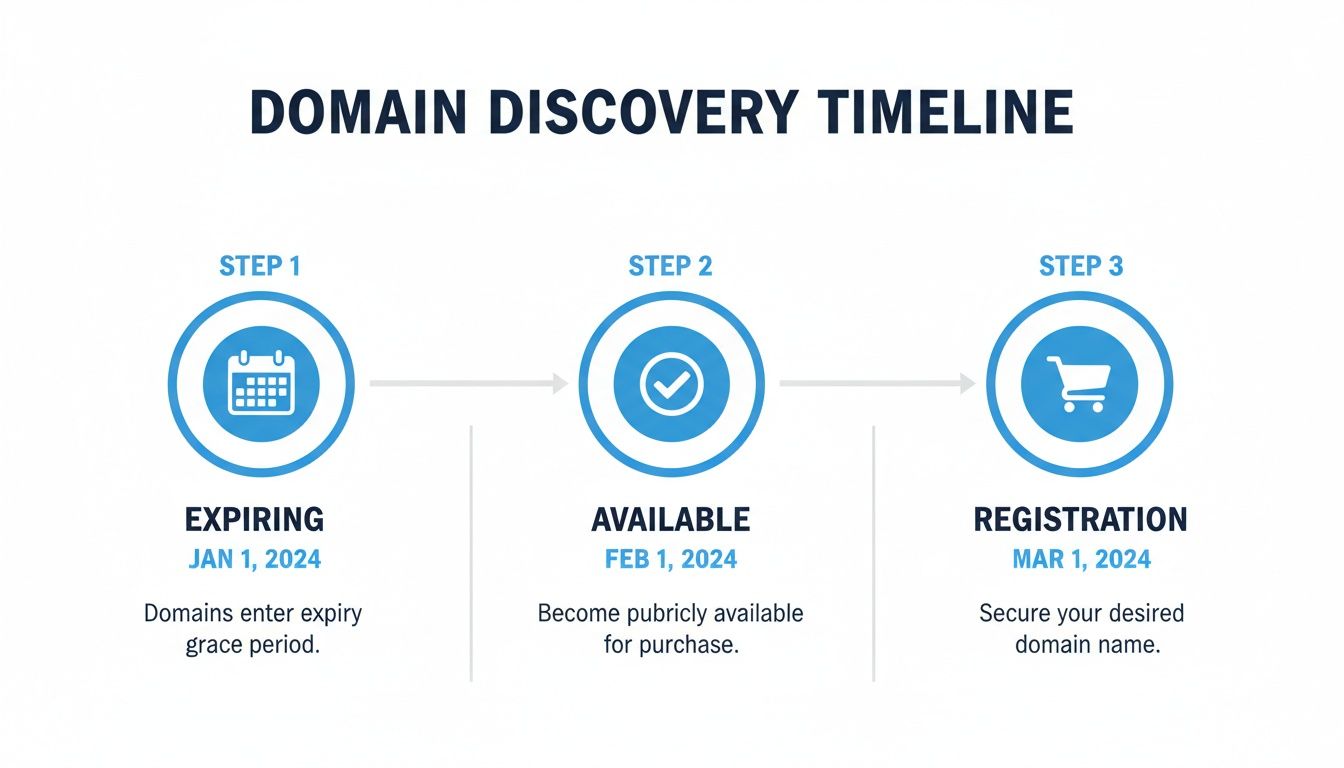
The key takeaway is that there are opportunities at every stage. You can be tracking an Expiring domain before it ever hits auction, or you can be patient and scoop up a dropped one for next to nothing.
Mastering this 43-day calendar is the first step to bidding like a pro. It allows you to plan your attack: Will you place an early bid to show strength, or will you wait patiently to snipe a deal in the final seconds? Knowing the timeline gives you control.
How To Vet Expired Domains And Avoid Costly Mistakes
So you've found a domain with some juicy SEO metrics. Great. That's the easy part. A high Domain Authority score doesn't tell you if you've found a diamond in the rough or a digital liability just waiting to tank your project with a hidden Google penalty.
This is where the real work begins—the part that separates successful domain hunters from people who just bought an expensive headache.

Think of it this way: buying a domain is like buying a used car. You wouldn't buy a car just because the odometer has low mileage. You’d pop the hood, check the service records, and see if it's been in a wreck. We need to do the exact same thing with our domains—dig deep into their past lives.
Uncovering The Domain's Shady Past
Your first and most important stop is the Wayback Machine. This incredible internet archive lets you travel back in time and see what the website actually looked like over the years. You're looking for signs of abuse.
I've seen it all, but here are the classic red flags that scream "run away!":
- The Foreign Language Flip: The site was a legitimate English blog for years, then suddenly it's in Russian or Chinese, covered in spammy ads. This is a dead giveaway it was hacked and repurposed for spam.
- Obvious PBN Footprints: Did the content abruptly switch from a personal blog to junk articles about casinos or payday loans, with every other word linking out to some commercial site? That domain was almost certainly part of a Private Blog Network that got torched by Google.
- Forbidden Niches: Unless you're specifically in these markets, you'll want to check for a history in adult content, gambling, or pharmaceuticals. A clean break from these niches is hard, and the link neighborhood is often toxic.
If the history is clean, consistent, and makes sense for the domain name, you've passed the first major test. That's a fantastic sign. For a deeper dive into the sleuthing process, you can learn more about how to check a domain's history before you ever place a bid.
Analyzing The Backlink Profile
Backlinks are where a domain gets its authority, but they're also where it can hide its poison. A profile riddled with junk from spammy directories, foreign forum profiles, or shady PBNs can carry a penalty right over to you.
A crucial part of your due diligence is knowing how to find websites linking to a site to see where its power comes from. You need to look at the anchor text. Is it a natural mix of brand names, URLs, and descriptive phrases? Or is it just "best plumber in phoenix" spammed a thousand times? The latter is a huge red flag for over-optimization.
A sudden, sharp drop in the number of referring domains is a massive red flag. This often indicates the site was part of a PBN that got de-indexed by Google, and all that link equity vanished overnight.
To help you stay organized, I've put together a quick checklist of the essential things I look at before bidding on any expired domain.
Expired Domain Vetting Checklist
Here's your quick-reference guide to essential checks before bidding on any expired domain.
| Check | Tool/Method | What to Look For |
|---|---|---|
| Site History | Wayback Machine (Archive.org) | Consistency. Sudden changes to spam, foreign languages, or PBN-style content are major warnings. |
| Backlink Profile | Ahrefs, Moz, Semrush | Quality over quantity. Look for links from relevant, authoritative sites. Avoid junk. |
| Anchor Text | Ahrefs, Moz, Semrush | Natural distribution. Over-optimized, spammy anchor text is a huge red flag for manipulation. |
| Referring Domains Trend | Ahrefs, Moz, Semrush | A sudden, steep drop-off can signal a de-indexed PBN or widespread link removal. |
| Google Index Status | Google Search: site:domain.com |
Check if pages are still indexed. De-indexation is the ultimate penalty and a deal-breaker. |
This checklist isn't exhaustive, but it covers the big, costly mistakes. Following these steps will help you filter out the vast majority of toxic domains.
While tools like Ahrefs or Moz are non-negotiable for this work, don't just trust their automated "spam scores." You have to get your hands dirty. Manually click on some of the highest-authority links. Do they look like real, earned mentions, or were they clearly bought and placed on irrelevant sites?
Developing this skill—the ability to feel if a link profile is clean or dirty—is what separates a successful domain investor from someone who just collects digital garbage. The tools get you 80% of the way there, but your own judgment is the final filter.
Bidding Strategies to Win Without Overpaying
Alright, let's talk about the auction itself. This is where all your careful research and due diligence can evaporate in a five-minute, ego-driven bidding war. Heading into a GoDaddy Auction without a concrete plan is, without a doubt, the fastest way to overpay for a domain.
The goal isn't just to win. Anyone can win if they're willing to throw enough money at the screen. The goal is to win at the right price—a number that makes sense for your project and gives you a fighting chance at seeing a return on that investment. To pull that off, you need to understand the mechanics of bidding and, more importantly, have a firm grasp on your own discipline.
Proxy Bidding vs. Last-Minute Sniping
When you place a bid on GoDaddy, you're not just lobbing a single number into the ring. You're actually setting your maximum proxy bid. Their system then does the bidding for you, incrementally, up to that ceiling. This creates two fundamental paths you can take.
Proxy Bidding (The "Set It and Forget It" Discipline): You figure out the absolute highest price you’re willing to pay, enter that number, and walk away. GoDaddy’s system automatically outbids others for you in small increments until it hits your max. This is the best way to stay disciplined and avoid the emotional rollercoaster of the final minutes. It takes your ego out of the equation.
Last-Minute Sniping (The High-Stakes Gambit): This is exactly what it sounds like. You wait until the last few seconds of the auction to place your one and only bid. The idea is to catch everyone else off guard, giving them no time to react. It’s a thrill when it works, but it's incredibly risky. A lagging internet connection, a mis-timed click, or GoDaddy extending the auction time (which they do!) can leave you with nothing.
My honest advice? Lean heavily on the proxy-bidding model. Decide your price, set it, and be prepared to lose. If a domain is an absolute must-have and the bidding is still well below your max, you can always come back in the final moments to manually bump your bid. But use sniping as a rare exception, not your default strategy.
Setting Your Maximum Bid and Sticking to It
The most important part of your bidding strategy is decided long before the auction timer starts ticking down. It’s setting your maximum bid. This number can’t be a gut feeling or a random figure. It has to be a cold, hard business decision rooted in the value you found during your vetting process.
Your maximum bid is your anchor. It's the number that keeps you from getting swept away by auction fever. If the bidding goes past it, you don't get upset; you simply let it go and move on to the next opportunity.
So, how do you land on that magic number? It's a mix of tangible and intangible factors that you have to weigh.
- Link Equity Value: What would it cost you in time and money to build a similar backlink profile from scratch? If acquiring 20 high-quality links would cost $5,000 in outreach and content creation, that gives you a baseline.
- Traffic and Revenue Potential: Does the domain get any existing type-in traffic? A few visitors a day are a head start. Can you monetize that traffic immediately?
- Brandability: How good is the name itself? A short, memorable .com is always going to be worth more than a clunky, hyphenated name in a less popular TLD.
- Your Plan for the Domain: The value is different depending on your end goal. A domain for a simple 301 redirect to an existing money site has a different value proposition than one you intend to build out into a full-fledged authority site.
Tally up these factors and arrive at a firm number. This turns the chaos of an auction from an emotional battle into a simple, binary decision. Is it below my number? Yes or no. If it's a no, you close the tab and get back to finding the next one.
Frequently Asked Questions (The Stuff You're Afraid to Ask)
Jumping into GoDaddy's domain auctions can feel like walking into a casino for the first time. There are a lot of flashing lights, fast-talking players, and a whole dictionary of lingo that seems designed to confuse you.
To help you place your bets with a bit more confidence, let's clear up some of the most common questions I hear. Think of this as the hard-won advice I wish someone had given me when I was starting out.
Expiring vs. Available: What's the Real Difference?
This is easily the most common point of confusion, and getting it wrong can torpedo your entire strategy before you even start. The terminology is tricky, but it's the absolute foundation of this game.
An expiring domain is where the real action is. The owner missed their renewal date, but the domain is still caught in GoDaddy's elaborate cycle of grace periods and auctions. It isn't available for anyone to just grab; you have to fight for it by winning an auction or snagging a backorder. These are the domains you want to scout and vet before the general public can get their hands on them. A good starting point is a curated list of Expiring domains that are scheduled to drop soon.
An available domain, which you might also see called a 'dropped' domain, is a different beast entirely. It’s already been through the whole expiration wringer—auctions and all—and nobody claimed it. The registry has released it back into the wild. Now, anyone can register it instantly at any registrar for the standard price. You can find these by filtering for Available domains that have just been released today, or within the last 30 days.
Can You Lose a Domain After Winning?
It’s a terrifying thought, right? You celebrate winning an auction, only to have the domain snatched away. The short answer is: it's incredibly rare, but it is technically possible within a very specific window.
The original owner has what's called a redemption period, and in some cases, they can swoop in and reclaim their domain even after an auction has begun.
That said, once the auction is over, your payment has cleared, and GoDaddy moves the domain into your account, it is yours. Period. Here's my ironclad rule: never, ever start building on a domain—don't point it, don't invest a dime, don't even think about it—until it is sitting securely in your GoDaddy account. A little patience here will save you a world of potential pain.
How Much Should You Budget for a First Domain?
This is the "how long is a piece of string?" question of domaining. The answer varies wildly, but you don't need a huge bankroll to get in the game. In fact, you can pick up perfectly decent domains in GoDaddy's closeout auctions for less than $20.
For the real prizes, though—domains with strong SEO history, clean backlinks, and brandable names—things can get competitive fast. It's not uncommon to see bidding wars push prices into the hundreds, or even thousands, of dollars.
For your first few forays, I suggest setting a hard budget between $50 and $150. This gives you enough runway to learn the ropes, participate in a few auctions, and maybe even win a solid domain without risking your shirt. Consider it a cheap education in a very expensive school.
Ready to stop guessing and start finding high-value domains? With NameSnag, you get AI-powered analysis and alerts to discover clean, powerful expired domains before anyone else. Cut through the noise and find your next digital asset at https://namesnag.com.
Find Your Perfect Domain
Get access to thousands of high-value expired domains with our AI-powered search.
Start Free Trial