So, you're curious about domain name investing? Awesome. Think of it as digital real estate. It's the art of buying web addresses, not to build a website, but to sell them for a profit down the line. Some domains are like beachfront property in Malibu, while others are like a fixer-upper in the middle of nowhere. The real trick is learning how to spot the difference.
Welcome to the World of Digital Real Estate

Ever wondered how a simple web address can be worth a small fortune? It’s because a great domain is way more than just a name; it’s a powerful business asset, packed with branding potential and a direct line to that sweet, sweet search engine traffic.
Just like in the physical world, location is everything. A domain like Coffee.com is the digital equivalent of a storefront on Fifth Avenue. It's short, it's memorable, and it tells you exactly what to expect. This kind of prime digital property naturally attracts visitors, builds trust, and can give a new business an incredible head start.
On the flip side, a clunky, forgettable domain is like a shop hidden down a dark alley. It’s tough to find and even harder to remember. Getting a feel for this difference is your very first step to making killer investments.
The Value Behind the Name
So, what exactly turns a string of characters into a valuable asset? It’s not just one thing, but a cocktail of factors that come together to create a desirable piece of digital real estate.
- Brandability: The best domains are easy to say, spell, and recall. They just sound like a real brand.
- Keyword Relevance: Names that include high-value keywords (think "insurance" or "loans") can be magnets for targeted traffic.
- Length: Shorter is almost always better. One or two-word
.comdomains are the undisputed gold standard. - SEO History: An older domain with a clean track record and some quality backlinks can offer a massive SEO advantage right out of the gate.
This isn’t some niche hobby; it's a serious market. The domain name investment space has exploded, with some sales hitting jaw-dropping figures. For instance, the domain Cars.com was valued at a staggering $872 million as part of a larger deal, and Business.com fetched $345 million. These sales prove that domain investing is a legitimate asset class with returns that can blow traditional investments out of the water. You can see more top-tier sales here to get a sense of just how high the ceiling is.
Your Path to Finding Digital Gold
Don't worry, you don't need millions to get started. The real opportunity is in sniffing out undervalued domains before they hit the mainstream radar. This guide is going to skip the dry, technical jargon and give you battle-tested strategies to spot these hidden gems.
The secret to domain investing isn't just about buying names; it's about seeing the potential in a web address that everyone else has overlooked.
We'll walk you through exactly where to look, what metrics actually matter, and how to build a portfolio that grows in value over time. Whether you're a complete beginner or you've been around the block, you’ll learn how to navigate this exciting world and make smart domain name investments.
Decoding a Domain's True Value
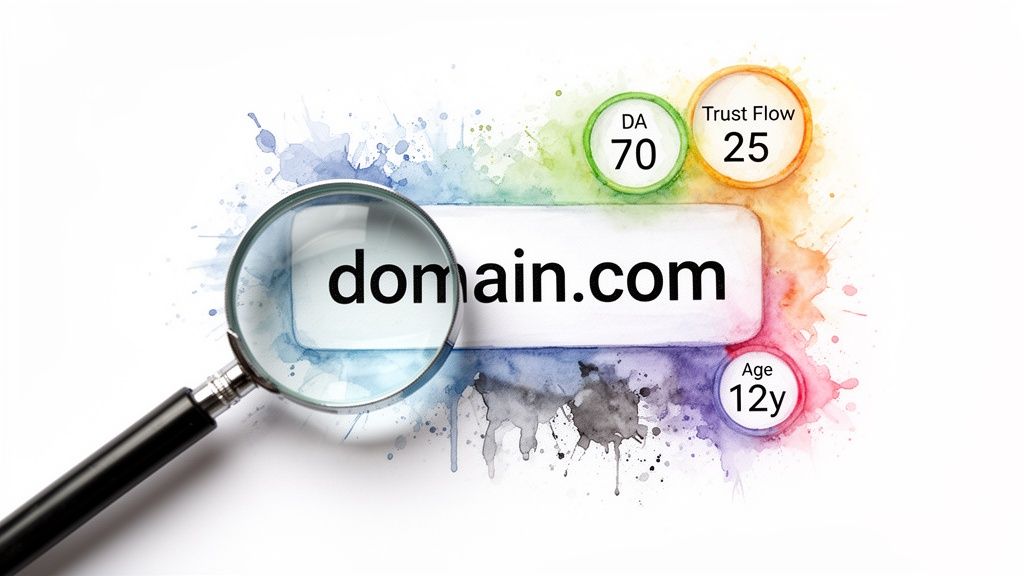
So, how do you spot the difference between a future lottery winner and a digital dud? You have to pop the hood and take a look. It’s a lot like a real estate appraiser inspecting a house for good bones—you need to check the domain’s foundation. The real value is a mix of its brand appeal and whatever SEO power it's built up over the years.
Think of an aged domain with a solid history like a well-established storefront on a busy street. It already has roads leading to it (backlinks) and a good reputation in the neighborhood (search engines). Starting there is worlds easier than building from scratch on an empty plot of land. This is the heart of smart domain name investments.
The SEO Powerhouse Metrics
Your best friends in this game are Search Engine Optimization (SEO) metrics. They're the data-driven snapshot of how much authority and trust a domain has in the eyes of Google. Flying blind without them is like buying a classic car without ever checking the engine.
Here are the heavy hitters you absolutely need to get a handle on:
- Domain Authority (DA) and Trust Flow (TF): Think of these as a domain's credit score. Developed by SEO tools like Moz and Majestic, they predict how well a site is likely to rank. Higher scores mean more authority, plain and simple.
- Backlink Profile: This is the collection of all the links pointing to a domain from other websites. The mantra here is quality over quantity. Links from reputable, relevant sites are pure gold. Links from spammy corners of the web? A massive red flag.
- Domain Age: Older domains that have been consistently online and active are often seen as more trustworthy by search engines. They've stood the test of time, and that can give a new project an incredible head start.
When you find a domain with high DA, a clean backlink profile, and a few years under its belt, you've found an SEO powerhouse just waiting to be put to work. That built-in authority can shave months or even years off the time it takes for a new website to start ranking for valuable keywords.
A great domain name is a strategic asset. It's not just about what it is, but what it can become. The right name with the right history can give a new business an immediate and powerful competitive advantage.
Brandability and Memorability
Okay, let's move beyond the numbers. A domain can have stellar SEO stats, but if it’s a pain to remember or spell, its commercial value takes a nosedive. Brandability is the secret sauce that makes a domain truly special.
When you're sizing up a domain's brand potential, run it through this simple gauntlet:
- Is it easy to say and spell? If you have to spell it out over the phone, it’s probably not a winner. Think simple.
- Is it memorable? Does it stick in your brain after hearing it just once? Names that are catchy, clever, or evocative have a huge leg up.
- Does it pass the "radio test"? If you heard the domain on a podcast or the radio, would you know exactly how to type it into a browser? No hyphens, no weird spellings.
This table gives you a quick reference for the core factors to look at. Use it as a checklist when you're evaluating any potential domain investment.
Key Domain Valuation Factors at a Glance
| Valuation Factor | Why It Matters | What to Look For |
|---|---|---|
| Length | Shorter is better. It’s easier to remember and type. | Ideally under 15 characters. Single-word domains are the holy grail. |
| TLD (.com, .net, etc.) | .com is the king. It holds the most trust and commercial value. | A strong preference for .com, but ccTLDs (like .io, .co) can be valuable in specific niches. |
| SEO History | Pre-existing authority (DA, TF) gives you a massive head start. | High DA/TF, clean backlink profile from relevant sources, established age. |
| Keyword Relevance | If it contains a high-value keyword, it can attract targeted traffic. | Exact match keywords (e.g., BuyShoes.com) or strong topical words. |
| Memorability | If people can’t remember it, they can’t find it. | Simple, catchy, and passes the radio test. Avoid hyphens and numbers. |
| Brandability | A great brand name is an asset in itself. | Unique, evocative, and sounds like a real brand, not just a keyword string. |
Think of these factors as a scorecard. A domain doesn't need to be a perfect 10 in every category, but the best investments usually score high across the board.
For a much deeper dive into the art and science of valuation, check out our complete guide on how to value domain names. It’ll give you a more detailed framework for weighing all these different factors.
Tying It All Together
Ultimately, the domains that turn into home-run investments find that sweet spot between SEO power and pure brand appeal. They're short, relevant, memorable, and have a clean, authoritative history.
But there’s one final, critical check: legal standing. Before you get too excited, you need to avoid names that could have trademark conflicts, which can turn a great domain into a worthless legal headache. Getting familiar with a comprehensive guide to intellectual property law is non-negotiable. The goal isn't just to find a technically sound domain, but one that’s also legally clear for you to build on or sell later.
Where to Find High-Value Domains
Alright, you know how to size up a domain's potential. Now for the fun part: the treasure hunt.
Finding great domains is a lot like fishing. You need to know the right spots to cast your line and, more importantly, what bait to use. For domain investors, the two most fertile fishing grounds are the pools of expiring and available domains.
Think about it: every single day, thousands of domain names aren't renewed. Maybe the business behind it closed up shop, a project fizzled out, or someone just plain forgot to pay the bill. Whatever the reason, these domains enter a lifecycle process, and at the very end, they drop back into the wild, ready to be registered again.
This is where a savvy investor can really clean up.
The Two Main Hunting Grounds: Expiring vs. Available
Getting your head around the difference between "expiring" and "available" domains is absolutely crucial. They're two completely different types of opportunities.
- Expiring Domains: These are names that have passed their expiration date but are still in a "grace period." The original owner can still technically renew them. If they don't, the domain will eventually be deleted and "drop." Finding these is like getting a hot tip on a property that's about to hit the market.
- Available Domains: These are domains that made it through the entire lifecycle—they’ve officially dropped and are back on the open market. Anyone can register them right now for a standard fee. This is like finding a prime piece of real estate with a "For Sale" sign on the lawn, ready for you to claim.
Your strategy will dictate which pool you fish in. If you like to plan ahead and target high-value assets, you can browse Expiring domains on NameSnag to build a watchlist and get ready to catch a name the second it drops. You can even filter by names dropping in the next 3, 7, or 30 days to build a solid pipeline of targets.
For a deeper dive on this, check out our guide on how to find expired domains.
Grabbing Opportunities in Real-Time
On the other hand, if you're the type who's ready to act now, the "available" list is your playground. These are domains that dropped today (or within the last few days) and are ripe for the picking. No waiting around, no auctions—just find a gem and register it at your favorite registrar. This is where you can find some incredible deals, but it's all about speed and having the right tools to cut through the noise.
One killer tactic is to specifically hunt for Available domains that dropped Today. This gives you a massive first-mover advantage, letting you snap up valuable names before the rest of the market even knows they exist.
This screenshot shows a real-time list of domains that have just become available and can be registered instantly. Each name is shown with key metrics, letting you spot opportunities fast without having to do a ton of manual research.
Successful investors are clearly focusing their efforts. Recent data shows that .COM extensions get 65% of all investment attention, blowing alternatives out of the water. The most profitable strategies are zeroing in on industry-specific domains (30% priority), brandable names (24%), and aged premium .COMs (21%). It's a clear signal that the smart money is following end-user demand.
Other Paths to Acquisition
While expiring and dropped domains are fantastic sources, they aren't the only game in town. Two other common ways to get your hands on valuable names are backorders and auctions.
Backordering: Think of this as placing a bid on a house before it officially goes on sale. You use a service to automatically try and register an expiring domain the split-second it becomes available. If you're the only one who backordered it, you get it. If multiple people did, it usually goes to a private auction.
Auctions: This is the more traditional route, where domains are sold to the highest bidder on platforms like GoDaddy Auctions or NameJet. Auctions are great for high-value, competitive names but often demand a much bigger budget.
For investors looking to build a portfolio by spotting multiple opportunities at once, using specialized bulk domain search tools can be a massive time-saver. By getting comfortable with all these different ways to acquire domains, you can build a flexible and powerful strategy for your domain name investments.
Your Tactical Playbook for Snagging Great Domains
Alright, theory is great, but let's get our hands dirty. It's time to turn all that knowledge into a repeatable process you can actually use. This is your tactical playbook for finding and buying domains without the guesswork.
Think of it as a treasure map for smart domain name investments.
Success starts with knowing what you're trying to accomplish. Before you even look at a single name, you have to ask yourself: What's the plan for this thing?
- Building a Niche Site? You're hunting for domains with existing topical relevance and a clean SEO history in your target niche. A name that was once about your topic gives you a massive head start.
- Flipping for Profit? Your eye should be on brandability, keyword value, and strong, transferable metrics. The name itself is the product, so it needs broad, obvious appeal.
Deciding on your endgame from the very beginning keeps you focused. It stops you from getting distracted by shiny objects and ending up with a portfolio of mismatched, low-value names that don't fit your strategy.
Starting the Search and Cutting Through the Noise
This is where the real work begins. Every single day, tens of thousands of domains drop. It's a firehose of opportunity, and your job isn't to drink from it—it's to find the few valuable drops of water inside. Smart filters are how you do it.
Instead of scrolling through endless lists, you can zero in on what actually matters. A great tactic is to look for Expiring domains that are set to drop within the next 7 Days. This gives you a decent window to do your homework on the best prospects without feeling rushed.
This immediately transforms an overwhelming list into a manageable set of high-quality targets. You can see crucial metrics like authority scores and backlinks at a glance, helping you spot the high-potential candidates right away.
Don't just browse with a vague ‘looking for good names’ mindset. Search with a purpose, armed with a clear set of criteria. The most successful investors are disciplined and methodical, not just lucky.
This disciplined approach is vital when you consider the sheer scale of the market. The Web Domain Name Sales industry in the U.S. alone pulls in an estimated $10.1 billion in revenue, and it's growing as more of the world moves online. You can dig into the numbers in this industry report from IBISWorld that breaks down the market's expansion.
Performing Your Due Diligence
Once you've got a shortlist, it's time to play detective. A domain might look great on paper, but you need to check its history for any skeletons in the closet. This is, without a doubt, the single most important step to avoid buying a dud.
Your due diligence checklist should always include these three things:
- Spam Checking: Was this domain ever used for spam, a private blog network (PBN), or other shady stuff? A toxic backlink profile can get a domain penalized by Google, rendering it totally worthless.
- Reviewing Past Content: Use the Wayback Machine (Archive.org) to see what the site used to be. Was it a legit business? A thin affiliate site? Something in a foreign language? Make sure its history actually aligns with what you want to do.
- Checking for Trademark Infringement: A quick search at the U.S. Patent and Trademark Office (USPTO) can save you from a world of legal pain later. Steer clear of names that are even remotely close to established brands.
This process is non-negotiable. Skipping it is like buying a used car without checking its accident history—you might get lucky, but you're more likely to end up with a lemon that costs you far more in the long run.
Securing Your New Digital Asset
After a domain has passed your checks with flying colors, it's time to make it yours. The final move depends on whether the domain is available right now or still in the expiring phase.
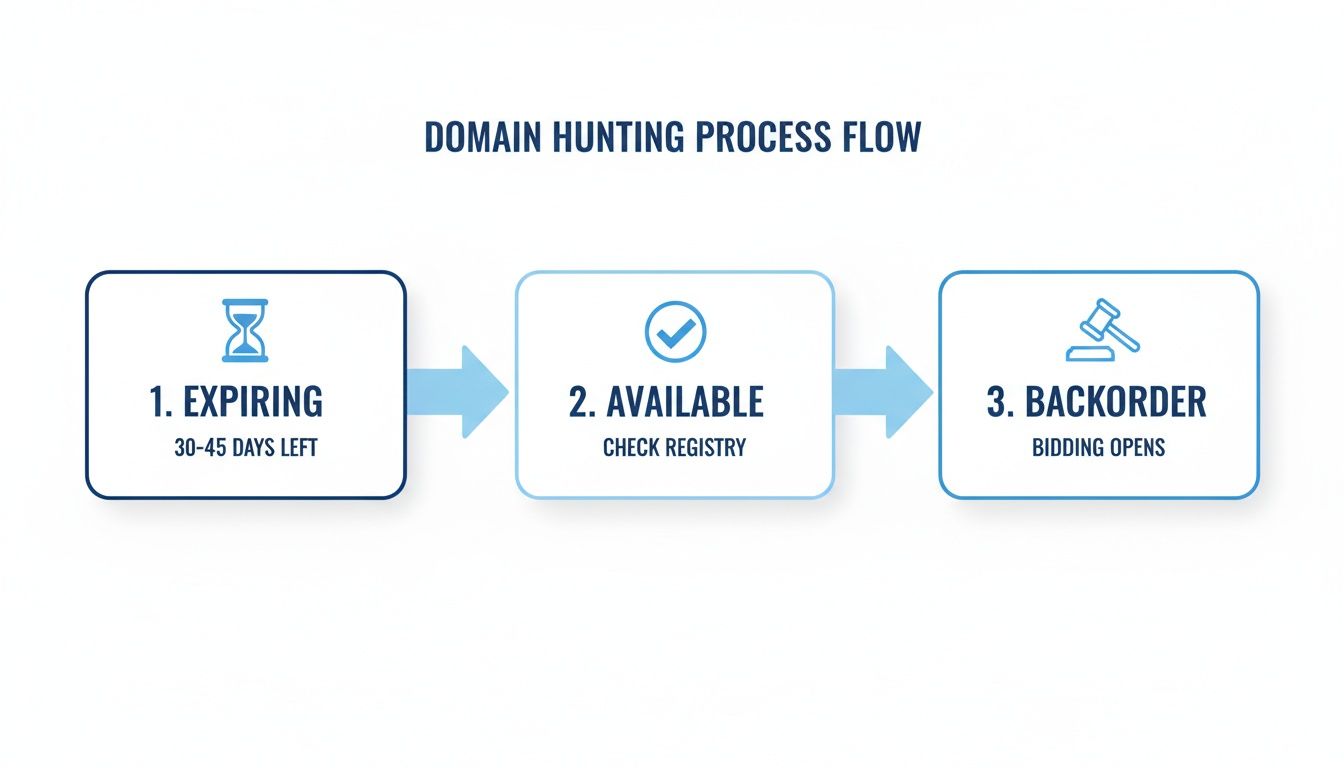
Here’s how you seal the deal for each type:
- For Available Domains: This is the easy part. If a domain has already dropped, it's fair game. You can head straight to a list of available domains that dropped today, find the one you want, and register it immediately at any registrar like GoDaddy or Namecheap.
- For Expiring Domains: You have to play the waiting game. You can't just register it until it officially drops. Your best bet here is to place a backorder with a service that will try to "catch" the domain for you the microsecond it becomes available.
By following this playbook, you take the guesswork out of domain investing. It becomes less of a lottery and more of a structured, strategic process—dramatically increasing your odds of snapping up valuable digital real estate.
How to Manage and Monetize Your Domain Portfolio
So, you've pulled the trigger and acquired a few domains. Congratulations! You're officially a digital landlord. Buying a great name is a rush, no doubt about it, but the real work—and the real money—in domain name investments starts now. A portfolio is more than just a list of names you own; it's about how you manage it and, ultimately, how you get paid.
This is the point where you have to decide what kind of investor you want to be. Are you playing the long game, or are you looking to make a quick buck? Your entire approach hinges on that question.
To Flip or to Hold: That is the Question
Much like stock trading, domain investing breaks down into two main camps: the flippers and the holders. Each has its own rhythm, its own risks, and its own rewards. Figuring out which one you are—or what mix you want to be—defines your exit strategy from day one.
- The Quick Flip: This is pure velocity. You snag an undervalued domain, maybe one riding a current trend or a news cycle, and your goal is to sell it in a few weeks or months. You aren't trying to hit a grand slam; you're aiming for a steady stream of singles and doubles. It's a volume game.
- The Buy and Hold: This is the real estate model. You hunt for domains with timeless appeal—short dot-coms, powerful single-word keywords, killer brandables—and you sit on them. For years, sometimes. The bet here is that the asset will appreciate significantly over time, just like a piece of prime property in a growing city.
There's no universally "correct" answer. Plenty of savvy investors do both. They'll flip a handful of domains to keep cash flowing while letting their crown jewels quietly appreciate in value, waiting for that big payday.
Getting Your Portfolio in Order
Once your collection grows from a couple of names to a few dozen (or hundred), organization stops being optional. It becomes critical. The worst-case scenario for any investor is forgetting to renew a valuable domain. It's the equivalent of owning a beachfront mansion and losing it to foreclosure because you missed a single tax payment. Utterly avoidable, and utterly painful.
You don't need anything fancy to start. A simple spreadsheet will do the trick. For every single domain, track this stuff:
- Domain Name: The full name, TLD included.
- Registrar: Where you registered it (e.g., GoDaddy, Namecheap).
- Acquisition Date & Cost: When you bought it and what you paid.
- Renewal Date: This is the single most important date on the whole sheet. Set multiple calendar reminders. Seriously.
- Target Price: Your gut-check estimate of what you'd be happy to sell it for.
Keeping a meticulously organized portfolio is the difference between a professional investor and a hobbyist collector. It protects your assets, clarifies your strategy, and prepares you for opportunities when they arise.
Cashing In Your Digital Assets
Alright, the main event: turning those domain names into actual money. Monetization is a mix of art and science. It involves smart pricing, getting your domains in front of buyers, and knowing how to negotiate.
First, you have to price your domain based in reality. The single biggest mistake newbies make is slapping a fantasy price tag on a mediocre name. Your price should be grounded in comparable sales data, the domain's own metrics (like age or authority), its brandability, and keyword value—not what you wish it was worth.
Next, you need to list it where the buyers are. Don't expect them to find you. The biggest marketplaces for this are:
Listing on these platforms is like getting your property on the MLS; it gives you exposure to millions of potential buyers around the world. When an offer lands in your inbox, don't jump at the first number. The first offer is almost never the best one. Be polite, be firm on your minimum, and be prepared to wait. The right buyer will eventually see the value and pay a fair price. A smart exit, after all, is just as important as a smart acquisition.
For a deeper dive on what to do right after you've made a purchase, our guide on what to do after buying a domain name will walk you through the immediate next steps.
Your Top Questions About Domain Investing, Answered
Jumping into domain name investments feels a lot like learning a new language. You get the grammar down, but a few tricky phrases always trip you up when you try to have a real conversation. Let's tackle some of the most common questions head-on to clear the air so you can move forward with confidence.
This isn't about memorizing textbook answers; it's about building real-world know-how.
How Much Money Do I Need to Start Investing?
This is probably the number one question on everyone's mind, and the answer is refreshingly simple: not as much as you think. You don’t need a massive bankroll to get in the game. You can literally start with less than the cost of a nice dinner out.
The trick is to focus on Available domains that have just been released back into the wild. These can be registered for the standard fee, usually around $10 to $15, at any registrar. The real investment here isn't a huge upfront cost; it's the time you put into research and the skill you develop spotting undervalued assets. You can find a huge list of domains that dropped today by checking out the available domains on NameSnag, many of which are perfect for a first low-cost, high-potential investment.
The barrier to entry in domain investing isn't financial; it's educational. Your most valuable asset isn't a big budget, but the ability to spot a diamond in the rough that everyone else overlooked.
How Much Time Does This Actually Take?
The time you put in is incredibly flexible—it all comes down to what you're trying to achieve. Are you aiming to build a full-time income, or is this just a profitable side hustle?
- The Casual Investor (1-3 hours/week): You can easily spend a few hours a week scanning the latest dropped domains, doing some quick due diligence on promising names, and managing a small portfolio.
- The Serious Flipper (5-10+ hours/week): If you're looking to actively flip domains for a quicker profit, you'll need to dedicate more time to deep research, tracking expiring auctions, and managing your listings across different marketplaces.
The beauty of it is that you can scale your effort up or down. As you get more efficient with your research, you'll find you can analyze more domains in less time, making even a small time commitment more powerful.
Is Domain Investing a Risky Venture?
Like any investment, there's risk involved, but it’s very manageable. The biggest danger isn't losing a fortune on a single bad bet; it's accumulating a portfolio of low-quality domains that never sell and just become a nagging annual renewal expense. This is where having a clear strategy saves you from yourself.
If you have a nagging doubt about a name, just walk away. The internet isn't running out of domains anytime soon. By being disciplined, performing solid due diligence on every potential purchase, and steering clear of names with trademark issues or spammy histories, you can dramatically lower your risk. Think of it less like gambling and more like calculated speculation based on good data. Your goal is to make informed bets, not take wild shots in the dark.
We get a lot of questions from new investors, so we've put together a quick-reference table to cover a few more common ones.
Quick Answers to Your Top Questions
| Question | Answer |
|---|---|
| How much can I realistically make? | It varies wildly. You might flip a domain for a $100 profit in a month, or you might sell a premium name for $10,000+ after holding it for years. Income is inconsistent, especially at first. |
| Do I need to be a tech expert? | Absolutely not. If you can register a domain and use a spreadsheet, you have all the technical skills you need. The rest is about learning valuation and market trends. |
| What's the hardest part? | Patience. Finding great domains takes time, and selling them can take even longer. The biggest challenge is resisting the urge to buy mediocre names and waiting for the right buyer for your premium assets. |
By asking the right questions and sticking to a disciplined strategy, you can navigate the world of domain investing with confidence and, over time, build a truly valuable portfolio of digital assets.
Ready to stop guessing and start finding high-value domains with confidence? NameSnag uses powerful analytics to score over 170,000 domains daily, cutting through the noise to show you the gems with real SEO and brand potential. Start your free trial today and discover your next great investment in minutes, not hours.
Find Your Perfect Domain
Get access to thousands of high-value expired domains with our AI-powered search.
Start Free Trial