
You've probably done this already. You come up with a strong AI product idea, open a registrar tab, type in the name you want, and get hit with the same three outcomes: taken, absurdly priced, or technically available but so clunky you'd be embarrassed to print it on a business card.
That's where many make a bad decision. They either overpay for hype, or they settle for a weak name and tell themselves the product will do the branding work later. Sometimes it does. Usually it doesn't.
Cheap AI domains are still out there, but not in the way most beginners expect. You rarely find them by typing random prompts into a name generator and hoping for magic. The better path is to treat domain hunting like asset hunting. You're looking for mispriced opportunities, overlooked inventory, and names other people dropped, ignored, or failed to value properly.
The Great AI Domain Rush Is On
A founder I know described the hunt perfectly. He had the product direction, a rough MVP plan, and enough caffeine in the system to believe he could launch in a weekend. Then he started checking domains. Every clean one-word or sharp two-word .ai was gone. The few that weren't gone had price tags that felt more like used-car listings than domain registrations.

That frustration is real, and it isn't just bad luck. The .ai market moved from a niche extension to a serious asset category fast. Registrations climbed from around 50,000 in 2018 to over 610,000 by early 2025, with one industry analysis noting a 300% year-over-year increase in 2024 at Openprovider's .ai market overview. When that many buyers pile into one extension, average founders stop competing against other founders. They start competing against agencies, speculators, and domain investors who know how to move faster.
Why the rush creates opportunity
That sounds like bad news, but there's a useful flip side. Hot markets create waste. People register names they don't build on. Startups pivot. Side projects die. Good inventory slips out of weak hands all the time.
That's why I don't treat the AI domain rush as a reason to quit. I treat it as a reason to hunt smarter.
Good domain markets don't run out of opportunity. They hide it behind lazy search habits.
There's also a branding angle people miss. If you're building an AI product, your domain now plays two jobs. It identifies the brand, and it signals what category you belong to. That's especially useful if you also care about discovery in AI-native search environments. If you're working on distribution as seriously as naming, this guide on content optimization for AI Overviews is worth reading alongside your domain strategy.
What cheap really means now
In this market, “cheap” doesn't always mean rock-bottom pricing. It often means underpriced relative to branding potential. A name can be cheap because it's available at standard registration fee after dropping. It can be cheap because no one noticed the category fit. It can be cheap because the obvious buyers were looking in the wrong place.
That's where the edge lives.
The TLD Showdown AI vs COM vs IO
Start with the buyer, not the extension.
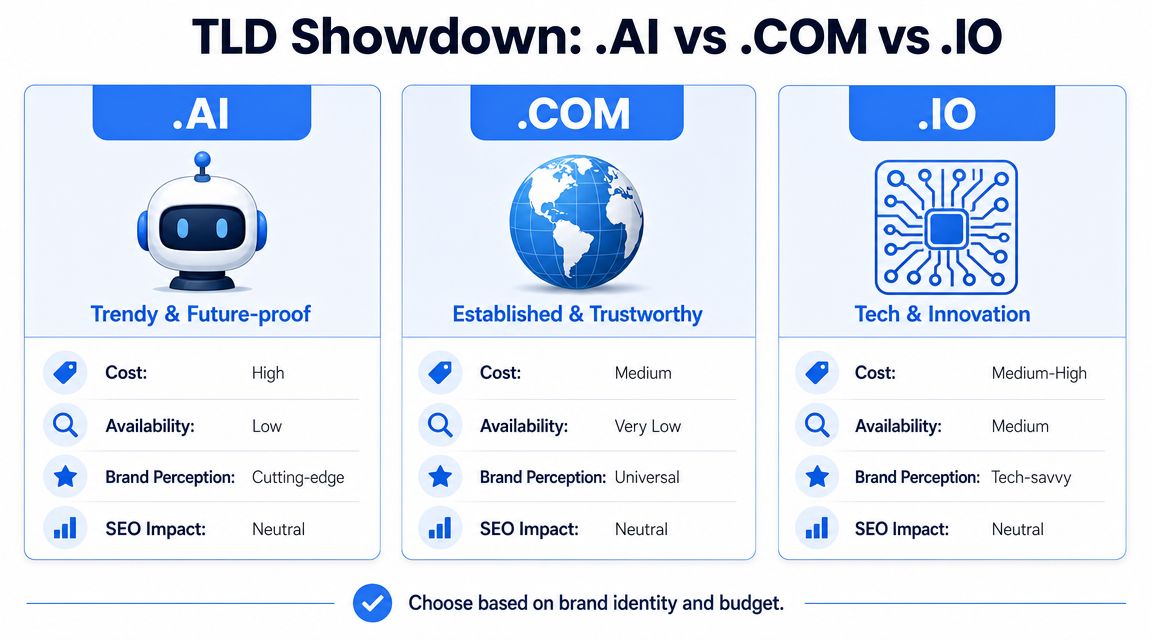
I've seen founders burn a week arguing about whether .ai looks cooler than .com, then overpay for a name that boxed them into the wrong brand. The extension should match the business you plan to build, the audience you want to reach, and the price you can live with for more than one renewal cycle.
What .ai really buys you
.ai is Anguilla's country-code extension, and buyers worldwide can register it through major registrars, including Namecheap's .ai registration page. That broad access is great for founders and bad for bargain hunters. It means every investor, startup operator, and speculator is shopping the same shelf.
The upside is obvious. A good .ai tells the market what you do before anyone reads the headline on your homepage. For AI-native products, that signal has real value. A sharp two-word .ai can beat a clunky .com on first impression.
The trade-off is recurring cost. .ai usually costs more to register and renew than .com or .io, and some registrars structure it with a higher upfront commitment. I treat that as part of acquisition cost, not a footnote.
Cost rule: Judge the domain by the two-year hold cost, not the first checkout screen.
Where .com still wins
.com remains the default if you want broad trust. It works with enterprise buyers, local businesses, consumers, and people who still type .com out of habit. If the company might grow beyond an AI label, .com gives you more room.
The problem is inventory quality. Good .coms are rarely sitting unclaimed. If one is available, it's often long, awkward, or one legal letter away from trouble. In practice, a lot of the best .com opportunities come from expired-domain hunting, not fresh registration searches. That's one reason I don't treat .com as “too picked over.” I treat it as a market where lazy search methods fail.
I've bought names in this category because they gave the brand a longer runway, even when the matching .ai looked flashier.
Where .io fits
.io still works, especially for technical products. Developer tools, APIs, infrastructure software, and operator-focused SaaS can wear .io well because the audience already accepts it.
Its weakness is positioning. .io says software company. .ai says AI company. If your product pitch depends on immediate category recognition, .io asks the brand to do more work. If you want a wider view of how country-code endings get used outside their original geography, this country domain extension list is a useful reference.
A practical decision framework
| TLD | Best for | Main strength | Main risk |
|---|---|---|---|
| .ai | AI-native startups | Clear category signal | Higher carrying cost |
| .com | Broad brands | Familiar and trusted | Strong names are hard to find |
| .io | Technical products | Good fit for startup and dev audiences | Weaker AI signal |
My short version is simple:
- Choose .ai if AI is the core identity and you can justify the higher hold cost.
- Choose .com if you want trust, flexibility, and a brand that can expand past the current AI wave.
- Choose .io if the audience is technical and the name is meaningfully better than your .com or .ai options.
The mistake is assuming one extension wins in every case. The better move is buying the name that is underpriced for its actual commercial use, which is often easier to spot once you start looking beyond standard registrar search results.
Hunting Strategies Beyond Brainstorming
Brainstorming has its place. I still do it. But brainstorming alone is where people waste days trying to invent a clean domain out of picked-over inventory.
The standard advice goes like this: combine a keyword, add a modifier, maybe shorten a word, and keep checking registrars until something vaguely decent appears. That process usually produces names that are available for a reason.
The two paths
One path is hand registration. You invent something new, hope it's free, and register it. This works best when you're unusually good at naming or when your brand doesn't need any history behind it.
The other path is domain hunting. You search for names that expired, dropped, or are about to drop. A lot of underrated value resides in this approach.
A dropped domain can give you a stronger name than brainstorming ever would. Sometimes it's shorter. Sometimes it's cleaner. Sometimes it has age, links, or old brand recognition attached to it. And sometimes the previous owner forgot to renew something they should have held onto.
Why expired inventory is different
Expired and expiring domains have one big advantage. They were already valuable enough for someone to register in the first place.
That doesn't make them automatically good. Plenty of expired domains are junk. But the ceiling is much higher than with random hand-reg ideas.
If you want creativity help before you start hunting, use a tool built for ideation, not guesswork. This AI domain name generator can help surface patterns and naming angles worth testing. Then take those ideas into the expired market and look for cleaner, stronger versions.
What to look for first
When I hunt for cheap AI domains, I don't start with “What can I invent?” I start with:
- Shortness: Fewer moving parts means fewer branding problems.
- Clarity: You shouldn't need to explain spelling over a call.
- Category fit: The name should feel natural next to AI products.
- Optionality: A good domain should still work if the product expands later.
That last point matters more than people think. A name that's too literal can age badly. A name with a little room to grow usually holds value better.
Your Secret Weapon For Finding Domain Gold
Manual hunting is miserable. You open too many tabs, check too many registrars, and end up spending more time sorting junk than finding anything worth buying.
A dedicated discovery workflow is faster.
Start with dropped names you can register now
The easiest win is fresh drop inventory. These are domains that have already fallen out of the previous owner's hands and can be registered immediately.
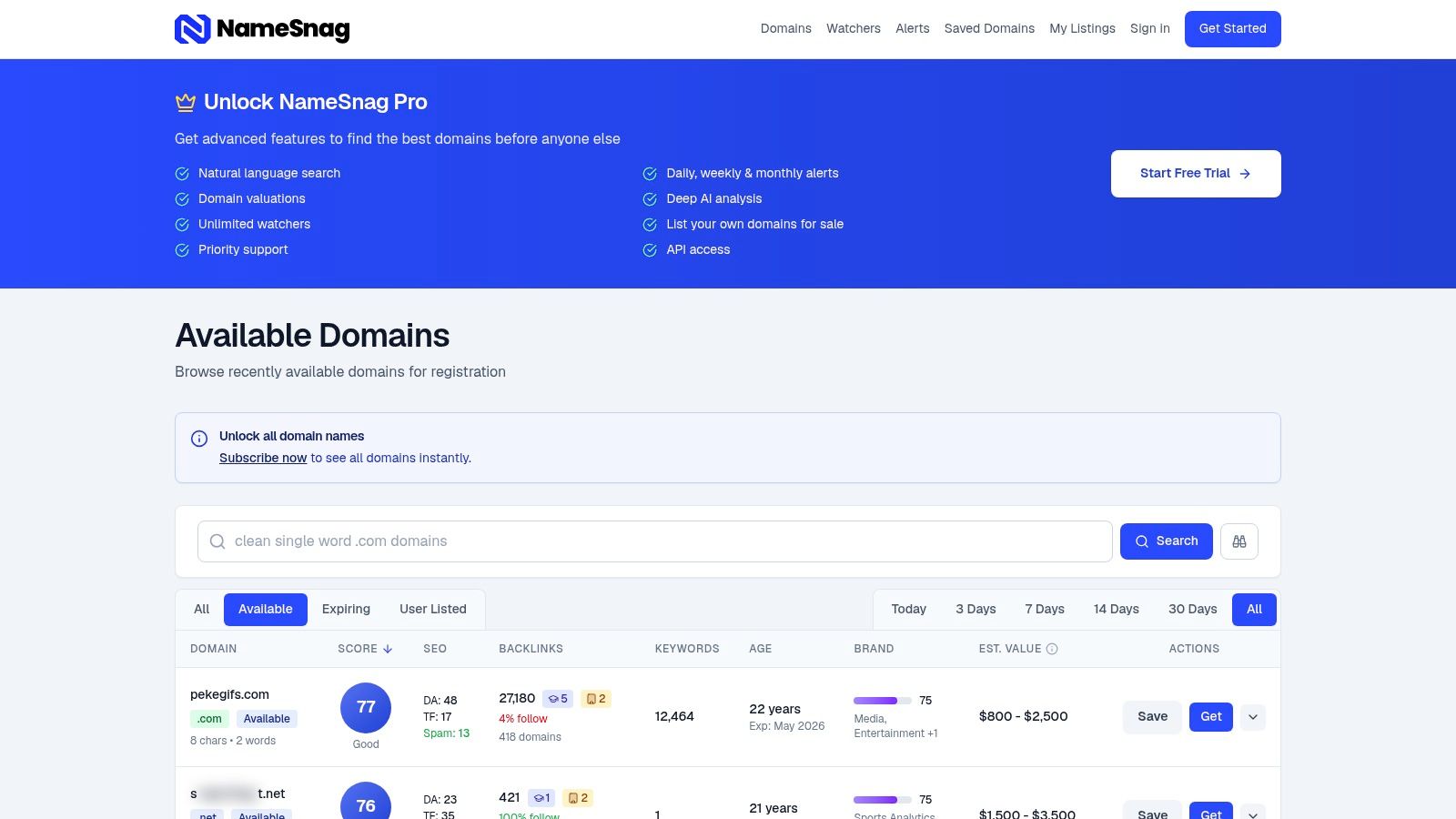
If you're scanning for immediate opportunities, the Available domains view is where I'd begin. The key is not to scroll endlessly. Filter by timeframe first. Start with Today, then widen to 3 Days or 7 Days if the niche is tight.
That approach keeps you focused on names with the highest chance of being overlooked. Once a drop has sat around for too long, the best pieces are usually gone.
Then move into expiring names with intent
Expiring domains are different. They haven't fully dropped yet, which gives you time to evaluate and decide whether the name deserves attention. That's useful when you want to line up a move instead of impulse-buying whatever happened to become available this morning.
The Expiring domains view is where more strategic hunting starts. I like this list for building a watchlist around category terms, brandable fragments, and names that might attract multiple buyers once they hit the open market.
Here's the practical split:
- Use Available when you want instant registration options.
- Use Expiring when you want planning time and better selectivity.
- Use shorter time filters when freshness matters more than volume.
- Use wider time filters when you're mapping a niche and hunting themes.
How I sort signal from noise
I usually scan in layers.
First pass, I kill obvious junk fast. Weird spelling, trademark bait, awkward word order, names that sound like prompt spam. Gone.
Second pass, I look for patterns. Strong prefixes, strong suffixes, product words, technical verbs, and names that feel like they could support both SaaS and content plays. If you like category-led hunting, it can also help to explore PeerPush's P-domain list for naming patterns and lexical inspiration outside the usual registrar bubble.
A quick walkthrough helps if you want to see the process in action.
The mistake that burns most buyers
People confuse activity with selection. They think seeing more domains means making better decisions. Usually it means getting sloppy.
A tighter workflow wins. Search recent drops. Flag only names you would use. Re-check them with a clean head. Then buy one good domain, not five mediocre ones.
The best cheap AI domains don't look cheap. They look like someone else made a mistake by letting them go.
Vetting Your Domain Like a Pro
A domain can look perfect on the surface and still be a headache underneath. Amateur buyers fall into this trap. They chase a cool string of characters and ignore the history attached to it.
That mistake gets expensive fast.
The fast checklist
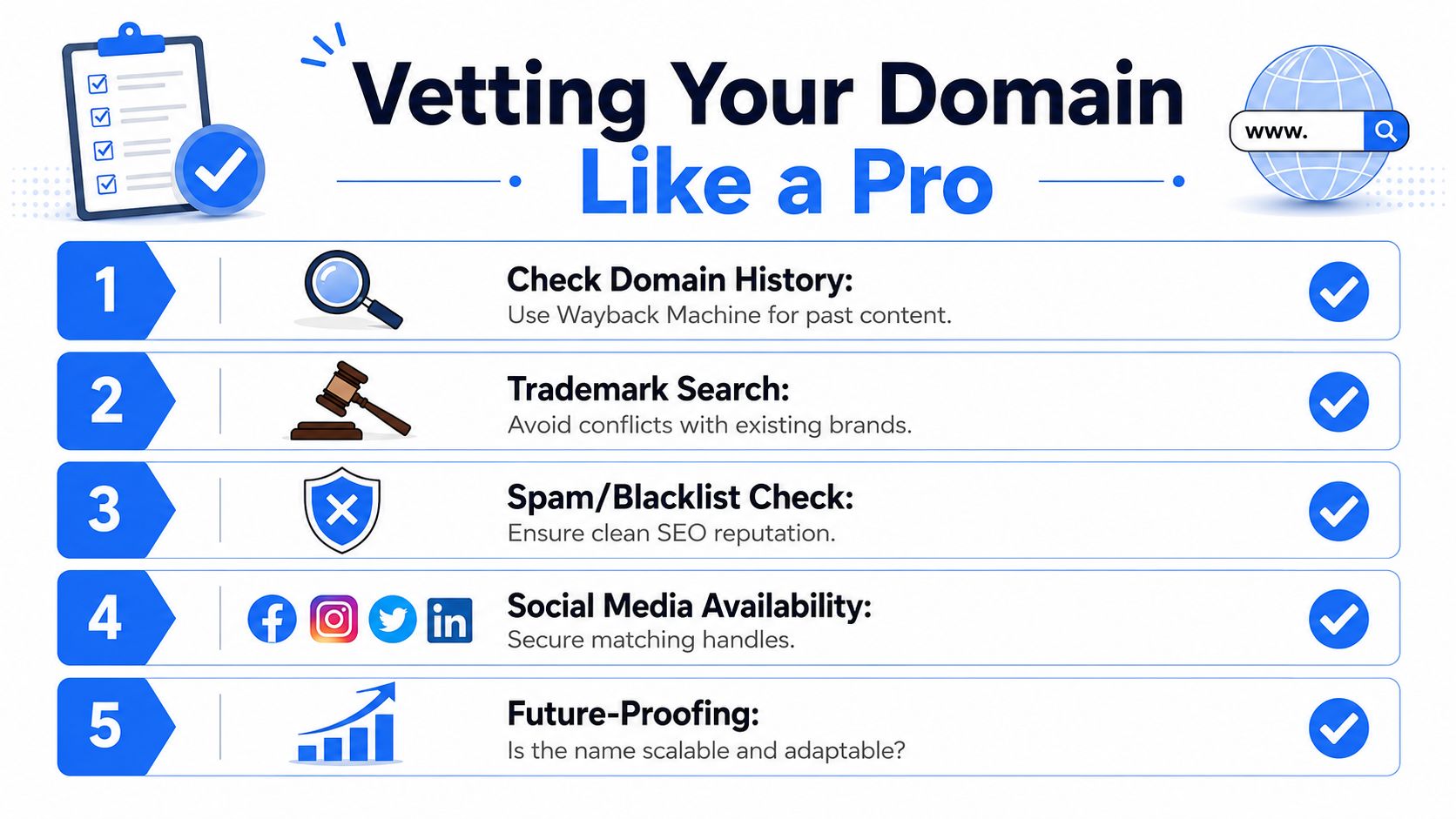
I use a short checklist before I touch any expired or expiring name:
- Check the historical use: Look at old snapshots in the Wayback Machine. If the domain used to host spam, scraped content, or something wildly off-brand, I'm cautious.
- Check for trademark conflict: You don't need a legal dissertation at this stage. You need a sanity check. If the name is too close to a known brand, walk away.
- Check search and SEO cleanliness: If the domain has obvious spam footprints, deindexed pages, or suspicious anchor patterns, it's probably not the bargain it looks like.
- Check brandability out loud: Say it on a call. Spell it once. If it creates friction, the market will feel that friction too.
- Check handle availability: A decent domain gets stronger when matching social handles are still within reach.
Metrics help, but they don't rescue a bad name
A lot of buyers overcorrect here. They find a domain with decent SEO signals and ignore the fact that the name itself is weak. Don't do that.
If you're evaluating authority signals, this explainer on domain authority for SEO is a solid refresher on what those numbers are trying to represent. For a more practical scoring angle, this guide to domain score is useful when you want a framework for balancing authority, history, and brand quality instead of obsessing over one metric.
A clean history can make a good domain better. It can't make an awkward domain memorable.
The gut check I trust most
After the metrics, I ask one simple question: would I still want this name if there were no backlinks attached to it?
If the answer is no, I usually pass. Good expired domains have two ways to win. They can help with search equity, and they can help with brand equity. If you only have one of those, the name needs to be very strong on that one axis.
That's the difference between buying inventory and buying an asset.
Sealing the Deal Without Getting Fleeced
This is the part where people get lazy because they've already fallen in love with the domain. That's exactly when mistakes happen.
If the domain is newly available and sitting at a registrar, the move is simple. Slow down and read the pricing details. The advertised registration fee isn't always its full long-term cost. Renewal and transfer pricing can be materially different, and comparison data shows .ai pricing across registrars ranging from about $24.77 to $195.77 at TLD-List's .ai pricing comparison. That spread is why a “cheap” buy can stop looking cheap very quickly.
For standard registrations
Use this purchase checklist:
- Check renewal first: If year one is low but renewal is painful, your cheap buy may only be cheap today.
- Check transfer pricing: You want optionality later, especially if you consolidate domains.
- Check the full cart: Privacy, add-ons, and upsells can distort the total amount.
For aftermarket deals
Negotiation is a different sport. Don't send emotional messages about your startup dream. Sellers smell attachment and price accordingly.
A better approach is calm and businesslike:
- Lead with clarity: Ask if the name is available and whether the seller has a target range.
- Stay disciplined: If the seller is anchored in fantasy, leave room to walk.
- Don't fake indifference badly: Serious buyers ask smart questions, not theatrical lowballs.
I've seen more buyers lose money from impatience than from hard negotiation. If the domain isn't mission-critical, be willing to pass. There's always another name, and in active drop markets there's usually a better one coming.
Quick Answers to Your AI Domain Questions
Is a .com with AI in the name better than a .ai domain
Sometimes, yes. A .com tends to feel more universal, and that matters if your audience isn't overly technical. A .ai domain gives you a stronger category signal right away. If the .com is clean, short, and on-brand, I usually give it serious weight. If not, a strong .ai can be the better branding play.
How long does it take for an expired domain to become available
It depends on the registrar and the domain's status along the lifecycle. In practice, there's usually a grace period first, then a redemption phase, and then a final deletion stage before the domain drops back into open availability. The important takeaway is that “expired” doesn't mean “available now.”
What if the domain I want is taken but unused
You still have options. You can watch for expiration, use a backordering service, or contact the owner directly if the name matters enough. If you reach out, keep the message short and professional. Don't tell them how perfect the domain is for your business. That only helps their price.
Are cheap AI domains still worth chasing in a crowded market
Yes, but only if you define cheap correctly. The best buys are often names that are underpriced relative to their branding upside, not just names with the lowest sticker price. A weak cheap domain is still weak. A clean dropped domain at standard registration cost can be a steal.
Should I buy multiple domains or focus on one
For most founders, one strong domain beats a pile of backups. Extra domains make sense when you're protecting a brand or controlling obvious variants. They don't make sense when you're buying out of indecision.
If you want a faster way to find clean, high-potential expired and expiring domains without drowning in junk, take a look at NameSnag. It's built for the exact workflow that uncovers undervalued domain opportunities, especially when you care about both branding and SEO upside.
Find Your Perfect Domain
Get access to thousands of high-value expired domains with our AI-powered search.
Start Free Trial