You type in the perfect domain. It's taken.
You try a clever variation. Also taken.
Then the registrar starts “helping” by suggesting a name that sounds like a password generated by a sleep-deprived robot. That's usually the moment people decide domain buying is just luck plus persistence. It isn't. The best way to buy domain names has a lot less to do with the search bar and a lot more to do with choosing the right acquisition path for your goal.
A founder launching a brand, an SEO building a content site, and a domain investor hunting upside should not shop the same way. They're solving different problems. One needs something clean and memorable. One wants history and authority. One wants spread between acquisition cost and resale value.
That distinction matters because the market is huge. As of September 30, 2024, there were 362.3 million domain name registrations worldwide, and .com alone accounted for 156.7 million according to Openprovider's domain market overview. In a market that crowded, “just search and hope” is not a strategy. It's how people end up overpaying for mediocre names or settling for a domain they'll regret in six months.
So You Need a Domain Name Now What
Many individuals start in the worst possible place. They begin with the assumption that buying a domain is one decision.
It isn't. It's a chain of decisions. Are you building a long-term brand? Do you need a domain with existing history? Are you buying for SEO, resale, or pure credibility? The right answer changes the buying method.
That's why I'd reframe the question from “what domain should I buy?” to “what is the smartest way for me to buy one?” Once you do that, the noise drops fast.
The search bar is not the strategy
A registrar search box is a checkout tool. It's not a decision framework.
If you're building a startup, you may want a fresh, brandable name with no baggage. If you're building an affiliate site, an aged domain with a clean backlink profile can be more interesting than a shiny new registration. If you're buying a category-defining brand, the search bar won't help much because the name is already owned and you'll need a negotiation path.
The mistake isn't wanting a great domain. The mistake is assuming every great domain should be acquired the same way.
There's also a practical issue people miss right away. A domain rarely lives alone. You'll probably connect email, redirects, analytics, a site, maybe a landing page, maybe a sales stack. If you buy a domain and then need mailboxes later, this guide on how to configure GoDaddy email is a useful operational reference, especially if you inherited a setup that's messier than it should be.
Start with fit, not availability
A good domain strategy asks three things first:
- What's the asset for. Brand launch, SEO advantage, investment, or defensive ownership.
- How fast do you need it. Today, this week, or after negotiation.
- How much history can you tolerate. None, some, or specifically desirable history.
If you're still at the naming stage, this guide on how to find good domain names is a better place to start than another registrar homepage pretending your fifteenth fallback option is “just as good.”
The Five Paths to Your Perfect Domain
There are five real ways to acquire a domain. Everything else is just a variation with nicer buttons.
| Path | Best for | Upside | Catch |
|---|---|---|---|
| Hand registration | New brands, side projects, budget-conscious founders | Cheap entry, full creative control | Good names are harder to find |
| Aftermarket marketplace | Buyers who want quality now | Better names, faster than waiting | Pricing can get irrational fast |
| Expired and dropping domains | SEOs, affiliates, opportunistic investors | Existing history can matter | Requires due diligence |
| Domain broker | Premium buyers who want discretion | Useful for hard-to-reach owners | Added cost, mixed incentives |
| Private acquisition | Experienced buyers and investors | Can find off-market value | Requires outreach and negotiation skill |
A quick read on each path
Hand registration is the clean-slate option. You search, you find something available, you register it. Best for people creating a brand from scratch who care more about control than inherited history.
Aftermarket marketplaces are where already-owned domains get listed for sale. Useful if you've got a specific target or you're tired of pretending your fourth-choice hand reg is “growing on you.”
Expired and dropping domains sit in the sweet spot for SEO-minded buyers. These are names that have lapsed or are about to drop, and some of them still carry usable history if you vet them properly.
Domain brokers step in when the asset is important enough that a clumsy direct email could hurt your position. They're not magicians, but they can create distance and structure.
Private acquisition means contacting the owner yourself. This can work well if you know how to negotiate and don't mind detective work.
Practical rule: Don't choose the path that sounds easiest. Choose the one that fits the value you need from the domain after purchase.
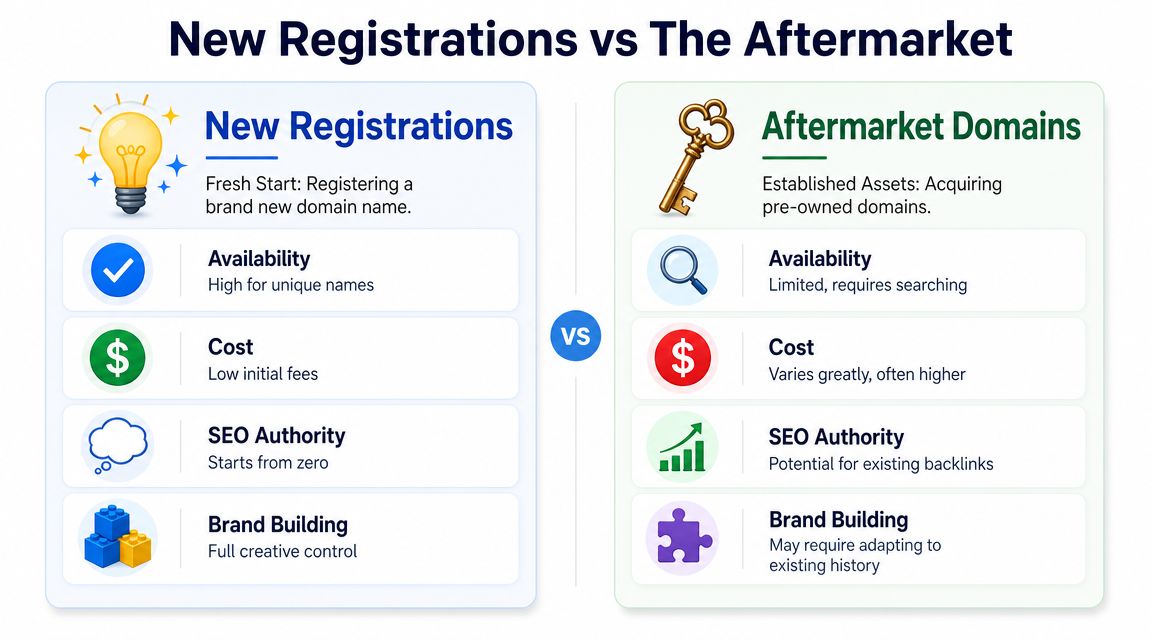
New Registrations vs The Aftermarket A Comparison
This is the real fork in the road. Most buyers end up choosing between a fresh registration and some kind of pre-owned domain. Both can work. Both can waste your money if you use them for the wrong job.
| Criteria | New registration | Aftermarket purchase | Expired or dropping domain |
|---|---|---|---|
| Best use case | New brand creation | Premium branding and exact matches | SEO projects, authority rebuilds, selective investment |
| Name quality | Usually more creative than obvious | Often stronger and more direct | Mixed, depends on what drops |
| History | Clean slate | Existing ownership trail | Existing history that needs vetting |
| Speed | Fast if available | Can be fast or negotiation-heavy | Research-heavy but can uncover value |
| Risk | Low baggage, weaker inherent signals | Price inflation, hidden past issues | Spam, bad links, messy old use |
| Buyer mindset | Build from zero | Pay for fit | Hunt for asymmetry |
When new registrations make sense
A hand registration wins when brand flexibility matters more than existing authority. You get a clean history, no weird backlinks from a casino forum in another language, and no need to reverse-engineer what the domain used to be.
This path works well for:
- Founders naming a company
- Creators launching a new media brand
- Small businesses that need a memorable home base
- Teams that want simple legal and operational ownership
The downside is obvious. Most strong one-word and two-word combinations are long gone. You often need creativity, not just persistence.
When the aftermarket is worth the headache
The aftermarket is where better raw assets live. Short names, category terms, clean brandables, exact-match phrases, and domains someone else had the foresight to secure years ago.
You pay for that convenience in one of two ways. Money, or time.
If the domain is listed at a fixed price, the pain is mostly financial. If it isn't, then you're in negotiation territory. That can be worthwhile for a core brand asset, especially when the domain shapes credibility, recall, or resale potential.
A premium domain can save years of explaining a forgettable one. It can also become a vanity purchase with no business case. Both things happen every day.
Why expired domains are their own category
Expired domains get lazily lumped into “aftermarket,” but they deserve their own lane because the logic is different. You're not just buying the string. You're buying history, and history is either an advantage or baggage.
That's why experienced buyers treat expired domains like an investigation, not a shopping trip. A strong expired domain may have useful age signals, mentions, and backlinks. A bad one may have a penalty trail, spam anchors, and enough cleanup work to make a fresh registration look glamorous.
The shortest honest answer
If your priority is brand, start with hand registration and only move to marketplaces when the naming gap is obvious.
If your priority is SEO advantage, look hard at expired and dropping domains.
If your priority is prestige or category ownership, the aftermarket is usually the arena.
The best way to buy domain names is not one method. It's matching the acquisition method to the outcome you need.
The Hand Registration Playbook For New Brands
For many, hand registration is the ideal starting point. Not because it's always best, but because it gives you the cleanest asset with the fewest surprises.
The catch is that registrars love turning a simple purchase into a carnival of promos, upsells, and future regret.

Ignore the cheap first-year bait
The sticker price is often the least important part of the decision.
Registrar comparisons repeatedly warn that introductory prices can be misleading and that buyers should compare registration, renewal, management, and transfer fees across a 2 to 3 year ownership horizon, as covered in GoDaddy's registrar comparison guide. That's how the game works. Not “Can I get this for almost nothing today?” but “Will this registrar punish me for still owning it later?”
A cheap first year can turn into an annoying ownership experience if privacy costs extra, renewals jump, or transfers feel like filing paperwork in a basement office from 1997.
What to compare before you buy
Don't overcomplicate this. Use a simple checklist.
- Renewal pricing. Registrars make their money here.
- Privacy inclusion. If it's bundled, good. If it's another add-on, note it.
- Transfer process. Someday you may want out. Assume that day comes.
- DNS and account controls. Basic management should be easy, not buried.
- Support quality. You won't care until something breaks on a Friday.
The cheapest domain is often the one that becomes expensive the moment you need normal account features.
Keep your registrar separate from your host
This is one of those unsexy lessons people only learn after a mess.
Buying your domain from the same company that hosts your site can feel convenient at first. Then you want to migrate, split services, change providers, or hand the site to an agency. Suddenly your domain, hosting, billing, and support are tangled together like old Christmas lights.
For a new brand, clean separation is usually smarter. Keep the domain with a registrar you trust. Point it wherever you want. That preserves your control and reduces operational friction later.
Who should hand register
Hand registration is a strong fit if you are:
- Launching a startup on a real budget
- Building a personal brand
- Creating a local business site
- Testing an idea and need a clean asset
It's weaker if you need instant authority, a category-defining phrase, or a highly competitive exact match. In those cases, forcing a hand reg can waste more time than it saves.
Unlocking SEO Power With Expired Domains
Expired domains are where domain buying stops being retail and starts feeling like fieldwork.
For SEO projects, affiliate sites, and certain content plays, a good expired domain can be attractive because you're not always starting with a blank slate. You may be inheriting age, references, backlinks, and a recognizable topic footprint. You may also be inheriting a trash fire. That's why this path rewards discipline more than optimism.
The edge comes from history
This market is driven by data. WHOIS intelligence providers maintain databases with over 5 billion historic records, which means buyers can inspect prior ownership, age, and historical use before purchasing, as summarized by Domainnamestat's market data. That's the difference between guessing and underwriting.
A domain with relevant old usage, clean ownership patterns, and normal backlink history can be useful. A domain that was repurposed repeatedly, redirected through spammy projects, or used for junk campaigns is usually not worth the cleanup risk.
What a clean expired domain looks like
You're not hunting for perfection. You're hunting for alignment and absence of obvious poison.
Look for signs like:
- Topic consistency. The old site's purpose should make sense for your intended use.
- Natural backlink profile. Links from real sites, not obvious garbage piles.
- Brandability. If the name itself is unusable, the metrics won't save it.
- Ownership sanity. Repeated churn can be a warning sign.
- Archived history that doesn't make you nervous. If old snapshots look sketchy, trust your discomfort.
If you're building a young SaaS and trying to move fast on tooling across the board, this broader piece on AI tools for early-stage SaaS startups is a useful complement to domain research because the ultimate efficiency gain usually comes from improving the whole workflow, not one step.
The practical hunt
There are two broad opportunities most buyers care about.
First, domains that have already dropped and can be registered immediately. Those are often the easiest to act on if you're fast.
Second, domains that are expired but still in a grace period. Those give you a head start because you can monitor them before they fully drop.
One option for this workflow is NameSnag's available domains search for recently dropped names and NameSnag's expiring domains search for domains still heading toward deletion. The time filters are useful too. You can narrow by Today, 3 Days, 7 Days, 14 Days, 30 Days, or All, which is a much saner way to work than opening twenty tabs and pretending that's research.
If you want a deeper process for sourcing and vetting these names, this guide on how to find expired domains is worth reading before you place a single bid or registration.
Here's a walkthrough that fits the workflow:
What usually goes wrong
Expired domain buyers make the same mistakes over and over.
- They buy metrics, not history. Numbers can hide ugly use cases.
- They chase random authority. Relevance matters.
- They skip archive review. That's how bad surprises happen.
- They assume older means better. Sometimes older just means more chances to have gone wrong.
A clean expired domain can accelerate a project. A dirty one can consume weeks before you admit you should've walked away.
The High Stakes Game Marketplaces And Brokers
Some domains can't be found. They have to be acquired.
That's the marketplace and broker world. Buyers go to these venues when they need a specific asset, not just a usable one. Short brandables, exact-match commercial terms, category names, and domains a founder has wanted for months usually end up here.
What marketplaces are good at
Marketplaces are good for visibility and transaction structure. You can see what's listed, compare alternatives, and sometimes buy instantly. That's the easy version.
The hard version is valuation. Domain pricing is part logic, part positioning, part ego, and part “the owner had coffee and decided the number should be higher today.” You can use comparable sales thinking, brand fit, memorability, and commercial intent, but there is still art in the final price.
If you're evaluating one of the larger platforms, this overview of the Sedo domain marketplace gives a useful read on how that acquisition channel works.
When a broker helps
A broker can make sense when the domain matters enough that direct outreach creates risk. They can preserve anonymity, manage communication, and sometimes stop a negotiation from turning into theater.
What matters most is process. Use escrow. Verify transfer steps. Confirm where the domain will land after purchase. And don't ignore registrar choice after the deal closes.
That matters because platform lock-in is a real operational risk. Advice on domain purchasing often warns against buying through the same company handling your hosting because it can tie you to that provider and complicate future transfers, a concern highlighted in this domain purchasing guide. When you've paid serious money for a domain, the last thing you need is administrative friction.
Your Decision Framework Which Path Is Right For You
Many domain buyers don't need more options. They need a shorter decision tree.

If you're a startup founder
Start with a hand registration unless the exact domain is central to the business story. A clean, memorable, brandable name beats a compromised domain bought out of impatience.
Keep one eye on the aftermarket for future upgrades. But don't let domain envy delay launch.
If you're an SEO or niche builder
Put expired and expiring domains at the top of the list. Your upside often comes from finding a name with relevant history and avoiding obvious damage.
This path takes more work, but that's exactly why it can produce better opportunities than retail search.
If you're a domain investor
Use a blended approach. Hand register only when you spot unusual brandability. Spend more time on expirations, drops, and selective aftermarket buys where pricing and resale potential aren't completely detached from reality.
If you're buying a premium brand asset
Use marketplaces or a broker, then focus hard on safe transfer and long-term control. The buying price is only part of the cost.
Cloudflare's registrar positioning makes a useful point here. The biggest cost of a domain often isn't the purchase itself, but the renewals, transfers, and add-on fees that follow, which is why the cheapest first-year promo often turns into the wrong optimization over time, as noted in Cloudflare's low-cost domain names page.
Buy the domain for the future you'll actually live with, not the promo banner staring at you today.
The best way to buy domain names depends on what you need the asset to do after the purchase. Brand builders should optimize for clarity and control. SEOs should optimize for vetted history. Investors should optimize for pricing discipline and optionality. Everyone else should stop letting registrar coupons make strategic decisions for them.
If you're shopping for domains with SEO or resale potential, NameSnag is a practical place to start. It helps you sort through available and expiring domains without doing all the manual digging first, which is useful when you want cleaner candidates and less junk in the pipeline.
Find Your Perfect Domain
Get access to thousands of high-value expired domains with our AI-powered search.
Start Free Trial