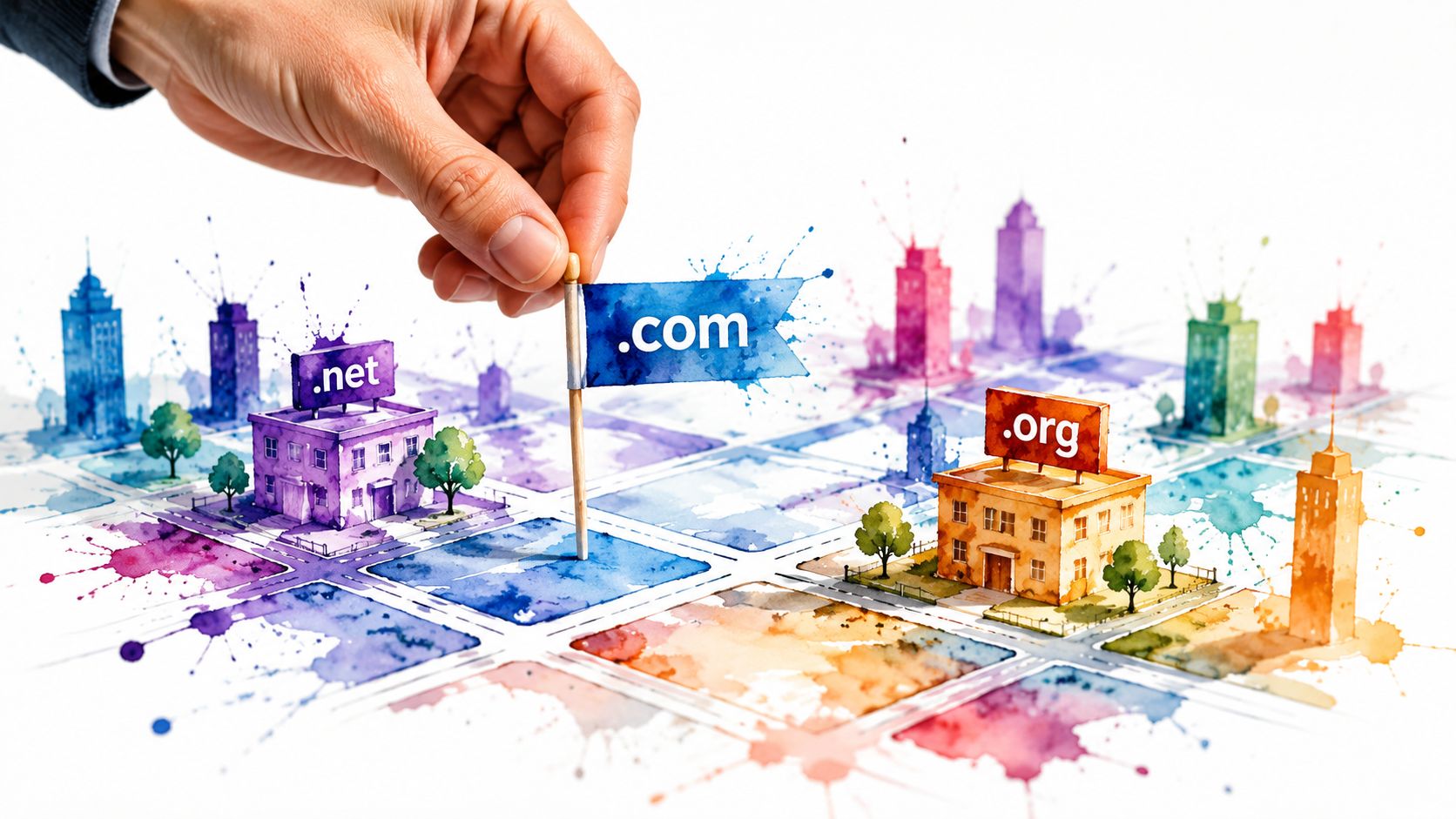
Ever had that lightbulb moment, the perfect domain name that just sings? You rush to a registrar, heart pounding, punch it in, and... already taken. Of course it is. So what now? Is that brilliant idea just dead in the water?
Not so fast. This is exactly where the Sedo domain marketplace comes swaggering in. Think of it less like a store for brand-new stuff and more like a massive, global brokerage for digital real estate. It's the place you go when the domain you really want is already owned by someone else.
Sedo is what we in the biz call a secondary market. It's not where you register fresh, unused names. Instead, it’s the central hub connecting people who want to buy a specific, already-registered domain with the person who currently owns it. It’s the eBay for web addresses, but with way higher stakes and a whole lot more strategy involved.
A Marketplace for Every Ambition
The sheer variety of people on Sedo tells you everything you need to know about the domain game. It’s a real cross-section of the digital economy, and you’ll find yourself rubbing shoulders with all sorts of characters.
- Scrappy Startup Founders: They're on the hunt for a brandable name that’s catchy, memorable, and legit. They need that perfect
.comand are willing to pay for it. - Pro Domain Investors: These are the digital property flippers. They snatch up names they believe are undervalued, park them on Sedo, and wait for the right buyer to come along so they can turn a sweet profit.
- Corporate Giants: Big companies use Sedo to acquire names for new product lines, killer marketing campaigns, or even to buy up defensive domains that are similar to their main brand to shut down trademark squatters.
What makes Sedo the heavyweight champion is its mind-boggling scale. We’re talking over 19 million premium domains listed for sale. This massive inventory is managed by a community of more than 2 million members across the globe, cutting deals in over 25 languages.
This isn’t just for small-time trades, either. This is where serious digital assets change hands. Big-ticket sales happen all the time, like safemoon.com which sold for a cool $67,554. If you’re nosy about the business side of their operation, Growjo has some interesting insights into their scale and revenue.
The platform is designed to get right to the point: helping you find a domain to buy or figuring out what one of yours is worth.
It's More Than Just a "For Sale" Sign
Sedo isn't just a listing service; that would be too easy. Their real value comes from the awesome ecosystem they’ve built around the buying and selling process.
They provide a trusted third-party escrow service, which is absolutely critical. You’re not just sending a stranger thousands of dollars and crossing your fingers they'll transfer the domain. Sedo holds the money and the domain, making sure both sides of the deal are honored before anything is finalized. It takes the terror out of the transaction.
For the really high-value names—the ones selling for five or six figures—they offer professional brokerage services. A broker will step in, negotiate on your behalf, and handle the entire messy process. They even offer a domain parking service, which lets sellers earn a bit of passive income from ads displayed on their unused domains. It's a clever way to make a domain "earn its keep" while it's waiting for a buyer. This full-service approach is why Sedo has become such a fundamental piece of the domain industry.
To understand why a marketplace like Sedo has so much gravity today, you have to remember what the domain world looked like before it. It wasn't always this organized.
Think back to the early 2000s. The secondary domain market was the digital equivalent of the Wild West—a chaotic, high-risk free-for-all. Sedo showed up and started building a town hall where there was just a dusty street. They didn’t just slap up a bulletin board with domains for sale; they introduced things that feel obvious now but were revolutionary then, like secure escrow services and professional brokerage.
This wasn't just about facilitating sales; it was about building a foundation of trust. By professionalizing the transaction process, they made buyers feel safe and attracted serious investors who were tired of the chaos. That early focus on security and service is what built their loyal user base.
Thriving When Others Faltered
The real measure of any market, or any company for that matter, is how it holds up when the economy gets rocky. Sedo didn't just survive downturns; it demonstrated the surprising resilience of the domain industry. While other sectors were shrinking, the appetite for premium digital real estate just kept growing, with Sedo right at the heart of the action.
Take the 2008 global recession. Most businesses were just trying to keep the lights on, but Sedo actually saw its sales grow. They pulled in $77,413,390 in total sales and transfers, an 8% jump from the year before. That wasn't a fluke. It was a clear sign that people with money view high-quality domains as stable assets, especially when everything else feels uncertain. If you're curious, you can dig into the numbers yourself in Sedo's own market study from that era.
From Marketplace to Multi-Faceted Powerhouse
Sedo’s smartest moves didn't stop at just buying and selling. They rolled out domain parking, which let sellers earn ad revenue from their undeveloped domains. This was a simple, yet brilliant, way to turn a static asset into something that could generate passive income while waiting for a buyer.
It's a fundamental shift in the economics of domain investing. Suddenly, a domain could pay for its own registration fees, or even turn a small profit. It made holding a portfolio of names far more attractive and less of a pure cost center.
This kind of innovation wasn't new for them. Even back in 2004, Sedo was reportedly handling something like 60% of all secondary domain sales on the planet. The average .com sale on their platform that year was clearing $9,700—a hefty sum that underscored just how valuable this "digital real estate" was becoming.
This is how Sedo became a pillar of the industry. They started by solving the trust problem, proved the market's resilience during a crisis, and then innovated with new revenue streams like parking. They didn't just build a platform; they built an ecosystem based on a deep-seated understanding of what domainers and buyers actually need.
Alright, you get why the Sedo domain marketplace exists. Now for the fun part: the "how."
Making a deal on Sedo isn't some one-size-fits-all process. It’s a bit like a transaction with its own set of rules and strategies, depending on whether you’re buying or selling, your patience, and the specific domain in question. Let's break down the playbook so you can jump in without getting played.
For the Buyer Hunting for a Gem
As a buyer, you have three main ways to get your hands on a domain at Sedo. Each has its own rhythm and requires a different game plan.
"Buy Now" for a Quick Win: This is the express lane. The seller has put a firm, take-it-or-leave-it price tag on the domain. If you see a "Buy Now" price you like, you can snap it up instantly. It's the cleanest, fastest way to secure a name you want without any haggling. No muss, no fuss.
"Make Offer" for the Art of the Deal: This is where the real action happens. The seller is signaling they're open to negotiation, and you can put a number on the table. This is your shot to land a great name for less than the asking price, but it takes some finesse. A lowball offer will get you ignored. A reasonable, well-thought-out one starts a real conversation.
Domain Auctions for the Thrill of the Chase: Some of the best names on the platform end up in auctions. Here, you're bidding against other interested buyers, pushing the price up until only one person is left standing. It can be an adrenaline rush, for sure, but you absolutely must have a hard stop price in mind before you even start. It's dangerously easy to get swept up in the moment and overpay.
For the Seller Looking to Cash In
If you're sitting on a valuable domain, Sedo is where you connect with a massive pool of potential buyers. Your main decision is picking the sales format that fits your asset and how quickly you want to move it.
The timeline below gives you a sense of Sedo's long-standing market dominance. Even during major economic downturns, they were facilitating huge sales.
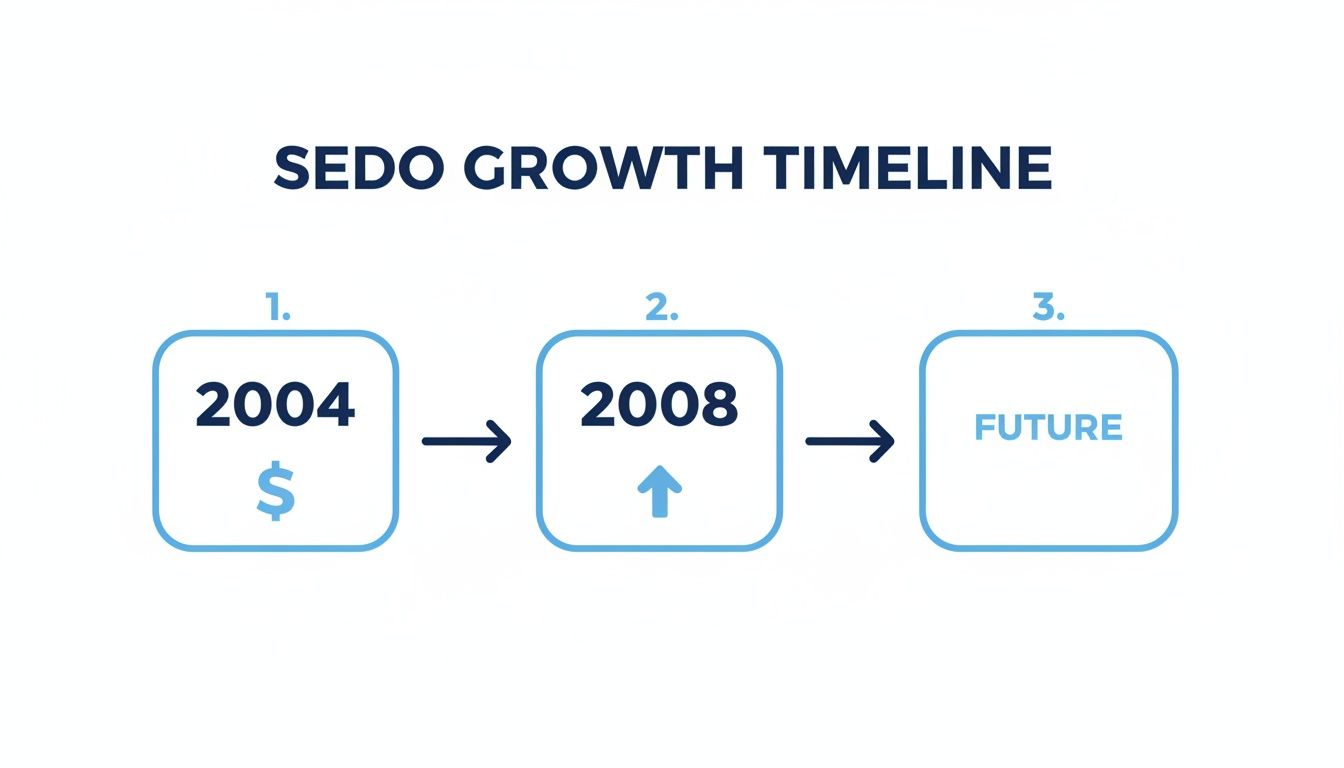
This isn't just a historical footnote; it's market validation. People with real money trust this platform to move high-value assets.
To help you decide on your approach, here’s a quick breakdown of your selling options on the platform.
Sedo Selling Options at a Glance
| Selling Format | Best For | Pricing Control | Sale Speed |
|---|---|---|---|
| Buy Now (BIN) | Domains with a clear market value or when you want a fast, no-haggle sale. | Full Control: You set a fixed, non-negotiable price. | Fastest: A buyer can purchase instantly. |
| Make Offer | High-value, unique, or brandable domains where the price isn't set in stone. | Flexible: You set a minimum, but the final price is negotiated. | Varies: Can be quick or take time, depending on the negotiation. |
| Auction | In-demand, premium domains with multiple potential buyers. | Market-Driven: The final price is determined by competitive bidding. | Fixed Duration: Auctions have a set timeframe, creating urgency. |
Ultimately, choosing between "Make Offer" and "Buy Now" comes down to your asset and your goals. "Make Offer" invites conversation for those one-of-a-kind names, while "Buy Now" is for when you know your price and want a clean, quick transaction.
Pro-Tip: Don't just list your domain and pray. You need to opt into the SedoMLS (Multiple Listing Service) network. Think of it as a megaphone for your listing. Sedo pushes your domain out to its network of over 120 partner registrars. That means your "For Sale" sign pops up in domain searches all over the web, not just on Sedo itself. It’s a massive force multiplier for your visibility.
And no matter which side of the deal you're on, Sedo's secure escrow service acts as the trusted third party. They hold the buyer's funds until the domain has been successfully transferred, giving everyone involved the confidence to see the deal through. It's a critical piece of the puzzle that makes these high-stakes transactions possible.
Finding Domains Before They Hit the Marketplace
While Sedo is the main stage for premium domains, the savviest investors often find their assets before they ever get listed there. This is where you can get a real edge.
You can't do this on Sedo itself, but using the right tools, you can discover valuable names just as they become available. For instance, you can monitor Expiring domains that are about to drop or hunt for quality Available domains that can be registered for a standard fee.
Snapping up a gem this way and then listing it on a major platform like the Sedo domain marketplace is a classic domain flipping strategy. If you're looking for more advanced tactics, we have a whole guide on how to buy a taken domain name that dives deeper.
Navigating Sedo's Fees and Payouts
If you want to turn a tidy profit into a painful loss, the fastest way is to fly blind on your finances. To actually make money in the Sedo marketplace, you need a painfully clear understanding of their fee structure and how you actually get paid. This isn't just boring accounting; this is the core of your investment strategy.
Think of Sedo’s fees as their cut for giving you access to a global audience and handling the messy, high-stakes process of transferring a domain and money between strangers. The fee isn't one-size-fits-all; it changes based on how your domain sells, which is a critical detail when you're setting your prices.
Breaking Down the Commission Structure
The main number to burn into your memory is 15%. That's Sedo's standard commission for most sales that happen right on their platform, whether it’s a "Buy Now" purchase or a back-and-forth negotiation.
But that’s not the whole story. The commission changes depending on the sales channel. Here’s how it breaks down:
- Standard Sales: If your domain sells through a "Buy Now" price or a "Make Offer" deal on Sedo.com, you’ll pay a 15% commission on the gross selling price.
- SedoMLS Sales: When your name sells through a partner registrar in the SedoMLS network, the commission jumps to 20%. You're paying extra for that wider net they cast for you.
- Auctions: A winning auction bid also lands you in the standard 15% commission bracket.
Let's make this real. Say you sell a domain for $2,000 through a "Make Offer" negotiation on Sedo. Their cut is $300 (15% of $2,000), and you pocket $1,700 before any other fees. But if that same domain sold for $2,000 through a SedoMLS partner, their take is $400 (20%), leaving you with $1,600.
Knowing this difference is everything. It dictates your actual ROI and helps you price your domains so you walk away with the profit you targeted. Some investors will even pad their "Buy Now" price a bit on listings they think will sell via SedoMLS, just to cover that bigger commission. If you're weighing your options, our guide on GoDaddy's auction fees makes for a useful comparison.
Getting Your Payout
After the high of making a sale comes the final step: getting your money. Sedo acts as an escrow agent, holding the buyer's funds until the domain is safely sitting in their account. This is a good thing; it protects everyone from getting ripped off.
Once the transfer is done and dusted, Sedo gets to work on your payout. You can have the funds sent via wire transfer to your bank or directly to your PayPal account. The timing can fluctuate, but once Sedo releases the money, it usually hits your account in a few business days, depending on where you are and the method you chose. Just do yourself a favor and double-check that your payment details in Sedo are perfect to avoid any frustrating delays.
Advanced Strategies for Winning on Sedo
Knowing Sedo's basic rules gets you in the door. Actually winning—the kind where you consistently snag undervalued domains and flip them for a healthy profit—is a different game entirely. It's time to stop just listing and waiting.
The pros don't just react; they anticipate. They have a process. It's a mix of sniffing out trends, smart negotiation, and using the right tools to build an edge. Let's break down how they do it.
Riding the Wave of Market Trends
The best investors seem to have a sixth sense for what's about to get hot. It isn't magic; it's paying attention to the data. Sedo’s search trends are a goldmine if you know how to read them. They show you exactly what thousands of potential buyers are looking for, right now.
Looking at the data, you can see which sectors are on fire. For a long time, AI-related keywords have absolutely dominated searches, with terms like Crypto, Bet, and Casino trailing right behind. A smart investor sees this and starts grabbing names like "AI[Service].com" or "[Industry]Bot.com" before the market gets flooded. You can dig into these market-driving search trends yourself to see what’s moving.
When new buzzwords like "Meta" or "Agent" start climbing the charts, that’s your cue. It’s like that old Wayne Gretzky quote: Skate to where the puck is going, not where it's been.
Mastering the Art of Negotiation
A great domain is worthless if you fumble the negotiation. Whether you’re on the buying or selling side, your approach to the deal can make or break it. Forget about throwing out insulting lowballs or getting emotionally stuck on a fantasy price.
Here's what actually works:
- Make a Real First Offer: As a buyer, your first offer needs to be based in reality. If you can, cite a few comparable sales. An offer that’s 60-70% of a fair asking price starts a real conversation. An offer of 10% gets you ignored, or worse, blocked.
- Justify Your Counter: As a seller, don't just send back a number. If an offer is too low, counter with your price and a simple, professional reason. Something like: "Thanks for the offer. Based on recent sales for similar one-word .coms, my firm price is $X." It shows you know your domain's value.
- Know Your Walk-Away Number: Both sides need to have a number in their head where they'll just walk away from the deal. Getting emotional or needing to "win" is the fastest way to overpay for a domain or kill a perfectly good sale.
The point of negotiation isn't to crush the other person. It's to find a price where both you and the other party feel you got a fair shake. That’s how you close deals smoothly and build a good reputation.
The Power of an External Workflow
While Sedo is a fantastic place to sell, the most profitable flips often start completely outside of it. The real advanced strategy is finding a killer domain for next to nothing and then bringing it to Sedo's massive audience. You're creating your own supply.
This means hunting for domains before they ever hit the general market. It’s a two-pronged attack:
- Hunting for Expiring Gems: These are domains that someone let expire but are still in a grace period before being deleted. Using a service to track these lets you find incredible names with history, authority, and backlinks. You're essentially snagging a mature asset for the price of a backorder.
- Sifting for Available Gold: Millions of domains are dropped every single day. Most are junk, but brandable names with good keywords become available for hand-registration constantly. You just have to find them.
For example, you could use a tool like NameSnag to find recently Available domains that just dropped today, or you can keep an eye on high-value Expiring domains about to be released. Finding a clean, memorable name for a $10 registration fee and listing it on Sedo for $2,500 is the classic domainer success story. It happens every day.
This combination—sourcing undervalued assets externally and selling them on a major marketplace—is the engine that powers a lot of successful domain businesses. To really make it work, you also need to get good at auctions, so mastering some solid domain auction bidding strategies is a critical piece of the puzzle.
Finding Your Next Domain Gem Before Anyone Else
 Look, the Sedo domain marketplace is a fantastic place to sell a domain. It’s the final arena where high-value digital real estate gets traded. But here’s a secret the most successful investors know: the big money isn't made by buying on Sedo. The real wins, the kind that generate massive returns, start long before a name ever gets listed there.
The game is about finding a high-potential asset for peanuts before anyone else realizes its value. You get in on the ground floor, acquiring a diamond in the rough for a simple registration fee, and then you bring it to the big leagues like Sedo to cash in.
This entire strategy boils down to understanding two types of opportunities.
Available vs. Expiring Domains
First, let's get the lingo straight, because these two terms are your ticket to finding gold. They might sound similar, but they represent entirely different paths to grabbing a great name.
Available Domains: These are names that were once owned, got dropped, and are now back in the public pool for anyone to register. You can grab them right now at any registrar for a standard fee—usually around $10. They're a clean slate.
Expiring Domains: These are domains where the owner simply forgot to renew. They aren't available just yet, but they're in a grace period and will be "dropping" soon. Snagging one often means placing a backorder, but it lets you acquire a name that might already have some history or SEO authority.
This is the repeatable workflow that separates the casual sellers from the serious investors. You find a winner for pocket change, then list it on the Sedo domain marketplace where thousands of buyers are actively looking for premium names.
This strategy is all about arbitrage—buy low, sell high. By sourcing your inventory outside of the hyper-competitive marketplaces, you dramatically inflate your potential profit margin on every single flip.
Your Unfair Advantage in Domain Hunting
So, how do you find these hidden gems without manually sifting through endless lists of dropped domains all day? This is where a dedicated tool gives you a serious, almost unfair, edge. Instead of guessing, you can filter through hundreds of thousands of daily drops with surgical precision.
This is what tools like NameSnag were built for. You can instantly find freshly Available domains that just dropped today, or you can hunt down valuable Expiring domains that are set to become available in the next 3, 7, or 14 days.
Imagine finding a short, brandable .com that someone let go of—a name you've verified is spam-free and has a decent backlink profile. You could acquire it for the price of a movie ticket. Then, with a quick listing, you expose it to Sedo’s massive pool of international buyers.
To get even better at this, a solid domain name monitor can become your best friend, keeping a vigilant eye on your targets so you never miss an opportunity. This is how you build a real, profitable domain investing business from the ground up, not just get lucky once or twice.
Still Have Questions About Sedo?
Got a few questions rattling around? You’re not the only one. Sedo is a huge marketplace with a lot of moving parts, and it's easy to get turned around. Let's clear up some of the most common points of confusion for buyers and sellers.
Think of this as the talk you'd get from a seasoned investor over coffee—no fluff, just what you need to know to navigate the platform confidently.
Is It Free to List a Domain on Sedo?
Yes, listing costs you nothing upfront. You can put your entire portfolio up for sale without paying a dime.
Sedo’s business model is simple: they only get paid when you get paid. A commission fee is taken after your domain sells successfully. The exact percentage isn't one-size-fits-all; it changes based on how the domain sells. A direct "Buy Now" purchase has one rate, while a sale through their wider SedoMLS network has another, for example.
How Does Sedo Protect Buyers and Sellers?
This is the whole reason the system works. Sedo acts as a neutral third-party escrow service, which is what prevents you from getting ripped off when dealing with a total stranger online.
It's a two-way street of security, and it’s pretty straightforward:
- For Buyers: You send your payment to Sedo, and they hold it securely. The seller won't see a penny until they've transferred the domain and you have full control.
- For Sellers: You don't even begin the transfer process until Sedo confirms they've received and verified the buyer's full payment. This eliminates the very real risk of handing over your asset and never getting paid.
This escrow process is the absolute foundation of trust on the platform. It's what makes it possible—and reasonably safe—to conduct transactions worth tens or even hundreds of thousands of dollars.
Auction vs. Make Offer: What's the Difference?
These are two entirely different animals, and choosing the right one comes down to your game plan.
Making an offer is a private, one-on-one negotiation. It’s you and the seller, trying to find a price you can both live with behind closed doors. No pressure from other bidders, just a straight-up deal.
An auction, on the other hand, is a public brawl. You’re pitted against other interested parties, and the bidding drives the price up until the clock runs out. Auctions are fantastic for creating urgency and can often squeeze a higher final price out of an in-demand name.
Can I Earn Money Without Selling My Domain?
You can, and it's a smart way to make your portfolio work for you while you wait for a buyer. This is done through Sedo's domain parking program.
When you "park" a domain, you let Sedo display relevant advertising on its landing page. If a visitor clicks an ad, you earn a share of the ad revenue. It's a simple way to generate some passive income, helping your domains "earn their keep" instead of just sitting there costing you renewal fees.
While Sedo is a fantastic place to sell, the most profitable domain flips often start well before a name ever hits the open market. NameSnag gives you that crucial early advantage. Instead of fighting over listings on Sedo, you can snap up freshly Available domains for the cost of registration or hunt down valuable Expiring domains before they drop. This is how you source like a pro and set yourself up for maximum profit.
Find Your Perfect Domain
Get access to thousands of high-value expired domains with our AI-powered search.
Start Free Trial