
You're probably in one of three situations right now.
A competitor owns more search real estate than you do, and you're wondering if the answer is simple: buy another domain, launch another site, and grab more rankings. Or you're dealing with international growth and stuck in the familiar headache of subfolder versus subdomain versus country domain. Or you've found an aged domain with a decent history and you're tempted to turn it into a shortcut.
That temptation is real. SEO multiple domains can work.
It can also turn into an expensive portfolio of half-maintained sites, fuzzy attribution, duplicate content problems, and a brand structure nobody on your team can explain clearly. I've seen multi-domain setups yield benefits. I've also seen them become a graveyard of “good ideas” that should've stayed in a spreadsheet.
So You Want to Juggle Multiple Domains for SEO
The original appeal of multiple domains was obvious. Businesses wanted more visibility across markets, products, and languages, and separate domains gave them a clean way to target different audiences without forcing everything into one site structure. That logic still holds.
What changed is the operating model.
Industry guidance around multiple domain strategy describes a clear shift from simple domain ownership to coordinated portfolio management, including structured workflows where teams group connected properties and analyze them together rather than as isolated sites. That's the essence of modern multi-domain SEO. It isn't a land grab anymore. It's a management discipline.
More domains means more responsibility
Owning extra domains is easy. Running them well is not.
Every additional site brings another content system, another analytics property, another technical stack to monitor, another crawl pattern to evaluate, another editorial calendar to feed, and another set of pages that can drift off-brand or out of date. If your team already struggles to keep one domain clean, fast, and strategically aligned, adding more domains usually multiplies confusion rather than opportunity.
Practical rule: If you can't explain each domain's exact audience, role, and success metric in one sentence, you don't have a strategy. You have inventory.
The biggest mistake people make is treating domain acquisition as the strategy. It isn't. The strategy is the relationship between the domains.
What multi-domain SEO has become
For serious brands, multi-domain SEO now looks more like managing a search asset portfolio than building “a few extra websites.” That means centralized visibility, separate keyword targets, governance over overlap, and a clear reason for each property to exist.
A useful mental shift is this:
| Old mindset | Better mindset |
|---|---|
| Buy more domains | Define separate search assets |
| Publish more pages | Create unique value by audience or market |
| Cross-link everything | Control relationships intentionally |
| Rank twice for one term | Avoid self-competition unless the business case is strong |
This matters even more if you're entering new geographic markets, launching separate product lines, or trying to occupy more of the first page with different entities. The upside is real, but the workload is real too.
A strong multi-domain setup doesn't feel clever. It feels organized.
The Big Decision When to Actually Use Multiple Domains
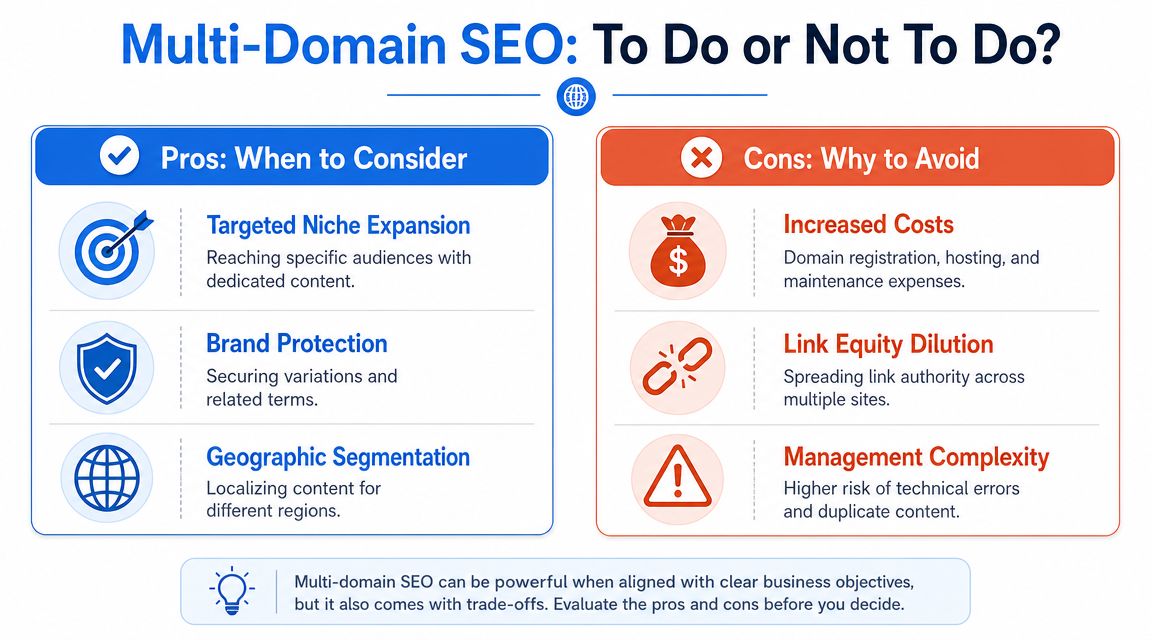
The default answer to “should we use multiple domains for SEO?” should be no.
That isn't because multiple domains never work. It's because the maintenance burden is often underestimated and the ranking upside overestimated. The sexy version of the story is “more domains, more SERP control.” The boring version is “more domains, more chances to create thin differentiation, dilute authority, and confuse both users and search engines.”
A sharper question came into focus after Google's recent quality systems tightened up. Coverage on the topic increasingly points to the core issue: do multiple domains create more SEO risk than opportunity once quality expectations are applied across the portfolio? Guidance discussing Google's March 2024 core and spam updates highlights risks around scaled content abuse, expired-domain misuse, and thin value patterns that are highly relevant to sloppy multi-domain setups, especially microsites and recycled domains (analysis of multiple domains and Google quality risk).
When a separate domain is justified
There are cases where a separate domain earns its keep.
- Different audience segments: A brand serving two genuinely different customer groups may need separate positioning, messaging, and search intent coverage.
- International market separation: Legal, linguistic, or regional expectations can make a local domain the cleanest fit.
- Distinct brands: If one offering would weaken or confuse the main brand, isolation can be smarter than forcing everything under one umbrella.
- Brand protection: Owning variants and related names can make sense, especially when some are used strictly as defensive redirects.
These are business reasons first. SEO is downstream.
When it's usually a bad idea
Most bad multi-domain plans start with one of these impulses:
- “We want to rank twice for the same keyword.”
- “We found an old domain, so let's throw content on it.”
- “Our main site is hard to fix, so let's build a new one.”
- “This product is important, so it deserves its own site.”
That last one catches a lot of teams. Important does not mean separate.
Thin differentiation is where multi-domain SEO gets ugly fast. If a visitor can't tell why domain B exists instead of living on domain A, Google may ask the same question.
Subdomain or separate domain
This is usually the first fork in the road.
If the content should inherit the brand, the trust, and the topical authority of the main business, staying close to the main domain is often cleaner. If the content needs independent brand positioning, separate geo targeting, or strong audience separation, a separate domain can be justified.
A simple decision framework:
| Question | Lean toward one domain | Lean toward separate domains |
|---|---|---|
| Same brand story? | Yes | No |
| Same buyer journey? | Yes | No |
| Same keyword universe? | Yes | No |
| Separate legal or geographic identity? | No | Yes |
| Team can maintain unique content and UX? | Maybe not | Must be yes |
If you're in the middle of a rebrand or migration decision, this often overlaps with domain-change strategy. A practical reference on that problem is how SEO changes when you change domains.
Choosing Your Multi-Domain Model
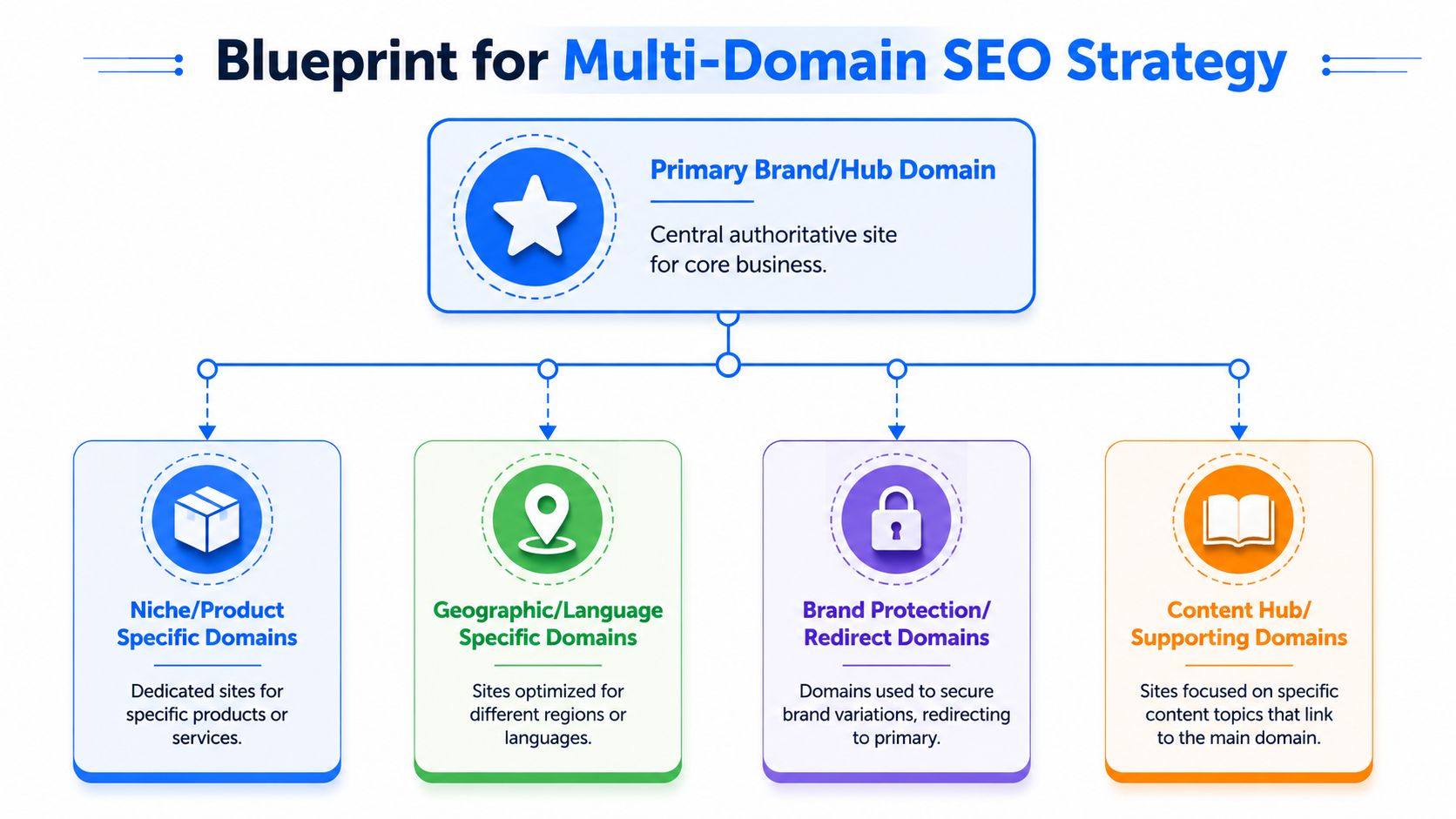
If you've decided to proceed, pick a model before you pick domains. Multi-domain SEO breaks when a company mixes three strategies at once and pretends they're one.
The digital fortress
This is the brand-defense play.
You own brand variations, common misspellings, campaign domains, and adjacent names tied to your core business. Most of these domains should not become full standalone sites. They usually exist to protect navigation traffic, control brand confusion, and route users to the right destination.
This model works best when the architecture stays simple. A handful of redirect assets is manageable. A swarm of mini-sites built around your brand name usually becomes a maintenance tax.
The global ambassador
This is the international model.
You create distinct properties for separate countries or languages because localization is deeper than translated copy. The domain, content, trust signals, and editorial decisions all need to feel native to that market. This model is justified when regional separation is strong and the local team can support it properly.
The trap is fake localization. Slapping translated pages on several domains without market-specific value is a fast way to create overhead without strategic depth.
A useful benchmark is whether each market site could defend its existence without saying “because SEO.”
Later in the build, implementation details matter more than logos and nav menus. This walkthrough is worth watching before teams start improvising structure:
The niche portfolio
This is the operator's model. Affiliate marketers, publishers, lead-gen teams, and some agencies love it.
Each domain serves a tightly defined topic, product class, or audience slice. When it works, each site has a clear reason to exist and enough editorial depth to stand on its own. When it fails, it looks like a stack of near-identical sites chasing the same keywords with different logos.
A good niche portfolio feels like a group of focused brands. A bad one feels like one site wearing different hats.
Pick the model that matches the business. Don't buy domains first and invent a model later.
The Technical Trenches and How to Survive Them
In this context, good intentions usually get punched in the mouth.
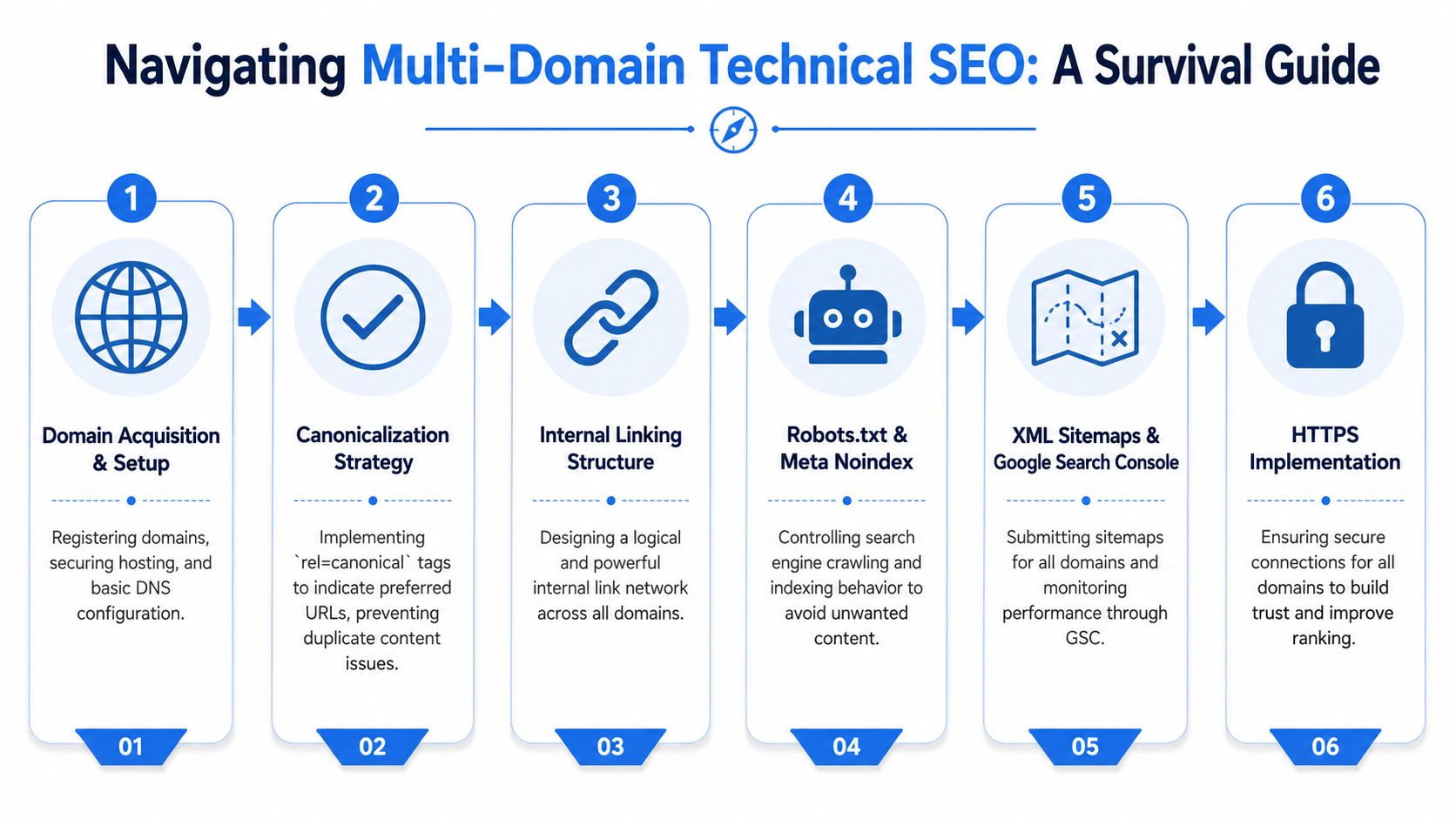
Multi-domain SEO isn't dangerous because Google hates multiple domains. It's dangerous because teams create overlap, muddy ownership signals, and forget that every technical decision teaches search engines how the properties relate to each other.
Start with keyword boundaries
The cleanest implementation rule is also the most ignored: give each domain a sharply defined keyword set and purpose. Guidance on multiple-domain SEO strategy makes the point plainly. Canonical tags are for unavoidable overlap, not as a bandage for a sloppy plan. Ranking two separate domains on page one for the same term can happen, but it's costly, and one domain is usually the safer default unless audience separation is strong.
That means before launch, you should already know:
- Primary topic ownership: Which domain owns which terms and why.
- Overlap tolerance: Which pages may touch adjacent intent, and where the line is.
- Consolidation rules: What happens if two domains start competing for the same query set.
If nobody owns these rules, the sites will drift into each other.
Redirects are not magic
A 301 redirect can pass link equity from a purchased or migrated domain, but only when the move is relevant and clean. Redirecting an old domain into a new property isn't a cheat code. It's a transfer with baggage.
Use redirects when the old domain's history, topic, and destination make sense together. Don't redirect random aged domains into your money site and call it strategy. That's how teams import junk, confusion, and trust issues.
For a deeper look at the mechanics and trade-offs, domain forwarding and SEO is a useful reference.
Redirects work best when a human reviewer would say, “yes, that destination is where this should go.”
Canonicals, hreflang, and tracking
Canonical tags are your pressure valve when overlap can't be avoided. They help indicate the preferred version, but they don't rescue a portfolio built on duplicate pages. If half your sites rely on canonicals to explain away structural confusion, the underlying problem is strategy, not markup.
For international builds, hreflang belongs in the same conversation. If country or language properties exist, their relationships need to be explicit and consistent. Otherwise, the wrong regional page can surface, or the domains can blur together in unhelpful ways.
Cross-domain analytics matters too. If users move between properties during the same buyer journey, fragmented attribution will make good domains look weak and bad domains look useful. SEO teams often obsess over indexation and ignore reporting until leadership asks which domain contributes pipeline.
If you work on stores or product-heavy catalogs, the technical discipline is similar to what e-commerce teams use to boost Shopify traffic with technical SEO. The same habits apply here: control duplication, clarify preferred URLs, and keep structure intentional.
Finding Your SEO Assets with NameSnag
The domain hunt is where a lot of operators get reckless.
They find a dropped domain, glance at the name, spot a few backlinks, and convince themselves they've uncovered buried treasure. In practice, most domain lists are noisy, and manual review burns hours fast. That's especially true if you're trying to separate a genuinely useful asset from a domain with spammy history, irrelevant links, or a reputation you don't want to inherit.
A cleaner workflow starts with intent.
Two hunting modes that matter
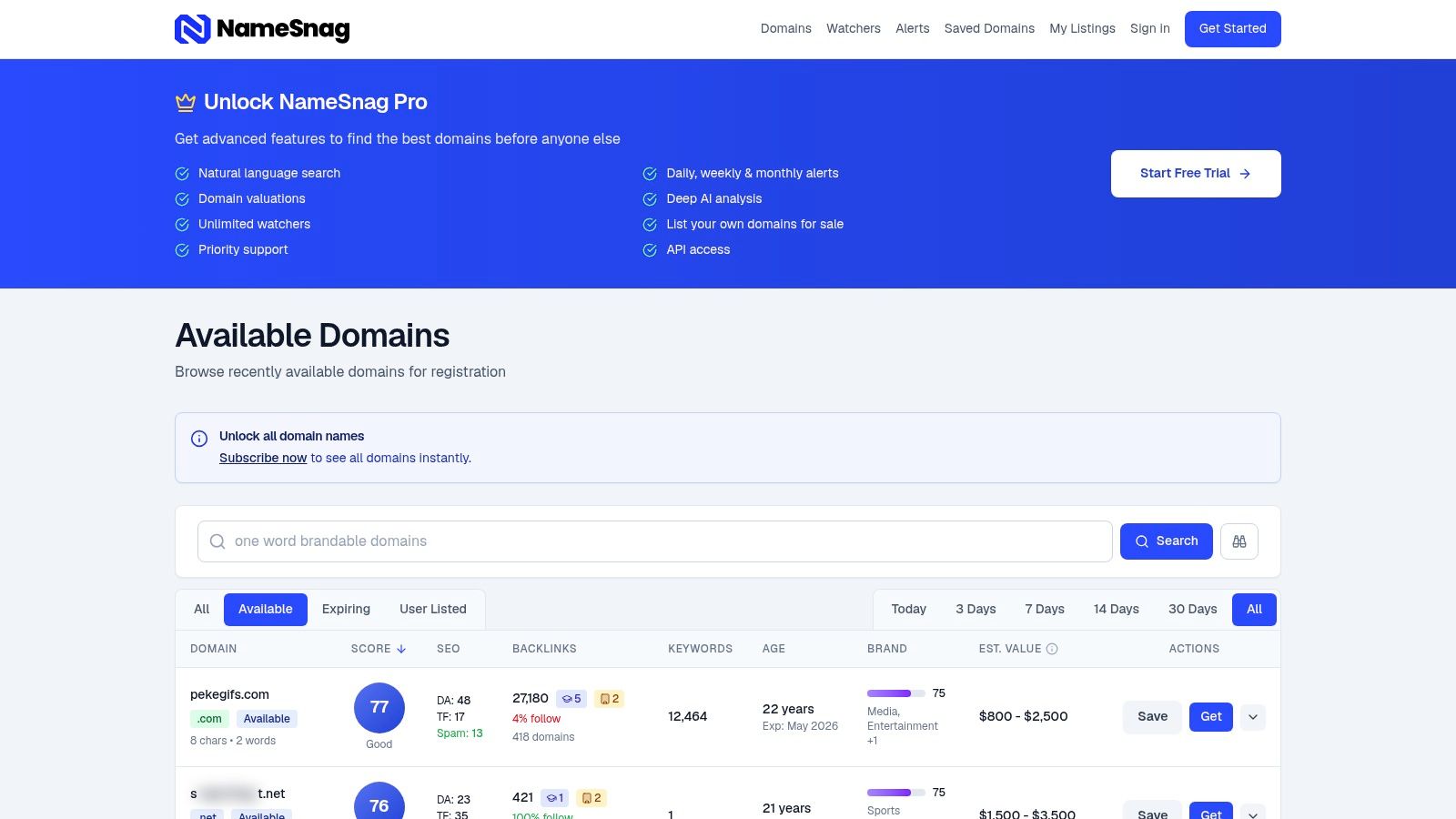
If you want a domain you can act on immediately, the play is to monitor available domains. These are domains that have already dropped and can be registered right away. That's useful when you've already defined the role of the asset and just need to secure a fit.
If you're willing to wait for stronger options, expiring domains are where patience pays off. These are still in the grace period and may drop soon, which gives you time to review candidates before they hit open registration.
The built-in time filters matter more than people think. Sometimes you want today's fresh list. Sometimes you want a wider window because your niche is thin and quality inventory doesn't show up every day.
What a serious buyer actually checks
A decent name is not enough. For SEO use, I'd review domains in roughly this order:
- Topical fit: Does the historical theme match the site you intend to build?
- Brand fit: Can the domain support a real property, or does it sound disposable?
- Link sanity: Are the backlinks relevant enough that you'd want to explain them to a client or founder?
- Risk profile: Does the history suggest spam, churn, or weird ownership patterns?
- Deployment path: Will this become a standalone site, a redirect asset, or a defensive hold?
That last point gets skipped all the time. You should know the intended use before acquisition, not after.
A solid supporting read for the process is this guide to an expired domain finder, especially if you're still sorting through how to evaluate candidates without drowning in junk.
The part people romanticize
Expired and dropped domains are not “free authority.” They're raw material.
Some become useful support assets. Some deserve a full rebuild. Some are only good for brand protection. Many should be left alone. The skill is not finding domains. It's rejecting bad ones fast.
That's the unglamorous edge in multi-domain SEO. Good operators say no more than they say yes.
Managing the Beast Without Getting Eaten Alive
Launching a multi-domain setup feels productive. Managing it month after month is where reality shows up with a clipboard.
The harsh operational truth is simple: multiple-domain SEO materially increases management complexity and cost, and the strategy only makes sense when the expected gain is big enough to offset the workload. Industry guidance also warns that weak execution can trigger self-competition, duplicate content issues, and diluted authority, which is why architecture and discipline matter so much in ongoing management (pros and cons of multiple website domains).
Run it like a portfolio, not a pile
Each domain needs an explicit role.
One may exist to serve a region. Another may support a product line. A third may be a redirect asset with no editorial life of its own. If you don't classify the portfolio, teams start applying the same expectations to every domain, and that's where resources get wasted.
I like to track domains in three buckets:
| Portfolio type | What it should do | What to watch for |
|---|---|---|
| Operating domain | Rank, convert, build authority | Keyword overlap and editorial decay |
| Support domain | Feed a specific niche or market | Thin content and weak differentiation |
| Redirect domain | Transfer users or equity cleanly | Broken mapping and irrelevance |
That framework keeps bad ideas from hiding behind “but it might help.”
Watch the cannibalization before it gets expensive
Cross-domain cannibalization is nastier than same-site cannibalization because teams often miss it. One content team sees growth on domain A. Another celebrates traction on domain B. Nobody notices they're chasing the same terms until both sites start wobbling.
Review these patterns regularly:
- Same keyword, different domains: Decide who owns it.
- Same audience, different messaging: Fix the positioning before search engines have to guess.
- Repeated templates across sites: Rewrite or consolidate.
- Cross-links that feel forced: Remove anything that exists only to manipulate relevance.
If two domains need the same content brief to grow, one of them probably shouldn't exist.
Know when to consolidate
Not every domain deserves a long life.
A support property that can't maintain unique value becomes a drag. A market-specific domain without local ownership turns stale. A niche site that never develops an editorial identity may be better folded into a stronger property. The hard part isn't seeing this. The hard part is admitting it before sunk-cost thinking takes over.
Consolidation isn't failure. Sometimes it's the smartest SEO move on the board.
This is also where search behavior is shifting beyond classic blue-link optimization. If you're rethinking how your properties surface in AI-driven environments, this AEO strategy guide for 2026 is a useful companion to traditional SEO planning.
A disciplined operator doesn't ask, “How many domains can we manage?” The better question is, “Which domains still justify the oxygen they consume?”
If you're building a multi-domain strategy and need cleaner raw material, NameSnag is a practical place to search for domains worth reviewing. You can monitor expiring and available inventory, cut through junk faster, and spot assets that fit a real SEO plan instead of buying names first and inventing excuses later.
Find Your Perfect Domain
Get access to thousands of high-value expired domains with our AI-powered search.
Start Free Trial